Pillar Topic · Thread-Centric PLM
The thesis post: why suite-centric PLM is breaking down and what replaces it — PLM Core as system of record, MCP as the integration verb, composable best-of-breed around the thread.
Key Takeaways
- PLM core remains system of record
- Modernize stack around PLM core
- Implement governed data contracts and access rules
- Use agentic orchestration for workflows
- Enable composable capabilities with best-of-breed apps
🎧 Audio Version
Listen to "From Suite-Centric to Thread-Centric PLM"
More audio articles at DemystifyingPLM/listen
Short Answer
The article proposes a shift from suite-centric to thread-centric PLM by keeping the PLM Core as the System of Record and modernizing the stack around it, which enhances governance, tool standardization, agility, and enterprise reach.
- PLM Core remains the System of Record for critical data
- Modernizes stack with Data Contract + Governance
- Introduces MCP Tool Layer for standardized tools
- Enables composable capabilities through best-of-breed apps
Why it matters: This approach improves PLM's flexibility and efficiency, crucial for modern businesses.
Executive Summary
PLM isn’t broken. The suite-centric architecture is.
Keep PLM Core as the System of Record for what must be governed (BOM/configuration, change, lifecycle state).
Then modernize the stack around it:
- Data Contract + Governance: semantics, access rules, lineage, quality
- MCP Tool Layer + Agentic Orchestration: standardized tool “verbs,” human-in-the-loop, audited execution
- Composable Capabilities: swap in best-of-breed apps where agility matters
- Enterprise Reach: ERP/CRM/SLM/ECM accessed via tools, not brittle custom integrations
The result is thread-centric PLM: faster lifecycle flow without losing control, traceability, or compliance.
Why the architecture has to change now
From Suite-Centric to Thread-Centric PLM
PLM Core stays. The architecture evolves: governed contracts, agentic execution, composable capabilities.
PLM isn’t the problem. Suite gravity is.
For 25+ years, the PLM suite era optimized for features inside one platform: more modules, deeper configurations, tighter coupling. It delivered real value—configuration control, Change Management, traceability, compliance, and scaling engineering across sites and suppliers. The incumbents (Dassault Systèmes, Siemens DISW, PTC) earned their position by building domain depth most “modern stacks” still underestimate.
But the world changed.
The product lifecycle is now multi-domain, multi-system, multi-speed. Engineering moves fast. Manufacturing moves differently. Supply chain is volatile. Service has its own clock. Quality feedback is continuous. Sustainability reporting is becoming mandatory. And AI is arriving—not as a dashboard feature, but as an execution force multiplier.
The suite-centric model—where one platform tries to be the data model + workflow engine + UI + integration hub + analytics layer—is increasingly paying three structural taxes:
- Integration tax: every connection becomes custom plumbing
- Upgrade tax: customizations turn upgrades into mini-migrations
- Adoption tax: friction pushes work back into Excel, email, and tribal knowledge
You feel those taxes as: “We’ll integrate it later.” “Let’s freeze changes until go-live.” “That’s not in scope.” “We’ll do it in phase 2.” “We can’t change the data model.”
And now there’s a fourth tax emerging fast:
- AI tax: if your stack can’t provide governed semantics, lineage, and permissions, your “copilot” becomes a demo—useful for Q&A, dangerous for action.
So what replaces suite-centric PLM?
Not “rip and replace.” Not “PLM is dead.” Not a new UI.
The next era is Thread-Centric PLM:
one governed backbone for product truth + agentic execution through tools + swap-in capabilities at the edges.
Below is the reference pattern, why it’s technically valid, how to implement it without chaos, and a scorecard you can use to evaluate architectures (vendor or homegrown) in 30 minutes.
What I mean by “Thread-Centric PLM”
Thread-centric PLM is not a product. It’s an architecture pattern.
It treats PLM the way modern software treated “platforms” after monoliths:
- Keep the core system of record for the things that must be controlled (state, configuration, effectivity, releases).
- Put a governed contract around it so multiple tools can share meaning safely.
- Expose actions as tools (not one-off integrations) so agents can orchestrate workflows across the lifecycle.
- Let specialized apps (including startups) compete where they win: UX, narrow domain focus, rapid iteration—without fragmenting the truth.
This is how you get coherence without forcing everything into one suite.
The reference architecture (the “rings”)
Think in five layers, from center outward:
1) PLM Core — System of Record
This is the authoritative layer. It should own the lifecycle state of controlled product objects:
- Parts / BOM / configuration / effectivity
- Change objects (ECR/ECO/ECN), approvals, releases
- Baselines, revisions, traceability to decisions
- The minimum set of governed documents that must be controlled with the product
PLM Core is where you enforce “what is released,” “what is valid,” and “what is the current truth.”
This is where suites are genuinely strong—and why “throwing PLM away” is usually a bad idea.
2) Data Contract + Governance — the control plane
This layer answers: what does the data mean, who can see it, and can we prove where it came from?
A practical governance contract has four pillars:
- Data semantics: shared ontology (what is a part? a variant? a requirement? an as-maintained configuration?)
- Data access rules: consistent permissions, entitlements, and policy enforcement
- Data lineage: provenance and audit trails (source, timestamp, transform, approver)
- Data quality rules: validation, constraints, completeness, exception handling
This is the layer that makes the thread “real” rather than marketing.
If you skip this layer, you end up with a lake of disconnected objects and a thousand dashboards with conflicting numbers.
3) MCP Tool Layer + Agentic Orchestration — the execution plane
This is the piece most PLM conversations are missing.
Instead of building brittle point-to-point integrations, you expose each system’s capabilities as standardized tools with clear verbs:
- GetBOM(), CreateChangeOrder(), UpdateMaterial(), PublishWorkInstruction()
- CheckEffectivity(), ValidatePartNumber(), RetrieveApprovedSupplier()
- ExportMBOMtoERP(), ArchiveReleasePackageToECM(), NotifyService()
MCP (Model Context Protocol (MCP)) is a clean way to standardize tool interfaces so agents can call them reliably, securely, and audibly. The key idea is not “AI doing everything.” It’s AI calling governed tools.
Agentic orchestration adds the missing workflow behaviors modern organizations require:
- Plan / route: decide steps across tools
- Human-in-the-loop: approvals, exception queues, escalation
- Grounding + citations: actions tied to governed records and lineage
- Monitoring / SLOs: observability, error budgets, rollback paths
If governance is the control plane, the MCP/agentic layer is the execution plane.
4) Composable capabilities — best-of-breed at the edge
This is where you plug in domain apps that move faster than suites:
- PDM (lightweight CAD data workflows)
- Materials management
- MBSE / requirements tooling
- DfM feedback loops
- Sourcing / supplier collaboration
- 3D content pipeline management
- Work instructions
- CAM/CNC adjacency
- Quality workflows
- Simulation data packaging
Some of these may still be provided by the suite. Some may be startups. The architecture doesn’t care—as long as the contract and tools are enforced.
The big idea: these capabilities become swappable modules, not permanent customization.
5) Outer enterprise ring — ERP / CRM / SLM(MRO) / ECM
These systems are not “outside the lifecycle.” They are the lifecycle.
Thread-centric PLM acknowledges that the Digital Thread must reach the enterprise. The difference is how:
Agents don’t “integrate” to ERP through custom code.
Agents call ERP tools through the MCP layer, governed by contract rules.
That’s how you get outward execution without spaghetti.
Why this is not just “more integrations”
A fair pushback is: “Isn’t this just drawing more arrows?”
No. The difference is the unit of connection.
Suite-centric world:
- connections are bespoke integrations (one-off, fragile, hard to test)
Thread-centric world:
- connections are standardized tools with contracts, tests, permissions, monitoring, and rollback
You are moving from “integration as craft” to “integration as product.”
That is what unlocks velocity.
What stays central (and why suites still matter)
Boardroom-safe truth: incumbents aren’t obsolete. They’re essential—if used correctly.
The PLM Core should remain the authoritative layer for:
- controlled configuration, effectivity, baselines
- change governance and lifecycle state
- core traceability and compliance controls
Where suites struggle is when they are expected to be:
- the best UI for every persona
- the fastest place to innovate
- the universal integration hub
- the only system that is allowed to hold product meaning
That “do everything in one platform” expectation is what creates the taxes.
Thread-centric PLM keeps the suite value and replaces the suite gravity.
The “agentic” part, in plain language
The moment you add MCP tools + orchestration, you unlock a new class of outcomes:
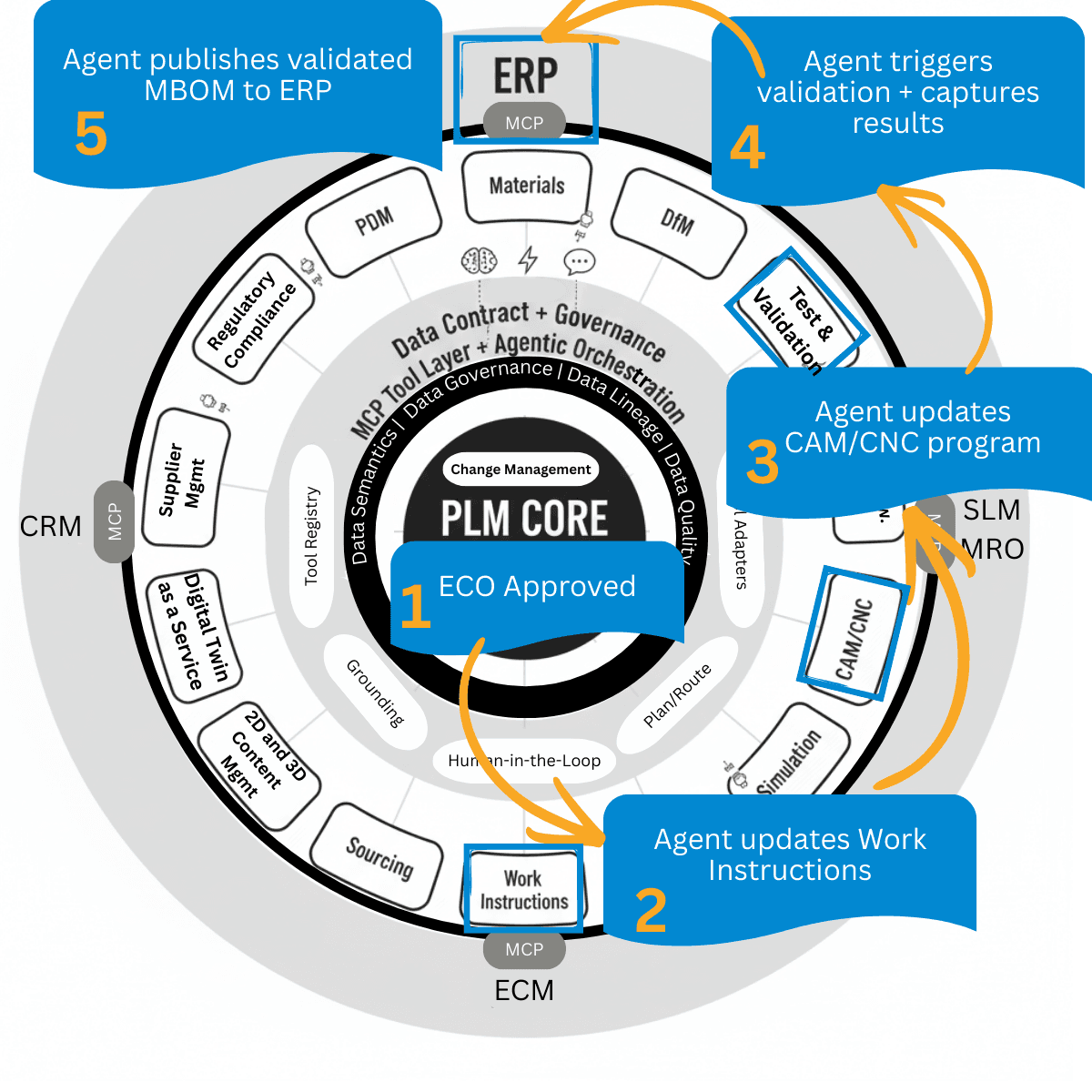
Example flow: Change approved → enterprise execution
- ECO reaches “Approved” in PLM Core
- Agent validates: effectivity, supplier status, material compliance (contract rules)
- Agent publishes MBOM / routings to ERP via ERP tools
- Agent updates work instructions via Work Instruction tools
- Agent archives release package to ECM via ECM tools
- Agent notifies service (SLM/MRO) of impacted configurations
- Everything is logged with lineage and citations (what records were used, what approvals were applied)
That’s not “chat.” That’s execution with governance.
And that is exactly why the contract layer and tool layer must be cleanly separated in your architecture.
How to implement this without blowing up your PLM program
If this sounds like “rebuilding everything,” don’t do that.
Implement it as a strangler pattern: thin slices that prove value and reduce risk.
Step 1: Declare the System-of-Record boundaries (2 weeks)
Write down—explicitly—what PLM Core owns vs what it publishes.
Example:
- PLM Core owns: released BOM, effectivity, change state
- PLM Core publishes: approved change events, released structure snapshots
You cannot build a thread if you don’t define “truth.”
Step 2: Create the contract (start narrow, expand)
Pick one object family and define:
- canonical IDs
- required attributes
- lifecycle states
- allowed relationships
- access rules
- lineage requirements
Start with: Part + BOM + Change.
If you can’t govern those, nothing else matters.
Step 3: Build the tool gateway (MCP registry + adapters)
Create tools for the top 10 actions your organization performs repeatedly.
Examples:
- GetReleasedBOM
- CreateECO
- ApproveECO
- PublishToERP
- UpdateWorkInstruction
- ArchiveToECM
- ValidateCompliance
- RetrieveApprovedSupplier
- NotifyService
- OpenExceptionTicket
This is where you get leverage. You are turning workflows into callable building blocks.
Step 4: Pick one cross-boundary workflow and ship it
Don’t boil the ocean. Pick the one flow that hurts the most.
Typical high-ROI candidates:
- ECO release → ERP publish → work instructions update
- Supplier change → compliance checks → downstream notifications
- Quality nonconformance → change trigger → service bulletin update
Ship it end-to-end, with monitoring and human approval checkpoints.
Step 5: Only then, plug in best-of-breed apps
Once the contract + tools exist, swapping capabilities becomes safe.
Without those layers, “best-of-breed” becomes fragmentation.
How to avoid the common failure modes
Thread-centric PLM fails for predictable reasons. Here’s the short list:
Failure mode 1: “We built a graph but didn’t govern meaning”
A graph without semantics and access rules is just a prettier data swamp.
Fix: contract-first: semantics + permissions + lineage + quality.
Failure mode 2: “We built an agent but didn’t constrain actions”
Agents without tool constraints become unpredictable and un-auditable.
Fix: tools-first execution: agents call tools, tools enforce policy, everything logs.
Failure mode 3: “We treated governance as a committee”
Governance must be productized. It needs ownership, tests, observability.
Fix: treat the contract like software: versioning, CI tests, change control.
Failure mode 4: “We tried to migrate everything at once”
That’s how programs die.
Fix: ship one workflow slice across PLM → enterprise → back.
The Thread-Centric PLM scorecard (quick version)
Use this to evaluate any architecture proposal—vendor, integrator, or internal.
Score each 0–3:
- 0 = missing
- 1 = ad hoc
- 2 = implemented but inconsistent
- 3 = standardized + monitored
A) Truth + Governance (Contract)
- System-of-Record clarity (one authority per object/state)
- Canonical IDs + versioning (revisions, effectivity, baselines)
- Semantics (ontology + constraints, not just fields)
- Lineage + audit (provable provenance end-to-end)
B) Execution + Agentic (MCP)
- Tool coverage (real verbs, not read-only APIs)
- Policy enforcement (access rules applied at runtime)
- Human-in-the-loop (approvals, exceptions, rollback)
- Grounding + citations (every action tied to governed records)
C) Composability + Enterprise Reach
- Swap-ability (replace edge apps without replatforming)
- Event-driven operation (pub/sub, not nightly batches)
- Enterprise tool gateway (ERP/CRM/SLM/ECM callable via tools)
- Operational quality (SLOs, monitoring, integration tests)
Interpretation:
- 0–12: suite-bound, high taxes
- 13–24: transitioning, mixed model
- 25–36: thread-centric, execution-ready
This scorecard is intentionally architecture-first. Because the bottleneck in 2026 won’t be “feature completeness.” It will be coherence + velocity + auditability.
What this means for executives, architects, and practitioners
For executives
Stop asking: “Does the suite have the module?”
Start asking: “Can we change the lifecycle flow in weeks, not quarters—and prove it?”
For enterprise architects
Your job is to define:
- SoR boundaries
- the contract
- the tool gateway
- observability + policy enforcement
Not to pick a single mega-platform and hope it covers everything.
For PLM leaders
Your roadmap shifts from “deploy modules” to “build repeatable execution paths.”
For startups
You don’t have to replace PLM. You can plug into a contract + tools and win on:
- UX
- narrow domain outcomes
- faster iteration
- measurable workflow improvement
The contrarian conclusion
The future of PLM is not “more PLM.”
It’s:
- PLM Core as System of Record
- Data Contract + Governance as the control plane
- MCP tools + agentic orchestration as the execution plane
- Composable capabilities at the edge
- Enterprise reach without integration blood
That’s how you get flow across the lifecycle—fast, auditable, and human-in-the-loop.
Scorecard here: https://www.demystifyingplm.com/thread-centric-plm-architecture-scorecard-12-criteria/
We hope you enjoyed this article!
Michael Finocchiaro is a Franco-American PLM expert and Fractional CTO with nearly 35 years of experience advising global manufacturers and technology providers.
Having worked for IBM, HP, PTC, and Dassault Systèmes, he combines deep technical mastery of PLM platforms, enterprise SaaS, and AI with a rare, cross-industry perspective spanning aerospace, industrial manufacturing, consumer goods, and luxury goods & accessories.
Known for connecting strategy, architecture, and real-world execution, Michael is a trusted advisor to executives navigating complex digital transformation and product innovation challenges.
Michael is also a recognized PLM thought leader on LinkedIn with over 24k followers and two podcasts: The Future of PLM and AI Across the Product Lifecycle. He is also the author of books on SaaS PLM and a forthcoming book on the history of PLM and CAD.
Sources and Further Reading
Architecture & Integration Standards
- Model Context Protocol (MCP) (MCP) — Standardized contract for AI agent system access
- OpenAPI Specification — RESTful API design standards
- JSON Schema — Data contract definition and validation
Best-of-Breed PLM Ecosystem
- Siemens Teamcenter Cloud — Modular cloud PLM platform
- PTC Windchill + MCP Integration — Thread-based data governance
- Aras Innovator Architecture — Model-based, modular PLM
Related Articles
- What is PLM? — Definition and core concepts
- Digital Thread vs Digital Twin — Architecture patterns
Citation: Finocchiaro, Michael. "From Suite-Centric to Thread-Centric PLM." DemystifyingPLM, 2026. https://www.demystifyingplm.com/from-suite-centric-to-thread-centric-plm.
Last updated: 2026-01-11
Looking up PLM terminology? Browse the canonical reference.
PLM Glossary →Cite this article
Finocchiaro, Michael. “From Suite-Centric to Thread-Centric PLM.” DemystifyingPLM, January 25, 2026, https://www.demystifyingplm.com/from-suite-centric-to-thread-centric-plm
Michael Finocchiaro (opens in a new tab)
PLM industry analyst · 35+ years at IBM, HP, PTC, Dassault Systèmes
Firsthand knowledge of the evolution from early 3D modeling kernels to today's cloud-native platforms and agentic AI — the history, strategy, and future of PLM.