About the guest
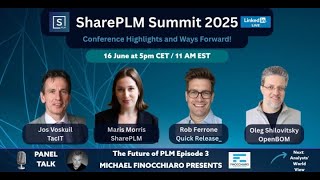
Jonathan Scott from software development; Patrick Hillberg from consulting in manufacturing; Michelle Stone from product management; Oleg Shilovitsky from LinkedIn; Rob Ferrone from engineering; Brion Carroll from PLM.
Episode summary
The episode "Ch-Ch-Ch-Changes: PLM's Unfinished Revolution" delves into the evolving landscape of Product Lifecycle Management (PLM) through a panel discussion
Key takeaways
- →Change extends beyond engineering to enterprise-wide transformations.
- →Configuration control ensures consistent product features across lifecycle stages.
- →Effective change requires active employee engagement and adaptation.
- →Proactive OCM is crucial for organizational success in PLM.
- →Continuous process improvement complements software implementation.
Topics discussed
Episode Summary
The episode "Ch-Ch-Ch-Changes: PLM's Unfinished Revolution" delves into the evolving landscape of Product Lifecycle Management (PLM) through a panel discussion featuring experts from various industries. The guests include Jonathan Scott, Patrick Hillberg, Michelle Stone, Oleg Shilovitsky, Rob Ferrone, and Brion Carroll. Each guest brings unique insights from their respective companies, ranging from software development to consulting in the manufacturing sector.
The episode highlights several key technical and strategic insights. First, the panel discusses the multifaceted nature of change management within PLM, emphasizing that it extends beyond traditional engineering change management to include enterprise-wide changes involving multiple disciplines. Second, they explore how configuration control plays a crucial role in managing product configurations and their features, ensuring consistency across different stages of the product lifecycle. Lastly, the discussion delves into organizational change management (OCM), stressing its importance as a human-driven process that requires active participation from employees to adapt to new ways of working.
For PLM and engineering professionals, the key takeaway is the recognition that effective change management is not just about implementing software solutions but also involves continuous adaptation and improvement in processes. The panel underscores the need for proactive engagement with change, viewing it as an integral part of organizational success rather than a temporary inconvenience.
Full Transcript
Michael FinocchiaroAnd we're live. This is Michael Finocchiaro with the Future of PLM podcast. I am joined by some amazing panel of experts who are going to introduce themselves with slides. This is a new feature of the, that we thought of for the ch-ch-ch-change management. You don't recognize this because we're not wearing our Ziggy Stardust things, but don't worry. There's dancing after this and everything. ⁓ So I'm going to impose a two minute limit on each speaker going through their slides. And I'm going to post two minutes on
Brion CarrollI know.
Oleg ShilovitskyYou
Michael Finocchiaroquestions from this panel and Brian will be looking at the questions. So please post your questions in the comments and we'll go on from there. So we're going to have a, I believe we said it's Jonathan and then it was Patrick and then it's Michelle and then it's Brian and then it's ⁓ Oleg, Yas Oleg and then Rob, something like that. So ⁓ I will get ready. We will now hit the share button and we will hope this works because we've never done this before. So it's quite dangerous. Okay, ready to go. So are you ready for your two minutes? Patch, you ready, Mr. Bingo.
Jonathan Scottdon't see any slides yet, so I'm not ready yet.
JosYeah.
Jonathan Scottslides? I don't see them.
Michael FinocchiaroHahaha!
Michelle StoneYeah.
JosYeah.
Oleg Shilovitskyyou
Michael FinocchiaroJonathan.
Jonathan ScottYeah. Do you guys hear me?
Michael FinocchiaroYou don't see the slides? It's not sharing.
Brion CarrollAre you looking at the actual Riverside event? Doesn't seem to be.
Michael FinocchiaroIt's not sharing. The first slide should be
Oleg ShilovitskyDon't... Don't look
Michelle StoneGood sharing.
Michael Finocchiaroa.
JosI think we see them and we have maybe here also the initial definition of change management. What are the four topics we can talk about? Maybe Michael, you will do the intro on this.
Oleg Shilovitskyat LinkedIn, it takes time.
Michael FinocchiaroYeah. No, this is Jonathan.
Jonathan ScottYeah, I'm happy to do it. The slides are coming across. I'm seeing some kind of delay. Hopefully you guys are hearing me on.
JosOkay.
Rob FerroneCan you sit? Jonathan's dropped off.
Brion CarrollThere you go.
JosJonathan is gone. That was the trick.
Rob FerroneOkay, maybe you'll see, maybe you take us through the different types of changes while we're waiting for Jonathan to get back.
Patrick HillbergYou
JosOkay, good. So the topic was change management, but then if we look at change management, actually there are different types of change management. Historically, we have the engineering change management, which was very much related to the traditional PDM world. Thanks to connectivity, we talk more often about enterprise change management involving also other disciplines and extending the scope of change management. Then another discipline that is about change management is configuration control, a configuration of the products and its capabilities, features. And then another topic, sometimes confusing is organizational change management, which is a more human driven activity than I would say our traditional processes. And I think, and I haven't seen all the slides from everyone, we will focus mainly on the PLM type of change management. Yeah. Yeah.
Michael Finocchiarowith an A and a B, but there'll be a little bit of C. And I believe ⁓ we're probably gonna do a podcast just on C because it's a whole humongous area of the PLM world, right? ⁓ Is Jonathan back? Because I don't have any visibility on him. Okay, your turn. ⁓
Jonathan ScottI think ⁓ Riverside just told me I couldn't be in anymore, so I'm back.
JosExactly. Yeah.
Jonathan ScottBeautiful. All right. So ⁓ out of those four categories that I think just got talked about, I'm touching on A and B, right? Those are the two that I spend the most time with with customers and ⁓ a couple of questions that got asked sort of prompting coming into the conversation or what are the key factors in these pieces of change management? And I think ⁓ first I touch on is there are major change stages and minor change stages. And in my view, the major ones are
Michael FinocchiaroOkay, you got your two minutes starting now.
Jonathan Scottdefining the problem, the solution, executing the change, and notifying people of the change. And people have all kinds of names for those, but I think that's pretty universal. When you get down into the minor change stages, everybody looks at that differently, but it's not as important as making sure you sort of separate those and that the minor stages relate to what you need to do in your business. I think another thing that's important is making sure that you decouple the right things, right? I'm not gonna read all the points I've made here, but I see lots of folks mix up the stage of the things they're trying to change with the stage of the change process. So those are the couple of things I'd say are key factors. If you could give me the next slide, I think there are a handful of variables that are important to change management too. What are you trying to track and manage and who's involved? These make a big difference in what your change process should look like and how complex it is and how you can make it faster or more robust, that kind of thing.
Michael FinocchiaroYou got one minute left.
Jonathan ScottYou also can look at things like how do you categorize or segment your change process that can really matter like major or minor change? Am I fixing a spelling error or making a design change? And then the last thing we talked about that's a big piece of variability in change management is what really impacts the way change looks different from customer to customer. And I'll say your business model, the amount of time you spend manufacturing your product.
Michael Finocchiaro15 seconds.
Jonathan Scott⁓ And how many do you make? Are you making a million or are you making 10? And of course, that can be inverse to the manufacturing time. You're making a jet engine, it takes a while, but these things impact. How do you do change and how does it look? So that's kind of my kickoff to the process.
Michael Finocchiarotime. Perfect timing, two minutes. Any questions?
JosOkay. I think I like the concept we often discuss about major and minor changes. I mean, could you say something more about it? Why would you have minor and major changes? Not that I don't know, but I would like to hear you.
Jonathan ScottYeah, no, I think it's a great one to highlight. I mean, it's in a company, you can go a lot faster when it's a minor change and you know what the review is. Right. And this is one of the things I love about the CM2 process. And I'm not going to try and speak to that in detail, but it's important. Right. Right. It's important to think about what's the magnitude of the change you made and get the review process and the whole, you know, who's looking at it, who's agreeing with it to be proportionate to the change you're making.
Patrick HillbergYeah.
Michael FinocchiaroWe don't have an hour, no.
Jonathan ScottA spelling fix doesn't need a lot of look, but a change that's going to impact hardware, software, and product performance does. So I think to me, that's that's about.
Oleg Shilovitsky.
Michael Finocchiaro45 seconds for the second question. 45 seconds. Any other questions?
Brion CarrollNo, I'll only.
Oleg ShilovitskyI have a question, Jonathan. So I like what you put on the key variables, what you track and manage. So how do you see companies tracking all these things? Because those are wide scope of things.
Michael FinocchiaroOkay.
Jonathan ScottYeah, it's a wide scope and I'd see a lot of companies just trying to widen the scope more and more as they
Michael Finocchiaro30 seconds.
Jonathan Scottthink about what they track in their business. ⁓ And it's a challenge because you don't always track these the same way, right? A great example is tracking the change on software from hardware is pretty tricky. So I won't go into a lot more details, I know we're short on time, but it's a challenge to think about what you manage and then is it all in one process.
Michael FinocchiaroI really like these three reasons. I think that's really great. Thank you very much, Perfect Jonathan. ⁓ Next up is Mr. Dr. Patrick Hilberg. Take it away, Patrick.
Patrick HillbergYes, that's right. Get my title right. I worked hard on that. So that's truly, truly important to me. this actually is a story. Yeah, yeah, we're taught to speak in 90 minute increments, right? So actually, this was a story I created when I working on a, I was implementing a change management PLM system at a large ship builder. was not the ship builder, but.
Michael FinocchiaroAnd he's a professor, he's going to be tight getting into the two minutes, but he's going to try. Yep.
Patrick HillbergSo it was a fictional story I created in 2011. It actually occurred in 2017, so I'm prescient, right? In simple terms, if there's too much water in the bilge, we can either reduce the amount of water coming in or we can pump it out faster. We may want to study both alternatives and then decide which makes the most sense. Each study would get a sandbox to play in with isolated revisions of CAD and other files so that any changes made by one study team is only visible to that team.
Oleg Shilovitsky.
Patrick HillbergWe do not copy and paste data. We make isolated revisions of that data specific to that study. So we want to make sure that the ⁓ structure study is separated from the piping study. And more than likely, the people on one study can't even see the data that's going on in the other study. With both studies complete, the company would hold a design review to choose the best alternative. The winning study is then released to a design workflow, and the design team would have access to the collateral created in the structure study. And these designs with detailed decisions. No, go back one. Go back. And these designs with detailed decisions made in the study are sent to manufacturing. In a PLM database, the problem report object collects information regarding the initial issue. The change request derives from the PR and collects information developed in the studies. After the design review, change requests are issued to the design team based on the structured study. And designers can look upstream for information available in the CR and the PR. When the design workflow is complete, necessary information for this change is sent to the manufacturing floor. OK, now you can go next and take this one to the end of the slide. Sorry, I thought I'd removed my animations. So for context, the status quo system at my client was based on the technology available in the early 2000s. And it included 11 independent SQL Server databases. I'd like to think that this slide that I'm showing right now is too old to be useful. Still, I go to conferences and I see people talking today about things, things that I know that I saw 15 years ago. So to quote the sci-fi writer, Gibson, the future is here, but it is unevenly distributed. So in the diagram, imagine that a new pump is needed with a new pipe routing. We need to add the pipe and the pump into the part catalogs. We will need to order them again when the ship is serviced. Then there's a series of steps in which the designer requests access to appropriate assemblies and then asks in four different places whether the foundation can support the pipe and the pump. Again, using 2000's technology, these are requests coming into independent SQL Server databases. In fact, we can imagine that the databases were the solution to the previous problem of emails flying back.
Josyou
Michael Finocchiaro15 seconds.
Patrick HillbergIn the end, using a single PLM database and the CM2 methods discussed previously, our team was able to replace 11 databases with one workflow. I'll just finish up with this. However, the entire organization was built around all 11 databases and the left-hand side, and to move them to the much simpler workflow was a huge organizational change effort. And with that, I'm done.
Michael FinocchiaroThus, tying in OCM, very good. Two questions. Who wants to grab one? Go Brian.
Michelle Stoneand
JosYeah.
Brion CarrollSo, so Patrick, I have a question. The 11 databases, did you replace it with one monolithic system or was it done a different way?
Patrick HillbergNow we replaced, so there were 11 independent databases. We replaced it with one single PLM system. ⁓ Mostly we implemented the functionality of the 11 databases through workflows.
Brion CarrollOkay, thank you. Gotcha, thank you.
Michael FinocchiaroSecond question.
JosAlthough I don't believe in the single database, I'm curious if you could also solve it in a more federated way. Do you need a single database to solve this issue?
Patrick Hillberg⁓ and this issue, was, there was great improvement to it. yeah, it's, I don't know. I think that one's going to go from organization to organization and, you know, what, frankly, we're dealing with aircraft carriers. There were only a dozen on the, on the surface of the sea at any given time. ⁓ I mean, in any given decade. So I think one database is pretty good for that, but I don't know that I would use a single database for like 1.3 billion automobiles.
Michael FinocchiaroI feel that Yass is going to come up with Joshua Hussman's statement when during his speech. No, no, no, no. There you go. OK. Is anybody, are we good? I think we're at time. ⁓
JosNo, no, no, not this time. Yeah.
Patrick HillbergIf we get the nearest source of truth, this is going to go on for quite a while.
Jonathan ScottI want to add a comment if I could. I won't make it a question, but I think it's interesting, Patrick, the way you framed it ⁓ about exploring two different design alternatives in the change process. And what I see with a lot of customers is they don't have the tools and the ability to do that and track that and keep those separate like you described, but it was really interesting point the way you framed it.
Patrick HillbergYeah, I'm trying, I'm trying to stay away from specific technologies, but this is 2011. I was an architect for Siemens at the time, and this is what we could do in team center, but I'm sure other PLM implementations can do this. I'm sure the technology is available in other PLM software.
Michael FinocchiaroYes. We'd like to welcome Michelle Stone. She's joining us for the first time on the podcast. So I think most of us had crossed her when she was in her previous life at Propel, who I've interviewed on my AI podcast in the past. So welcome to Michelle. Thank you for joining us. And you had a couple of slides.
Michelle StoneAll right, so let's see if I can get this in two minutes. I'm a fast talker, so I'm positive I can. So when I was asked to join to talk about change management, I started thinking about the three different levels of change management through various lenders. thought about traditional product lifecycle that we think about in engineering to program management, thinking about organizational change management, and started making some comparisons to software development. So my background is Half of my time in PLM has been in consulting. The other half has been in product management. I've actually worked for five different PLM companies. when you think about all of these, I think at the highest level, organizational change management, managing the software rollout is just as important as the widgets you make. It's just as important as the drawings you use, the information you're sending to contract manufacturers or on the shop floor. regulatory impacts, all those elements are all part of traditional engineering change management. But similar to what Jonathan showed, I think there's different stages in all of those that are related. So kind of zooming out at each level in all of these elements that I've listed out, ⁓ you need an objective, right? A digital transformation program or even a specific change request, both need to start there. Then you need to understand the impact of that change. you can make proposals, evaluate different approaches. After that, you get stakeholder alignment. Then once you plan the work, it's time to work the plan. So communication really becomes key. So in my next slide, I'm going to talk about what I call right sizing change management. So many software vendors will all provide you with a great starting point template based on best practices.
Michael Finocchiaro45 seconds.
Michelle StoneBut the processes vary so much by industry and even by company maturity. How you originally roll out your ECO process might change as your company grows. I talked about what happens if ⁓ you configure it to be too complicated. It gets really bogged down. People aren't going to use it. So you're no longer facilitating innovation. You're impeding it. On the other side, it can be too streamlined. If you don't have the right controls in place to ensure governance and ensure that people are
Michael Finocchiaro10 seconds.
Michelle Stonearen't bypassing any necessary checks, making sure that the right people are reviewing, this could lead to issues with compliance or even data quality, which becomes really important if we talk about AI. So what do I mean by the right people? So I think that part of the reason I was asked to join was my experience with several of the born in the cloud solutions that are out there, where the target buyer is industries outside of what you guys talked about in the last podcast.
Josyou
Michelle StoneYou know, so it's not just planes, trains and automobiles. A lot of times in modern product development, you're involving contract manufacturers and suppliers directly in the change process. That becomes really important and having a way to involve them, you know, early and in a streamlined method outside of, you know, emails and the like. You know, and then again, I didn't really touch too much on CM, but you know, different industries have different compliance needs.
Oleg Shilovitskyyou
Michelle StoneYou know, some companies need and want that intense scrutiny of changes. If you're in aerospace or healthcare, there you might see a more strict ECR ahead of the ECO process. And then on the other end of the spectrum where you've got, you know, maybe a consumer products good where speed is key, getting, you know, markets out the door quickly, or even at least out the prototype. So you need like a more streamlined process. So I'll just say as a consultant, I've seen there's an art to... you know, not creating a one size fits all change process approach. A lot of it comes down to listening, listening to your customer, finding the right level of control at the right time. As I mentioned before, it can change and having that flexibility to have different flows, you know, based on, you know, some criteria, maybe the, you know, some initial criteria or the category of the change. We talked a little bit about, you know, the difference between an ECOMCO, DCO, ACO. I think I got a lot of... ⁓ acronyms in there in probably over two minutes.
Michael FinocchiaroYou're a minute 42 over. ⁓ One question for, it's okay, great talk. I enjoyed that. Thank you, Michelle. One question.
Michelle StoneAlright.
Brion CarrollSo let me ask one question. ⁓ Sorry, Patrick. Go ahead.
Patrick Hillberg⁓ you made the comment about aligning to your customers' processes. What if your customer's wrong?
Michelle StoneWell, I think that's a lot of times why they bring a consultant in, right? You you've been there, done that, you've seen it, you've got all the war stories. So a lot of that is taking the time to look at your as is process, talk about the to be and course correct them. You don't want to necessarily tell them they're wrong, but you do want to go in and say, hey, you hired me because I've done this at other companies. Let me show you a way. again, going back to that alignment, getting them to agree with you. That's an art.
Michael FinocchiaroMmm.
JosYeah.
Patrick HillbergYeah.
Michael FinocchiaroThank you, Michelle. Let me just do a small pause. Are we getting any questions in the chat, Brian? None yet. Okay, well.
Brion CarrollI also posted the fact that if they put something there and we don't address it, then we will follow up, which is generally what you do.
Michael FinocchiaroExactly. Awesome. Thank you very much. ⁓ Next up, Mr. Openbomb. ⁓ Bring us Oleg.
Brion CarrollI mean
Oleg ShilovitskyWait a second, you forgot we're on PLM, but it's okay.
Michael FinocchiaroBeyond PLM. Sorry. Yeah, so he's both open-bomb and beyond them He is a schizophrenic crazy guy that never ever sleeps as we talked about before you arrived
Oleg ShilovitskyThank you, thank you, thank you, Michael. All right, so what I wanted to talk about is to present the difference that I see now. in the past, all time that I remember in the PDM and PLM space, we've been working with documents. So we continue to work with documents and when changes come, we do some work, we review it, we approve it, we release, we get a document. So this type of work is collapsing now. First, it's collapsing under the complexity. Jonathan said we have e-bomb, m-bomb design, all this kind of things, electronic software, everyone is telling me. So that's somehow we need to make it work differently. And now we have also AI. So how we sneak AI into this work because we want to take the data and put it in the AI and say, are we doing right? Did we forget something? So that brings a different sequence of work. We want to collaborate, we want to explore, we want to align, and then we would like to snapshot and said, this is what we did. This is a change. So this is the transformation that I see going in the industry significantly. Now where it brings us, please advance this slide. So what it brings us is that the ⁓ workflow is changing. So the way we work is changing. So what we had in the past is that PLM is capturing the results. It's the beginning on this diagram and the end of this diagram. So what is not captured is everything that happens in between. All our discussions, all our reasoning, all our intent, all our conversations, everything that happens in between until we decide it. So what was the change before in PLM is just an approval workflow. The work is gone, so we're not capturing this. So we're losing a lot of information and I see some changes in the way this environment will work because it will allow it to people to work together and it will allow it to AI agents to work together. And this change of work, this is the major changes that I see is happening in the way we treat changes. That's it, two minutes.
Michael Finocchiaro15 seconds. Perfect timing. ⁓ Any questions? Come on, Rob, you've got to have a question. Yes, okay. Go ahead, yes.
Josthink you know me as Okay.
Oleg ShilovitskyThe competition, competition.
JosYou know me a little bit as the cynic about AI. think AI will solve everything as a new technology wave. I agree with you. We are now also capturing more and more also the context and the reasoning and why, and this is what we can do in a digital world. But I'm still a little bit cautious when I say the AI is going to solve everything. But Rob?
Oleg ShilovitskyI didn't say, yes, didn't say it will solve everything, but it's freaking less...
JosBut it's already on the slide.
Patrick HillbergI'm a proud skeptic also.
Michael FinocchiaroHahaha
Jonathan ScottYou
Oleg ShilovitskyYou're reading too much in PLM slides, Yos.
Michael Finocchiaro⁓
JosYeah, yeah.
Michael FinocchiaroSomeone who never worked for DASSO on the line there.
Patrick HillbergHmm.
Rob FerroneI am. I find it interesting, Oleg, that you talk about the work that happens outside of the PLM system. And I think there's a load of work. It's not just change management, but there's a lot of work that ultimately goes back into PLM that happens outside of the system. Obviously, you talked about the stuff that happens in Excel spreadsheets. And so the question is, is it PLM's job or PLM technology's job to pull in all of that stuff that happens outside of PLM? Or do you think things can exist outside and that's the best place for them?
Brion Carrolljust going to make a note since you said that it's not a question, it's a statement that says PLM is really a solution, it's not a system. I say that 751 times a day, but to the point that it's a solution, all the content, all the data should be something that's amassing in an AI environment. AI accessible environment.
Oleg ShilovitskyI thought it was a question for me, no? I thought it was a question to me,
Michael FinocchiaroYou've got 30 seconds to respond.
Oleg Shilovitskyokay, all right. Rob, I think the boundary of PLM, it's something that can be defined and redefined. I think there are people that like PLM, people that hate PLM, people that belong to PLM, and people the same that the same things are out. So it depends who you're talking to. All people are different. So I think we can speak about this when we will address the organizational change management. know, some people buy a system and call it PLM and some people buy a system and say, just tell me it's not like PLM. And we have both, so it's okay.
Michael FinocchiaroAwesome. Thank you very much, Oleg. Next up, from the balcony, Mr. Brian Carroll of the Digital Solution Group. Well, under, sorry, I should have said under the fan from the balcony. Yeah.
Brion CarrollLet me jump down, I hope I don't break the leg.
JosYeah.
Brion CarrollUnder my fan, my favorite Hunter fan. Yes, indeed. So what I'm hitting is something that's different than the others is, is when you look at this slide and talks about engineering change request and the change order and the change notice, it gives some content definitions of what that means and how it impacts an organization. But if you could, Michael, just go through it. This is what systemic involvement and participation in an engineering change process could. in invoke cause to happen, right? So now you've got PLM, you've got PIM, you've got e-commerce, ERP, ⁓ MES, know, supply chain management, all these things, plus email spreadsheets, PowerPoints all over the world. The fact of the matter is, this is what PLM really is. PLM is not that little ⁓ green ⁓ orb or box in the diagram. It's really Product data management plus, which means I'm doing engineering change against the product, its data, its engineered structure. I'm looking for approvals, which might get into market research because you want to make sure that whatever new material you're going to use will work in all the places you want to apply it. You may be doing a lot of things, but all that data, and this goes to Rob's point, should find its way back into a centralized database. And Digital Solution Group believes in what we call a solution scape. PLM-based solutions scape, which means all these systems should intimate or intelligently integrate so that when you get down to the change order and the change notice, nobody gets left out. It's full transparency. It also sets the stage for what I would consider an AI base, meaning content consistent across all these systems if drawn into or applied into an AI framework. Thank you.
Michael Finocchiaro15 seconds.
Brion Carrollwould enable AI to rest on top, knowing that no data changed without population expansion, meaning if a PLM piece of data went into ERP and ERP changed it, it has to go back to PLM or MES or ECOP, right? So this is a systemic profile of what systems could be involved in a PLM engineering change management environment.
Michael FinocchiaroSo I'm gonna take one of the questions. ⁓ So where do you draw the line? Because engineering change management for me was that first box, right, with the impact and the stuff on the left. But when you start extending that to ERP, SCM, MES, and e-commerce and all that, doesn't that become enterprise change? Or these are just ⁓ pieces of information I need and I need to kind of read only that are coming in to inform my decisions that I make at the ECO level?
Brion CarrollSo if you see in the engineering change order, you'll see product design, ECL and manufacturing ECL, tooling ECL, supply chain or supply ECL. Those are the potential. Now, if you took a, I'm just going to change. I don't know who brought it up. The wording of something that has no mechanical or structural impact, then that could fly just in PLM and never go anywhere. But if you're going to do something that adds tooling, if you're going to do something that changes, what you consider the manufacturing execution systems process, then you have to apply an ECO that looks at that as well, because it's under the ECR. The engineering change request says, I have this many ECOs. And under each ECO, you have this many notifications. And that's the way the world works. And you can't run away from it. Go ahead, Rob.
Michael FinocchiaroRight, but my question was where's the boundary between that and enterprise change management?
Brion CarrollThat is enterprise change management. This is what no PLM, ECM.
Michael FinocchiaroOkay, so the title of the slides should be Enterprise, right?
Brion CarrollI just grabbed the thing that you had injury change, man, and I transformed to the right. So sorry about that.
Michael FinocchiaroOkay, okay,
JosThank you.
Oleg Shilovitskyyou
Michael Finocchiarothat's okay. We got 15 seconds for another question.
Brion CarrollBye.
Michael FinocchiaroAnybody?
Oleg ShilovitskyI... Can I?
Brion CarrollRob, what were you going to ask?
Rob FerroneI think Oleg had his hand up, then Patrick had his hand up. I'm happy to give it to Oleg.
Michael FinocchiaroYeah.
Michelle StoneMm-hmm.
Oleg ShilovitskyBrian, you mentioned database at the beginning. So the question is this, is there anything that we do today is not in the database in general? Because you sort of differentiate it's data.
Michael FinocchiaroHmm.
Brion CarrollAnything you today? Well, yeah, there's a lot of things we do. They're not in a database and they're in Excel spreadsheets. They're in emails. They're in documents. They're in arguments. They're in a meeting, right? Meeting room that didn't have auto, which would automatically transcribe all of the language used and get rid of maybe some frictional language that they don't want to have in the system.
Oleg ShilovitskyBut if I will put, now I got this point, but if I will put something now in the meeting that will listen to me, eventually it's end up with the database. So technically everything in the database, right? All right, okay.
Brion CarrollIt it should have ended up in a database, a database. And I don't care if it's graph database, if it's a, you know, RDVM relational database management system. I really don't care. That's based on the solution.
Oleg ShilovitskyIs it PLM database or it's not like you just separate is it PLM database or non-PLM database?
Brion CarrollWell, that's why PLM continues downloading. PLM should always get what it needs to best represent the content. But if you do that, you should always have the ability to trace the ECR to the ECO to the content of other systems. So a solutioning is what we should be looking at, not a system. It should be a solution of systems.
Michael FinocchiaroI have.
Oleg ShilovitskyAll right, it's a longer conversation. Thank you.
Brion CarrollThank you.
Michael FinocchiaroI have two remarks that I want to bring in from my conversations with the startups. One is, my previous ⁓ call, I just did with Exelir and Mont Blanc AI, who are doing PLM, well, more MES, or ⁓ operational related stuff in the process industries. What's interesting is they said that when they're ⁓ using, ⁓ basically that the conversations they're having with the AI, ChatGBT, those also go into Git along with everything else. And it reminds me that, Perhaps that's another thing when we're using AI, that ought to be part of that thing because anything we're exchanging in order to make our decision, that stuff is of course disappearing into the memory of Chatchapiti. And the second thing is I was talking to Adam Keating of Colab and he thinks that, we'll see, it'll be an interesting discussion with him, but he thinks that at one point we won't necessarily have a database at the end, it'll just be AI, but I kind of contest that idea because
Oleg ShilovitskyThat's exactly the point. It's all in the databases.
Brion CarrollRight, so that has to end. It's impossible.
Michael FinocchiaroIt's impossible because the AIA forgets its name after two minutes. So, anyhow, it was
Oleg ShilovitskyThis is But AI
Michael Finocchiaroa great debate.
Oleg Shilovitskyis another database, Michael.
Michael FinocchiaroYeah, yeah, yeah.
Patrick HillbergLet me, I'm sorry,
JosThank
Patrick HillbergI want to
Josyou.
Patrick Hillbergadd one, I'm sorry, go back. I gotta add one thing, because I'm gonna show this to my students. The customer's not involved in this. You end at the factory door. So what we're missing is maintenance, repair, and overhaul. We're missing internet of things, and we're missing the disposal life cycle.
Michael FinocchiaroYep. at MRO.
Brion CarrollYeah, I'm
Michael FinocchiaroYeah.
Brion Carrollagreeing with you. didn't put all it became a collage that, you know, really kind of strikes at the mind. So I just put what is the highest recommend recognized systems. But I agree IOT. got a Toyota Avalon that talks to Toyota. I'm with you.
Michael FinocchiaroYes, my friend, yes, you have two minutes, go.
JosOkay. Yeah, yeah. So I thought let's keep it simple. Nowadays, we always talk about enterprise change management and not anymore about engineering change management. And also I want to go back to the foundation. Most of the time, the processes you see here are hardware oriented and many of my companies are still at that level. And one thing I want to focus on first is the cheap advantage you can get from managing issues. If you look at process one, it starts with issues and as soon as it's product related, you should be managing it in your PLM environment because it can either lead to an engineering change or a manufacturing change order, but it can also be an issue that you just have to track and to follow up. CAPA, corrective action, preventive action, is a kind of change management also in the pharmaceutical industry. In the early days of Smart Team when we did data modeling, the first thing I always said, add the issue to your data model because this is your knowledge capturing. This is the way how you collect things from the field that they don't disappear in emails and in, I would say in phone calls. Then if you have an issue, then the ECR afterwards, if it becomes an ECR, it's important to have this process in place. And what I see a lot in companies also is Even this ECR process is not yet formalized. They think it's a linear process to an ECO or it's only having a go or a no-go. But I also think it's important that an ECR process has an on-hold option where you can link the result to your product portfolio. Including your product portfolio to your change process is also important. And that's somehow I would say that the foundation. And then, it's good, Michael, you're going to the next slide. because the future is not hardware anymore, the future is about also managing systems. And if you look at in general, the traditional diagram on the top left is as long as we work in this concept, in this design space, we still have low cost of change and we still have not so much costs committed. And that's why also
Michael FinocchiaroI was listening actually.
Brion CarrollHahaha
Joswe have to change more and more on thinking first and because the early changes are cheap and with the combination of hardware and software, we have to move more and more also to system engineering, to system thinking because then if we look at the virtualization of the product, also we can make decisions upfront that don't cost too much. A final observation, I had a customer that had also in the concept phase already traditional change management with approvals and that's slowing down so much and that's why they try to avoid to have changes in the concept design phase even. That's a bad practice. I think Jonathan you talked about also minor changes or early phase. Don't try to manage them as rigid as the hardware changes. That's my two minutes.
Michael FinocchiaroExcellent. Well, three minutes and 15 seconds, but close enough. ⁓ Okay, two minutes of questions for Yos. Who wants to go first? Go, Oleg.
Michelle Stoneyou
Oleg ShilovitskyYes, I can go first if you don't mind. So, ⁓ you're speaking about transformation to systems. How in your perspective a change in the results will be delivered to the people that need to execute it? In other words, will it still be a drawing that will be sent and stamped to the people after the change or it will be something different?
JosIt depends on of course where you to whom you're talking. Are you talking to somebody who is manufacturing pieces of the system? They might follow in the end the hardware flow and then I like to hear an annotated model instead of ⁓ a drawing. But yes, we are in the mechanical world. But if you want to understand the impact of change of a system or a product, then you should have one level higher. I call it the logical product structure. where you also need to be able to manage and track your changes. But yes, every company still has also the hardware world because that's the most costly one. Machines, materials, dependencies.
Oleg ShilovitskyBut not only the hardware, this is a software change, how you deliver the software change after the change and it's approved. So how it will be delivered in your view, the change approved and delivered, how it will come down to the results.
Michael FinocchiaroThat's true.
JosWell, when I talk about software changes, talk more about software compatibility because it's like on your computer, you can run on a previous version of Windows, but you still have an update possible. And we should think the same way with products. They are linked through the logical product structure and you should make them compatible with hardware releases. That's the target.
Oleg ShilovitskyYeah, thank you.
Michael FinocchiaroGreat question.
Brion CarrollYeah, all I could would seem that the software would have a revision and version control that would link to the structure that it's applied to, right? As long as that change, so that may be a drawing change in the factory, because they need to make sure they have the right ⁓ version of the software to install on. But nevertheless, ⁓ I have a question and it relates, ⁓ Yoss, to the first thing where you said issue, and you went, and if it's an issue,
JosOkay.
Brion Carrollthat doesn't require PLM, you do see that as some, do you see that as something that should still be registered and visible and managed by a solution?
JosI think if it's product related, I promote companies to track it, to see do we have issues with this part or with this solution. But if it's outside the PLM scope, I don't know who is Michael, were annotating it. Yeah. So yeah, you always have to have a first filter. Is it really product related or not? But sometimes the issue can be solved without
Michael FinocchiaroYeah.
Michelle StoneYeah.
JosPLM involvement, but it's product related.
Brion CarrollGotcha. Yep, so so you see it going somewhere, but it doesn't necessarily mean PLM influenced. OK, gotcha. Thank you.
JosYeah, yeah. Everything that could be in an email should be ready to the product should be in an issue.
Brion CarrollRight, gotcha. Thanks.
Michael FinocchiaroI would just like to add that what's interesting is we still think of these as sequential things, where now with design for manufacturing, some of that manufacturability is already being done at the concept phase. Even design for services is already being done. it's interesting to think of how these things get compressed because we're able to, with the AI tools, actually look at it. Well, actually that design is not manufacturable. I've already looked at 10,000 plans doing the same and that will never work, therefore.
JosMm-hmm.
Brion CarrollRight.
Oleg ShilovitskyThat's.
Michael Finocchiarochange it and that's going to compress the manufacturing cycle a bit. So it's just interesting to see.
Oleg ShilovitskyThat's the
Brion CarrollExactly.
Oleg Shilovitskyworkspace that you think about, how to combine it all.
JosYeah.
Michael FinocchiaroYeah. So that's, and I think that's one of the big transformations that we're seeing and we're gonna see is that the engineer that used to only worry about his CAD drawing, he's actually has to think about all those other things. And he's probably gonna be able to do simulation and cam simulation right from his desktop without having to call somebody else. ⁓
JosMaybe he doesn't have to think about it, but he will be asked about it.
Michelle StoneMm-hmm.
Michael FinocchiaroExactly. Which
Oleg ShilovitskyThat's, that's...
Michael Finocchiaromeans he'll still be employable because the EI won't be able to do it on its own. ⁓ Rob, you've got, think, the longest one and you're the last one. So ⁓ let's go through your animations, shall we?
Brion CarrollRight.
JosYeah. Yeah.
Oleg ShilovitskyThat's the question.
Rob FerroneOkay. So I take this from a case study that I did with the company, very, very bright CEO and the CEO, ⁓ he was, ⁓ he was a bit jealous. He was jealous of the razor leaf merchandise and he wanted to his own merchandise. So he said, I'm going to create a product, which is, one of these wobbly head figures that sits on your desktop. And this guy, he knew the product development process and the life cycle from start to finish. So he thought it'd be no problem.
Michael FinocchiaroI don't recognize that guy.
Brion CarrollMost wanted.
Michael FinocchiaroYou
Rob FerroneBut as he started to develop the product and go into production, he found all kinds of changes that were happening across the lifecycle. And so therefore he contacted me and said, can you help me with my enterprise level product change management? And I said, OK, there's eight building blocks that we need to consider. And the first one was obvious, that change can happen across the lifecycle. know, you also talked about the implications of changing later rather than earlier on. And then. So the next step, we went and spoke to purchasing and said to them, for example, why have you changed the supplier? And they said, well, it's actually due to tariffs. So we had, it's very expensive to import this product, so we have to manufacture locally. So then we realized, okay, there's a change trigger for all of these changes. There's something that drives them. And then as you can see, there's actually many different types of changes. So it's not just a design change, but you've got changes that you want and changes that you're reacting to. Okay, so we went and spoke to the validation team and said, why are you creating a new abuse test? And they said, well, actually, it was driven by service. So we in the warranty, we had a lot of claims where the head has fallen off because people were using this toy as a, as a stress object, they were hitting the head. ⁓ And that, that, that drove the, the need to have stronger glue to hold the spring in place. And, and then you needed the test as well to test that it actually held it in place.
Brion CarrollYou
Michael FinocchiaroThey were fed up with open bomb.
Oleg ShilovitskyYou
Rob FerroneAnd so that was, you know, the scope and impact across the whole life cycle. So you could have a change that happens downstream and it actually affects everything upfront. Number five is governance. you he said, well, who's going to, who's going to run this? Who's going to own it? Is it, you know, by functions, are we going to have something that's a cross function? You know, and how do you manage change if I, if I'm going to break the change on the new glue, do we, do we do that immediately, et cetera? Number six. ⁓ This guy was a fan of technology and systems and he believed in databases and data. So he asked, know, how are we going to execute this from a technology perspective? And can we have a single change platform as well? Obviously, he didn't just like technology was very much a human advocate and he understood that humans are in the loop. And so he asked questions about the things we need to consider in terms of human behavior. And finally, and most interestingly, When we looked at the business part of this, you we examined the cost of changes versus not changing and the you impact potential impact to you know his brand and I think the final point was that when you look at how companies manage change You can actually think of it in terms of being a competitive advantage. So those companies that can manage their change across the enterprise The best are the ones that win And ultimately, the CEO realized that in the end, the product wasn't just this desktop toy, but perhaps the product was having an enterprise level product change management tool.
Michael Finocchiaro221 nice job man nice job
Rob FerroneThe end.
Brion CarrollVery good, very good, very good.
JosWow, great story Rob.
Rob FerroneI hope that didn't break the NDA.
Oleg ShilovitskyVery good.
JosYeah.
Michael FinocchiaroHahaha questions for Rob.
Oleg ShilovitskyI have to. Michelle, please go ahead. No, no, no, no, no.
Brion CarrollMichelle.
Michelle StoneYeah, had that. It's funny because a similar question
Michael FinocchiaroYeah.
Michelle Stonewith with Josh and I guess with Rob as well. You talked here about handling change quickly can be a competitive advantage. And the name of this podcast is the future of PLM, right? And a lot of that is, you know, the people that are responsible for PLM. I've seen a lot of people talk about streamlining change management to the extent of removing the ECR process and just doing everything through an ECO. Thoughts on that not just you but to the crowd because you know, I'm old school, right? So for me growing up in aerospace and defense It's like well, what do you mean? But then you talk about the consumer product good like a toy company You know, maybe it's really important for them to get out quickly.
JosRight.
Brion CarrollI'd like to just respond that ECR and ECO have two different definitions, right? The ECR is why, ECO is what, and the ECN is we did it, right? So all you gotta do is streamline the ECO process to be, and I think someone brought it up before, a simple change, and have it be very efficient. There's nothing that stops a company from implementing a automated workflow that requires simplicity or complexity, depending on the scope of the change. So if you're to have one change that's going to push off multiple ECOs, you can't eliminate the ECR that was the foundation of the ECOs. Otherwise, these ECOs are going to be talking to each other saying, hey, we're all together. And then someone's going to ask, why the hell are you all together? And then you automatically say, well, we should have had the ECR because the ECR would have told us why those three are together. So that's my response.
Oleg ShilovitskyI cannot, I can't.
Rob FerroneTo quote Brian Carroll Jr. I'd say that it really does depend on the nature of the company and it's a strategic business decision how you want to manage change. So it doesn't mean that fast change is good change. It just means that it's right sized and it's proportional to the impact that you're going to have. exceptions is part of it as well. When do you need to go fast and go around the change process and catch up later? ⁓
Brion CarrollRight. Yeah, BMC2 is right out.
Rob FerroneSo ⁓ next in the queue, thank you for the question, Michelle. Next in the queue is Oleg.
Oleg ShilovitskyYes, Rob, first of all, thank you for bringing the use case. didn't know about this, but I mean, that's the thing. But here is the... Is it only me getting some noise?
Rob FerroneGood night.
Oleg ShilovitskyGood.
Rob FerroneI can
Brion CarrollAre you?
Rob Ferronehear a very strange alien kind of effect.
Brion CarrollYeah,
JosIt's a spring of...
Michael FinocchiaroI think he's been transformed into a
Brion Carrollit appears that somebody's got.
Oleg ShilovitskySomething.
Michael Finocchiarobobblehead before our very eyes.
JosIt's a spring on your microphone, think.
Oleg ShilovitskyI don't know what is there, but now it works. Can you hear me? So Rob, the one thing that I think was really missing and I can bring you a real case, know, timeline. So because in the recent OpenBOM merchandise change, I had to go to 3D experience world. So here is what the case, as you can see OpenBOM.
Brion CarrollThat's what it is.
Michael FinocchiaroYep.
Brion CarrollYep.
Oleg Shilovitskyis a blue Navi, but SolidWorks world or 3D experience world recently decided to go back to red. So that was a real change how to reprint and how to make the merchandise with a red color. So it was three suppliers at the one that won is the one that was able to make it fast before 3D experience world. And it was a changing from blue that I'm wearing now to red that I was wearing 3D experience.
Michael Finocchiaro⁓
Oleg ShilovitskySo timeline is important.
Rob Ferronebig
Brion CarrollSo what's your retail price for that thing?
Oleg ShilovitskyI don't want to do it, to make any advertising, so you can contact me later.
Brion CarrollHa ha ha.
Michael FinocchiaroI'm gonna stop sharing now.
Rob Ferroneyou
Michael FinocchiaroReally weird. ⁓
Rob FerroneMy audio has gone terrible for some reason.
Oleg ShilovitskySomeone is getting
Brion Carroll10, five,
Oleg Shilovitskysome Microsoft issues, I think.
Brion Carrollseven, testing, I don't know.
Michael FinocchiaroOkay, I think that's better. Okay.
Jonathan ScottYeah. I don't know what that audio is. I'll jump in though. I've got a comment to make as we were talking. I'm going to go about. Yeah.
Michael FinocchiaroYeah, you haven't said anything in a while, Jonathan. We were wondering, the lack of bow tie is like, you know, not helping here.
Brion CarrollI'm
Jonathan ScottNobody knows who I am here. ⁓
Brion CarrollRight, his shield, his shield
Michael FinocchiaroI know you're like anonymous, so please jump in, Jonathan.
Brion Carrollwas missing.
Jonathan ScottYeah, yeah. So I want to comment about the speed issue, right? Because I see something that's very counterintuitive with a lot of customers. ⁓ They talk about wanting to speed up their change process and the logical conclusion they come to are things like what Michelle mentioned earlier, like getting rid of the ECR, right? Getting rid of a step or removing steps from whatever process they have. And I see that having the opposite effect, right? Because what they do is then they increase confusion downstream in the process, like you Brian was talking about, you remove the why and suddenly people are working on a problem, but they don't understand what problem they're working on. And I think the sort of, need to go slow to go fast is really important in a change process that if you recognize the steps you need to do in your business to get change, right, always do those steps. It's a question of how fast you do each of those steps, right? So if you, get to a step that's about analyze something and you realize the impact, you figure it out like that. Great. Move on, right? but don't skip the step where you check the impact. That to me is an important observation for people to think about.
Brion CarrollAnd to add to Jonathan's point, I think the data, the information, the decisioning methodology should have some way of finding its way into what we'll call the broader PLM solution database, right? I having meetings with Otto so that it transcribes, I'm not an Otto human, but I just think of that one because it followed me around for a couple of weeks, I couldn't get rid of it. ⁓ But using something like that that actually transcribes a meeting, like, You know, the 12 angry men meeting, right, where everyone's arguing. That kind of thing, digested or ingested into the back end system gives historic evidence as to why the why occurred or why the how occurred, right. So I think to Jonathan's point, all those things should find their way to be sucked in.
Michael FinocchiaroSo there are actually some questions in the chat. There's my friend James White who's asking Michelle, although it could almost go to Patrick because it's one of his, what was the cause of the door lock that flew off of the Alaska flight leaving Portland two years ago? The door landed a mile from my house.
Patrick HillbergWow, how about that?
Michelle StoneYeah, pretty close to my house too, since we live close to each other.
Michael FinocchiaroThe plane was
Patrick Hillbergreally?
Michael Finocchiaroabout to be delivered to Alaska when they removed the door lock to fix a minor flaw. They didn't reinstall the five high-tensile dowels, but installed the interior lining. Big change or small change failure. People overriding system failure.
Patrick HillbergYeah. And, and where I go with this is, ⁓ the NTSB complained that there was not record keeping done in Renton. ⁓ when that, so the, the plug was initially installed in Wichita. It was uninstalled and reinstalled in Renton. When they reinstalled it in Renton, they did not keep proper, ⁓ records of sign-off, you know, what was the work instructions? What were the sign-offs? And on that particular one, which occurred in 2024. In Renton, my team in 2009 at the same company in North Charleston implemented the manufacturing software, which would accomplish that. So when I talk about organizational change, you one of the things I bring up is why after 15 years could that technology make its way from the Atlantic to the Pacific in the same company?
Brion CarrollYou mean why didn't it make its way?
Patrick HillbergYeah. Why didn't it, or why couldn't it, you know, what, were the barriers? And I think they're cultural that would have not, not allow the technology existed inside Boeing for 15 years. Cause I put it in there and yet it couldn't make it from North Charleston to rent.
Brion CarrollYeah, yeah. Bye.
Michael FinocchiaroThere's another really good question here from ⁓ Savanakumar, I hope I pronounced that right. ⁓ Saranavanakumar, ⁓ how are EMS and SCM supply chain systems protected from performance degradation when large volumes of design changes are released? I that's a good one. Yas, I think it's a good one for you, right?
JosOkay, so you have to repeat the question because it was a little bit, how can or.
Michael Finocchiarosorry. How are MES and SCM systems protected from performance degradation if there's a huge volume of design changes that get released at the same time?
JosIt's an interesting question. If you are we talking about technical performance or about company performance? Because if we talk about and I want to talk about company performance, if you have a lot of design changes, of course you align them. You're not going to follow them all. You understand your pipe of changes and then you will have a massive change, including a lot of ECOs at the same time. I think that's the most common practice. treat them individual one by one, but group them where needed. If that was the answer on the performance issues. Otherwise, yeah.
Brion CarrollHey Rob, you were gonna answer?
Rob FerroneYeah, if I can talk to this one briefly. something I see in companies a lot of the time is the idea of change fatigue and people being overwhelmed with changes that they have to review, that they have to approve. And so I think whenever you're developing change processes for an organization, you have to be aware that there's a flow of change and sometimes that peaks and sometimes it reduces. But ultimately you have to also factor into it people's ability to review and approve in a way that it manages throughput.
Michael FinocchiaroGreat response.
Brion CarrollYeah, if I might just add something, this gets into the AI-ness of the world evolving from now, is that let's say your SEM and your MES are getting bombarded with a series of what I would consider sequential changes. AI could look at that and find ways, and this goes to, I think it was Yoss's point that you could package them based on AI looking at the context, the type of change, and say, well, SEM, you need these now, but if you do that, MES needs to do this. And that whole ding, ding, ding, ding, ding can really be supportive if AI is aware of how SEM, MES is being influenced from upstream ECOs. So that's something that people should look at if they bring AI into their world and have manufacturing and supply chain management as something that they want to, quote, control through this AI initiative.
Michael FinocchiaroThanks, Brian. Another interesting comment in here, I think it kind of touches on one thing I mentioned a little earlier, is from Pradjish Kumar Gopalan. He said the time required for each domain is different, so software and hardware. the rate of change is different. And that sort of speaks to what I was saying, how a lot of the cycle's being compressed. Now with design for manufacturing, I'm compressing that whole. ⁓
JosYep.
Michael FinocchiaroI'm thinking of it and I'm manufacturing it in a lot less time. ⁓ How does change management catch up? How do we keep up with the fact that the rate of change is exponentially ⁓ accelerating?
JosWell, this was partly what I said also. If you work more collaborative in the beginning, you have much more changes, but don't use your rigid change processes to manage those changes. See it more as a system of engagement where you work together till you create a baseline. Don't try to manage every individual that change per discipline. I think that's the approach.
Brion CarrollYeah, I was- So let me just add one thing. This goes back to are humans available to make these kind of decisions, right? Let's say you've got sequentiality of energy union change orders that's hitting SEM, which influences MES or hits MES, which influences SEM. Humans could look at it and say, hey, you're number seven, but you should be next because what you're doing is something that does not affect any of the other ones. And let's get that off the table. ⁓ Or we need to group them this way. So that's why I keep going back to or initially said AI could look at that framework and begin to understand how to package, compress, know, ⁓ pull out and pull forward or pull out and push back, change orders that are going into SEM and MES to enable the smoothest, it might still be rocky, but the smoothest transformation of a series of changes into MES and SEM.
Oleg ShilovitskyYou
JosSo I'll call you the AI Advocate Brian.
Brion CarrollNot yet, but...
Oleg ShilovitskyIt's not
Michael FinocchiaroIt's a miracle.
Oleg ShilovitskyAI, I think it's just about changing of workflows of how systems work together. So we're just pulling information from this and then doing work on this information instead of creating revision and then approving it.
Brion CarrollBut there has to be some logic in there to know.
JosYeah, yeah.
Patrick HillbergI'm gonna...
JosYeah, we can have a separate session on the term AI.
Patrick HillbergGood day, everyone.
Michael FinocchiaroYeah, I have a whole podcast on it.
Patrick HillbergYeah.
Rob FerroneIn terms of organizational change management and in relation to this group, Michael, we're like two minutes out from the end of the webinar. So what would you like to do in that time?
Oleg Shilovitskyyeah.
Michael FinocchiaroYeah, exactly. I just wanted to ⁓ thank everybody. ⁓ I wanted to maybe ask if the next subject should be that configuration management, which is that third bullet we didn't really touch on or barely. ⁓ And just let you guys go around the horn and ⁓ give one parting thought about change management each. Go, Jonathan. You're first.
Jonathan ScottYeah, what I was going to raise, ⁓ and I'll use it as my parting thought, is something Michelle raised earlier about maturity, right? Organizational maturity. How ready is the organization for the kind of change you want to put in place? I think that's a really important thing to remember, especially as we were just talking about when you end up with a throughput problem, right? So don't make matters worse by not knowing how to manage change and how much change your people can handle.
Michael FinocchiaroThank you, Jonathan. Dr. Patrick.
Patrick Hillberg⁓ I'm quite concerned about impact analysis. You know, I, I look a lot at, catastrophic failures and there's often a change that leads to the catastrophic failure. And what's just missed is the, the impact, you know, analyzing the impact of, the change. And let me say that I'm probably skeptical of AI and in particular, in terms of change management, the crisis happened. The crises are seen as weak signals inside the culture and AI is targeted specifically at strong signals. AI is just not going to be capable of recognizing the weak signals that would otherwise warn you of a catastrophic failure.
Michael FinocchiaroMichelle.
Michelle StoneAll right. I think, you know, change doesn't happen in the vacuum. So I think, you know, what Josh brought up with having, you know, an issue management tracker or when you manage quality management ahead of change, you know, in the same system, there's a lot of value there. So I think something to keep in mind, people just don't decide, hey, I want to change something, tracking the reasons for it become really important.
Michael FinocchiaroWe're really glad you're here. We hope you come back again. I hope we didn't scare you off, Michelle. We'll see. Okay. darn it. That's not a vote of confidence. ⁓ Oleg, do you have any parting thoughts?
Michelle StoneWe'll see. We'll see.
Brion CarrollHaha.
Oleg ShilovitskyYes, I think first of all, we need to remember that we can be skeptical about everything and then find that everyone already using it. It happened before with cloud. Everyone said, no one is using cloud. And then apparently everyone is using this just saying, don't want to say it. So just be careful when you say the same about AI. But the biggest thing that I see now is the collapse of the disciplines.
Michelle StoneMm.
Oleg Shilovitskyand collapse of the jobs. Because now, like in the past, designers were doing something, engineers were doing something, and manufacturers were doing something. Now everyone has an opinion about someone else and we have cross disciplines. So the product managers now can do a little bit programming, programming can do a little bit everything, and it's all collapsing. So the change control board, you remember this thing? So people that are coming from different disciplines, now they all come together and everyone will have opinion about everything. So somehow we need to be prepared. Michael Finocchiaro (1:00:10) And I think three of the people on the Change Your View Board will be agents, but that's another thing. Brian. Brian? Oleg Shilovitsky (1:00:16) They will bring a lot of agents. Brion Carroll (1:00:19) Yeah, let me just point one thing out. I had humans that were birthed under my control, so to speak, right? Kids. And when they were teenagers or younger, they would say, well, what's my job? And I say, going to school, that's your job. It's going to school. And so the same comes from, and we look at organizational change management. If you have a job in a business that has a definition, and it has things that you are supposed to do and you're called upon to change how you do it. That's your job. Change how you do it. You shouldn't just sit there and go, well, I used to do it that way, so that's what I'm going to continue to do, you know, screw that. You should just do your job. Now, if something's wrong with your change, then speak up because that's also your job is to speak up if something's weird or not working. I would encourage all people who have like, I don't know how many dozen on the call to look at their job and say, am I doing my job as it relates to organizational change management? Has change management changed and have I stayed with it? Because that's your job. So that's it. Michael Finocchiaro (1:01:34) How about you, Yas? And maybe you're going to say we ought to have a session of OCM with SharePLM, but you you're up to, you can say whatever you want. Brion Carroll (1:01:41) Ha ha ha. Jos (1:01:41) Okay, yeah, so maybe you know I'm a big fan of Greece and Greek and it was Heraclitus who said, tapandare, that means change is continuous, everything flows. And to Olek, the Greek word skeptical means thinking. So it has a relation. Michael Finocchiaro (1:02:02) Thank you, yes. And Rob, we'll end on you. Oleg Shilovitsky (1:02:03) Good one, yes. That's a good one. Brion Carroll (1:02:03) Exactly. Jos (1:02:04) Yeah. Yeah. Rob Ferrone (1:02:08) So change management is not a process. Change management should be something, the way you manage change should be your competitive advantage. Michael Finocchiaro (1:02:22) Awesome. Thank you everybody. I don't know, do we have a consensus on what the next, is the next call OCM or is it configuration? Thumbs up for our configuration. Well, all right. We can do that. And I encourage you guys to use the chat to ask any more questions to our esteemed panelists and our esteemed panelists will take the time to answer. Rob Ferrone (1:02:33) Maybe we ask in the chat and see what the audience would like to see next. Jos (1:02:36) Yeah. Michelle Stone (1:02:37) Okay. Oleg Shilovitsky (1:02:38) You For some reasons. Michael Finocchiaro (1:02:50) And we'll be back in a couple of weeks. You can find me at Prove It next week. You could have found Oleg ⁓ and Jonathan last week at SolidWorks World. Anybody else going to be traveling or publicly visible in the next two, three weeks? Yes, no? Yes? No? Brion Carroll (1:03:06) Yeah. Patrick Hillberg (1:03:08) I just booked my tickets to the share PLM Summit. So there we go. Michael Finocchiaro (1:03:12) there you go. That's in Jos (1:03:12) Yeah, See Oleg Shilovitsky (1:03:12) There you go. Jos (1:03:14) you there. Michael Finocchiaro (1:03:14) ⁓ May. Oleg Shilovitsky (1:03:15) Will we have it in person with everyone? Michael Finocchiaro (1:03:18) Yeah, we might have to do a future PLM conference. We'll have at least five of us, right? ⁓ Thank you very much. Thank you to everybody in the audience for joining. It was fantastic. And we'll see you on the next call. Thank you very much and see you next time. Jos (1:03:19) Almost. Patrick Hillberg (1:03:20) Yeah, we should have that solo Jos (1:03:21) Yeah. Patrick Hillberg (1:03:21) in person. Michelle Stone (1:03:22) Thank Jos (1:03:34) Thank you. Oleg Shilovitsky (1:03:34) Thank you everyone. Bye. Jonathan Scott (1:03:35) Thanks everybody. Brion Carroll (1:03:36) Okay, bye. Michael Finocchiaro (1:03:37) Okay, don't.