
Show all chapters ▸Hide chapters ▾
- 1Top 5 AI Trends Transforming Engineering Simulation 2026
- 2Top 5 AI Trends Transforming PLM & Digital Thread 2026
- 3Top 5 AI Trends Transforming Manufacturing 2026
Key Takeaways
- AI is compressing manufacturing cycles from weeks to days by optimizing scheduling, setups, and changeovers upstream.
- Predictive quality control catches defects before they happen, not after. Computer vision + domain models eliminate 80%+ of manual inspection.
- Supply chain visibility is becoming real-time. AI-powered demand sensing and inventory optimization reduce working capital and expedited shipping.
- Equipment monitoring has moved from reactive maintenance to predictive—manufacturers now replace bearings before they fail, not after the line stops.
- Human-machine collaboration is reshaping the factory floor. Cobots + AI coaching amplify worker productivity without massive automation capex.
- The competitive advantage shifts to companies that can close the feedback loop: production data → AI inference → shop-floor action in minutes, not weeks.
🎧 Audio Version
Listen to "Top 5 AI Trends Transforming Manufacturing 2026"
More audio articles at DemystifyingPLM/listen
Short Answer
Five AI trends are remaking manufacturing: predictive scheduling compresses cycles, autonomous quality control catches defects upstream, supply chain AI optimizes inventory and demand, equipment monitoring prevents failures, and human-machine collaboration amplifies worker productivity. Startups are shipping these capabilities while incumbents argue about legacy system integration. The factory floor is becoming a real-time feedback loop where AI inference happens on the production line, not in an office dashboard.
- AI scheduling optimizes setup time, changeovers, and job sequencing. Cycle time reduction: 15–40%.
- Computer vision + domain models replace manual quality inspection with 99%+ accuracy, reducing defect escape rate.
- Demand sensing AI predicts demand 2–4 weeks ahead, allowing just-in-time inventory and reducing working capital by 20–30%.
- Equipment sensors + AI anomaly detection shift maintenance from reactive to predictive, reducing unplanned downtime by 50%+.
- Cobots guided by AI coaching adapt to worker expertise in real-time, increasing throughput without retooling.
- The ROI is fastest for companies with good data: sensor-connected equipment, digital-native production records, and a defined feedback loop.
Why it matters: In the next 24 months, manufacturing will split into two tiers: (1) companies running AI-optimized production with compressed cycles and real-time feedback, and (2) companies running legacy scheduling with manual quality gates. The gap compounds quarterly. First-mover advantage in AI-native manufacturing is the strongest we've seen in 20+ years—not because the technology is hard, but because the operational discipline to close feedback loops is rare. Startups without legacy baggage are shipping it faster.
The One-Sentence Signal
AI on the factory floor doesn't just make production faster—it compresses the feedback loop so that decisions happen in minutes instead of weeks.
5 Trends from the Factory Floor
Trend 1: Predictive Scheduling Compresses Cycle Time by 30–50%
The problem: Production scheduling is a constraint-satisfaction nightmare. Given N jobs, M machines, worker shifts, material delivery windows, and setup times, the order in which jobs run determines whether you ship on time or wait. Manufacturing teams use Gantt charts and heuristics. They're good, but they're human-bounded.
The AI shift: Optimization algorithms model the full constraint space and reorder jobs in seconds. A job that was queued for 3 days gets moved up because AI sees a 20-minute setup savings if it runs after Job X instead of Job Y. Setup overhead drops. Cycle time drops with it.
What it means for operations: Job shops that deploy predictive scheduling report 15–40% cycle time compression within 6 months. The upside: ship more with the same equipment, or ship the same volume with 30% less capital.
Trend 2: Autonomous Quality Control Catches Defects Before Escape
The problem: Quality inspection at most manufacturers is sampling-based. Sample 5% of parts, measure dimensional tolerances, pass/fail. The 95% you didn't inspect? Hope they're good. For high-consequence products (medical devices, aerospace), you escape defects into the field, and then you have a recall and reputation damage.
The AI shift: Computer vision models trained on defect images inspect 100% of parts in real-time. Thermal imaging catches voids in castings. Acoustic anomaly detection identifies delamination in composites. The AI "sees" what would slip past a tired inspector at the end of a shift.
What it means for operations: Manufacturers deploying 100% AI vision inspection report 80–95% reduction in defect escape rate. Cost savings compound: fewer customer returns, fewer warranty claims, fewer recalls.
Trend 3: Supply Chain AI Predicts Demand, Optimizes Inventory
The problem: Demand forecasting is traditional: look at historical sales, adjust for seasonality and promotions, and hope. If you're wrong on the high side, you're carrying excess inventory. If you're wrong on the low side, you expedite shipments at 5× cost.
The AI shift: Demand sensing models ingest 50+ signals (orders, search trends, competitor inventory, macroeconomic data, weather) that precede actual demand. The AI predicts demand 2–4 weeks ahead with 85–90% accuracy, allowing procurement and production to adjust in advance.
What it means for operations: Just-in-time inventory becomes actually just-in-time. Working capital drops by 20–30%. Expedited shipping vanishes.
Trend 4: Equipment Monitoring Shifts from Reactive to Predictive
The problem: Equipment breaks when a bearing wears, a motor overheats, a fluid degrades. Traditional maintenance waits for the failure (reactive) or runs on a calendar (preventive). Both are expensive: reactive breaks the line unexpectedly; preventive replaces parts that still had life left.
The AI shift: Sensors (vibration, temperature, acoustic) stream data continuously. AI anomaly detection spots degradation patterns that precede failure by days or weeks. Maintenance replaces the bearing on schedule during planned downtime.
What it means for operations: Unplanned downtime drops by 50%+. Equipment life is extended (you're not over-replacing). Maintenance costs shift from firefighting to planning.
Trend 5: Human-Machine Collaboration Amplifies Throughput
The problem: Cobots (collaborative robots) are strong and safe. They can lift 5 kg and work alongside humans. But they're not intelligent—you have to program every task. A human cobot pair is slower than a human alone because the cobot is so dumb about what the human is trying to do.
The AI shift: AI coaching gives the cobot real-time guidance. "This worker is left-handed; rotate the part 180°." "This assembly step has 8% error rate; tighten the tolerance check." "Worker is fatigued (posture sensors); simplify the next task." The cobot becomes a responsive partner, not a dumb tool.
What it means for operations: A cobot with AI guidance is 2–3× more productive than a cobot alone. Throughput increases without the capex and retraining overhead of traditional automation.
Why It All Works: Real-Time Feedback
All five trends converge on one insight: close the feedback loop.
Traditional manufacturing: defect discovered → report written → process adjusted → parts run → next defect discovered (weeks later).
AI manufacturing: defect detected → inference runs → cobot adjusts grip → next part is perfect (seconds).
The speed of feedback determines the speed of improvement. Companies that ship AI-native feedback loops will dominate companies still running manual inspection, scheduling, and maintenance.
The Competitive Window
Right now, startups are shipping these capabilities faster than incumbents can integrate them. In 12–18 months, we'll know which manufacturers are AI-native and which are still scheduling with Gantt charts. The gap compounds quarterly.
The takeaway: If your factory isn't running AI-powered scheduling, 100% vision inspection, demand sensing, and predictive equipment monitoring within the next 18 months, you're betting that your manual processes are good enough to compete against competitors who've automated theirs. That's a losing bet.
Related on ThreadMoat: Top 5 AI Trends Transforming Manufacturing in 2026 and Manufacturing AI and the MINT Stack. On DPLM: The Case for Adaptive Manufacturing.
Show all chapters ▸Hide chapters ▾
- 1Top 5 AI Trends Transforming Engineering Simulation 2026
- 2Top 5 AI Trends Transforming PLM & Digital Thread 2026
- 3Top 5 AI Trends Transforming Manufacturing 2026
Looking up PLM terminology? Browse the canonical reference.
PLM Glossary →Cite this article
Finocchiaro, Michael. “Top 5 AI Trends Transforming Manufacturing 2026.” DemystifyingPLM, April 15, 2026, https://www.demystifyingplm.com/insights/top-5-ai-trends-manufacturing
PLM industry analyst · 35+ years at IBM, HP, PTC, Dassault Systèmes
Firsthand knowledge of the evolution from early 3D modeling kernels to today's cloud-native platforms and agentic AI — the history, strategy, and future of PLM.
Related Articles

The 80/20 Rule for AI in Manufacturing: Which Tasks AI Owns and Which Humans Keep
May 23, 2026 · 8 min read
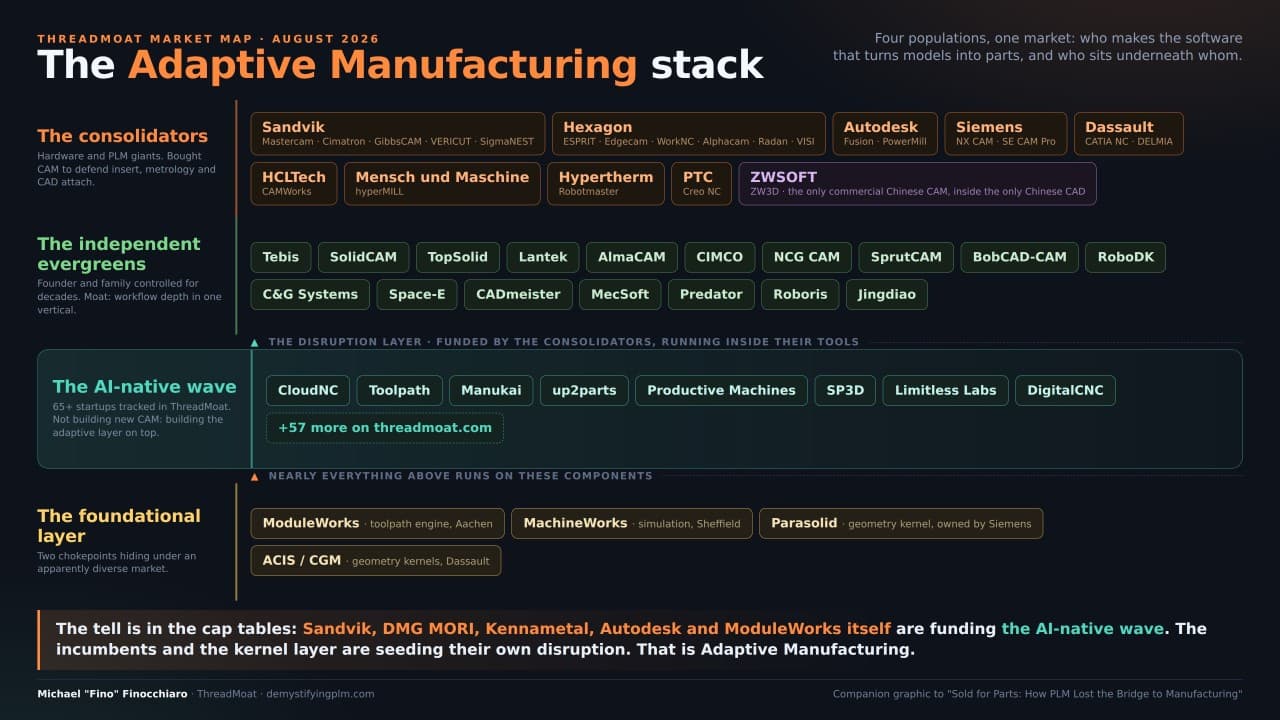
The Case for Adaptive Manufacturing: The Money Has Already Voted
Aug 4, 2026 · 9 min read
AI-Accelerated Design: How Neural Surrogates and Topology Optimization Are Changing Engineering Timelines
May 23, 2026 · 7 min read