Key Takeaways
- PLM AI Copilots are moving from pilot to production in leading manufacturing companies
- Early adopters report 20–30% reduction in design cycle time
- Data quality and governance are the primary success factors, not the AI model itself
- The distinction between copilot (advisory) and agent (autonomous) matters for risk governance
Short Answer
An AI Copilot in PLM is an intelligent assistant integrated into product lifecycle management workflows that helps engineers answer questions, catch errors, suggest design alternatives, and automate routine tasks—trained on your specific products, standards, and processes.
- AI Copilots in PLM are domain-specific—trained on your products, standards, and history
- They answer questions about part numbers, compliance, and change impact in seconds
- Copilots reduce routine engineering work by 30–50%, freeing engineers for creative tasks
- They do not replace PLM systems—they augment them as an intelligent interface layer
- Security-conscious deployments run on-premises or in private cloud, keeping IP inside your firewall
What Is an AI Copilot in PLM?
An AI Copilot in PLM is a domain-specific intelligent assistant embedded in product lifecycle management workflows.
Unlike general-purpose AI tools, a PLM copilot is trained—or retrieval-augmented—on your organization's specific products, design standards, supplier lists, change history, and compliance requirements. It knows your world, not the entire internet.
The result is an assistant that can answer "can I substitute this part?" or "what will this change break?" in seconds, with answers grounded in your actual product data.
Why "Copilot" and Not "Agent"?
The distinction matters for governance.
A copilot advises. It provides answers, flags risks, and drafts suggestions—but a human reviews and approves before anything changes. Every action is human-initiated and human-confirmed.
An agent acts. It executes tasks autonomously within defined boundaries, without per-step human approval. Change propagation, supplier substitution, and document generation can all be delegated to an agent once trust and data quality are sufficient.
Most organizations in 2026 are implementing copilot capabilities first. Agents require Product Memory and mature data governance to work safely at scale.
What a PLM AI Copilot Can Do
Answer Engineering Questions Instantly
Engineers spend hours searching for part information, compliance status, and design decisions scattered across PLM systems, email, and SharePoint.
A copilot retrieves that information in natural language. "What standard governs the fastener torque on this joint?" returns the relevant standard, the engineering note that cited it, and the test record that validated it—in one query.
Trace Change Impact
Before submitting an engineering change, an engineer typically spends hours tracing which assemblies, drawings, suppliers, and processes will be affected.
A copilot with access to the full product graph completes that trace instantly. It flags downstream impacts the engineer may not have considered, reducing the rate of incomplete change orders.
Check Designs Against Standards
Design rule checking traditionally happens during formal review cycles. AI copilots enable continuous checking as engineers work.
The copilot compares the current design state against your company's approved materials, supplier lists, tolerance standards, and regulatory requirements—flagging violations before they reach a drawing release.
Draft Documentation
First-draft generation for test reports, change request justifications, and compliance summaries is one of the highest-value early copilot use cases.
The copilot pulls the relevant data from PLM, drafts structured prose, and presents it for engineer review. What previously took two hours takes ten minutes.
How PLM AI Copilots Differ From General AI
The key differentiator is domain specificity.
| General AI (ChatGPT, etc.) | PLM AI Copilot | |
|---|---|---|
| Knowledge scope | Broad, shallow | Narrow, deep |
| Data source | Public training corpus | Your PLM, standards, and history |
| Answer grounding | Probabilistic | Retrieval-based, citable |
| IP exposure | High (data leaves your perimeter) | Low (runs in your environment) |
| Engineering context | None | Full product, BOM, change history |
A general AI tool can define what a Digital Thread is. A PLM copilot can tell you whether a specific proposed change breaks your digital thread for program XYZ, and why.
The Architecture Behind PLM AI Copilots
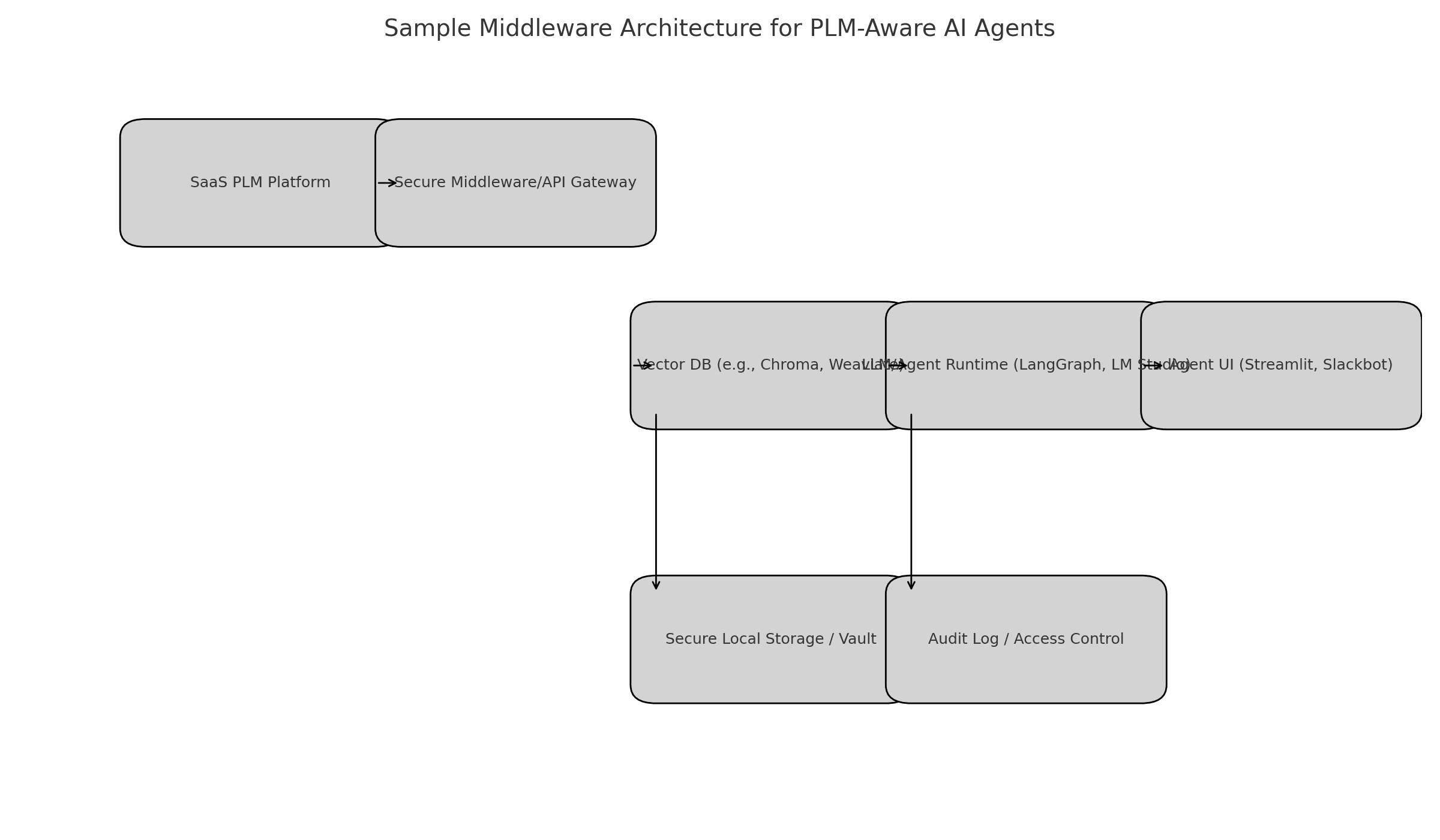
Most enterprise PLM copilots use Retrieval-Augmented Generation (RAG).
Rather than baking all your product data into a model (expensive, stale), RAG retrieves relevant records at query time and feeds them to the language model as context. The model synthesizes the retrieved data into a coherent answer.
This means:
- Answers are always grounded in your current data
- The system can explain why it gave an answer (and cite the source)
- Updates to your PLM data are immediately reflected in copilot answers
- Your product data never needs to leave your control
For highly structured tasks (change impact tracing, BOM traversal), graph-based retrieval over the product knowledge graph outperforms flat document retrieval. Leading implementations combine both.
Security and IP Protection
Intellectual property protection is the first concern enterprises raise.
Enterprise-grade PLM copilots address this by running entirely within your security perimeter. The language model is deployed on-premises or in a private cloud tenant. Your product data is never sent to public AI APIs. The model is either fine-tuned locally or retrieval-augmented against local indexes.
This architecture satisfies the requirements of aerospace and defense (ITAR), medical devices (FDA CFR 21 Part 11), and automotive (TISAX) environments where data residency is non-negotiable.
Implementation Considerations
Data Quality Is the Gating Factor
A PLM copilot is only as good as your data. If your BOM has inconsistent material classifications, your parts don't have requirement links, and your change orders have free-text "see conversation with Dave" justifications—the copilot will give unreliable answers.
Data quality investment before or alongside a copilot rollout is not optional. It is the primary success factor.
Start With High-Signal Use Cases
The fastest copilot wins come from use cases where the data is already structured and the query type is well-defined:
- Compliance status queries — Is this part on the approved list?
- Change impact tracing — What uses this part number?
- Supplier information — Who is the approved second source for this component?
- Standard lookups — What standard governs this weld joint classification?
These don't require perfect data across the entire PLM. They require good data in one well-defined area.
Define Copilot vs. Agent Boundaries Early
Governance conversations about where human approval is required must happen before deployment, not after an incident.
Define: which question types can the copilot answer autonomously? Which require engineer confirmation? Which should the copilot decline and escalate? These boundaries belong in documented policy, not just model prompts.
PLM Vendor Landscape
All major PLM vendors are building or acquiring copilot capabilities.
PTC has integrated generative AI into Windchill. Siemens is embedding AI assistance across Teamcenter. Dassault Systèmes is extending the 3DEXPERIENCE platform with AI-native features. Independent providers like Aras are pursuing open-architecture AI integration.
The capability is becoming table stakes. The differentiation is in how deeply it integrates with your specific product data, not whether it exists.
The Path From Copilot to Agent
Today's copilots are tomorrow's agents.
The engineering teams building copilots now are training themselves—and their data infrastructure—for autonomous operation. Every question-and-answer pair the copilot handles is a reinforcement signal. Every structured decision record captured in Product Memory is training data for the next generation.
Organizations that wait to start until the technology is "more mature" will find themselves without the data infrastructure that makes agents trustworthy. The copilot phase is the prerequisite.
Summary
An AI Copilot in PLM is a domain-specific intelligent assistant that makes PLM systems dramatically easier to query, use, and act on—without replacing them.
The key to value is domain specificity: training or retrieval-grounding on your products, your standards, and your history. General AI tools can define concepts. PLM copilots can answer questions about your actual programs.
Data quality governs outcomes more than model choice. Start with high-signal, well-structured use cases, define copilot-vs-agent governance boundaries, and protect IP with on-premises or private cloud deployment.
Related reading:
- What is Product Memory?
- What is a Digital Thread?
- What is PLM Integration?
- What is a Digital Twin?
- What is Change Impact Analysis? — how AI copilots use impact analysis to surface risk before approving changes
Want to listen instead of read? 56 DemystifyingPLM articles are available as audio.
Browse audio →Looking up PLM terminology? Browse the canonical reference.
PLM Glossary →Cite this article
Finocchiaro, Michael. “What is an AI Copilot in PLM?.” DemystifyingPLM, February 10, 2025, https://www.demystifyingplm.com/what-is-ai-copilot-in-plm
PLM industry analyst · 35+ years at IBM, HP, PTC, Dassault Systèmes
Firsthand knowledge of the evolution from early 3D modeling kernels to today's cloud-native platforms and agentic AI — the history, strategy, and future of PLM.