Key Takeaways
- ALM manages software from requirements to release; PLM manages physical product data from design to disposal
- The integration point is the embedded software configuration — what software version maps to which product serial number
- MBSE provides the system model that makes ALM-PLM integration coherent, not just a data copy
- AI agents that can traverse the ALM-PLM thread will be able to answer "what software was in this product at ship date"
Short Answer
ALM (Application Lifecycle Management) is the discipline and toolchain for managing software applications through their complete lifecycle. In manufacturing, it governs the embedded software inside physical products — and must integrate with PLM to ensure hardware and software configurations stay in sync.
- ALM manages software lifecycle; PLM manages physical product lifecycle — they converge at systems engineering
- Polarion (Siemens), Codebeamer (PTC), Jira, and Azure DevOps are the leading ALM platforms
- ALM-PLM integration solves configuration drift between mechanical BOMs and software release records
- MBSE is the bridge between ALM requirements traceability and PLM structural data
- Automotive, aerospace, and medical devices are the highest-stakes ALM-PLM integration domains
What Is ALM? Application Lifecycle Management in PLM Context
ALM (Application Lifecycle Management) is the discipline and toolchain for managing software applications through their complete lifecycle — from requirements gathering and design through development, testing, deployment, and maintenance. In manufacturing, ALM governs the embedded software inside physical products. It must integrate with PLM to ensure hardware and software configurations stay in sync.
That last sentence is the part most organizations get wrong.
ALM vs PLM: The Core Distinction
PLM governs the mechanical and systems design of physical products — the BOM, the CAD data, the change orders, and the configuration of what you ship. ALM governs the software development lifecycle — requirements, source code, test cases, builds, and releases.
They are not competitors. They are parallel systems that govern different halves of the same product.
The problem is that they converge at the product. A modern vehicle ECU is simultaneously a mechanical component (PLM owns the housing, the connector, the mounting, the part number) and a software artifact (ALM owns the firmware version, the requirements trace, the test coverage, and the release record). Neither system alone can tell you what was actually shipped.
| Dimension | ALM | PLM |
|---|---|---|
| Primary artifact | Requirements, code, builds, test results | BOM, CAD, change orders, configurations |
| Lifecycle governed | Software development → release → maintenance | Concept → design → manufacture → service |
| System of record for | Software version and requirements traceability | Physical product structure and change history |
| Typical stakeholders | Software engineers, QA, release managers | Mechanical engineers, manufacturing, PLM admins |
| Convergence point | Systems engineering — where functional behavior meets physical architecture |
The architectural distinction matters because it determines which data lives where. Confusing the two leads to one of the most common failure modes in embedded-software programs: the software release record and the mechanical BOM live in separate systems, managed by separate teams, with no governed link between them.
Why ALM-PLM Integration Matters
Configuration drift is the failure mode. It happens when the software version in the PLM product record stops matching the software version that was actually flashed to the device at manufacturing.
In automotive, an ECU controls functions from anti-lock braking to battery management. When a software patch ships, the mechanical BOM in PLM needs to reflect the new software part number and effectivity. If that link is broken — if ALM releases version 2.3.1 and PLM still records 2.2.7 as the as-shipped configuration — the downstream consequences compound: field service teams order the wrong calibration, warranty claims can’t be matched to the correct release, and recalls become forensic exercises across two separate systems.
In medical devices, the stakes are regulatory. FDA 21 CFR Part 820 and IEC 62304 both require traceability between software requirements and design outputs. That traceability only works if the ALM requirements record and the PLM device master record are linked. When they are not, audit preparation becomes a manual reconciliation project that takes months.
In aerospace, DO-178C certification requires that every line of flight-critical software be traceable to a verified requirement. Polarion or Codebeamer can hold that trace. But the system-level allocation — which software functions satisfy which system requirements, and which hardware assemblies host which software components — lives in the systems model and the PLM BOM. A gap between the two creates a DO-178C traceability hole.
The business case for ALM-PLM integration is not efficiency. It is correctness: knowing, with certainty, what software was in which product at ship date.
The Key Integration Points
Three integration points carry most of the weight:
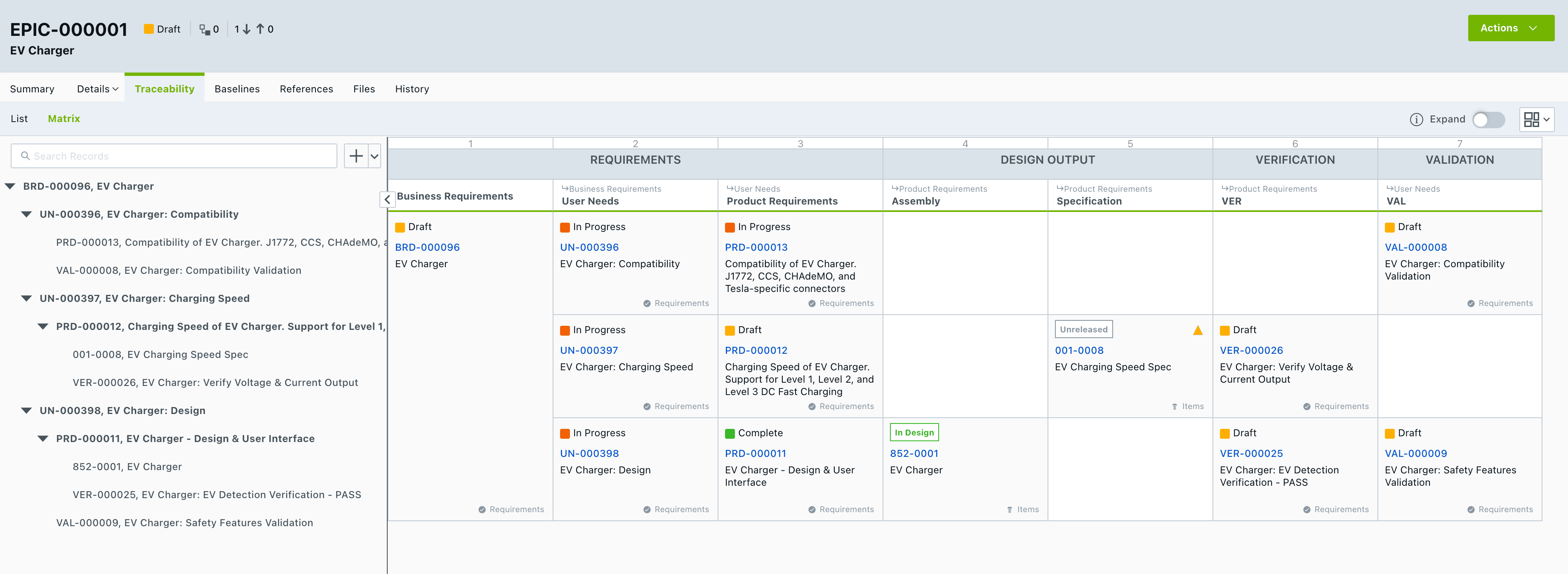
Requirements traceability across the boundary. A customer or regulatory requirement allocated to software needs to trace from the top-level system requirement (often in PLM or an MBSE model) through the software requirement (in ALM) to the code module and test case that satisfies it. That end-to-end trace does not exist unless PLM and ALM share a reference model. Without it, "requirements coverage" is a claim, not a fact.
Software as a BOM component. When a software deliverable reaches a releasable state in ALM, it should create or update a controlled software part number in PLM — with the version, the release date, and the ALM artifact references attached. The software becomes a line item in the product BOM with the same governance as a mechanical part: effectivity, change history, and configuration control. Treating software as a "file on a fileserver" rather than a BOM component is where most configuration drift begins.
Synchronized change management. When a software change is released in ALM — a patch, a new feature, a safety fix — the corresponding PLM change record (ECO or equivalent) must reflect it. The effectivity needs to say "units serial 14500 onward receive firmware 2.3.1." If the ALM release and the PLM change order are managed independently, that effectivity either never gets written or drifts out of sync within weeks.
Leading ALM Platforms
Four platforms dominate enterprise ALM in manufacturing contexts:
Polarion ALM (Siemens) is the most deeply PLM-integrated option available. Siemens sells Polarion as part of the Xcelerator portfolio alongside Teamcenter, with native connectors that let a Polarion requirement link directly to a Teamcenter part or BOM node. For automotive OEMs and Tier 1 suppliers working in AUTOSAR and ASPICE environments, Polarion is the reference platform. Its traceability model is rigorous and its requirements matrix tooling is best-in-class for regulated industries.
Codebeamer (PTC) positions itself as the agile-friendly ALM for medical devices and embedded-systems teams. PTC acquired Codebeamer (formerly Intland Software) in 2022 and has been integrating it with Windchill to close the same ALM-PLM gap that Siemens closes with Polarion-Teamcenter. Codebeamer’s strength is its configurability for IEC 62304, ISO 26262, and DO-178C workflows — out-of-the-box templates for the most common regulated-software development standards.
Jira (Atlassian) is the most widely deployed ALM-adjacent tool in the industry, even if Atlassian does not market it as ALM. Most software teams already use Jira for issue tracking and sprint management. The PLM integration challenge with Jira is that it was not designed for requirements traceability or configuration baseline management — those gaps are typically filled by add-ons (Xray, Jira Align, Confluence for documentation) or by a wrapper tool. For low-regulation environments, Jira-based ALM is pragmatic. For ISO 26262 or DO-178C, it requires significant configuration overhead to become compliant.
Azure DevOps (Microsoft) occupies a similar space to Jira — widely deployed among software-first engineering organizations, with strong CI/CD and repository integration but limited native PLM connectivity. Its requirements management is workable for simpler programs. For large-scale regulated-software development with deep PLM integration needs, Azure DevOps typically requires custom integration work.
The pattern: for manufacturers where ALM-PLM integration is a compliance requirement rather than a nice-to-have, Polarion and Codebeamer are the serious options. For manufacturers where software is still a secondary concern and the PLM integration can be loose, Jira or Azure DevOps will do the job.
MBSE: The Bridge
Model-Based Systems Engineering (MBSE) is what makes ALM-PLM integration coherent rather than just a data transfer.
An MBSE model — built in SysML, executed in Cameo Systems Modeler, Rhapsody, or Capella — captures the system architecture: the functional decomposition of what the product must do, the physical architecture of how it will do it, and the allocation of functions to physical components and software subsystems. That allocation is the bridge.
From the MBSE model, PLM knows which hardware assemblies host which software components. ALM knows which software requirements satisfy which system functions. The system model holds the allocation that connects them. Without that common reference, PLM and ALM are two systems that both claim to understand the product but cannot be reconciled to each other.
In automotive, this matters at the ISO 26262 HARA (Hazard Analysis and Risk Assessment) level. Safety goals allocated to software components need to be traceable from the system model down through ALM requirements and back up to the PLM product configuration. The system model is the governing artifact; PLM and ALM are the implementation records on either side.
In aerospace, the digital thread between a DO-178C software artifact and its parent system requirement in the design model runs through the MBSE layer. MBSE is not optional for serious ALM-PLM integration — it is the substrate that makes the trace credible.
What the Future Looks Like
The trajectory is toward a unified digital thread where mechanical design data, system models, and software release records share a governed reference model — not a single system, but a connected set of systems with explicit contracts between them.
The near-term version of this is already visible in the Siemens stack: Teamcenter as the PLM spine, Polarion as the ALM spine, and a Siemens Capital or Cameo model as the systems layer connecting them. Each system owns its domain; the contracts between them are formal and versioned.
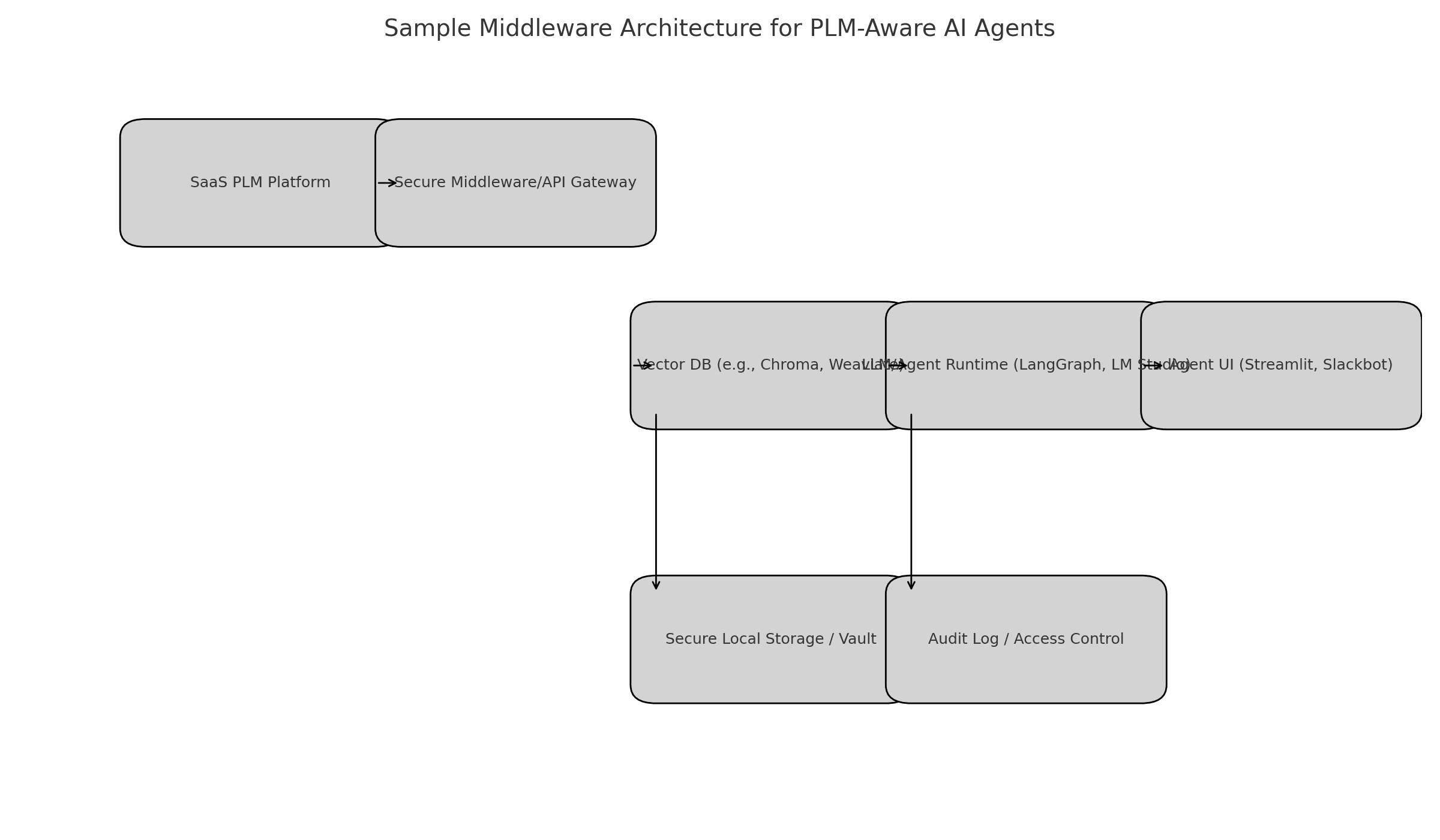
The next version involves AI agents traversing that thread. An agent that can query "what software version was in unit serial 48221 at ship date, which requirements governed that release, and which hardware configuration was it tested against" is solving a question that today requires three separate investigative threads across two or three systems. That question becomes a single query only when the ALM-PLM thread is clean.
Manufacturers who have not solved the ALM-PLM integration problem today will find it much harder to solve when AI agents are the primary consumers of the answer. The thread either exists and is governed, or the agents produce confident wrong answers at machine speed. There is no middle ground.
Related reading:
- ALM and PLM Integration: Connecting Software and Hardware Development — the practitioner guide to integration patterns, tooling, and governance
- What is a Digital Thread? — the architecture that ALM-PLM integration enables
- What is Agentic PLM? — how AI agents traverse the ALM-PLM thread
Want to listen instead of read? 56 DemystifyingPLM articles are available as audio.
Browse audio →Looking up PLM terminology? Browse the canonical reference.
PLM Glossary →Cite this article
Finocchiaro, Michael. “What Is ALM? Application Lifecycle Management in PLM Context.” DemystifyingPLM, March 20, 2023, https://www.demystifyingplm.com/what-is-alm
PLM industry analyst · 35+ years at IBM, HP, PTC, Dassault Systèmes
Firsthand knowledge of the evolution from early 3D modeling kernels to today's cloud-native platforms and agentic AI — the history, strategy, and future of PLM.