Key Takeaways
- 600 startups across 45 countries, 10 unicorns, $15.7 billion in VC—a parallel engineering software industry rivaling the Big Three (Autodesk, Siemens, PTC) combined in velocity and funding.
- Order-of-magnitude workflow compression is the entry bar, not the differentiator. Compute Maritime compressed naval design from 2–5 months to 1–2 days. That's not a 20% improvement—entire stages of the workflow disappeared.
- Agent-native architecture is the default design pattern. These are not legacy products with an LLM bolted to the sidebar. They are AI-first from conception.
- Data governance, not AI capability, is the actual bottleneck. 90% of CAD files still live on local desktops with inconsistent naming. AI cannot fix decades of data hygiene retroactively.
- Incumbents are on the back foot. Dassault, Siemens, and PTC have no major AI breakthroughs shipping in 2026. Startup momentum is outpacing large-org delivery cycles by 2–3 years.
- 90% of these startups will fail. But the 10% that survive will rewrite the industry. The question is not 'are startups a threat?' but 'which startups do I acquire or partner with before they become threats?'
🎧 Audio Version
Listen to "157 Billion: The Shadow Ecosystem That's Rewriting Engineering Software"
More audio articles at DemystifyingPLM/listen
Short Answer
At Threaded Warwick and Threaded Miami 2026, I saw 600+ engineering software startups representing $15.7 billion in venture capital—a parallel industry that is compressing workflows from months to days while incumbents stall on legacy system integration. Agent-native architecture, multi-physics automation, and AI-powered data governance are table stakes, not differentiators. 90% of these startups will fail, but the 10% that survive will consolidate into a new competitive landscape. The question for enterprise PLM strategists is no longer whether to evaluate startups, but which ones to acquire or partner with before they rewrite the industry.
- $15.7B in VC funding for engineering software startups reflects a market belief that incumbents have failed to deliver.
- Workflow compression is measured in orders of magnitude: ship design 2–5 months → 1–2 days; CAD to parametric 4 hours → 10 minutes.
- Agent-native architecture (AI reasoning about design, manufacturing, and constraints) is the dominant design pattern, not a feature.
- Data governance is the hidden bottleneck: legacy file chaos, inconsistent metadata, and broken relationships block both incumbent and startup solutions.
- Incumbent velocity is matched by startup velocity—large organizations have no first-mover advantage in AI-native engineering tools.
- Consolidation is inevitable: 600 startups, 10 unicorns, maybe 30–50 will survive to $100M ARR. Expect major M&A 2027–2029.
Why it matters: For PLM strategists and engineering leaders: the status quo is not stable. Incumbents are betting that integration and ecosystem lock-in will hold customers. Startups are betting that order-of-magnitude workflow gains will flip that equation. The data will decide. Companies that invest in evaluating startup alternatives now will be better positioned to make acquisition or partnership decisions in 12–18 months, when the category consolidation accelerates.
The One-Sentence Signal
A $15.7 billion parallel engineering software industry is shipping order-of-magnitude workflow improvements while incumbents argue about legacy system integration.
What I Saw at Threaded
In April 2026, I attended back-to-back Threaded conferences — first in Warwick, UK (co-located with DEVELOP3D LIVE), then in Miami (co-located with Aras ACE). Both were convened to surface the next generation of engineering software founders and connect them with PLM practitioners, customers, investors, and analysts.
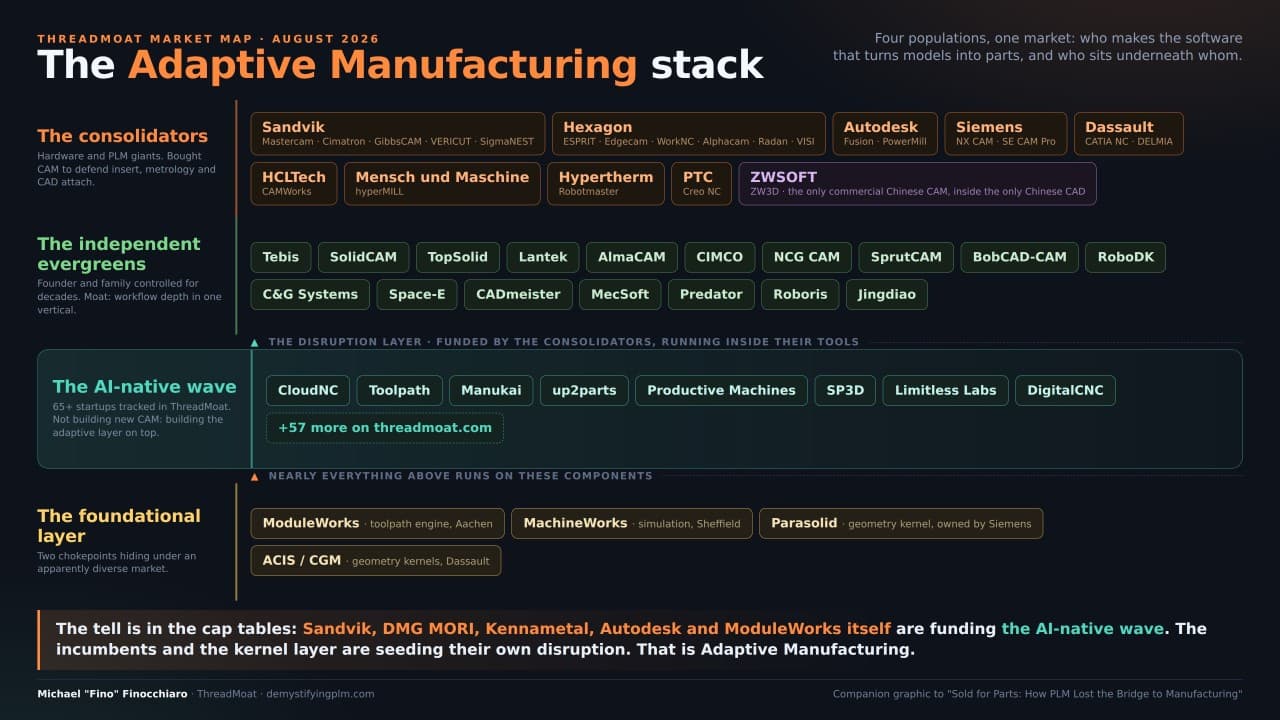
What I observed was not a series of vendor pitches. It was a parallel engineering software industry — 600 startups across 45 countries, 10 unicorns, $15.7 billion in venture capital — operating independently of (and in some cases, in competition with) the legacy incumbents. These are not niche tools filling small gaps. They are category contenders solving the same problems that Autodesk, Siemens, PTC, and Dassault are solving — just differently, faster, and more intelligently.
Workflow Compression, Not Incremental Improvement
The sharpest signal from both conferences: speed gains are measured in orders of magnitude, not percentages.
| Startup | Capability | Before | After |
|---|---|---|---|
| Compute Maritime | Naval ship design cycle | 2–5 months | 1–2 days |
| Bench | Reverse-engineer STL to parametric CAD | 4 hours | 10 minutes |
| Productive Machines | CNC cycle time optimization | baseline | −18% to −37% |
| Secondmind | Design exploration + prototyping | baseline | 50% faster, 40% fewer prototypes |
These are not "features." Entire workflow stages are disappearing.
When Compute Maritime's founder walks you through a naval design cycle that used to be 5 months but is now 2 days, he is not describing a faster tool. He is describing the elimination of the iteration loop that used to define naval architecture as a profession.
Agent-Native as the Default Design Pattern
The architectural shift is unmistakable: agent-native is becoming the default, not an add-on.
Agent-native means: the system is designed from conception around autonomous AI agents that reason about design, manufacturing, and constraints. Not a legacy CAD system with a chatbot in the corner. Fully integrated, machine-speed decision-making.
Working examples on display:
- Bild — Meru — Multimodal AI that understands CAD revisions and annotations with 82% accuracy, reducing engineering change order cycles by 60%.
- OpenBOM — CAD File Agent — Intelligent automation for SolidWorks file handling, BOM generation, and procurement workflow integration.
- Trace.Space — AI-native requirements tool with graph-based architecture enabling "two-click traceability" between requirement, design element, and field data.
- TDengine — Reframes industrial sensor data as continuous feeds with AI anomaly detection, rather than dashboard-as-the-product.
- Violet Labs — Permissioned AI orchestration layer providing agent access across requirements, CAD, PLM, MES, ERP, and simulation tools via the Model Context Protocol.
Each of these is a different approach to the same problem: how do you compress engineering workflows from weeks to days using AI that actually reasons about the domain, not just runs transformers on generic text?
The Data Governance Bottleneck
Here's what nobody wants to admit: data governance, not AI capability, is the actual blocker.
Lucy Hoag from Violet Labs put it bluntly at the Warwick event: "Engineering software design hasn't fundamentally changed since the 1990s. 90–95% of CAD files still live on local desktops. PDM implementations fail over basic things like consistent file naming. Historical data is often in PowerPoint with the source files deleted. AI cannot fix data hygiene retroactively—it can only amplify whatever quality you start with."
That is the unglamorous truth that neither startups nor incumbents are eager to broadcast. You can build the most sophisticated agent-native system imaginable, but if the CAD files it's trying to reason about are named v2_final_REAL_no_wait_THIS_is_final.stp, you're fighting upstream.
Incumbents cannot solve this because they're locked into customer implementations they dare not disrupt. Startups are trying to solve it by building data remediation into their onboarding, but it's slow, expensive, and often painful for customers.
The Incumbent Velocity Problem
At both Threaded events, the theme from enterprise customers was consistent: large vendor velocity is not competitive with startup velocity.
- A feature request to a major CAD/CAE vendor: 12–18 month lead time to evaluation, negotiation, and deployment
- A feature request to a startup: shipped in 4–6 weeks
- New category (agent-native orchestration): Siemens, PTC, Dassault are evaluating it. Violet Labs (2-year-old startup) is shipping it.
Incumbent advantage: ecosystem, integration, customer lock-in, installation base.
Incumbent disadvantage: governance, slow development cycles, architectural debt, legacy system integration overhead.
The question is which advantage wins. Based on the funding (600 startups receiving $15.7B) and the customer appetite (every enterprise I spoke to was actively evaluating 3+ startup alternatives), the answer seems to be: "It depends on execution, not category dominance."
Will They Survive?
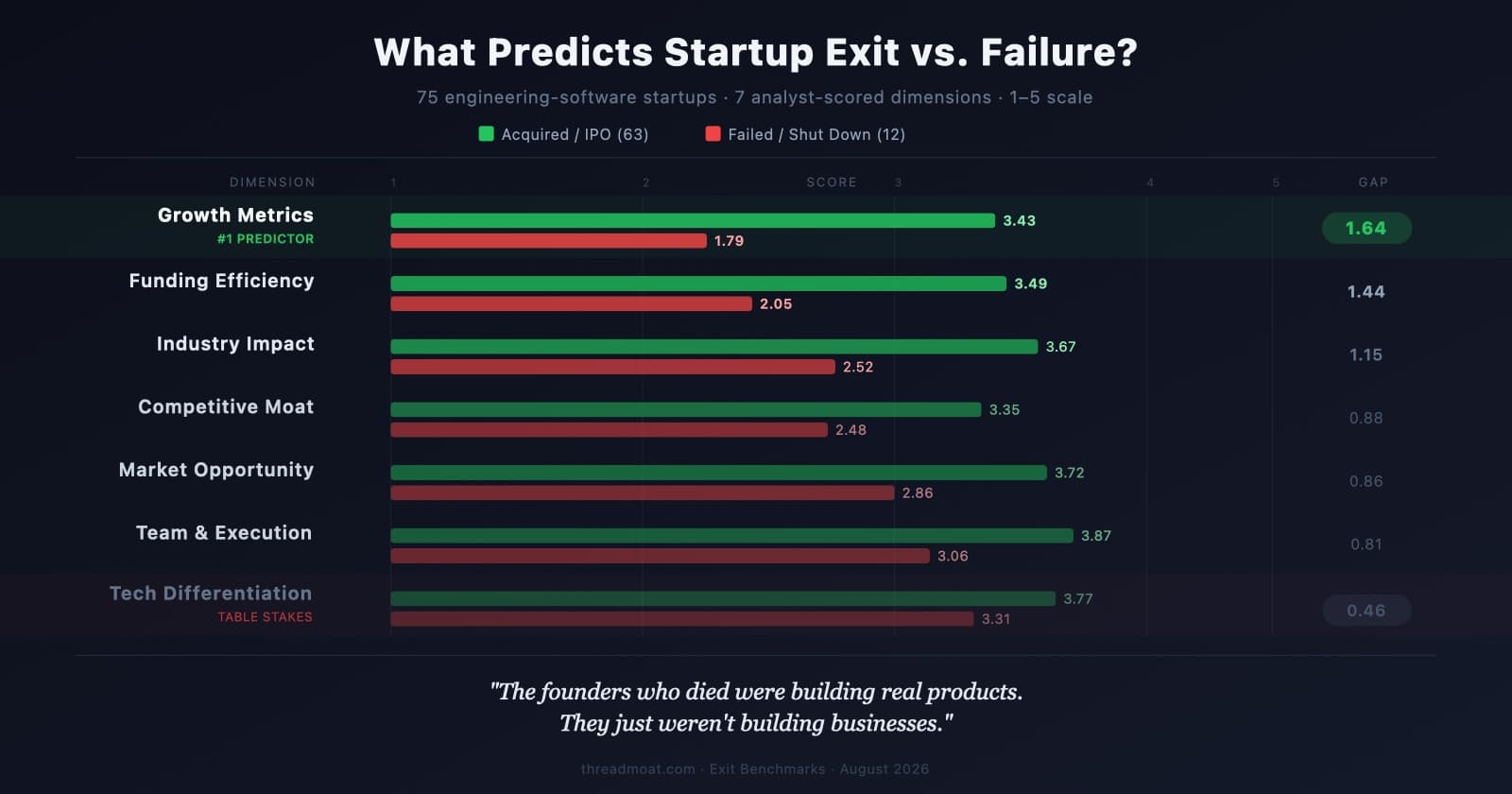
Ralph Verrilli from Next Stage Advisors delivered the sobering reality: "90% of those guys won't get past the three, four million dollar range."
Math: 600 startups × average founding capital of 300M in annual burn rate. Add Series A/B fundraising for maybe 150 of them, and you're talking about $1.5–2B in cumulative capital deployed. At 10% survival rate, that's sustainable. At 5%, there's bloodshed.
The issue: engineering software has brutal unit economics.
- Long sales cycles (6–12 months for enterprise)
- High implementation cost (customer has to train teams on new tools)
- Integration nightmare (customer has to wire new tool into existing PLM, ERP, data pipelines)
- LTV/CAC ratio pressure (payback period has to be under 2 years to be fundable at VC scale)
Most of these startups are founded by incredible domain experts (PhD in computational fluid dynamics, veteran Siemens architect) who can build beautiful technology but have no idea how to sell to a PLM committee or navigate a 6-month enterprise procurement.
What Happens Next
If history repeats (CAD industry in the 1990s, cloud infrastructure in the 2010s):
- Years 1–2: 600 startups, high burn, lots of pivoting. 50% shut down, get acquired cheaply, or merge.
- Years 3–5: 100–150 viable companies with product-market fit. Top 10–15 unicorns or late-stage rounds.
- Years 5–8: 30–50 companies with clear paths to IPO or $500M+ acquisition. Major consolidation by incumbents. Most startups either IPO, sell to larger tech (Microsoft, Google, Amazon), or sell to PLM giants (Siemens buys 5–10, PTC buys 3–5, Dassault buys 2–3).
The question for industrial software executives now is: How fast can you evaluate these startups and decide which ones to acquire or partner with?
Because in 3 years, the ones you're ignoring today will be the ones you're paying 3–5× more to acquire.
The Competitive Implication
For anyone running PLM strategy, engineering technology, or manufacturing operations at an industrial company:
The status quo is not stable.
You can keep betting on Siemens, PTC, Autodesk, and Dassault to integrate AI and reinvent their workflows. You can believe that ecosystem lock-in and customer inertia will keep them dominant.
Or you can treat the 600-startup ecosystem as what it is: a signal that the incumbents have failed to innovate fast enough, and the market is funding alternatives at a rate we haven't seen since the cloud infrastructure wars.
The takeaway: Your job is not to predict which startups win. Your job is to know which ones are solving your problems faster than incumbents can integrate them. And you have 18 months to make that bet before consolidation locks in the leaders.
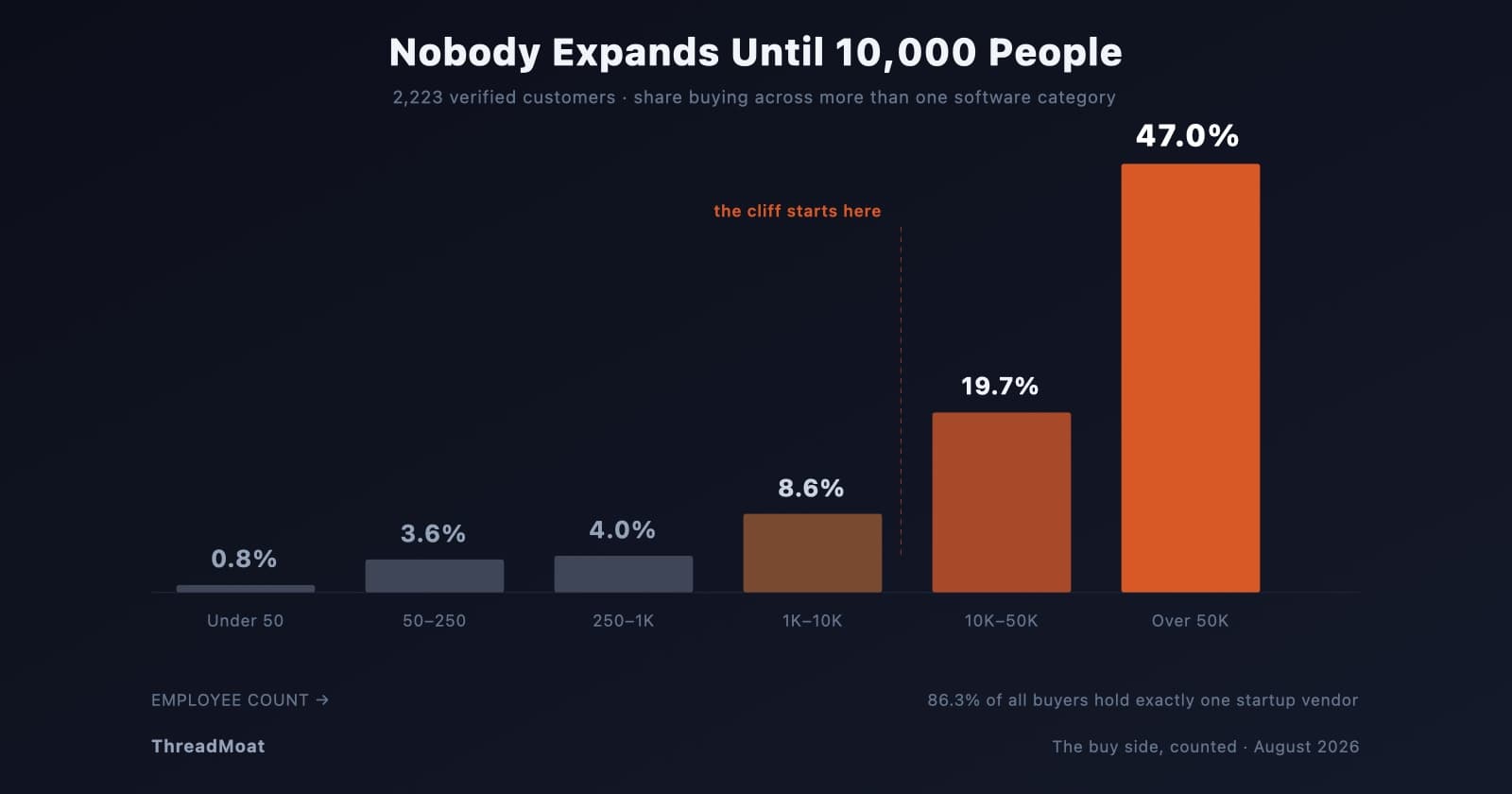
Related on ThreadMoat: The $1.57 Billion Shadow Ecosystem: the data cut and Who Actually Buys From Industrial Software Startups?. On DPLM: what the buy-side data means for PLM leads.
Looking up PLM terminology? Browse the canonical reference.
PLM Glossary →Cite this article
Finocchiaro, Michael. “157 Billion: The Shadow Ecosystem That's Rewriting Engineering Software.” DemystifyingPLM, April 20, 2026, https://www.demystifyingplm.com/insights/157-billion-shadow-ecosystem
PLM industry analyst · 35+ years at IBM, HP, PTC, Dassault Systèmes
Firsthand knowledge of the evolution from early 3D modeling kernels to today's cloud-native platforms and agentic AI — the history, strategy, and future of PLM.