🎧 Audio Version
Listen to "Aras vs Teamcenter: Flexibility vs. Scale in Enterprise PLM"
More audio articles at DemystifyingPLM/listen
Short Answer
Teamcenter is the default for large automotive/aerospace OEMs needing industry-standard assembly management and Tecnomatix integration. Aras is the choice for enterprises prioritizing customization flexibility, lower lock-in, and faster ROI on specialized processes. Teamcenter dominates large assembly; Aras dominates flexible deployment.
- Teamcenter is the reference PLM for automotive/aerospace OEMs; Aras is the customization-first challenger
- Teamcenter requires vendor investment; Aras enables business-driven configuration
- Aras Community Edition lets you try for free; Teamcenter requires licensing discussions
- Teamcenter's Tecnomatix integration is deeper; Aras integrates via flexible APIs
- Aras deployments are 30-50% faster; Teamcenter deployments deliver more manufacturing integration
In the PLM market, Teamcenter and Aras represent opposing philosophies. Teamcenter is the reference implementation—the platform that defines what large-scale enterprise PLM should do. Aras is the disruptor that proved you could deliver enterprise-grade flexibility without the vendor lock-in and upgrade nightmares that Teamcenter deployments are notorious for.
Teamcenter dominates automotive and aerospace OEMs managing 50,000+ part assemblies. Aras dominates enterprises that got burned by Teamcenter customization costs and want a faster, more flexible path.
For most enterprises, the choice isn't binary. Many run Teamcenter as the backbone and Aras as an overlay for processes Teamcenter doesn't handle well.
Quick Comparison: Feature Matrix
| Feature | Aras Innovator | Teamcenter |
|---|---|---|
| Business Model | Free Community + Paid Subscription (try-before-buy) | Per-seat licensing (entry via vendor discussion) |
| Customization Model | Open XML (low-code, upgrade-safe) | Hard-coded modules (code-heavy, upgrade-risky) |
| Configuration Speed | Weeks to prototype, 4-8 weeks for production workflow | Months to configure, 12+ weeks for major workflows |
| Core Philosophy | Flexibility, rapid deployment, customization-first | Scale, assembly depth, manufacturing integration |
| Large Assembly Management | Good for 10,000-40,000 parts; scalable but not assembly-optimized | Reference standard for 50,000+ part assemblies |
| Manufacturing Integration | MRO (native), simulation management, flexible integrations | Tecnomatix (deep), process planning, plant simulation, quality |
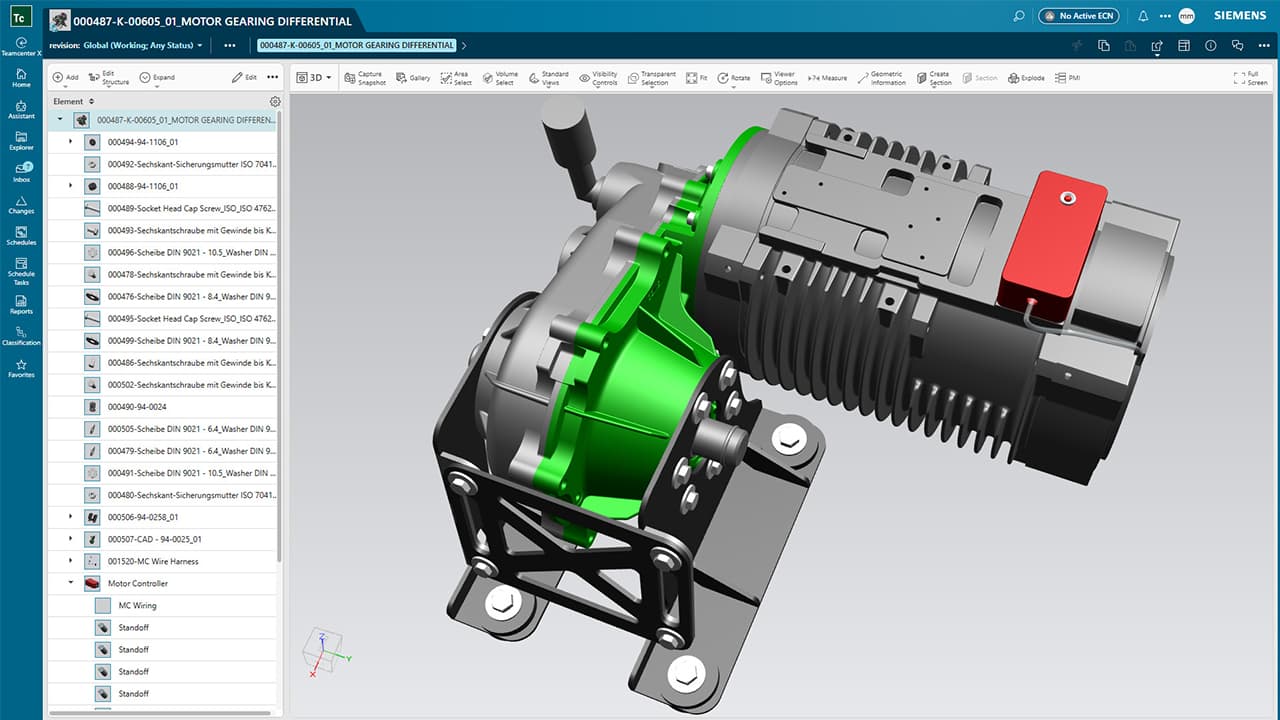
| Cloud Deployment | Aras Enterprise SaaS (full capability, true SaaS) | Teamcenter X (collaboration layer) + on-premises core |
| CAD Integration | Vendor-neutral APIs; treats all CAD equally | Vendor-neutral but deeply optimized for NX |
| Supplier Collaboration | Supplier Portal (2024, modern, configurable) | JT format + collaboration (established, industry-standard) |
| Implementation Time | 4-8 months (mid-market); 8-12 months (enterprise) | 16-24 months (mid-market); 24-36+ months (large OEM) |
| Upgrade Cycle | 2-4 weeks (customizations survive in metadata) | 3-6 months (customizations must be re-validated) |
| Cost per Seat | Subscription varies; Community Edition: free | $500-2000/month per user |
| Total Cost of Ownership | 40-60% lower for mid-market | Higher due to implementation time and upgrade costs |
At a Glance
Aras: The flexible, upgrade-safe PLM for enterprises that got burned by Teamcenter customization costs and want to prototype before committing—or for companies deploying specialized processes faster than Teamcenter can support.
Teamcenter: The reference implementation for large automotive/aerospace OEMs where assembly management at scale, manufacturing process integration, and industry standardization justify the deployment complexity and upgrade risk.
Business Model & Vendor Relationship
Aras's Try-Before-Buy Philosophy
Aras's business model is radically different. You can download Aras Innovator Community Edition for free—no license key, no sales discussion, no commitment. You can deploy it in production and run it indefinitely without paying Aras.
When you're ready for support, training, advanced features, or upgrade services, you subscribe. This model disrupted PLM procurement. For 30+ years, the conversation was: "Vendor: you have to license seats before you know if it works. Customer: we want a proof-of-concept first." Aras's model inverts that.
Teamcenter's Enterprise Licensing Model
Teamcenter starts with license agreements. You negotiate per-seat costs, module access, support terms—all before you've touched the product. Implementation costs (consulting, training, infrastructure) are separate.
This model works for enterprises that have already evaluated PLM and know Teamcenter is the right choice. It doesn't work for enterprises that want to try first.
Customization Philosophy: The Core Difference
Aras: Open XML, Upgrade-Safe Customization
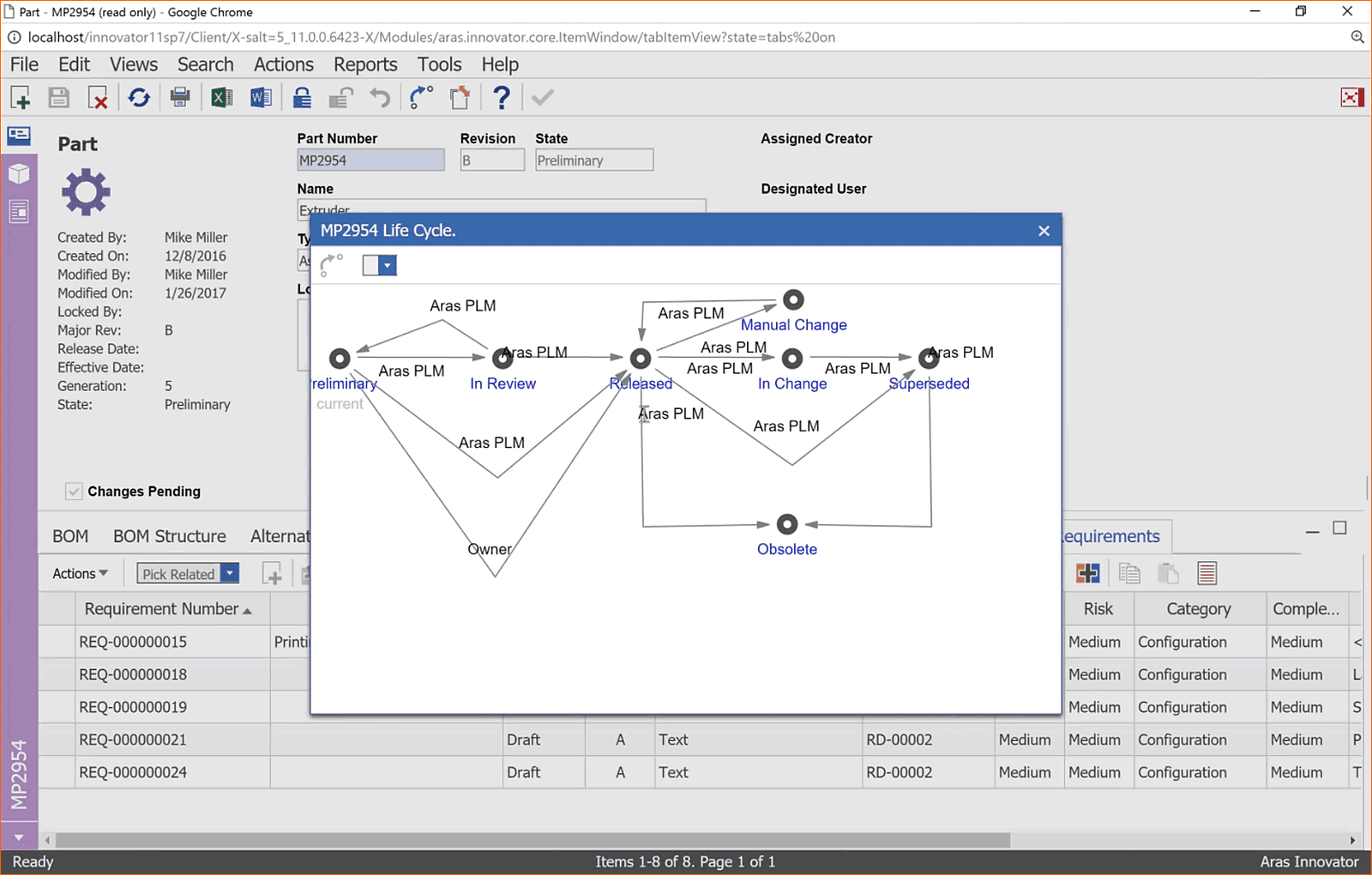
Aras Innovator is built on an Open XML modeling engine. When you customize Aras, you're declaring metadata. These customizations are stored separately from the platform code. When Aras releases a new version, your customizations survive intact. Upgrade a heavily customized Aras deployment in 2-4 weeks.
Teamcenter: Hard-Coded Modules, Upgrade Risk
Teamcenter's architecture treats customizations as code-level changes. You modify behavior by writing Teamcenter Scripting Language (TSL) or C++ plugins. When Siemens releases a new Teamcenter version, your customizations must be re-tested against vendor code. Typical upgrade cycle: 3-6 months.
When to Choose Aras
Ideal Customer Profiles
- Enterprises burned by Teamcenter upgrade costs
- Mid-market companies needing fast deployment (12 months, not 24+)
- Companies deploying specialized PLM requirements (overlay strategy)
- Multi-product portfolio with diverse BOM types
- Organizations concerned about vendor lock-in
Specific Use Cases
- Aerospace suppliers with MRO integration needs
- Electronics manufacturers with diverse products
- Medical device companies with specialized workflows
- Contract manufacturers managing diverse customer requirements
When to Choose Teamcenter
Ideal Customer Profiles
- Large automotive or aerospace OEM
- Complex, multi-generational manufacturing
- Deep digital manufacturing requirements (Industrie 4.0)
- Siemens ecosystem strategy (NX standardization)
- Industry standardization is required (JT format)
Specific Use Cases
- Automotive OEMs: Ford, GM, Stellantis, VW, BMW
- Aerospace & Defense: Airbus, Boeing, Lockheed, Raytheon
- Heavy Equipment: Caterpillar, John Deere
- Complex Assembly Manufacturing: 30,000+ part assemblies
Analyst Perspective
I've watched Aras grow from a small customization vendor to a credible PLM alternative by proving one thing: the Big Three's upgrade model is broken, and customers will flee to a vendor that offers upgrade-safe customization.
Teamcenter remains the best-in-class for what it was designed to do: manage 50,000-part assemblies at automotive OEMs, integrate manufacturing process planning, and serve as the reference implementation for enterprise PLM.
But Aras identified a massive gap in the market: enterprises that don't need Teamcenter's assembly scale but do need faster customization and lower lock-in. That market is growing as mid-market companies, suppliers, and specialized manufacturers want PLM without the Siemens-sized deployment cost.
The trajectory I see:
- Large automotive/aerospace: Teamcenter remains dominant
- Mid-market and specialized: Aras grows
- Hybrid deployments: Both platforms coexist
For your enterprise, the question is: Are you solving a scale problem (Teamcenter) or a flexibility problem (Aras)?
Conclusion
Aras and Teamcenter represent opposite poles of the PLM market. Teamcenter dominates where assembly scale and manufacturing integration are the primary drivers. Aras dominates where customization flexibility and rapid deployment matter more.
For large automotive/aerospace OEMs, Teamcenter is the default. For mid-market companies, suppliers, and enterprises needing specialized PLM capabilities, Aras is increasingly the choice. And for sophisticated enterprises managing both large assemblies and specialized processes, deploying both platforms—with clear role separation—is the winning strategy.
Related Reading
- What is Siemens Teamcenter? — the full architectural breakdown of Teamcenter modules and deployment models
- What is Manufacturing Process Planning? — how Tecnomatix (Teamcenter's process planning suite) fits into enterprise PLM
Vendor Deep Dives
- Aras Innovator Spotlight: Open PLM for Complex Enterprises — the full practitioner's guide to Aras: architecture, pricing, upgrade model, and ideal use cases
- Siemens PLM Spotlight: Teamcenter, NX, and the Xcelerator Portfolio — the full practitioner's guide to Siemens' products, strengths, and automotive dominance
Looking up PLM terminology? Browse the canonical reference.
PLM Glossary →Cite this article
Finocchiaro, Michael. “Aras vs Teamcenter: Flexibility vs. Scale in Enterprise PLM.” DemystifyingPLM, May 10, 2023, https://www.demystifyingplm.com/aras-vs-teamcenter
PLM industry analyst · 35+ years at IBM, HP, PTC, Dassault Systèmes
Firsthand knowledge of the evolution from early 3D modeling kernels to today's cloud-native platforms and agentic AI — the history, strategy, and future of PLM.