🎧 Audio Version
Listen to "Windchill vs Teamcenter: Enterprise PLM Comparison for Large Manufacturers"
More audio articles at DemystifyingPLM/listen
Short Answer
Windchill excels in cross-industry flexibility and multi-CAD environments with modern web architecture and rapid customization, while Teamcenter dominates large-scale distributed assembly management with deep manufacturing process integration and NX/Siemens ecosystem lock-in. Choose Windchill for diverse, distributed enterprises needing fast deployment; choose Teamcenter for automotive/aerospace OEMs managing tens of thousands of parts.
- Windchill evolved from internet-based collaboration; Teamcenter from automotive assembly complexity
- Windchill emphasizes customization flexibility and multi-vendor ecosystems
- Teamcenter leads in large assembly management and manufacturing process integration
- Windchill's web architecture enables faster cloud adoption
- Teamcenter's JT format and Tecnomatix integration define manufacturing PLM standards
Windchill is PTC's enterprise PLM platform — a web-native system for managing product data, BOMs, engineering change, and configurations across geographically distributed teams. Teamcenter is Siemens Digital Industries Software's PLM platform — the market-leading system for complex discrete manufacturing, with particular depth in automotive, aerospace, and heavy equipment assembly management.
When PTC acquired Windchill Technology in 1998, and when UGS merged with SDRC in 2001 to create unified Teamcenter, both companies were solving the same problem: how to manage complex product data across enterprise organizations. But they approached it from opposite starting points. Windchill came from internet-based collaboration tools seeking to break down silos. Teamcenter came from automotive assembly complexity seeking to scale distributed engineering. Today, both platforms dominate Fortune 500 PLM deployments, but they remain architecturally different and strategically positioned for different customer profiles.
For enterprises evaluating or deploying either platform, the choice isn't about which is "better"—both are best-in-class at global scale. It's about which philosophical approach aligns with your organizational structure, product complexity, CAD ecosystem, and deployment timeline.
Quick Comparison: Feature Matrix
| Feature | Windchill | Teamcenter |
|---|---|---|
| Architectural Origin | Internet-based collaboration; modular, web-native | Automotive assembly complexity; distributed caching |
| Core Philosophy | Flexibility, customization, multi-vendor neutrality | Scale, Configuration Management depth, OEM-optimized |
| CAD Integration | Multi-CAD neutral, extensive vendor integration | Multi-CAD neutral, deeply optimized for NX |
| Assembly Management | Strong, but focused on flexibility over extreme scale | Reference standard for 50,000+ part assemblies across distributed sites |
| Manufacturing Integration | MPMLink (acquired Polyplan); good but separate module | Tecnomatix (integrated); process planning, simulation, quality |
| Cloud/SaaS | Native cloud support, AWS Marketplace, PTC Cloud | Limited cloud; mostly on-premises or partner-hosted |
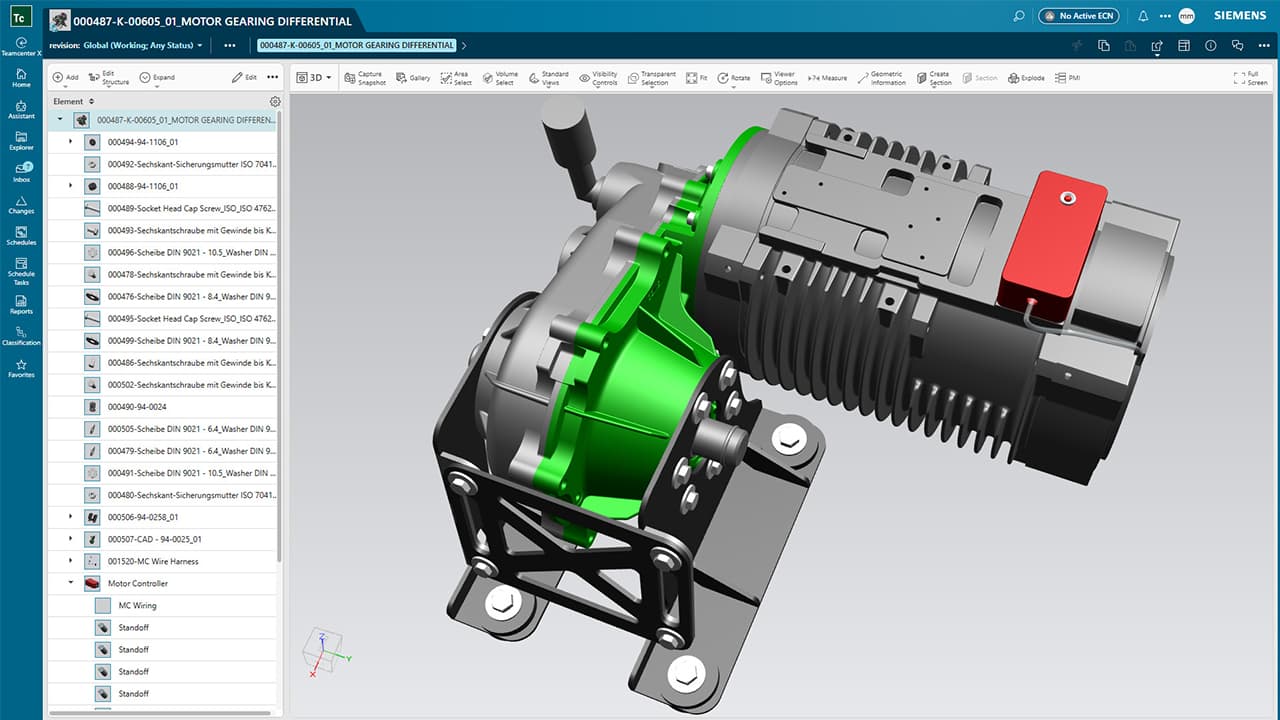
| Visualization | Standard CAD format support, web-based viewers | JT format (ISO 14306), lightweight for massive assemblies |
| Customization | Faster, more business-friendly, web services architecture | Deep, but requires PLM specialists and longer cycles |
| Typical Implementation | 9-14 months (mid-market), 12-18 months (enterprise) | 18-24 months (large OEM), 14-18 months (mid-market) |
| Cost per Seat | $500-1500/month (similar to Teamcenter) | $500-1500/month (similar to Windchill) |
| Total Cost of Ownership | 15-25% lower due to faster implementation | 30-40% higher due to complexity and specialized resources |
At a Glance
Windchill: The agile PLM for enterprises managing multiple CAD systems, geographies, and product lines—where speed to value and flexibility matter more than automotive-scale assembly depth.
Teamcenter: The reference implementation for large OEMs—where managing 50,000-part assemblies across continents, deep manufacturing process integration, and Siemens ecosystem benefits are the decision drivers.
Architectural Origins & Design Philosophy
Windchill's Internet-Based Roots
In 1998, when PTC acquired Windchill Technology, the startup had built something radical for its time: an internet-based collaboration tool that didn't require client installations or VPN tunnels. This architectural decision—web-first from the beginning—shaped everything that followed. PDMLink (launched 2002) inherited this web-native approach, layering on enterprise capabilities like version control, Change Management, and multi-CAD support while maintaining the modular, distributed services architecture.
Teamcenter's Assembly Complexity Foundation
Teamcenter evolved from the opposite problem. IMAN (InfoMANager), built by EDS Unigraphics in the early 1990s, was engineered to manage the massive, multi-site assembly structures of automotive and aerospace. The question IMAN answered was: how do you let 5,000 engineers across 20 sites work on the same assembly without forcing all queries through a single database connection?
D-IMAN (1997) solved this with distributed caching—local sites cache product structures and only push changes back to a central hub. This architecture is elegant if your primary use case is large assembly.
Analyst Perspective
Over 15+ years of following PLM evolution, I've watched these platforms diverge into mirror images of their starting points. Windchill kept the internet-first, flexible-configuration DNA of its 1998 acquisition. Teamcenter deepened the automotive-assembly-complexity DNA of IMAN.
The question for enterprises isn't "which is better?" It's "which philosophy aligns with our business model and deployment constraints?"
The Windchill argument: If you're managing multiple CAD ecosystems, multiple product types, and multiple geographies, and if speed-to-ROI is a strategic mandate, Windchill's configuration-driven, web-native approach will pay for itself faster.
The Teamcenter argument: If you're an automotive or aerospace OEM managing 50,000+ part assemblies, sourcing from a global supplier network, and integrating manufacturing process planning with engineering design, Teamcenter's architectural depth is not a luxury—it's a necessity.
For most enterprises, the decision comes down to: Are you solving an assembly complexity problem (Teamcenter) or a multi-vendor flexibility problem (Windchill)? Large OEMs solving assembly. Diversified manufacturers solving flexibility.
Conclusion
Both Windchill and Teamcenter are enterprise-class PLM platforms deployed at Fortune 500 manufacturers. Windchill excels at flexibility, rapid deployment, and multi-vendor environments. Teamcenter excels at assembly scale, manufacturing depth, and automotive/aerospace standardization. Your choice should align with your primary constraint—not with generic notions of which is "better," but with which addresses your specific business problem.
Vendor Deep Dives
- PTC Spotlight: Creo, Windchill, and the PLM Platform That Built Modern Manufacturing — the full practitioner's guide to PTC's products, strengths, and IoT differentiators
- Siemens PLM Spotlight: Teamcenter, NX, and the Xcelerator Portfolio — the full practitioner's guide to Siemens' products, strengths, and automotive dominance
Looking up PLM terminology? Browse the canonical reference.
PLM Glossary →Cite this article
Finocchiaro, Michael. “Windchill vs Teamcenter: Enterprise PLM Comparison for Large Manufacturers.” DemystifyingPLM, November 15, 2023, https://www.demystifyingplm.com/windchill-vs-teamcenter
PLM industry analyst · 35+ years at IBM, HP, PTC, Dassault Systèmes
Firsthand knowledge of the evolution from early 3D modeling kernels to today's cloud-native platforms and agentic AI — the history, strategy, and future of PLM.