Key Takeaways
- Engineering simulation tools have not kept pace with 30 years of exponential product complexity
- AI is shifting from copilot to autonomous co-worker handling high-level engineering tasks
- Three pillars of useful AI engineering: data accessibility, structured domain knowledge, autonomous execution
- Trust requires vendor-neutral, machine-readable artifacts — not hallucinated outputs
- Engineers move from 'finding the right CAD command' to defining and validating design intent
Short Answer
CDFAM Barcelona 2026 made the case that engineering software is at an inflection point: AI agents are moving from copilots to autonomous co-workers, and the gap between exponential product complexity and stagnant tooling is what's being closed by a new generation of AI-native software.
- Product complexity has scaled exponentially while CAD/CAE tooling has not
- Three pillars of useful AI engineering: data, domain knowledge, autonomous execution
- Multi-agent systems are shipping, not theorizing — Compute Maritime, Augmenta, BeyondMath
- Trust depends on vendor-neutral, machine-readable artifacts and deterministic pipelines
- Only ~9% of companies have mature AI implementations; ~80% are still piloting
Why it matters: If the speakers are right, engineering software is being rewritten end-to-end. PLM teams that wait for incumbents to ship 'AI features' will miss the structural shift — the next generation of tools is being built outside the Big Three.
CDFAM Barcelona 2026 was a different kind of engineering conference. No vendor booths competing on feature checklists. No "AI strategy" slides from incumbents. Instead, ~30 talks from founders, engineers, and researchers, almost all converging on the same argument: engineering is at a generational inflection point, and the tools we use to design products are being rewritten from the ground up.
Hat tip to Duann Scott and the CDFAM team for organizing what was easily the most intense — and most well-curated — symposium I attended this season.
The Exponential Gap
The framing talk of the conference, repeated in different forms by multiple speakers, was about what Wasil Rezk (BeyondMath, CCO) called the exponential gap.
Product complexity has grown exponentially over the last 30 years. Design variables, multidisciplinary constraints, and the cost of getting a wrong answer have all scaled with it. Simulation tools — and most of CAD — have not. They are still designed around a single engineer iterating one variable at a time.
Nico Haag (PhysicsX) put a hard number on what happens when you try to bridge that gap with a layer of AI bolted on top: 90–95% of engineering AI pilots fail to scale. Not because AI doesn't work, but because the surrounding workflow, data model, and domain reasoning weren't redesigned to support it.
The phrase that stuck: AI-native engineering. Not "AI assistance." Not "AI features." A reset.
Three Pillars of AI Integration
Javier Blanco (Quix) offered the cleanest framework I heard all week. Three things, all required:
- Data accessibility — raw, centralized, addressable. Not "we have a data lake somewhere."
- Structured domain knowledge — physics and engineering hypotheses embedded into the reasoning layer, not implicit in the engineer's head.
- Autonomous execution — agents that iterate code against real data, without a human approving each step.
His case study was a European vacuum manufacturer that compressed a balancing-algorithm optimization from days to minutes. The headline number is impressive. The structural lesson is more important: it worked because all three pillars were in place. Bolting an LLM onto a broken data pipeline produces nothing.
Digital Co-Workers
The most consequential shift in the room was the move from "AI-assisted" to autonomous agents.
A speaker from Synera/SEAT predicted that 60% of current engineering time will be eliminated as digital co-workers absorb the repetitive cognitive work — variant analysis, regression checks, compliance validation, parametric sweeps. Not because the work goes away, but because a human stops doing it.
The framework most commonly cited: LLM core + company knowledge + specialized automation layers. The LLM provides language and reasoning. The company-specific knowledge graph provides domain grounding. The automation layers (CAD APIs, simulation runners, data extractors) provide execution. Each piece is replaceable; none of them is the product.
Industry Applications That Are Already Shipping
Several talks moved past the framing to show working systems:
- Maritime — Shahroz Khan (Compute Maritime) showed foundational models for ship design. The first offshore vessel "designed, simulated, and optimized" entirely via AI is now in the water. (Compute Maritime later presented at Threaded Warwick — see the deck linked from the conferences page.)
- AEC / Construction — Richard Zhang (Augmenta) showed "Functional Intelligence" coordinating architectural, structural, and electrical constraints automatically. Building geometry as an output, not an input.
- Consumer products — Yuan Mu (Nike) showed AI handling personal style and performance outcomes simultaneously — the kind of multi-objective optimization that breaks traditional CAD parameterization.
Trust, Provenance, and Determinism
The trust conversation at CDFAM was unusually serious. Two speakers stood out.
Rebeka Melber (Istari Digital) argued that the industry needs vendor-neutral, machine-readable artifacts with unique identifiers. Not "AI-generated reports." Provenance-bearing data objects that downstream tools — and humans — can verify. Without this, every AI output is a hallucination risk.
Rhushik Matroja (Cognitive Design Systems) added the regulated-industry view: deterministic workflows with validated pipelines are not optional in aerospace, defense, or medical. He demonstrated a 600-hour design project compressed to 200 hours — but only because the AI sat inside a deterministic harness that produced verifiable, repeatable outputs.
The lesson: speed is not the moat. Verifiable speed is.
The Engineer's Evolving Role
The most quietly profound thread was about what engineers actually do in this new world.
The before: engineers spend their cognitive budget figuring out which CAD command to run. Memorizing menus. Wrestling with constraints. Searching forums.
The after: engineers spend their cognitive budget on design intent — what the product needs to be, why, and what the success criteria are. The AI handles iteration. The human validates whether the output actually solves the problem.
This is not a small change. It rewrites what we hire for, what we train for, and what counts as engineering judgment.
The Hard Numbers
Two statistics worth carrying home:
- ~9% of engineering companies have mature AI implementations
- ~80% are currently in pilot/experiment mode
Read those numbers as a window. The AI-native engineering shift is real but not yet broadly distributed. The companies that move from pilot to production in the next 18 months will set the operational pace for the rest of the decade.
Companies and Speakers Worth Following
BeyondMath, PhysicsX, Quix, Synera, SEAT, Compute Maritime, Augmenta, Nike, Istari Digital, Cognitive Design Systems, Siemens, NVIDIA, and Generative Engineering all had substance on the program.
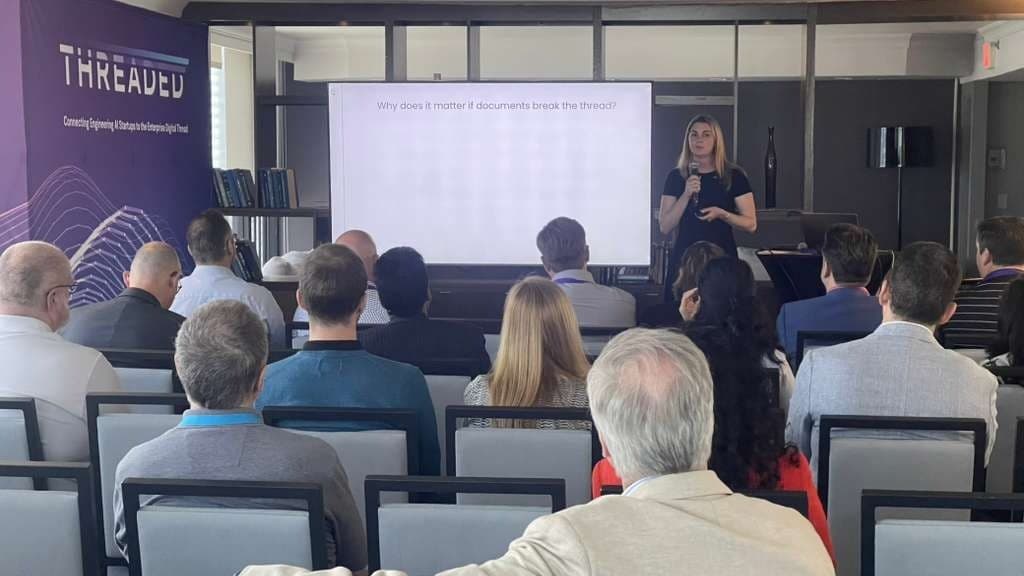
If you want the deeper dives, several of these vendors also presented at Threaded Miami and Warwick — their decks are available on the conferences page.
Read
CDFAM Barcelona was the cleanest, sharpest framing of where engineering software is going that I've seen this year. Not breathless. Not vendor-driven. Just engineers and founders looking at the gap between what tools do and what products now require, and arguing — with evidence — about how to close it.
If your PLM, CAD, or simulation roadmap doesn't have a serious answer for "what does AI-native look like in our stack," you are budgeting for the wrong decade.
Other 2026 conference reports: ProveIt! 2026 Key Learnings · Share PLM Summit 2026 · Siemens PLM Components 2026 · Threaded 2026
Want to listen instead of read? 56 DemystifyingPLM articles are available as audio.
Browse audio →Looking up PLM terminology? Browse the canonical reference.
PLM Glossary →Cite this article
Finocchiaro, Michael. “CDFAM Barcelona 2026 — Conference Report.” DemystifyingPLM, April 15, 2026, https://www.demystifyingplm.com/cdfam-barcelona-2026-conference-report
PLM industry analyst · 35+ years at IBM, HP, PTC, Dassault Systèmes
Firsthand knowledge of the evolution from early 3D modeling kernels to today's cloud-native platforms and agentic AI — the history, strategy, and future of PLM.