Key Takeaways
- 600 startups, 10 unicorns, $15.7B in VC — a parallel engineering software industry rivaling the Big Three combined
- Speed gains are orders of magnitude, not increments — entire workflow stages are disappearing
- Agent-native architecture is the new default design pattern, not a feature
- Data governance, not AI capability, is the actual bottleneck
- Technology success ≠ business success — 90% of these startups won't pass the $3–4M revenue mark
Short Answer
Threaded Warwick and Miami 2026 surfaced a $15.7B parallel ecosystem of ~600 AI-native engineering software startups that are shipping order-of-magnitude workflow compressions while incumbents stall — but data governance, not AI capability, is the actual blocker, and 90% of these startups won't survive to scale.
- Agent-native architecture is the dominant design pattern for new engineering software
- Workflow speed gains are 10×–100×, not 10–20%
- Data governance is the real bottleneck — broken since the 1990s
- Incumbents (Dassault, Siemens, PTC) are on the back foot with no major AI breakthroughs
- Business viability, not technology, determines which startups survive
Why it matters: If you run PLM strategy at an industrial company, the question is no longer whether to evaluate startups — it's how to evaluate them, knowing that 90% will fail and the 10% that survive may rewrite your toolchain.
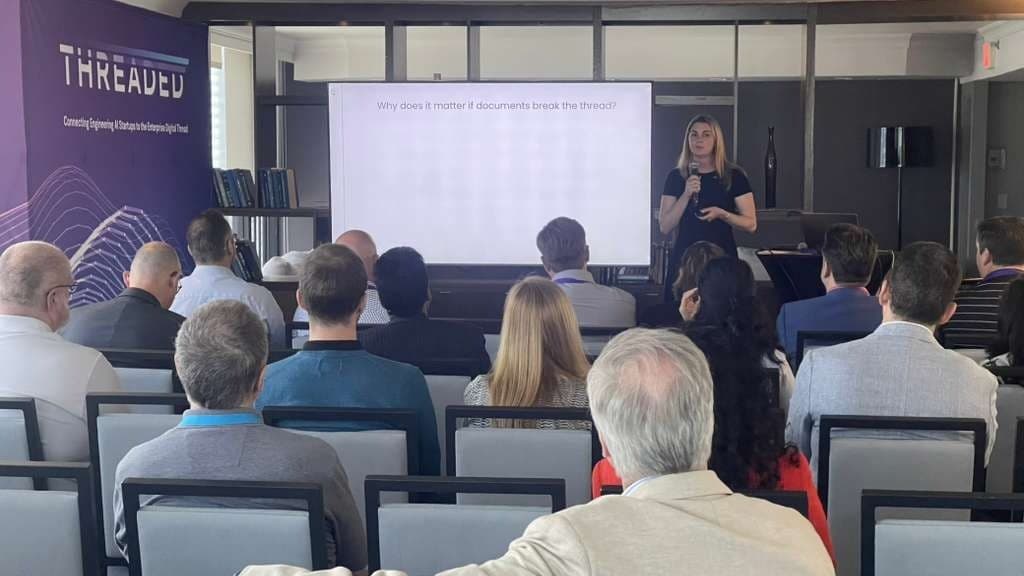
In April 2026, I attended back-to-back Threaded conferences — first in Warwick, UK (co-located with DEVELOP3D LIVE), then in Miami (co-located with Aras Corporation's ACE). Both were organized to connect the next generation of engineering software founders with the PLM, CAD, simulation, and manufacturing community.
What I saw was not a series of vendor pitches. It was a parallel engineering software industry — 600 startups across 45 countries, 10 unicorns, $15.7 billion in venture capital — building, in public, what the incumbents have failed to deliver.
The presentation decks from both events are available on the conferences page. What follows is the synthesis.
Workflow Compression, Not Incremental Improvement
The single sharpest signal from both events: speed gains are measured in orders of magnitude, not percentages.
| Vendor | Workflow | Before | After |
|---|---|---|---|
| Compute Maritime — NeuralShipper | Ship design cycle | 2–5 months | 1–2 days |
| Bench — Prism | STL → parametric CAD | 4 hours | 10 minutes |
| Productive Machines — SenseNC | CNC cycle time | baseline | −18 to −37% |
| Secondmind | Design exploration | baseline | 50% faster, 40% fewer prototypes |
These are not "AI features." Entire stages of the workflow are disappearing. When Compute Maritime's Shahroz Khan walks you through what it means to design, simulate, and optimize a vessel in days instead of months, he is not describing a faster tool. He is describing the elimination of the iteration loop that used to define naval architecture as a profession.
For the Compute Maritime conversation in depth, see aapl-e24 — Axial3D & Compute Maritime. For Productive Machines, aapl-e21.
The 95% Failure Rate in Physics AI
Andy Fine of the Fine Physics Consortium brought the most useful counter-balance of the conference. Citing a McKinsey survey, he noted that 95% of engineering companies exploring deep-learning physics AI have failed or continue failing.
The root cause, in his framing, is not the algorithms. It is domain knowledge — the kind data science alone cannot fabricate. He proposed a "Swiss Cheese Risk Model" with five filtering layers (data, physics, validation, domain, deployment) that each have to align before deep learning is the right tool.
His core line, which I wrote down twice:
"There's no substitute in any of this for domain knowledge."
(Andy is a co-guest on aapl-e28: Vinci — Physics × ChatGPT special edition.)
Agent Architecture as the Default Design Pattern
The most important architectural shift across both Threaded events: agent-native is becoming the default, not a feature added to existing products.
A non-exhaustive list of working systems shown:
- Bild — Meru — Multimodal AI understanding CAD revisions. 82% accuracy on change annotations, 60% reduction in engineering change order cycles. This is the kind of number that makes Engineering Change Management committees go quiet.
- OpenBOM — CAD File Agent — Intelligent automation for SolidWorks file handling and BOM-to-procurement workflows. (Conference deck linked from aapl-e05.)
- Trace.Space — AI-native requirements tool with a graph-based architecture enabling "two-click traceability." (aapl-e26.)
- TDengine — Reframes industrial data as feeds with AI anomaly detection rather than dashboards-as-the-product. (aapl-e13.)
- Violet Labs — A knowledge and orchestration layer providing permissioned AI access across requirements, CAD, PLM, MES, ERP, and simulation tools — via the Model Context Protocol (MCP).
Lucy Hoag from Violet Labs delivered the line that captured the design philosophy:
"If you don't like our BOM compare, you can build your own."
Read that twice. It's a direct refusal of the bundled-suite pattern that defined PLM for 30 years.
Data Governance: The Actual Bottleneck
The recurring theme across nearly every conversation at Threaded was that broken data infrastructure — not AI capability — is what blocks progress.
Lucy Hoag again:
"The way we build these products fundamentally hasn't really changed since the 90s."
Concrete data-readiness problems mentioned by speakers:
- 90–95% of CAD files still live on local desktops despite 15+ years of cloud computing
- PDM implementations fail over basic requirements like unique file naming
- Engineering data lacks AI-readiness — inconsistent naming, missing design intent, sparse metadata, no standardized GD&T
- Historical data often stored in PowerPoint, with source files long since deleted
This matches what Jeff Tao of TDengine argued from his side:
"Don't give me the data. Tell me what I should know."
The implication is structural: AI cannot retroactively fix data hygiene. It can only amplify whatever quality you start with. PLM teams that have been deferring data-cleanup work for a decade will pay for it in AI-readiness in 2026–2028.
The Business Valley of Death
Ralph Verrilli of Next Stage Advisors M&A gave the most sobering talk of either conference. His number:
"90% of those guys won't get past the three, four million dollar range."
Six hundred startups with remarkable technology, but lacking the sales, marketing, fundraising, and operational infrastructure to scale through the early-revenue valley.
Peter Schroer, founder of Aras, reinforced the same point from the acquirer's side: growth-at-all-costs strategies are now actively counter-productive. Profitable acquirers — and most acquirers in 2026 are profitable, not VC-fueled — demand clean books, audited financials, and disciplined cap tables. Many of the technically excellent startups in the room cannot pass that diligence today.
Expect heavy consolidation. The 10% that survive will likely set the operational pace of engineering software for the rest of the decade.
GPU and Quantum: Hardware-Software Co-Evolution
Rut Lineswala of BQP delivered the hardware-side argument I'll be repeating for months: only ~20% of available GPU compute is actually used in engineering simulation.
The reason is structural. Legacy solvers — Fluent, CFX, Star-CCM+ on the CFD side; HFSS, FECO, CST on the EM side — were designed for CPU architectures and have been ported to GPU rather than redesigned for it. GPU-native solvers, BQP among them, deliver 10× theoretical improvements because they treat the GPU as the substrate, not as an accelerator strapped to the side.
BQP is also developing quantum-ready architectures for deployment in the 2029–2030 window. The signal: the next decade of simulation performance gains will come from hardware-software co-design, not from incremental algorithmic tuning.
Seven Signals from April 2026
A compressed read of what these two events actually mean:
- The ecosystem is real and accelerating. $15.7B across 600 startups is parallel-industry scale.
- Dassault, PTC, and Siemens are on the back foot. No major AI breakthroughs from any of them this season.
- Agent-native architecture is now the default for new engineering software.
- Speed improvements are 10×–100×. Entire workflow stages are disappearing.
- Data governance is the bottleneck, not AI capability.
- Technology success ≠ business success. 90% will fail to scale.
- GPU and quantum hardware-software co-evolution is creating new performance tiers.
Vendors Worth Watching
From Threaded Miami — OpenBOM, Trace.Space, TDengine, Nullspace, CognaSIM, Fine Physics Consortium, Bild, BQP, Canvas Envision, Quarter20, Tech Soft 3D, Violet Labs, Aras (host), CoLab, Next Stage Advisors.
From Threaded Warwick — Threedy, Productive Machines, Compute Maritime, Bench, Bild, RD8, Elevating Patterns, NexCAD, Secondmind, Infinitive.
Decks from each presentation are available on the conferences page. Where a vendor was also a guest on the AI Across The Product Lifecycle podcast, the deck is linked directly from the episode.
Closing Quotes
From my own closing on Day 2 in Miami:
"The companies that do not adopt AI properly are going to be left behind very quickly."
And from a systems engineer named Matt McClean, after using Trace.Space:
"Two-click traceability — which spoils me, because I'm used to 10, 15, 20-click workflows."
The future, as I argued at the closing, won't be built by one vendor. It will be woven across an ecosystem — an ecosystem that, on the evidence of two weeks in Warwick and Miami, is already largely built.
Want to listen instead of read? 56 DemystifyingPLM articles are available as audio.
Browse audio →Looking up PLM terminology? Browse the canonical reference.
PLM Glossary →Cite this article
Finocchiaro, Michael. “The $15.7 Billion Shadow Ecosystem That's Rewriting Engineering Software.” DemystifyingPLM, March 10, 2026, https://www.demystifyingplm.com/threaded-2026-shadow-ecosystem-rewriting-engineering-software
PLM industry analyst · 35+ years at IBM, HP, PTC, Dassault Systèmes
Firsthand knowledge of the evolution from early 3D modeling kernels to today's cloud-native platforms and agentic AI — the history, strategy, and future of PLM.