Key Takeaways
- AI agents are moving from copilot to autonomous engineering co-worker — '50% of engineers will be AI agents'
- Hybrid modeling (B-rep + mesh + implicit + point cloud) is the new geometry baseline, not parametric-only
- Parasolid expanded large-assembly support by three orders of magnitude
- PLM market approaches $100B by 2027 — but only 6% of industrial customers have AI strategies vs 72% of vendors
- Siemens' $10B Altair acquisition is the structural play for an 'open tools' ecosystem
Short Answer
Siemens PLM Components 2026 framed the next decade of engineering geometry as hybrid (B-rep + mesh + implicit + point cloud) and agent-native, with Parasolid as the deterministic core, Altair as the open-tools expansion, and AI agents handling iteration while humans validate intent.
- Agentic AI is replacing copilots — autonomous workers managing complex engineering tasks
- Parasolid scaled large-assembly support by 3 orders of magnitude
- Hybrid kernels (B-rep + mesh + implicit + point cloud) are the new baseline
- Altair acquisition signals an 'open tools' strategy at the kernel layer
- 72% of vendors have AI strategies, only 6% of industrial customers do
Why it matters: If you depend on Parasolid, D-Cubed, or any Siemens kernel component — directly or via a CAD vendor — the architectural direction set at this conference determines what your toolchain can do in 2027–2030. Hybrid, agent-native, and 'open' are not marketing words here; they are roadmap commitments.
Siemens PLM Components 2026 was held at Downing College, Cambridge — a few hundred yards from where Ian Braid, Charles Lang, and Alan Grayer founded the geometry-kernel industry in the 1970s. The choice of venue was not accidental.
The conference brought together the Parasolid team, customers using Parasolid through every major CAD/CAE vendor, and a wave of AI-first startups now building on top of the kernel. The central question, asked in different ways across two days: as geometry representations multiply and AI agents enter the engineering loop, what role does Parasolid play in the next decade?
For a fuller index of the talks I covered with photos and individual LinkedIn posts, see my Fino Summaries and Photos thread.
1. The Era of Agentic AI and Digital Engineering Workforces
Andrew S. (Synera), Michael Bogomolny (InfinitForm), and Hugo Nordell (Encube) opened the AI track with a single-frame argument: the copilot era is ending. Agents are becoming autonomous workers that manage complex, multi-step engineering tasks under human oversight rather than per-step approval.
The line that landed hardest, repeated in two talks: "50% of engineers will be AI agents." Take it as a directional claim, not a forecast. The point is that the ratio of human-to-agent work in an engineering organization is being redrawn.
Concrete evidence from the talks:
- GPU-accelerated design enabling simulations that previously took hours to complete in half a second
- BMW and Airbus case studies showing design compression from weeks to minutes
- Autonomous variant generation and validation loops with humans only at intent and approval gates
Bogomolny made the InfinitForm case for generative design at scale — see also the aapl-e15 podcast with Nullspace and InfinitForm.
2. Human-Centered Manufacturing and the "Physical AI" Gap
Al Whatmough (Toolpath) and Stephen Graham (Hexagon Manufacturing Intelligence) balanced the AI optimism with a sober counter-thread.
Their argument: most factory automation addresses productivity gaps, not skill gaps. Trust and transparency are the actual currencies for adoption. AI tools should accelerate training of craftsmen, not replace them — and the cautionary example they kept returning to was AI-led refactoring of legacy code where specialized domain expertise quietly disappeared.
This is the same problem that shows up everywhere in PLM: the tribal knowledge stored in senior engineers' heads doesn't survive an AI-only handoff. If you optimize for speed and skip the trust transfer, you accumulate fragility.
3. Broadening Paradigms of Geometry Representation
The kernel-track talks were the structural heart of the conference.
Phil Nanson (Siemens Parasolid), Giampaolo Pagnutti (Siemens Altair), and Bradley Rothenberg + George Allen (nTop) made the case for hybrid modeling: seamless operations across B-rep, polygon mesh, implicit, and point cloud representations in a single workflow.
Why this matters concretely:
- Implicit geometry is the only practical way to handle heat exchangers, lattice structures, and metamaterial designs at scale. nTop has been the loudest voice here for years; the conference confirmed Siemens is treating implicit as a first-class representation, not a curiosity.
- Mesh-native workflows for AI-generated geometry, where the AI produces a mesh and the system reasons about it without forcing a B-rep round-trip
- Point cloud integration for reality-capture inputs feeding directly into design
The headline number from Phil Nanson's talk: Parasolid expanded large-assembly support by three orders of magnitude. That is not an incremental release. That is a structural change in what a single kernel session can hold.
4. Industry-Specific Transformations
Three talks showed what the kernel + AI combination actually produces in production:
- Construction — Chun Qing Li (KREODx) showed design-to-manufacturing data flowing on-site, providing financial certainty by collapsing the design-to-build feedback loop.
- Motorsport — Daniel Watkins (Red Bull Racing) demonstrated real-time CFD visualization inside the CAD environment. The Red Bull team's ability to iterate aerodynamic geometry against simulation in the design tool is exactly the "AI-native engineering" pattern CDFAM Barcelona had argued for.
- Medical — Bart Van Der Schueren (Materialise) showed AI image segmentation feeding personalized implants for 50,000+ patients annually. This is operational scale, not a pilot.
5. Market Outlook and Strategic "Openness"
Tom Gill (CIMdata) and Robert Haubrock (Siemens) closed with the structural numbers:
- PLM market approaching $100 billion by 2027
- 72% of software providers have AI strategies; only 6% of industrial customers do
- Siemens' $10 billion Altair acquisition as the structural play for an open-tools ecosystem
- High-quality documentation as a critical input for AI capability comprehension — without good docs, AI agents can't reason about your tools
The 72%/6% gap is the most actionable number from the entire conference. It says vendor capability is racing ahead of customer readiness, and the bottleneck is organizational — documentation, data quality, training, governance — not technological.
My Talk: From Buzz to Backbone
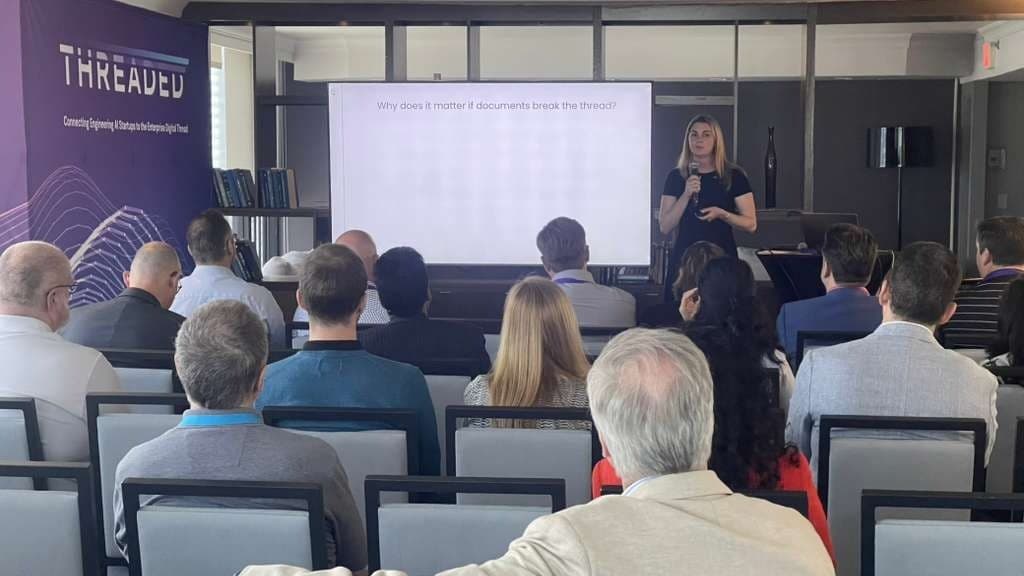
I gave a talk on Day 1 framing where AI sits in the PLM stack — somewhere between marketing buzz and load-bearing backbone — and what has to be true about your data, processes, and tools for it to actually shift load.
The TL;DR of the argument: AI is not a feature you add. It's a structural change in how engineering work flows, and Parasolid (and the rest of the PLM Components portfolio) is one of the few places in the stack where deterministic geometry and probabilistic AI can be married safely.
Apologies
I had to catch the Eurostar before the closing sessions and missed talks by Mark Driscoll, Olexiy Kilyakov, Jonathan Girroir, and Kostadin Vrantzaliev. If any of you are reading this — please send slides or a recording and I'll add a follow-up post.
Read
Siemens PLM Components 2026 was the most kernel-serious conference I've attended in years. The 2030 vision that emerged: closed-loop ecosystems where manufacturing data feeds back to design, where AI agents function as expert assistants to human craftspeople rather than replacements, and where the geometry kernel is the deterministic core that keeps the whole probabilistic system honest.
Cambridge, fittingly, is still the right place to think about this.
Want to listen instead of read? 56 DemystifyingPLM articles are available as audio.
Browse audio →Looking up PLM terminology? Browse the canonical reference.
PLM Glossary →Cite this article
Finocchiaro, Michael. “Siemens PLM Components 2026 — Parasolid: One Ring to Rule Them All?.” DemystifyingPLM, April 20, 2026, https://www.demystifyingplm.com/siemens-plm-components-2026-conference-report
PLM industry analyst · 35+ years at IBM, HP, PTC, Dassault Systèmes
Firsthand knowledge of the evolution from early 3D modeling kernels to today's cloud-native platforms and agentic AI — the history, strategy, and future of PLM.