Key Takeaways
- The eBOM (engineering BOM) is the product as designed — function-grouped, hierarchical, owned by engineering inside PLM.
- The mBOM (manufacturing BOM) is the product as built — process-grouped, sequenced for assembly, owned by manufacturing engineering and consumed by ERP and MES.
- The two are not different views of the same data — they are different documents with different structures, different parents, and different lifecycles.
- The translation between them is process planning: deciding work centers, routings, phantom assemblies, and the sequence in which physical parts come together on the line.
- MES exists in the gap because neither PLM nor ERP knows the shop-floor sequence — PLM stops at design intent, ERP stops at the work order, MES executes the routing the mBOM defines.
Short Answer
The eBOM (engineering BOM) is the structured list of parts and assemblies that defines what the product is, organized the way engineering thinks — by function and design intent. The mBOM (manufacturing BOM) is the structured list that defines how the product is built, organized the way the shop floor builds it — by assembly sequence, work center, and process step. They are not different views of the same data; they are different documents with different parents, owned by different organizations, and reconciled by a translation step called process planning. PLM owns the eBOM. ERP and MES consume the mBOM. The gap between them is where MES exists.
- eBOM = product as designed, organized by function. mBOM = product as built, organized by assembly sequence.
- The two BOMs are structurally different documents, not different views of one document.
- Process planning is the translation step that turns an eBOM into an mBOM.
- PLM owns the eBOM; ERP owns the procurement view of the mBOM; MES executes the routing the mBOM implies.
- Pretending one BOM can serve both engineering and manufacturing is one of the more expensive PLM mistakes.
Why it matters: The eBOM-to-mBOM translation is where most enterprise PLM-MES-ERP integrations either succeed or quietly fail. Get it right and a change in engineering propagates cleanly through process planning, work orders, and shop-floor routings with full traceability. Get it wrong and manufacturing maintains a parallel BOM in spreadsheets, engineering changes never reach the line, and the as-built configuration of any given unit becomes a forensic exercise across three disconnected systems.
The One-Sentence Answer
The EBOM is the product as engineering designed it. The MBOM is the product as manufacturing builds it. They are different documents with different structures, owned by different organizations, and the translation between them is the work that MES exists to execute.
What the EBOM Is
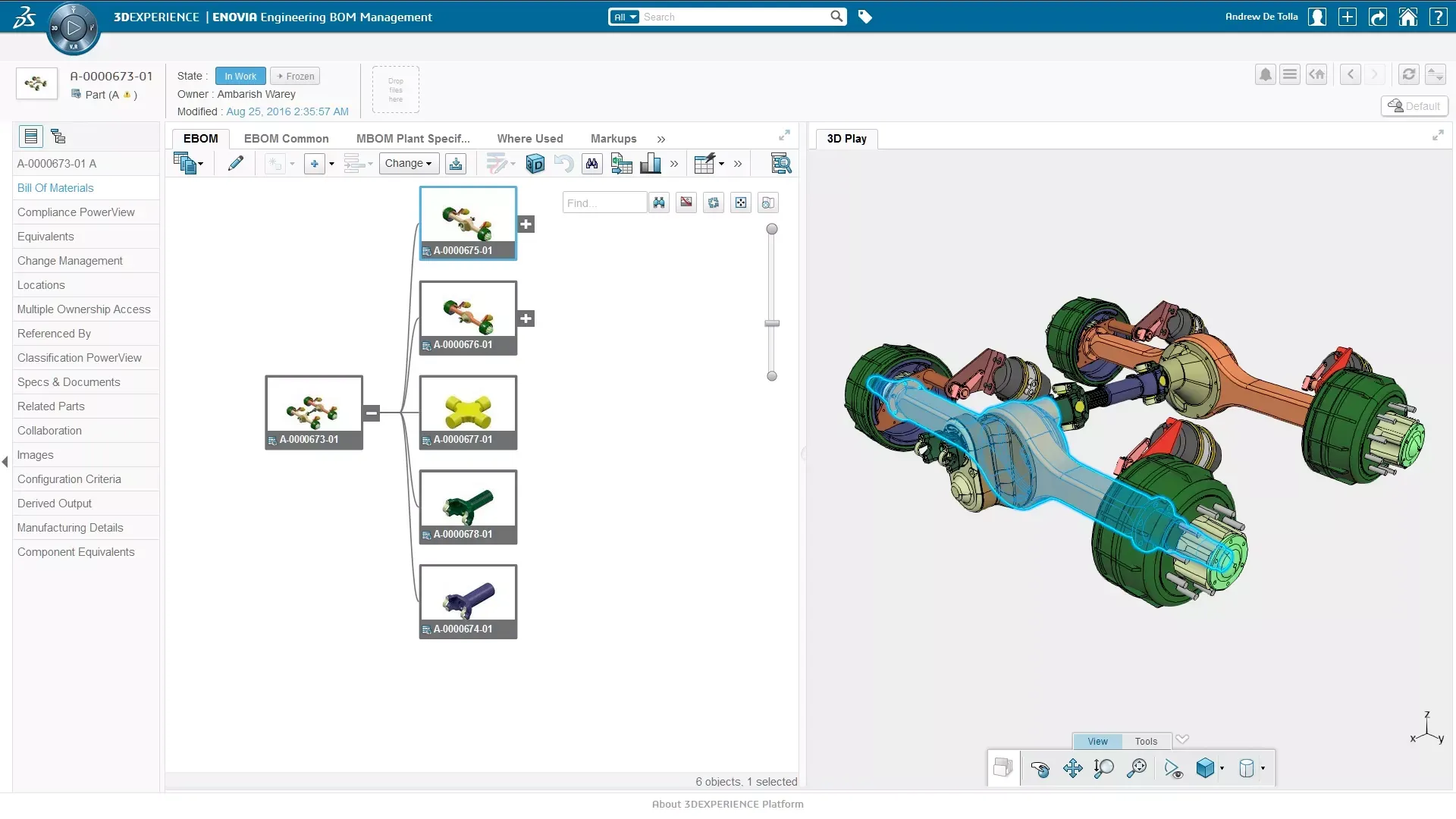
The Engineering Bill of Materials (eBOM) is the structured list of parts and assemblies that defines what a product is, organized the way engineering thinks. Engineering thinks in functions and subsystems: the braking system contains the master cylinder, the calipers, the rotors, the lines, the pads, the pedal assembly, regardless of which of those parts gets installed at which station on which day. The EBOM groups them together because functionally they belong together. It is hierarchical in the way the design is hierarchical — assembly contains subassembly contains part — and it carries the design intent, the geometry references, the material specifications, the controlled revisions, and the change history. The EBOM lives in PLM and is owned by engineering.
What the MBOM Is
The Manufacturing Bill of Materials (mBOM) is the structured list of parts, subassemblies, kits, consumables, and process references that defines how the product is built. Manufacturing engineering authors it from the EBOM, but it is restructured for the line. The dashboard wire harness might be installed at station 12 before the dashboard itself shows up at station 18 — the MBOM separates them even though engineering's EBOM treats the harness as part of the dashboard subassembly. A subassembly that engineering shows as one part is sometimes built on the line as three kits assembled at three stations, and the MBOM exposes those three kits as phantom assemblies that exist only in the build process. The MBOM carries scrap factors, routing references, work-center identifiers, and the process steps that the line actually performs. It is consumed by ERP for procurement planning and by MES for shop-floor execution.
The Actual Difference
The technical answer is that EBOM and MBOM contain mostly the same parts in different groupings. The honest answer is that they are answering different questions, and that is why the gap between them is non-trivial. Engineering's question is what is this product? — and the answer is structured by function so that a change to the braking system is one navigable subtree. Manufacturing's question is how do we build it? — and the answer is structured by sequence so that the operator at station 12 is looking at exactly the parts that get installed at station 12. The same physical product yields two different documents because the two organizations are looking at the same reality through different decompositions.
The mistake — the one this comparison is built to expose — is treating that as a representation problem that better tooling can solve. It is not. The two BOMs are structurally different because the two organizations are. Modern PLM platforms acknowledge this by carrying both explicitly, with documented translation rules between them, rather than pretending one can substitute for the other. The vendors that promise a single unified BOM are usually selling something that, at rollout, requires either engineering to learn process planning or manufacturing to abandon the way they actually build. Both options fail predictably.
Side-by-Side
| Dimension | EBOM | MBOM |
|---|---|---|
| Question it answers | What is this product? | How do we build it? |
| Organizing principle | Function and design intent | Assembly sequence and process step |
| Owner | Engineering | Manufacturing engineering |
| System of record | PLM | PLM (modern) or MES/ERP-adjacent (legacy) |
| Hierarchy reflects | Design decomposition | Build decomposition |
| Carries | Geometry refs, material specs, controlled revisions, ECO history | Routings, work centers, phantom assemblies, scrap factors, kits |
| Consumed by | Downstream BOM views (MBOM, sBOM), service, regulatory | ERP for procurement, MES for execution |
| Lifecycle trigger | Design release, ECO | Process plan release, work-order open |
| Typical authoring tool | PLM EBOM manager | PLM MPM module, dedicated MES tool, or (legacy) spreadsheets |
Where MES Lives in the Gap
Neither PLM nor ERP knows the shop-floor sequence. PLM stops at design intent — what the product is and how it changes. ERP stops at the work order — what to make, when, with what materials, against what financial transaction. The actual execution on the line — which station, which operator, which torque spec, which inspection, which serialization, with which traceability — is what MES (Manufacturing Execution System) is built to handle, and it executes against the routing the mBOM defines. For a direct comparison of MES against PLM and where their responsibilities diverge, see MES vs PLM.
This is the architectural answer to why MES is a separate system rather than a feature of PLM or a module of ERP. The EBOM-to-MBOM translation produces the routing; ERP schedules a work order against that routing; MES executes the routing operation by operation, capturing the as-built configuration as it goes. Strip out MES and the routing becomes a static document with no execution layer underneath it. Strip out the MBOM and MES has nothing to execute against. The three layers — design intent in PLM, financial transaction in ERP, physical execution in MES — interlock through the BOM translation and the routing it implies.
The Three-System Architecture
The correct enterprise architecture explicitly models all three BOMs and the translation steps between them:
- PLM hosts the EBOM — the upstream system of record, owned by engineering, modified through ECO governance.
- Manufacturing engineering translates EBOM → MBOM — this is process planning, where engineering changes are mapped to shop-floor realities: which assembly sequence, which work center, which kits, which routings.
- ERP consumes the MBOM — for procurement planning, materials management, cost rollup, and work-order generation against the routing.
- MES executes the routing — operation by operation, capturing actual vs planned deviations, labor hours, serialization, and the as-built configuration of every unit.
When this three-layer model is working, an engineering change takes a predictable path: EBOM change (ECO) → MBOM change (process plan update) → new work orders (ERP) → shop-floor execution (MES), with full traceability at every step.
When this model breaks — which happens in roughly 60% of enterprise deployments — manufacturing maintains a parallel MBOM in spreadsheets, ERP is working from one version of the MBOM, MES is executing against another, and nobody knows which version shipped in which unit. This is when warranty and recall teams spend weeks reconstructing the as-built configuration from physical units and paperwork rather than querying a system.
When This Matters in Practice
It matters at every engineering change. An ECO modifies the EBOM. If the EBOM-to-MBOM translation is documented and live, the change propagates through process planning, into the MBOM, into the routing, into the next work order MES executes — and the as-built record of every unit produced after the effectivity date reflects the change. If it is not, the change stops at the engineering door, manufacturing builds against a stale MBOM, and the as-shipped configuration of every unit produced thereafter diverges from the as-designed configuration in ways that surface only at warranty, recall, or audit.
It also matters during platform selection. The expensive failure mode is buying PLM on a promise of a single unified BOM for the whole enterprise, then discovering at rollout that manufacturing has quietly maintained a parallel MBOM in Excel for the entire program because the unified BOM does not match how the line actually runs. The correct conversation during selection is not can we have one BOM — it is how does this platform model the EBOM-to-MBOM translation, and how does that translation flow into MES?
Where to Go Next
- The pillar: What is PLM? — the canonical answer for what PLM is, what it owns, and where it stops.
- Related comparison: PLM vs PDM — the upstream boundary question, before BOM scope even comes up.
- Glossary: EBOM, MBOM, BOM.
- Vendor lineage: How PTC evolved Windchill from Pro/INTRALINK — how the BOM-management story actually evolved inside one major platform.
Want to listen instead of read? 56 DemystifyingPLM articles are available as audio.
Browse audio →Looking up PLM terminology? Browse the canonical reference.
PLM Glossary →Cite this article
Finocchiaro, Michael. “EBOM vs MBOM: What's the Difference, and Why MES Lives in the Gap.” DemystifyingPLM, January 18, 2023, https://www.demystifyingplm.com/ebom-vs-mbom
PLM industry analyst · 35+ years at IBM, HP, PTC, Dassault Systèmes
Firsthand knowledge of the evolution from early 3D modeling kernels to today's cloud-native platforms and agentic AI — the history, strategy, and future of PLM.