Key Takeaways
- PDM manages CAD files and engineering documents — versioning, check-in/check-out, assembly structure, access control. It stops at the engineering door.
- PLM extends that governance across the full product lifecycle: change, configuration, requirements, supplier, regulatory, service. PDM is a subset of PLM.
- The real difference is ambition, not features — PDM has no goals outside engineering; PLM has explicit lifecycle goals that often get overruled at the seams by ERP, MES, and CRM.
- Buying PLM-priced software for a PDM-shaped problem is one of the more expensive mistakes in enterprise engineering IT.
- Most enterprise PLM systems include a PDM layer underneath — the choice is rarely either/or once you exceed the PDM scope ceiling.
Short Answer
PDM (Product Data Management) manages CAD files and engineering documents — versioning, check-in/check-out, basic assembly structure. PLM (Product Lifecycle Management) is the broader category that extends those primitives across the full lifecycle: change management, configuration management, requirements, supplier collaboration, regulatory compliance, and connection to manufacturing and service. PDM is a subset of PLM. Most enterprise PLM systems include a PDM layer underneath.
- PDM has no ambitions outside engineering; PLM extends across the lifecycle.
- The boundary is organizational ambition more than technical capability.
- PDM is the right answer when the problem is CAD vaulting and check-in/check-out.
- PLM is the right answer when the problem is governed change, configuration, and lifecycle state.
- Most enterprise PLM systems ship with PDM capability — buying both is rarely the right answer.
Why it matters: Knowing the boundary matters during a buying decision. Buying PLM-priced software to solve a PDM-shaped problem is one of the more expensive mistakes in enterprise engineering IT — and the reverse, treating a PLM-shaped problem with a PDM-only tool, is how brownfield manufacturers end up with the orphaned spreadsheets and ungoverned change processes that eventually force the conversation that got you to this page.
The One-Sentence Answer
PDM manages CAD files. PLM governs the full product lifecycle. PDM is a subset of PLM, and the boundary is organizational ambition more than technical capability.
What PDM Is
Product Data Management is the discipline — and the software category — that grew up underneath CAD when engineering organizations shifted from drawings on paper to files on disk. Once there were files, somebody had to manage them: version them, control who could edit them, lock them when checked out, reassemble them into something that resembled a product. PDM was that somebody. Versioning, check-in/check-out, basic multi-level assembly structure, and access control are the four primitives, and a serious PDM tool delivers them well across at least one CAD ecosystem.
PDM has no ambitions outside engineering. It does not govern change beyond informal review, reconcile eBOM against mBOM, track requirements, route ECOs through approval gates, or recover the as-shipped configuration of a specific unit. It vaults files, controls revisions, stops there. That is not a criticism — it is the design intent. PDM solves a real, bounded problem.
What PLM Is
Product Lifecycle Management is the broader category that extends the same primitives — structured product data, versioned revisions, controlled access — across the full life of the product. PLM is the system of record for the product itself: the bill of materials in its engineering, manufacturing, and service variants; the change history; the valid configurations for each market; the lifecycle state of every controlled object from in work through released to obsolete. PLM is engineering-led — it owns the design intent — and sits next to ERP (financial transactions) and MES (shop-floor execution), not in place of them. The longer treatment is in What is PLM?.
The thing PLM does that PDM does not is govern change. An engineering change in PLM moves through a documented, audited three-stage flow functionally identical across every vendor: an Engineering Change Request raises the problem, an Engineering Change Notice describes the fix and routes it for review, and an Engineering Change Order authorizes implementation against a specific effectivity. Every gate has reviewers, sign-offs, and an audit trail. Without that flow, every downstream system — manufacturing, service, regulatory — is operating on assumptions.
The Actual Difference
The technical answer is that PLM is a superset of PDM. The honest answer is that the difference is one of organizational ambition more than features. PDM stops at the engineering door because PDM never had ambitions past it. PLM extends across the lifecycle because PLM is positioned to — but in practice almost always gets overruled at the seams by neighboring systems that already own those domains: ERP for operations, MES for the shop floor, CRM for the customer, MRO for service. Where the org chart draws those lines is where PLM's reach actually ends, and that line is rarely where the vendor's reference architecture says it should be.
This is why the comparison shows up in the wrong shape. RFPs ask "do we need PDM or PLM?" as if it were a feature checklist. The actual question is: how far past engineering does the organization need governed product data to extend, and is the rest of the company prepared to let it? A team with three CAD seats and an aspiration to "modernize their data" needs PDM. A company with cross-functional change exposure, regulatory obligations, and a service business that has to recover ten-year-old configurations needs PLM — and the alignment to make those lifecycle ambitions stick where ERP and MES are also planted.
Side-by-Side
| Dimension | PDM | PLM |
|---|---|---|
| Primary scope | CAD files and engineering documents | Full product lifecycle: design through end of life |
| Core primitives | Versioning, check-in/check-out, assembly structure, access control | All of PDM, plus governed change, Configuration Management, requirements, lifecycle state |
| BOM handling | Basic engineering assembly structure (EBOM) | EBOM, MBOM, sBOM, plus the bridges between them |
| Change Management | Informal — revision-level only | Governed three-stage ECR / ECN / ECO with approval gates and effectivity |
| Configuration Management | Not addressed | Variants, options, effectivity, as-shipped configuration recovery |
| Requirements | Not addressed | Anchored alongside parts with traceability to verification |
| Cross-functional reach | Engineering only | Engineering, manufacturing, supplier, quality, service, regulatory |
| Typical buyer | Engineering manager | CIO, VP Engineering, sometimes Quality or Operations |
| Implementation timeline | Weeks to a few months | Six to eighteen months for an enterprise rollout |
| Common standalone tools | SolidWorks PDM, Autodesk Vault, PTC Pro/INTRALINK | Dassault 3DEXPERIENCE / ENOVIA, Siemens Teamcenter, PTC Windchill, Aras Innovator |
When to Use Which
Use PDM when the problem is bounded inside engineering: stop file overwrites, control which revision is current, manage a multi-CAD assembly, hand a clean release package to manufacturing as a deliverable rather than a continuous data flow. PDM ships fast, is cheap to operate, and solves the problem completely if it stays inside the engineering door.
Use PLM when the problem extends past engineering: changes have to flow through governed gates with auditable signatures, configurations have to be recoverable for service or recall, manufacturing and supplier data have to stay consistent with engineering data over the product's life, or the company has regulatory obligations (medical-device QMS, aerospace certification, EU Digital Product Passport, CSRD) demanding auditable product records. Once any of those is true, PDM is structurally insufficient — not because PDM tools are weak, but because the scope is wrong.
The trap to avoid is buying PLM for a PDM-shaped problem because the sales process showed everything PLM could theoretically do. The implementation reveals that "everything PLM could do" requires cross-functional process change nobody agreed to fund, and the project descends into PDM-shaped use of an enterprise platform — paying enterprise prices for vault-and-checkout. The reverse trap is slower: a company with PLM-shaped problems treats them with a PDM-only tool for years, accumulating orphaned spreadsheets and ungoverned changes that surface only at warranty claim, recall, or audit. The boundary is the conversation worth having before signing.
Real-World Trade-offs: Cost, Timeline, and Governance
The abstract answer is "buy what your problem scope requires." The concrete answer requires understanding the trade-offs:
PDM Deployment Model
- Timeline: 6–12 weeks to deploy and train a single CAD ecosystem.
- Licensing: 150k per year for a 10–20 person engineering team.
- Internal effort: Moderate — mostly around CAD discipline and file-naming standards.
- ROI: Fast. File overwrites stop immediately; developers know which version is current without asking.
- Risk: Low, but only if the problem stays inside engineering. The moment a service question or regulatory audit needs to trace which version shipped — and PDM has no answer — the business learns why it underbought.
PLM Deployment Model
- Timeline: 6–18 months for enterprise rollout (data migration, integration, Change Management are the time sinks).
- Licensing: 500k+ per year for 50+ users across engineering, manufacturing, quality, and supplier collaboration.
- Internal effort: High — cross-functional process redesign, governance standards, ERP/MES integration, training for non-engineers.
- ROI: Slower to measure, but massive when change impact can be calculated instead of guessed, recall scope can be audited instead of forensic, and the org chart agrees on what "the source of truth" means.
- Risk: Moderate to high. PLM fails spectacularly when the org chart doesn't align on governance; a company can deploy PLM and use it as an expensive PDM for years.
The Decision Framework
Ask these questions in order:
- Are your engineers losing work to file overwrites? → PDM solves this.
- Do you need to recover which version of which part shipped in which product on which date for service or recall? → PLM required.
- Are you in a regulated industry (medical, aerospace, automotive, chemical) with compliance obligations for product records? → PLM required.
- Does your company sell the same product in multiple configurations with market-specific variants? → PLM required for configuration tracking.
- Do engineering changes have to flow through an audited gate before manufacturing can build them? → PLM required.
If you answered yes to question 1 only, PDM is your answer. If you answered yes to any of questions 2–5, PDM is insufficient and PLM is the right investment.
The Enterprise Reality: PDM ≠ PLM at Scale
Large manufacturers often deploy both PDM and PLM, but not as separate products — rather, PLM includes an embedded PDM layer that engineers use for day-to-day CAD management. This hybrid model looks like:
- SolidWorks + SolidWorks PDM for local CAD data versioning (the engineer's daily tool).
- Teamcenter or Windchill as the enterprise system of truth, mirroring the released data from PDM.
- ERP integration from Teamcenter/Windchill to SAP or Oracle, NOT directly from SolidWorks PDM.
This three-tier architecture exists because standalone PDM tools never had the scope or API surface to be the single source of truth across the enterprise. For a detailed look at what Autodesk Vault specifically provides — and where it hits its ceiling — see PDM vs Vault: When a Standalone Vault Is Enough. The moment a second system of record (ERP, MES, CRM) enters the picture, PDM becomes a local tool, and PLM becomes the enterprise backbone.
Key takeaway: Buying a standalone PDM tool "to avoid the cost of PLM" usually fails because PLM is solving a different problem — not better PDM, but enterprise-wide data governance. The vendors make this easy to confuse because they market "PDM capabilities" inside PLM, leading IT teams to think they're choosing a PDM versus PLM feature set when they're actually choosing a local tool versus an enterprise architecture.
Lessons from Vendor History
Each of the Big Three PLM vendors started with a PDM tool and eventually had to escape it:
- PTC: Pro/INTRALINK was a Creo-only PDM tool. Windchill was built as an enterprise wrapper around it, eventually absorbing the PDM layer entirely. Today, Windchill PDMLink exposes the same data governance PLM uses.
- Siemens: Teamcenter PDM started as the vault layer. Full Teamcenter expanded it to govern change, configuration, and supplier data. Siemens now markets Teamcenter PDM as a subset for teams that want vaulting without full PLM governance.
- Dassault Systèmes: ENOVIA's history is the most dramatic — ENOVIA VPM V5 was a tightly-coupled PLM tool that shipped with CATIA V5, but it couldn't scale to arbitrary product relationships. The acquisition of MatrixOne in 2006 was explicitly to escape that architecture. ENOVIA V6 and 3DEXPERIENCE inherited MatrixOne's relationship-based model, which is why Dassault could serve semiconductor, apparel, and consumer-goods buyers alongside aerospace.
This vendor history is not marketing trivia — it's a pattern: PDM tools are eventually insufficient, and the companies that survived did so by building an enterprise governance layer on top.
Where to Go Next
- The pillar: What is PLM? — the canonical answer for what PLM is, what it isn't, and where it's going.
- Glossary: PDM and PLM — short canonical definitions with related terms.
- History: PDM History 101 — Part 6: Toward PLM and the Digital Thread — how the PDM-to-PLM evolution happened.
- Vendor lineage: How PTC evolved Windchill from Pro/INTRALINK — the PDM-to-PLM arc inside one vendor.
- Related comparison: How Siemens Built Teamcenter — the Siemens history from PDM to enterprise PLM.
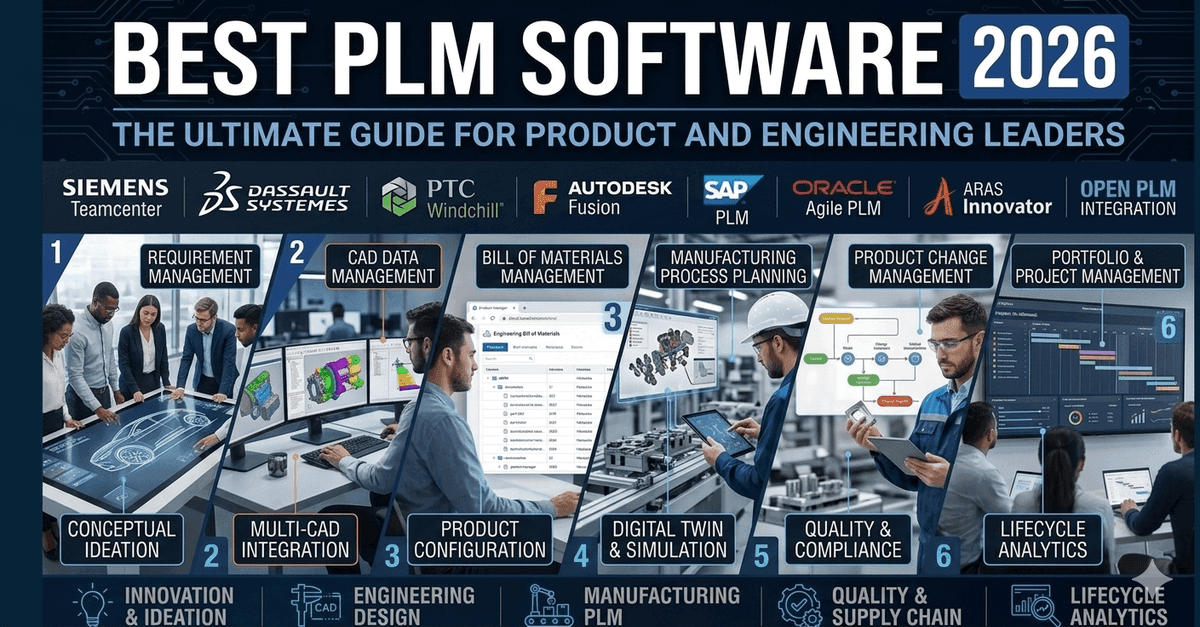
- Vendor selection — Best PLM Software 2026 — independent guide to PLM vendor selection with ranked analysis
Want to listen instead of read? 56 DemystifyingPLM articles are available as audio.
Browse audio →Looking up PLM terminology? Browse the canonical reference.
PLM Glossary →Cite this article
Finocchiaro, Michael. “PLM vs PDM: What's the Difference, and Which One Do You Actually Need?.” DemystifyingPLM, December 10, 2022, https://www.demystifyingplm.com/plm-vs-pdm
PLM industry analyst · 35+ years at IBM, HP, PTC, Dassault Systèmes
Firsthand knowledge of the evolution from early 3D modeling kernels to today's cloud-native platforms and agentic AI — the history, strategy, and future of PLM.