Show all chapters ▸Hide chapters ▾
- 1Best CAD Software 2026: The Engineer's Honest Guide
- 2Best PLM Software 2026: Q1 Edition (Archived)
- 3Best CAM Software 2026: The Machinist's Independent Guide
- 4Best MES Software 2026: Q1 Edition (Archived)
- 5Best Simulation Software 2026: Incumbents, Specialists, and the New Constellation
- 6Best MES Software 2026: The Manufacturer's Independent Guide
- 7Best PLM Software 2026: The Independent Buyer's Guide
- 8Best Operations & Asset Management Software 2026: The CIO's Independent Buyer's Guide
- 9Best BIM Software 2026: The Independent Buyer's Guide for AEC and Owner Organizations
- 10Best IIoT Platforms 2026: The Manufacturer's Independent Buyer's Guide
- 11Best SCM Software 2026: The Supply Chain Independent Buyer's Guide
Key Takeaways
- Enterprise PLM buyers should spend 80% of evaluation time on implementation partner quality, not platform features
- Cloud PLM is not a downgrade from enterprise PLM — it is a different product for a different buyer profile
- The midmarket gap (50–200 users, $1M–$10M revenue) is where Arena, Propel, and Duro are most competitive
- Every enterprise PLM vendor has won and lost programs in every industry — reference customers are marketing, not proof of fit
- No PLM implementation project ever completed on time and under budget on the first attempt; set realistic expectations
Short Answer
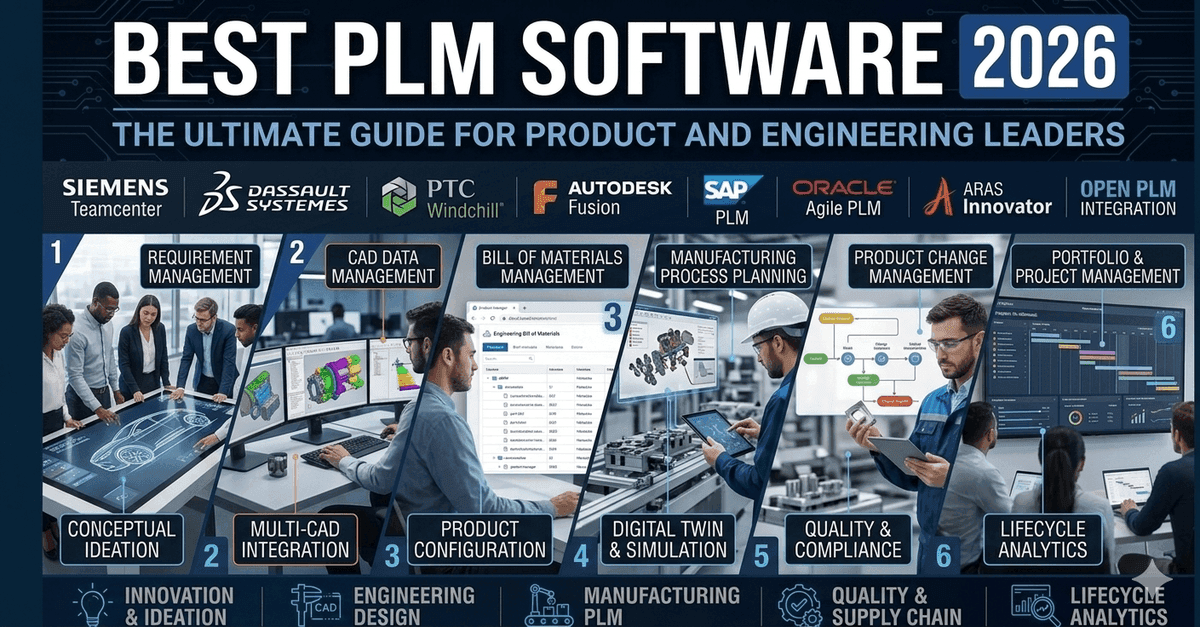
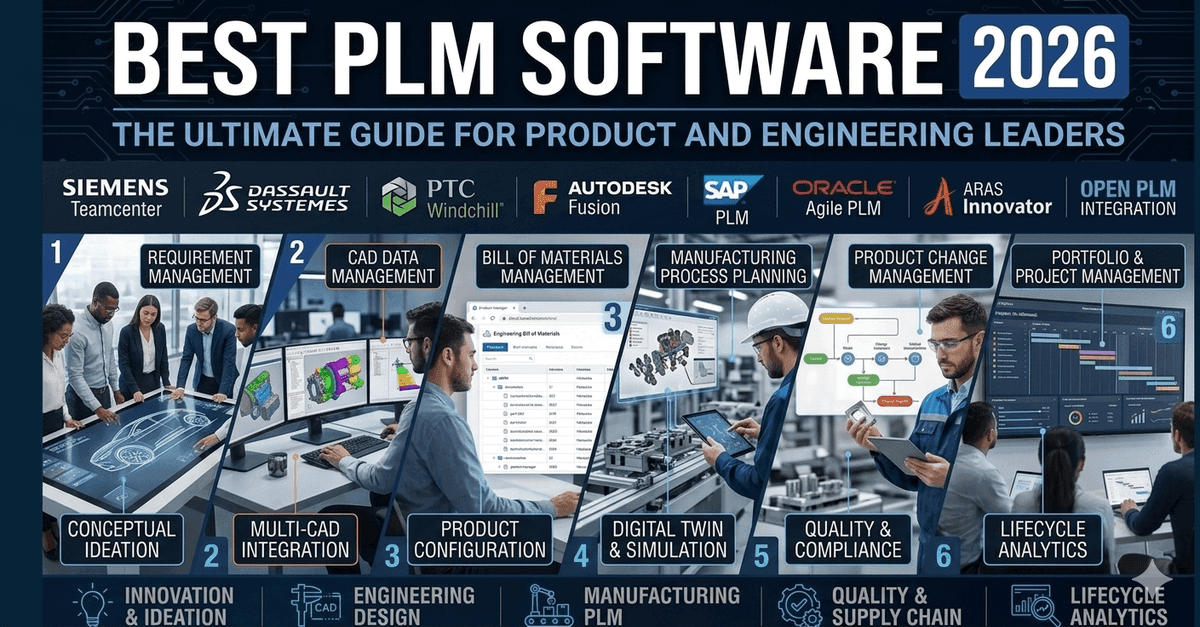
The best PLM software in 2026 depends on your scale and CAD environment. For enterprise automotive or aerospace programs with Siemens NX: Teamcenter. For enterprise industrial or medical with PTC Creo: Windchill. For CATIA-centric aerospace programs: 3DEXPERIENCE. For regulated industries needing maximum configurability: Aras Innovator. For cloud-first midmarket: Arena (PTC). For hardware startups and fast-growing product companies: Propel or Duro.
- Enterprise PLM (Teamcenter, Windchill, 3DEXPERIENCE, Aras) is for 50+ user programs with complex BOM and change management requirements
- Cloud PLM (Arena, Propel, Duro) is for midmarket companies wanting working PLM in weeks, not months
- CAD ecosystem is the dominant selection factor for enterprise PLM — pick the platform that owns your CAD vendor's native format
- No single PLM platform is best across all categories — this guide matches each platform to what it actually wins
- Total cost of ownership over 5 years ranges from $200K (small cloud PLM) to $10M+ (large enterprise on-premise)
- The "best" label is a function of fit, not features — the highest-featured platform is often the worst choice for a given program
Best PLM Software 2026: The Independent Buyer's Guide
Q2 2026 Edition — updated June 2026 with the complete VAULT framework, 30+ vendor scorecard, full AI-native PLM analysis, and industry-specific recommendations. The Q1 2026 archived edition is also available.
This post presents the key findings from the ThreadMoat PLM Buyer's Guide 2026. For the full report including all vendor scorecards and the complete VAULT scorecard matrix across 30+ vendors, visit threadmoat.com.
There is no universal "best PLM software" in 2026. There is best-for-your-situation, and that situation is now defined by five variables rather than four: organization size, CAD ecosystem, industry, deployment preference — and, increasingly, architectural posture. The first four are old questions with familiar answers. The fifth is the question this report exists to answer.
The PLM market is reorganizing around a structural shift that most analyst coverage still misses. Enterprise PLM platforms — Teamcenter, Windchill, ENOVIA 3DEXPERIENCE, Aras, SAP PLM, CONTACT Elements — were built as monolithic systems that aspire to own every layer of product data: the CAD vault, the bill of materials, the change workflow, the integration to downstream systems, and now the AI layer. A new generation of vendors has decided that no single platform should own all five — and is rebuilding each layer as a specialized, composable component.
This report introduces the VAULT Framework — a five-layer architectural lens for evaluating PLM platforms:
- V — Vault: Design Data Management (CAD geometry, requirements, simulation, document control)
- A — Authority: BOM and Configuration Management (eBOM, mBOM, sBOM, 150% BOMs, variants)
- U — Updates: Change and Lifecycle Governance (ECR/ECN/CO, release, effectivity, approvals)
- L — Linkage: Digital Thread and Cross-System Integration (ERP, MES, QMS, supplier, service)
- T — Thinking: AI and Intelligence (semantic search, impact analysis, document reasoning, knowledge graph)
The report evaluates 30+ vendors across this framework, scores each on Strategic Disruption Potential (SDP), and organizes the market into five architectural categories: Enterprise PLM Platforms, Cloud-Native Midmarket PLM, AI-Native PLM, Specialized Layer Owners, and Industry-Specialist PLM.
The headline finding: the most consequential PLM decisions in 2026 are not about platform features. They are about how many of the five VAULT layers a single vendor should own — and which layers belong to specialized players.
Scope and Categorization
What This Report Covers
This report covers the discrete manufacturing and retail PLM market. The vendors evaluated build platforms for product organizations that design, govern, and release distinct physical products — automotive, aerospace and defense, industrial equipment, medical devices, electronics, hardware startups, apparel, footwear, and consumer goods.
What This Report Does Not Cover
This report deliberately excludes the process industries asset lifecycle platforms — AVEVA, Hexagon, Infor M3/CloudSuite Industrial, and similar — because they sit in a different category. Their architectural center of gravity is asset lifecycle management (refineries, power plants, mines, continuous-process facilities) rather than product lifecycle management (discrete artifacts moving through release and revision governance). ThreadMoat publishes a separate report on asset lifecycle and EAM platforms; this PLM report stays in its own scope.
Digital Thread vs. Cognitive Thread
Digital thread is the data architecture that connects product information across systems and across the lifecycle. A working digital thread requires four properties: stable global identifiers, bidirectional traceability, event-driven propagation, and consistent versioning.
Cognitive thread is the intelligence layer that sits on top of the digital thread. A cognitive thread reasons across the connected data — answering questions like "what would happen if we changed this supplier?", surfacing latent relationships across change history, extracting context from unstructured engineering documents, generating system models from requirements. A cognitive thread without a digital thread under it is a chatbot bolted onto a document repository.
The VAULT Framework
Modern PLM architecture organizes around five layers, each with a clear responsibility and an identifiable owner. This report uses the VAULT framework to evaluate every vendor by which layers they actually own — versus which layers they claim to support.
V — Vault (Design Data Management)
The Vault layer owns the geometric and document-level design artifacts: CAD models, drawings, requirements documents, simulation files, design specifications, and the version control / check-in / check-out semantics that govern them.
In 2026, the Vault layer is the most contested layer in the market. Three forces are reshaping it: Cloud CAD is moving the geometry layer out of on-premise vaults. Git-for-CAD (Bild, GrabCAD Workbench) is bringing software-style branching and merging to hardware engineering data. Multi-source design data (requirements, simulations, AI-generated geometry) is broadening what a Vault layer must manage.
A "5" in Vault means the vendor is architected around design data management as its primary value proposition.
A — Authority (BOM and Configuration Management)
The Authority layer owns product structure: eBOM, mBOM, sBOM, and the cross-references between them. It also owns configuration management — variants, options, features, 150% BOMs, effectivity rules, and the question that every regulated industry must be able to answer: what configuration shipped to which serial number, on which date, under which approved change?
This is the layer where enterprise PLM has historically been least replaceable. Configuration management at automotive scale (Teamcenter's stronghold) or at regulated medical device complexity (Windchill, Aras) cannot be replicated by a cloud PLM platform architected around a flat BOM model.
A "5" in Authority means the vendor owns BOM and configuration management as the architectural center of its platform.
U — Updates (Change and Lifecycle Governance)
The Updates layer owns the workflow that governs product evolution: Engineering Change Requests (ECRs), Engineering Change Orders (ECOs/ECNs), release management, approval routing, effectivity dates, and the state machines that move artifacts through Concept → Design → Released → Obsolete lifecycles.
A "5" in Updates means the vendor's primary value proposition is the governance workflow itself.
L — Linkage (Digital Thread and Cross-System Integration)
The Linkage layer owns the connections from PLM to every other system in the enterprise: ERP, MES, QMS, supplier portals, and service systems. The Linkage layer is where most enterprise PLM platforms are weakest — not because they lack integration adapters, but because integration is treated as a configuration project rather than a productized capability.
A "5" in Linkage means the vendor's architecture is fundamentally about connecting PLM to its neighboring systems.
T — Thinking (AI and Intelligence)
The Thinking layer is the newest and most rapidly evolving layer of the VAULT stack. It owns the AI surface over product data: semantic search across BOMs and CAD models, impact analysis, generative design integration, document understanding, and increasingly the agentic interfaces that let engineers query product knowledge conversationally. This is where the cognitive thread lives.
A "5" in Thinking means the vendor was architected around AI and intelligence as its core capability — not as a bolt-on layer.
Why Ownership Beats Features
Every PLM vendor claims to support every layer of the VAULT stack. Every analyst feature matrix will check "yes" for vault, BOM, change, integration, and AI for every enterprise platform. The questions that actually determine outcomes:
- Which layer is the vendor's center of architectural gravity?
- Which layers are first-class capabilities, and which are check-the-box features?
- When you have a hard problem in this layer, is the vendor's R&D investment proportional?
Ownership is a stronger predictor of long-term fit than feature parity.
Part 2: The Vendor Landscape
The Five-Category Market
A complete view of the PLM market must include five categories:
- Tier 1: Flagship Enterprise PLM Platforms — Teamcenter (Siemens), Windchill (PTC), ENOVIA 3DEXPERIENCE (Dassault), Aras Innovator, and CONTACT Elements
- Tier 2: Adjacent Enterprise and Cloud-Native Midmarket PLM — SAP PLM, Oracle Agile, Centric Software, Arena, Propel, Duro, OpenBOM, Autodesk Fusion Manage, ProductFlo, Bluestar PLM
- Tier 3: AI-Native PLM (The Cognitive Thread) — SPREAD, EverCurrent, Authentise/Whisper, Cognyx, Cerebital, explore.de, and the requirements-AI specialists (Trace.Space, SysGit, Flow Engineering, Dalus)
- Tier 4: Specialized Layer Owners — CoLab, Bild, Makersite, Elevating Patterns, Sibe.io, Quarter20, Violet Labs, Kovair
- Tier 5: Industry-Specialist PLM — Bamboo Rose, Aletiq, Istari Digital
Tier 1: Flagship Enterprise PLM Platforms
Tier 1 contains the five PLM platforms that compete credibly for the most demanding enterprise programs in discrete manufacturing. These are the platforms that show up on every multi-billion-dollar program RFP.
These five are the only credible choice for programs with:
- 50+ active PLM users in complex engineering organizations
- Multi-level BOMs with variants, configurations, and 150% BOM logic
- Regulated industry requirements at the highest tier (FDA Class III, FAA Part 25, IATF 16949, ITAR/EAR, AS9100)
- Multi-year product lifecycles requiring auditable change history at decade-plus duration
- Deep, governed integration to ERP, MES, QMS, and supplier systems at enterprise scale
A new dimension in 2026: every Tier 1 enterprise PLM vendor now has a legacy on-premise version and a SaaS version, and the migration path between them is itself a significant program — particularly for Siemens and PTC, where the SaaS transitions require decustomization of years of accumulated on-premise tailoring.
Teamcenter (Siemens) and Teamcenter X
Siemens operates two Teamcenter offerings in 2026: legacy on-premise Teamcenter (the platform installed at thousands of large manufacturers globally) and Teamcenter X (the Siemens-hosted SaaS variant). Both share the same code base, but their deployment models, customization constraints, and migration economics are different enough to merit separate discussion.
Legacy Teamcenter is the most widely deployed PLM system in manufacturing, with particular dominance in automotive (70% of global OEMs) and aerospace. Its variant management is the reference standard — its option/feature configuration handles the combinatorial complexity (10^18 valid configurations per platform) that no other PLM platform can match.
Teamcenter X is the cloud-delivered version. Its practical reality is that migration from legacy Teamcenter to Teamcenter X typically requires decustomization — removing or refactoring the customizations that the on-premise installation accumulated over years. Panasonic is the most-cited marquee migration; the road is real but it is not short.
VAULT Profile (both variants): V=5, A=5, U=4, L=3, T=2 — dominant in design data management and product structure; integration and AI lag behind architectural strengths.
Architectural strengths:
- Variant and configuration management at automotive scale — 150% BOMs, option/feature filtering, effectivity rules at depth no other platform achieves
- NX native integration: NX model data, revision rules, and assembly structures are first-class Teamcenter objects without translation
- Global automotive ecosystem network effect — supplier programs feeding German, Korean, or Japanese OEMs encounter Teamcenter at every tier
- Active Workspace browser UI now mature for most modules
Architectural weaknesses:
- Most complex platform to implement and upgrade — 18-month minimum for enterprise deployment
- Non-NX CAD integrations work but lack the depth of NX integration
- The Teamcenter X SaaS migration journey is multi-year for any customer with significant on-premise customization
- AI layer is improving but architecturally retrofit
Reference profile: BMW Group, Volkswagen Group, General Motors, Ford, Caterpillar, John Deere, Boeing Commercial Airplanes, Lockheed Martin.
Strategic significance: Teamcenter sets the competitive ceiling for enterprise PLM. Its configuration management depth and NX integration define the feature bar that every other enterprise vendor is measured against.
Windchill (PTC) and Windchill+
PTC operates two Windchill offerings in 2026: legacy on-premise Windchill and Windchill+ (PTC-hosted SaaS). The same architectural pattern applies as with Teamcenter: same code base, different deployment model, non-trivial migration. PTC has a preferred services relationship with DxP Services specifically for these conversions — a signal that the migration is significant enough to require specialized expertise.
VAULT Profile (both variants): V=5, A=5, U=5, L=4, T=2 — strongest in change governance among enterprise platforms; integration is more productized than competitors; AI lags.
Architectural strengths:
- Multi-CAD breadth — Windchill manages multiple CAD tools simultaneously, including ECAD/MCAD co-management essential for electronics and hi-tech
- Windchill Quality Solutions (WQS) — the most mature on-premise quality layer of any PLM platform, with FDA 21 CFR Part 11 audit trails, Design History File management, and CAPA workflows
- Creo integration depth — Creo and Windchill are both PTC products with shared data model architecture
- Change governance — Windchill's workflow engine and release management are the strongest in Tier 1
Architectural weaknesses:
- Variant management at Teamcenter's automotive scale is not a Windchill strength
- Windchill+ migration is a structured multi-phase program — heavy customization is the migration killer
- AI capabilities are stronger in adjacent products (Onshape, Arena, Codebeamer) than in Windchill itself
Reference profile: Parker Hannifin, GE Aviation, Johnson & Johnson Medical Devices, Boston Scientific, Harley-Davidson, Lockheed Martin.
Strategic significance: Windchill is the most architecturally balanced of the Tier 1 platforms — strong across V/A/U with productized Linkage and a credible roadmap for Thinking layer integration via the broader PTC portfolio.
ENOVIA 3DEXPERIENCE (Dassault Systèmes)
A note on terminology. 3DEXPERIENCE is Dassault Systèmes' unifying platform — within it sit four primary application families: CATIA (design), DELMIA (manufacturing process planning), SIMULIA (simulation), and ENOVIA (PLM). The PLM product specifically is ENOVIA 3DEXPERIENCE.
ENOVIA 3DEXPERIENCE is the enterprise PLM application for CATIA-centric programs, with concentration in aerospace, transportation, and life sciences. The distinctive architecture is the single-platform design-to-manufacturing flow: because CATIA, DELMIA, SIMULIA, and ENOVIA all share the 3DEXPERIENCE platform substrate, a change in CATIA propagates through SIMULIA, DELMIA, and ENOVIA within the same platform session — without connector latency and version mismatch.
VAULT Profile: V=5, A=4, U=4, L=4, T=3 — strongest cloud-first deployment among enterprise platforms; integration spans the Dassault stack but is weaker outside it.
Architectural strengths:
- CATIA native integration with ENOVIA — shared data model with no connector translation
- Single-platform design-to-manufacturing — uniquely powerful for programs where CAD-driven manufacturing planning is the value driver
- Cloud-first deployment maturity — 3DEXPERIENCE Cloud has matured faster than Teamcenter X or Windchill+
Architectural weaknesses:
- Non-CATIA organizations get dramatically less integration value
- Authority depth (variant management at automotive scale) is strong but not at Teamcenter's level
The SolidWorks midmarket gap. Hundreds of thousands of SolidWorks customers in midmarket discrete manufacturing have no good PLM upgrade path within the Dassault portfolio. SolidWorks PDM Professional is capable PDM but is not a full PLM. 3DEXPERIENCE Works pricing and complexity make it a poor fit for many midmarket SolidWorks shops. The result is a structural midmarket gap that other vendors (Aras, Arena, Propel, Duro, ProductFlo, Sibe.io, Aletiq) are filling — and one of the most important market dynamics in PLM in 2026.
Reference profile: Boeing (partial), Airbus, Bombardier, Renault, Ferrari, Stellantis, Dassault Aviation.
Aras Innovator
Aras Innovator is the architectural outlier in Tier 1. Built on a graph-based data model and an open-source application layer, Aras was designed around a specific bet: customizations should survive major version upgrades without rework. For programs that run for decades — defense, aerospace, space — the ten-year cost profile of Aras at equivalent customization depth is materially lower than Teamcenter or Windchill.
VAULT Profile: V=4, A=5, U=5, L=4, T=3 — strongest at Authority and Updates for regulated industries; architectural flexibility maps naturally to AI-augmented workflows.
Architectural strengths:
- No-upgrade-tax architecture — graph-based data model means customizations survive major version upgrades. This is unique among enterprise PLM platforms.
- Open-source application layer — IT organizations can read and modify the code; for regulated industries requiring software validation to source level, this is a compliance requirement no other enterprise PLM vendor can match
- Multi-CAD without a primary — the most CAD-neutral enterprise PLM, ideal for heterogeneous CAD environments
- Configuration management depth at regulated-industry levels — strong in aerospace, defense, complex medical devices
- Ownership stability — GI Partners' growth investment in Aras (2021) provided expansion capital
Architectural weaknesses:
- SI partner ecosystem is smaller than Siemens' or PTC's, concentrating implementation risk
- UI has been modernizing but remains behind Teamcenter's Active Workspace in visual refinement
- AI roadmap is improving but trails the AI-native vendors
Reference profile: GE Aviation, Huntington Ingalls Industries, L3Harris, Nissan, Denso, Analog Devices, Edwards Lifesciences.
Strategic significance: Aras is the enterprise PLM platform whose architecture most naturally accommodates the next decade of PLM evolution. Its graph data model is the kind of substrate that AI-native applications can sit on top of without forcing the underlying platform into rework.
CONTACT Software (CONTACT Elements)
CONTACT Software is a privately held German PLM vendor with deep penetration in German-speaking manufacturing (DACH) and a growing presence in other European markets. CONTACT Elements is a modular PLM platform covering PDM, full PLM, IoT, project management, and engineering process collaboration.
VAULT Profile: V=4, A=4, U=4, L=4, T=3 — the most architecturally balanced of the Tier 1 enterprise platforms; no single weak layer.
Architectural strengths:
- Modular composability — customers deploy the subset of Elements modules they actually need
- Low-code customization — more accessible than ITK-style Teamcenter customization or Java-heavy Windchill customization
- Deployment flexibility — on-premise, private cloud, or CONTACT-managed SaaS, with the same code base across all three (a contrast to the legacy-vs-SaaS bifurcation at Siemens and PTC)
- Multi-CAD breadth comparable to Aras and Windchill
Architectural weaknesses:
- Limited brand recognition outside DACH and Europe — most North American RFPs do not include CONTACT by default
- Smaller SI partner ecosystem than Siemens or PTC, particularly in the US
- AI roadmap is improving but trails the AI-native specialists
Strategic significance: CONTACT is the Tier 1 enterprise PLM platform most under-discussed in English-language coverage. For organizations with significant DACH operations, multi-CAD environments, or appetite for modular composability rather than monolithic deployment, CONTACT deserves a place on the shortlist.
Tier 2: Adjacent Enterprise and Cloud-Native Midmarket PLM
Tier 2 contains two overlapping groups: Adjacent Enterprise PLM (platforms that are enterprise-class by scale but secondary by architectural quality or R&D investment trajectory) and Cloud-Native Midmarket PLM (platforms architected for weeks-to-deploy SaaS delivery at midmarket pricing).
SAP PLM / Engineering Control Center
SAP's PLM offering is the de facto PLM system at thousands of organizations where SAP ERP is the system of record. The SAP PLM portfolio includes Engineering Control Center (a CAD integration layer), Variant Configuration (deeply tied to SAP's BOM model), and the broader SAP Document Management ecosystem.
VAULT Profile: V=2, A=4, U=3, L=5, T=3 — strongest at Linkage (because SAP ERP is the destination for most enterprise PLM data); weakest at Vault.
Strategic significance: SAP PLM exists in the market not because of its PLM capabilities but because of its Linkage layer dominance. Organizations should evaluate SAP PLM when SAP ERP is non-negotiable and CAD-vendor integration is a secondary requirement.
Oracle Agile PLM
Oracle Agile PLM remains in use at large customer bases (medical devices, electronics, life sciences) but has had limited R&D investment since Oracle's 2007 acquisition of Agile Software. Most Oracle Agile installations are now in maintenance mode.
VAULT Profile: V=3, A=4, U=3, L=3, T=1 — capable but not architecturally evolving. New buyers should not evaluate it.
Centric Software (Apparel, Footwear, Retail, CPG)
Centric Software is the dominant PLM platform in apparel, footwear, retail, and consumer goods — segments where the discrete-manufacturing PLM platforms have historically been a poor fit. Centric was built around the unique product data structures of fashion: seasonal collections, color/size/material variant explosions, line planning, supplier sourcing, and retail-calendar-driven workflows. Dassault Systèmes acquired a majority stake in Centric in 2018.
VAULT Profile: V=3, A=5, U=4, L=4, T=3 — strongest at Authority for industry-specific BOM structures.
Reference profile: Adidas, Burberry, Coach, Crocs, L'Oréal.
The Cloud-Native Midmarket Vendors
Arena (PTC)
Arena (originally BOM.com, acquired by PTC in 2021) is the cloud PLM market leader in medical devices and electronics. Arena was built as a shared BOM management tool for hardware teams and expanded into full PLM governance while keeping the SaaS deployment model that makes it deployable in weeks rather than months.
VAULT Profile: V=3, A=5, U=4, L=3, T=3 — strongest at Authority for midmarket regulated industries.
Architectural strengths:
- FDA 21 CFR Part 11 support is native — Arena is the default cloud PLM for FDA-regulated medical device companies under 200 users
- Multi-tenant SaaS architecture means deployments measured in weeks, not months
- Strong integration to contract manufacturers, EMS providers, and supply chain partners
- PTC ecosystem provides a clear upgrade path to Windchill for organizations that outgrow Arena
Reference profile: Medical device companies, electronics manufacturers, hardware product companies in the 20–200 user range.
Propel
Propel is the only PLM platform built natively on Salesforce. Every BOM, change order, quality event, and supplier qualification record in Propel is a Salesforce object — visible to sales, customer success, and operations teams without a separate PLM login.
VAULT Profile: V=2, A=4, U=4, L=5, T=3 — strongest at Linkage because Salesforce is itself a Linkage substrate; weakest at Vault.
Architectural strengths:
- Native Salesforce integration — the only PLM-to-CRM coupling that does not require an integration project
- Strong fit for subscription hardware, IoT devices, consumer electronics
- Agentic AI roadmap leveraging Salesforce's Einstein and Agentforce investments
Reference profile: Subscription hardware companies, IoT device manufacturers, consumer electronics brands.
Duro
Duro is built specifically for the hardware startup-to-scale-up journey. Its core value proposition is managing the manufacturing BOM and contract manufacturer handoffs.
VAULT Profile: V=2, A=4, U=3, L=4, T=4 — strongest at the BOM-to-CM Linkage path and at AI-augmented BOM intelligence.
Architectural strengths:
- Architected around the contract manufacturer handoff — the most common PLM failure mode at hardware startups
- Strong AI integration roadmap; Duro's collaboration with First Resonance on AI-augmented PLM-to-manufacturing workflows is a leading example of cross-tier integration
- Deployment in days, not weeks — fastest time-to-value of any PLM platform
Reference profile: Hardware startups, IoT companies, robotics, consumer electronics in the 5–100 person range. Common in Y Combinator and Techstars hardware portfolios.
ProductFlo
ProductFlo is a cloud PLM/PDM platform built for hardware engineering teams — mechanical, electrical, and firmware — with integrations across SolidWorks, Fusion 360, CATIA, NX, and Creo. Its distinguishing architectural choice is AI-driven DFM and DFA analysis built directly into the engineering workspace.
VAULT Profile: V=4, A=4, U=3, L=3, T=4 — strong Vault and Thinking layers; built for the multi-CAD hardware product company.
Strategic significance: ProductFlo is one of the platforms most directly addressing the SolidWorks midmarket gap.
OpenBOM
OpenBOM is not a full PLM platform — it is BOM management and collaboration for small teams. For engineering teams in the early stages of product development, OpenBOM is the path of least resistance from Excel to structured BOM management.
VAULT Profile: V=1, A=4, U=2, L=2, T=2 — focused entirely on the Authority layer for small teams.
Autodesk Fusion Manage (formerly Upchain)
Autodesk acquired Upchain in 2021 and has since rebranded it as Autodesk Fusion Manage — integrated into Autodesk's broader cloud manufacturing portfolio.
VAULT Profile: V=4, A=4, U=3, L=3, T=3 — strong CAD-PLM integration in the Autodesk stack; competitive cloud-native architecture.
A signal from Autodesk's M&A: In May 2026 Autodesk announced its acquisition of MaintainX in a $3.6B all-cash deal — its largest acquisition ever. MaintainX will sit inside a new "Autodesk Operations Solutions" division alongside Fusion Operations and Tandem. The acquisition signals Autodesk's increasing commitment to discrete manufacturing software well beyond CAD — and creates downstream linkage potential between Fusion Manage (PLM), Fusion Operations (MES/work-management), and MaintainX (asset and maintenance intelligence).
Bluestar PLM
Bluestar PLM is a Microsoft Dynamics 365-embedded PLM platform — it runs natively inside Microsoft Dynamics 365 Finance & Supply Chain Management (F&SCM), sharing the same data model, database, and user experience as the host ERP.
VAULT Profile: V=3, A=4, U=3, L=5, T=3 — strongest at Linkage to Microsoft Dynamics 365 ERP, by architecture.
Strategic significance: Bluestar is the canonical answer to "we run Microsoft Dynamics 365 and need real PLM without leaving the data model."
Tier 3: AI-Native PLM (The Cognitive Thread)
AI-Native PLM is the category that did not exist five years ago and is the most consequential change to the PLM market in 2026. These vendors are architected around the Thinking layer of the VAULT stack and collectively build what ThreadMoat refers to as the cognitive thread — the intelligence layer that sits on top of the digital thread and reasons across product data semantically rather than navigating it structurally.
SPREAD
SPREAD is an AI-native PLM that understands BOM and CAD context — not just document summarization. SPREAD is taking aim at the lazy "AI for PLM" category by doing the hard work: understanding the semantic relationships between CAD models, BOMs, and change records rather than wrapping a general-purpose LLM around document search. Notable disclosed customers include Rheinmetall and MBDA Germany, with the two relationships announced at the September 2025 Macron–Merz summit as part of a Franco-German sovereign defense AI initiative.
VAULT Profile: V=2, A=4, U=2, L=3, T=5 — built around the Thinking layer with strong Authority awareness.
Strategic disruption potential: Very high. SPREAD's bet is that traditional PLM platforms cannot retrofit semantic AI without architectural rework.
EverCurrent
EverCurrent is building an AI-native platform for managing product data — the layer that sits on top of PLM and gives engineering teams a queryable, conversational interface to their own product knowledge. The founding insight is that PLM systems accumulate the data but rarely make it searchable or queryable by anyone who is not a PLM administrator.
VAULT Profile: V=2, A=3, U=2, L=3, T=5 — pure Thinking layer with strong integration architecture.
Strategic disruption potential: High. EverCurrent's positioning as the surface on top of existing PLM means it can attach to incumbents rather than replace them — a more capital-efficient go-to-market than full PLM replacement.
Authentise (Whisper)
Authentise launched Whisper officially in April 2026 as an agentic AI backbone for engineering and manufacturing — a backend platform that consumes the contextual collaborative data engineering organizations actually generate: email threads, Teams chat, meeting notes, documents shared between vendors, and the long tail of unstructured artifacts that conventional PLM never indexes. Whisper textualizes, categorizes, and reasons about this data without a predefined ontology. Authentise itself is a bootstrapped, cash-flow-positive vendor (founded 2012) that earned its position in additive manufacturing MES before extending into Whisper.
VAULT Profile: V=3, A=2, U=2, L=4, T=5 — Thinking layer specialist with strong document and Linkage capabilities.
Strategic disruption potential: Very high. Most PLM and MOS platforms still treat unstructured engineering content as a black box. Whisper turns it into a first-class input to execution and intelligence.
Cognyx
Cognyx is a French AI-native BOM platform that sits before PLM in the early R&D lifecycle. It ingests PLM and ERP data into a knowledge graph and an R&D ontology, then uses AI agents to build and optimize BOMs while continuously computing technical, financial, and CO2 indicators. Cognyx is explicit about not being a full PLM — it claims the upstream of the Authority layer, where the BOM is being constructed and optimized.
VAULT Profile: V=2, A=4, U=2, L=4, T=5 — Thinking-layer specialist with strong Authority-upstream and Linkage capabilities.
Strategic disruption potential: Very high. Pre-PLM BOM optimization with embedded sustainability indicators is exactly the kind of architectural seam that traditional PLM vendors have not occupied.
Cerebital / Nora IPLM
Cerebital's Nora IPLM ("Innovation PLM") is an all-in-one cloud platform that unifies PLM, PDM, change management, project, risk, and version control around a first-class innovation/ideation module. The differentiation is positioning idea capture, evaluation, and prioritization as a foundational PLM capability rather than a bolted-on adjacency.
VAULT Profile: V=3, A=3, U=4, L=3, T=5 — innovation-stage Thinking layer with mid-stack PLM capabilities.
explore.de
explore.de (EXP Software GmbH, Pfaffenhofen, Bavaria) describes itself as an AI-native digital thread platform with a dynamic digital twin layer on top. The platform ingests data from PLM (Teamcenter, ENOVIA 3DEXPERIENCE), CAD, ERP, OT, IoT, and simulation tools, holds it in a proprietary historized graph database, and surfaces it through Lora — explore.de's agentic AI engine. Lora handles auto-mapping during ingestion; the architecture deliberately avoids RAG in favor of agent-driven deterministic queries to preserve fine-grained per-user permissions at query time. Customers include John Deere, Mercedes, Porsche, Audi, and Volkswagen.
VAULT Profile: V=2, A=2, U=2, L=5, T=5 — pure cognitive thread plus heavy Linkage to source systems.
Strategic disruption potential: High. The combination of a vendor-neutral consolidation graph, an agentic AI surface that respects enterprise permissions, and concrete deployments at top-tier automotive and ag-equipment customers is rare.
Requirements as the Upstream of Authority
Requirements management has been a quiet PLM adjacency for two decades. A new generation of AI-native requirements platforms is emerging — and the category matters because regulations (ISO 26262 in automotive, DO-178C in aerospace, IEC 62304 in medical) require traceability from requirement through design to verification.
Trace.Space
Trace.Space brings AI to requirements management with strong workflow ergonomics for engineering teams.
VAULT Profile: V=4, A=3, U=3, L=4, T=5 — Thinking-layer specialist at the upstream of Vault and Authority.
Strategic disruption potential: Very high.
SysGit
SysGit (rebranded from Prewitt Ridge) brings a SysML v2 backend with full Git semantics — branching, merging, diffing, and CI/CD validation of system models — to requirements and MBSE. The target is the defense industrial base, where Git-style version control of system models matches how modern software engineering organizations think about source-of-truth artifacts.
VAULT Profile: V=4, A=3, U=5, L=3, T=4 — Vault-and-Updates specialist for systems engineering artifacts.
Strategic disruption potential: High.
Flow Engineering
Flow Engineering builds requirements and systems engineering for agile hardware teams. Customers include Rivian, Joby, and Astranis; the company raised a $23M Series A led by Sequoia in October 2025. The architectural differentiation is AI agents that continuously align CAD, simulation, code, and test artifacts against the requirements hierarchy as the system evolves.
VAULT Profile: V=3, A=3, U=4, L=5, T=5 — Thinking-and-Linkage specialist.
Strategic disruption potential: Very high.
Dalus
Dalus is a Y Combinator W25 MBSE platform for complex hardware programs — rockets, satellites, EVs, nuclear. It centralizes requirements, functions, architectures, and constraints in a SysML v2 living digital model and uses AI to generate system models in a day where manual approaches take weeks.
VAULT Profile: V=3, A=3, U=4, L=3, T=5 — Thinking-layer specialist for AI-generated system models.
Tier 4: Specialized Layer Owners
Specialized Layer Owners own one specific layer of the VAULT stack at depth that horizontal PLM platforms cannot match, while integrating with every PLM ecosystem rather than trying to replace it.
CoLab
CoLab fills the gap between email-driven design reviews and full PLM change management. CoLab provides async, visual, structured engineering collaboration that deploys in days, not months. Particularly strong in aerospace, defense, and complex mechanical programs where visual design review is a formal gate.
VAULT Profile: V=3, A=2, U=5, L=3, T=4 — owns the design review portion of the Updates layer at depth no PLM vendor matches.
Strategic disruption potential: Very high. CoLab does not try to be PLM — it owns the specific workflow (visual design review) that PLM does poorly.
Bild
Bild is "Git for CAD" as a real product, not a metaphor. It brings branch, merge, and diff workflows to hardware engineering data so teams can collaborate on product geometry the way software teams collaborate on code.
VAULT Profile: V=5, A=3, U=4, L=3, T=3 — owns the Vault layer with software-engineering-grade workflows.
Strategic disruption potential: Very high. If hardware design ever becomes as collaborative as software development, the architectural primitives must come from somewhere. Bild is building those primitives.
Makersite
Makersite connects BOM data to supplier network, carbon, cost, and compliance data — the sustainability layer that PLM platforms promise but rarely deliver out of the box. Makersite's architecture is correct: if an organization is going to reason about the carbon, cost, and compliance implications of a design decision, it needs to start from the BOM.
VAULT Profile: V=2, A=3, U=2, L=5, T=4 — Linkage specialist with Thinking-layer reasoning capabilities for sustainability and supply chain.
Strategic disruption potential: Very high. EU CSRD, CBAM, and Scope 3 reporting obligations are moving PLM-integrated sustainability intelligence from nice-to-have to compliance requirement.
Elevating Patterns
Elevating Patterns is PLM process automation built by ex-SAP and ex-Aras engineers who know exactly which PLM workflows generate the most organizational friction. Lightweight process automation that closes the PLM adoption gap without a twelve-month implementation.
VAULT Profile: V=2, A=3, U=5, L=4, T=3 — Updates and Linkage specialist focused on the long tail of small process automations.
Strategic disruption potential: High.
Sibe.io
Sibe.io is cloud PDM built around the SolidWorks user. SOC 2 Type II certified, browser-based, no on-premise servers or VPN, with free unlimited "web visitor" access for non-engineer reviewers. The founding team (CPO Vlad Petre and Chief Solution Architect Ken Maren, one of the official SolidWorks champions) explicitly cite Upchain and CoLab as architectural inspirations. Pricing is flat-rate around $50–60 per professional user per month.
VAULT Profile: V=5, A=2, U=3, L=2, T=2 — pure Vault specialist for SolidWorks teams.
Strategic disruption potential: High. One of the most direct answers to the SolidWorks midmarket gap.
Quarter20
Quarter20 is CAD-connected documentation and engineering wiki — auto-updating visuals and metadata as designs change. Its architectural insight is that work instructions, tech docs, and engineering knowledge bases drift out of sync with CAD almost immediately after they are created; Quarter20 binds them to live CAD models so the documentation moves when the design moves. Quarter20 is part of the Duro hardware digital-thread ecosystem.
VAULT Profile: V=4, A=2, U=3, L=4, T=4 — Vault-adjacent specialist for live engineering documentation.
Violet Labs
Violet Labs is building the "connective tissue" of the hardware engineering tool stack — a no-code integration platform that aggregates data from existing engineering tools without competing for system-of-record status. CEO Lucy Hoag's background spans Project Kuiper (Amazon spacecraft), Waymo, and Lyft.
VAULT Profile: V=2, A=2, U=2, L=5, T=4 — Linkage specialist with Thinking-layer overlay capabilities.
Strategic disruption potential: High. The hardware engineering tool stack is the most under-integrated category in product development.
Kovair
Kovair is a Linkage-layer specialist that productizes integration between PLM, ALM, ITSM, and other engineering tools.
VAULT Profile: V=1, A=2, U=2, L=5, T=2 — pure Linkage specialist, established player.
Tier 5: Industry-Specialist PLM
Bamboo Rose
Bamboo Rose is a retail-focused PLM platform with strength in private-label and consumer-brand programs. It owns supplier sourcing and seasonal merchandising workflows that horizontal PLM platforms do not.
VAULT Profile: V=3, A=4, U=3, L=4, T=2 — retail-specific Authority and Linkage.
Aletiq
Aletiq is a French cloud-native AI PLM aimed at SMB and mid-market manufacturers in regulated industries — aerospace, automotive, electronics, luxury goods, and medical devices. Aletiq raised €6M from Point Nine in March 2025; customers include Safran, Hutchinson, and Lisi. The platform centralizes the regulated-documentation paths (DT/Design Technique, DHF/Design History File, DMR/Device Master Record, DHR/Device History Record).
VAULT Profile: V=4, A=4, U=5, L=4, T=4 — full PLM coverage with mid-market deployment economics and AI-augmented capabilities.
Strategic significance: Aletiq is one of the most credible cloud-native answers to the SolidWorks/midmarket regulated-industry gap.
Istari Digital
Istari Digital is a digital engineering platform for aerospace and defense, backed by three major U.S. Air Force programs: the 19M Flyer Øne / FLYR1 contract to digitally certify an unmanned Lockheed Martin Skunk Works X-plane; and the $15M Model Øne AFWERX contract underpinning the "Internet of Models" architecture. The architecture is "maniacally vendor-neutral" — customers can uninstall Istari and keep their data and relationships intact.
VAULT Profile: V=3, A=3, U=3, L=5, T=4 — Linkage and Thinking layers specialized for data-sovereign aerospace and defense workflows.
Strategic significance: Istari is the most credible aerospace-and-defense-specific digital engineering platform of the new generation.
Part 3: Emerging Challengers and Architectural Themes
The Cognitive Thread Architecture
The "cognitive thread" is defined by three commitments:
- AI as foundation, not feature — the platform is architected around AI-native data structures from inception
- Cross-system reasoning — the platform reasons across PLM, ERP, MES, and engineering tools as peers
- Conversational and agentic interfaces — the platform replaces structured navigation with conversational UX as the primary mode of interaction
SPREAD, EverCurrent, Cognyx, Cerebital, Authentise (via Whisper), and explore.de are the canonical AI-native PLM vendors building the cognitive thread.
The Requirements Renaissance
Trace.Space, SysGit, Flow Engineering, and Dalus are the most aggressive AI-native re-imaginations of the requirements management category — together, they constitute a coordinated assault on a market segment that incumbents have not refreshed architecturally in over a decade.
Git for Hardware
Bild and SysGit are building software-style versioning, branching, and merge workflows for hardware engineering data. The architectural change it represents (from file-and-folder to commit-and-branch) is durable.
Sustainability-Native PLM
Makersite leads this category. EU CSRD, CBAM, and the broader regulatory environment are creating durable demand for product-data-aware sustainability intelligence — and PLM platforms are not architecturally well-positioned to deliver it natively.
Service-Side Digital Thread
A new category is emerging at the intersection of PLM, IoT, and field service: vendors building the "as-maintained" configuration of fielded products and the service-side digital thread. A notable adjacent signal: Autodesk's $3.6B acquisition of MaintainX in May 2026 brings asset and maintenance intelligence into the broader Autodesk discrete-manufacturing portfolio.
Part 4: VAULT Vendor Scorecard
The following scorecard rates 30+ vendors across the five VAULT dimensions plus Cloud maturity and Strategic Disruption Potential. Ratings are 1–5.
Scale:
- 5 = Architectural center; vendor was built around this layer
- 4 = Strong capability; first-class in the platform
- 3 = Functional capability; not a differentiator
- 2 = Basic support; check-the-box
- 1 = Minimal or absent
SDP Scale:
- 5 = Could redefine the PLM category over 5 years
- 4 = Significant disruptor in their layer
- 3 = Strong contender, not transformative
- 2 = Incremental improvement
- 1 = Primarily established model
| Vendor | V | A | U | L | T | Cloud | SDP | Category |
|---|---|---|---|---|---|---|---|---|
| Teamcenter | 5 | 5 | 4 | 3 | 2 | 3 | 2 | EP |
| Teamcenter X | 5 | 5 | 4 | 3 | 2 | 5 | 3 | EP |
| Windchill | 5 | 5 | 5 | 4 | 2 | 3 | 2 | EP |
| Windchill+ | 5 | 5 | 5 | 4 | 2 | 5 | 3 | EP |
| ENOVIA 3DEXPERIENCE | 5 | 4 | 4 | 4 | 3 | 4 | 3 | EP |
| Aras Innovator | 4 | 5 | 5 | 4 | 3 | 4 | 3 | EP |
| CONTACT Elements | 4 | 4 | 4 | 4 | 3 | 5 | 3 | EP |
| SAP PLM | 2 | 4 | 3 | 5 | 3 | 4 | 2 | EP |
| Oracle Agile | 3 | 4 | 3 | 3 | 1 | 2 | 1 | EP |
| Arena (PTC) | 3 | 5 | 4 | 3 | 3 | 5 | 3 | CL |
| Propel | 2 | 4 | 4 | 5 | 3 | 5 | 4 | CL |
| Duro | 2 | 4 | 3 | 4 | 4 | 5 | 4 | CL |
| ProductFlo | 4 | 4 | 3 | 3 | 4 | 5 | 4 | CL |
| OpenBOM | 1 | 4 | 2 | 2 | 2 | 5 | 3 | CL |
| Autodesk Fusion Manage | 4 | 4 | 3 | 3 | 3 | 5 | 3 | CL |
| Bluestar PLM | 3 | 4 | 3 | 5 | 3 | 4 | 2 | CL |
| SPREAD | 2 | 4 | 2 | 3 | 5 | 5 | 5 | AI |
| EverCurrent | 2 | 3 | 2 | 3 | 5 | 5 | 5 | AI |
| Authentise / Whisper | 3 | 2 | 2 | 4 | 5 | 5 | 5 | AI |
| Cognyx | 2 | 4 | 2 | 4 | 5 | 5 | 5 | AI |
| Cerebital / Nora IPLM | 3 | 3 | 4 | 3 | 5 | 5 | 4 | AI |
| explore.de | 2 | 2 | 2 | 5 | 5 | 5 | 4 | AI |
| Trace.Space | 4 | 3 | 3 | 4 | 5 | 5 | 5 | AI |
| SysGit | 4 | 3 | 5 | 3 | 4 | 5 | 5 | AI |
| Flow Engineering | 3 | 3 | 4 | 5 | 5 | 5 | 5 | AI |
| Dalus | 3 | 3 | 4 | 3 | 5 | 5 | 4 | AI |
| CoLab | 3 | 2 | 5 | 3 | 4 | 5 | 5 | SL |
| Bild | 5 | 3 | 4 | 3 | 3 | 5 | 5 | SL |
| Makersite | 2 | 3 | 2 | 5 | 4 | 5 | 5 | SL |
| Elevating Patterns | 2 | 3 | 5 | 4 | 3 | 5 | 4 | SL |
| Sibe.io | 5 | 2 | 3 | 2 | 2 | 5 | 4 | SL |
| Quarter20 | 4 | 2 | 3 | 4 | 4 | 5 | 4 | SL |
| Violet Labs | 2 | 2 | 2 | 5 | 4 | 5 | 4 | SL |
| Kovair | 1 | 2 | 2 | 5 | 2 | 4 | 3 | SL |
| Centric Software | 3 | 5 | 4 | 4 | 3 | 5 | 3 | IS |
| Bamboo Rose | 3 | 4 | 3 | 4 | 2 | 5 | 2 | IS |
| Aletiq | 4 | 4 | 5 | 4 | 4 | 5 | 5 | IS |
| Istari Digital | 3 | 3 | 3 | 5 | 4 | 5 | 4 | IS |
Category abbreviations: EP = Enterprise Platform | CL = Cloud Midmarket | AI = AI-Native PLM | SL = Specialized Layer Owner | IS = Industry Specialist
Architectural Observations
Observation 1: Most Enterprise PLM Platforms Only Truly Own Vault and Authority. Enterprise platforms (Teamcenter, Windchill, ENOVIA 3DEXPERIENCE, Aras, CONTACT) all score 4 or 5 on V (Vault) and A (Authority). None score 5 on T (Thinking). When evaluating enterprise PLM for AI capabilities, look at architectural commitments — knowledge graph foundations, vector-native search, agent-ready data exposure — rather than shipped features.
Observation 2: The Specialized Layer Owners and AI-Native Vendors Dominate SDP. The highest-disruption potential in 2026 is not coming from the established platforms. The competitive future of enterprise PLM is acquisition and partnership of these specialists, not in-house replication.
Observation 3: The Configuration Management Moat Is Real. This is the single most defensible architectural moat in PLM. AI-native vendors are correct to not try to own Authority. The composable architecture that works in 2026 layers AI-native Thinking on top of an Authority foundation owned by a Tier 1 or Tier 2 vendor.
Observation 4: Linkage Is the Most Productizable Layer. Every enterprise PLM deployment of the past two decades has spent more on integration consulting than on platform licenses. Productized Linkage threatens that economic model directly.
Observation 5: The SaaS Transition Is a Strategic Program, Not a Toggle. New enterprise buyers who can deploy directly on Teamcenter X or Windchill+ avoid the decustomization tax altogether; existing on-premise customers should plan for it explicitly.
Industry-Specific Recommendations
Automotive (OEM and Tier 1)
Tier 1 platforms: Teamcenter / Teamcenter X remains dominant. ENOVIA 3DEXPERIENCE for CATIA-centric programs (Renault, Stellantis, Ferrari). Aras for programs requiring deep customization or open-source compliance. CONTACT Elements where DACH supplier relationships dominate.
AI-native and specialist overlays: CoLab for design review across global supplier networks; SPREAD or Cognyx for upstream Thinking layer; Trace.Space, SysGit, or Flow Engineering for ISO 26262 requirements traceability; Makersite for CBAM compliance and Scope 3 reporting.
Primary architectural requirement: Variant management at automotive scale; supplier collaboration depth; CBAM and CSRD compliance.
Aerospace and Defense
Tier 1 platforms: Teamcenter / Teamcenter X for non-CATIA programs; ENOVIA 3DEXPERIENCE for CATIA-centric; Aras for regulated configurability requirements.
AI-native and specialist overlays: Istari Digital for federated digital engineering ("Internet of Models"); SysGit for SysML v2 MBSE with Git workflow; Trace.Space or Flow Engineering for DO-178C requirements traceability; CoLab for visual design review at AS9100 governance.
Primary architectural requirement: Auditability across decade-plus product lifecycles; ITAR/EAR compliance; data sovereignty in classified or controlled programs.
Medical Devices
Tier 1 platforms: Windchill / Windchill+ (with WQS) for enterprise medical; Aras for bespoke compliance workflows; Arena for midmarket.
AI-native and specialist overlays: Aletiq for SMB and mid-market regulated cloud PLM (DT/DHF/DMR/DHR as a single source of truth); Trace.Space, Flow Engineering, or Dalus for IEC 62304 requirements traceability; Makersite for material compliance and sustainability; Authentise/Whisper for unstructured regulatory document intelligence.
Primary architectural requirement: FDA 21 CFR Part 11 audit trails; Design History File integrity; material compliance.
Electronics and Hi-Tech
Tier 1 platforms: Windchill / Windchill+ for multi-CAD ECAD/MCAD environments; Arena for midmarket cloud; CONTACT Elements for European electronics manufacturers.
AI-native and specialist overlays: OpenBOM for early-stage BOM management; SPREAD or EverCurrent for Thinking-layer overlay on existing PLM; Cognyx for AI-augmented BOM optimization with sustainability indicators.
Primary architectural requirement: ECAD/MCAD co-management; contract manufacturer collaboration; rapid product variant cycles.
Industrial Equipment
Tier 1 platforms: Windchill / Windchill+ or Aras; Teamcenter / Teamcenter X for organizations with Siemens automation tie-in; CONTACT Elements for DACH and European industrial.
AI-native and specialist overlays: Violet Labs for engineering tool integration; explore.de for agentic digital twin overlays; Quarter20 for CAD-connected work instructions; Cognyx for early-stage configuration intelligence.
Primary architectural requirement: Configuration management for complex configurable products; manufacturing process planning integration; service-side digital thread for fielded assets.
Apparel, Footwear, Consumer Goods
Tier 1 platforms: Centric Software is dominant; Bamboo Rose for retail-private-label.
AI-native and specialist overlays: Makersite for sustainability reporting.
Primary architectural requirement: Seasonal cycle alignment; supplier sourcing depth; line planning.
Hardware Startups and Fast-Growing Companies
Tier 1 platforms: Skip Tier 1. Duro, Propel, Arena, OpenBOM, Autodesk Fusion Manage, or ProductFlo depending on commercial integration needs and CAD environment.
AI-native and specialist overlays: Sibe.io for cloud PDM as a stepping-stone for SolidWorks teams; Quarter20 for CAD-bound documentation; CoLab for structured review; Trace.Space or Flow Engineering when requirements management becomes a constraint; Bild for software-style versioning of geometry.
Primary architectural requirement: Deployment speed; contract manufacturer collaboration; growth path to enterprise PLM if and when needed.
SAP-Centric Organizations
Tier 2 platforms: SAP PLM / Engineering Control Center where the SAP integration depth is more important than CAD-vendor coupling.
AI-native and specialist overlays: Makersite for compliance and supply chain intelligence; Authentise/Whisper for document-heavy regulatory workflows.
Microsoft Dynamics-Centric Organizations
Tier 2 platforms: Bluestar PLM where deeper PLM functionality is needed inside the Microsoft Dynamics 365 F&SCM data model.
European SMB and Mid-Market Manufacturers
Tier 1 platforms: Aras Innovator or CONTACT Elements for organizations that can absorb on-premise complexity; Aletiq for SMB and mid-market regulated cloud PLM.
AI-native and specialist overlays: Cognyx for early-stage BOM intelligence; Trace.Space, Flow Engineering, SysGit, or Dalus for requirements management; explore.de for agentic digital twin capabilities; Sibe.io for SolidWorks-dependent shops.
Part 5: The Future of PLM (2026–2030)
Prediction 1: AI-Native Thinking Layers Will Be the Primary PLM Differentiator. By 2028, the question that determines PLM platform selection will not be "does it have AI features" — every platform will. The question will be "is the platform's AI architecture native or retrofit." Enterprise PLM vendors that do not acquire or deeply partner with AI-native specialists by 2027 will lose share in Thinking-layer mindshare regardless of their installed base position.
Prediction 2: Linkage Becomes a Separately-Buyable Category. By 2028, organizations will buy "PLM Linkage" as a separate category from "PLM Platform." Productized integration vendors will be evaluated on their own RFPs rather than as feature requirements of the host PLM platform.
Prediction 3: Git-for-Hardware Reaches Engineering Mainstream. By 2029, hardware engineering teams will collaborate on geometry the way software teams collaborate on code — with branches, merges, diffs, and pull requests.
Prediction 4: Requirements Management Becomes the New Upstream of PLM. By 2027, requirements management will move from "PLM-adjacent specialty tool" to "PLM-foundational discipline."
Prediction 5: Configuration Management Becomes More Defensible, Not Less. The combination of regulatory complexity, product complexity (software-defined hardware with configurable feature sets), and AI-augmented configuration optimization will deepen the moat around vendors with mature configuration management capability. AI-native vendors are correct to layer on top of Authority rather than try to replace it.
Prediction 6: The SolidWorks Midmarket Gap Triggers Acquisitions. The structural midmarket gap in Dassault's portfolio will resolve through M&A by 2028. Either Dassault acquires a midmarket cloud PLM (Aletiq, ProductFlo, or a competitor) to fill the gap, or the gap continues to subsidize the growth of Aras, Arena, and the new cloud-native entrants.
Prediction 7: PLM, MES, and Asset Management Converge in Multi-Vendor Stacks. By 2030, the historically separate categories of PLM, MES, and asset/maintenance management will converge into integrated platforms. Autodesk's MaintainX acquisition is the clearest recent signal.
Prediction 8: Open-Source PLM Gains a Second Wind. By 2028, a new generation of open-source PLM will emerge — likely from former Aras, Teamcenter, Windchill, or CONTACT engineering leadership — targeting the regulatory and customization requirements that closed-source PLM increasingly cannot serve credibly.
Architecture Selection Framework
Before selecting a PLM vendor, organizations should answer five questions deliberately. The answers shape the shortlist more than feature requirements do.
Question 1: Platform-Centric or Composable Architecture?
The platform-centric answer is correct when integration capability is constrained, governance overhead must be minimized, and a single vendor relationship is preferred. The composable answer is correct when the organization has the discipline to manage integrations as a first-class engineering responsibility, when AI-native capabilities are a near-term priority, and when avoiding single-vendor lock-in is a strategic objective.
Question 2: Where Will Configuration Authority Live?
In Tier 1 PLM? In ERP (SAP, Oracle)? In an industry-specific platform (Centric for apparel, Aletiq for medical SMB)? There is no right answer in the abstract. Most failed PLM deployments traced back to ambiguity on this question.
Question 3: Who Owns the Digital Thread?
PLM as the system of record? An integration platform (Kovair, Violet Labs, MuleSoft)? An AI-native overlay (SPREAD, EverCurrent, explore.de)? Multiple owners with clear handoffs? The digital thread answer determines integration cost and time-to-value for downstream systems.
Question 4: Where Will the Cognitive Thread Live?
Inside the PLM platform? In an AI-native overlay (SPREAD, EverCurrent, Cognyx, Cerebital, Authentise, explore.de)? Or in a domain-specific intelligence layer (Trace.Space for requirements; Makersite for sustainability)? AI inside the platform is convenient but architecturally constrained. AI-native overlays are powerful but introduce integration questions.
Question 5: How Replaceable Are Individual Layers?
If the chosen vendor underperforms in five years, can the organization replace the Vault, Authority, Updates, Linkage, or Thinking layer without rebuilding the entire stack? Architectures designed for layer replaceability survive vendor problems; architectures designed around platform integration do not.
ThreadMoat Recommendation
Organizations should stop asking: Which PLM platform is best?
Instead ask: Which architecture creates the clearest ownership model across the five VAULT layers — and across the digital and cognitive threads that connect them?
The strongest PLM architectures in 2026 combine:
- A platform that owns Vault, Authority, and Updates with maturity and depth
- Productized Linkage capabilities (either from the platform vendor or specialist Linkage vendors) that build a working digital thread
- An AI-native Thinking layer (either built into the platform's roadmap or via a specialist overlay) that delivers a working cognitive thread
- Clear boundaries between PLM ownership and adjacent system ownership (CAD, ERP, MES, QMS, Service)
Once those boundaries are established, vendor selection becomes a tractable problem. Without them, vendor selection becomes the wrong problem.
ThreadMoat 2026 PLM Watchlist
The highest-Strategic-Disruption-Potential vendors evaluated in this report. Watch these companies over the next 24 months.
| Vendor | SDP Score | Why It Matters |
|---|---|---|
| SPREAD | 5 | AI-native PLM that reasons about BOM and CAD context — not just document summarization. Sets the architectural bar for Thinking-native PLM. |
| EverCurrent | 5 | Queryable conversational surface on top of existing PLM. Attaches to incumbents rather than replacing them — most capital-efficient AI-native go-to-market. |
| Authentise / Whisper | 5 | Whisper agentic AI backbone turns unstructured engineering documents into agent-ready context. Closes the gap between document-bound knowledge and runtime decisions. |
| Cognyx | 5 | French AI-native BOM platform sitting before PLM in the R&D lifecycle. Knowledge-graph and CO2-aware BOM construction is a category, not a feature. |
| Trace.Space | 5 | AI-native requirements management at the upstream of PLM. Re-imagines a category that has been architecturally stagnant for two decades. |
| Flow Engineering | 5 | Sequoia-backed requirements AI with Rivian, Joby, and Astranis as customers. AI agents that continuously align CAD, simulation, and test to requirements. |
| SysGit | 5 | SysML v2 with Git semantics for defense MBSE. "Hardware as code" architectural commitment is category-defining. |
| CoLab | 5 | Owns the design review workflow at depth no PLM platform matches. Canonical specialized-layer-owner pattern. |
| Bild | 5 | Git-for-CAD as a real product. Could redefine how hardware engineers collaborate on geometry the way GitHub redefined software development. |
| Makersite | 5 | Sustainability-aware Linkage layer. EU CSRD and CBAM compliance moving from nice-to-have to compliance requirement makes this category structural. |
| Aletiq | 5 | French cloud-native AI PLM for SMB and mid-market industrials. One of the most credible answers to the SolidWorks/midmarket regulated-industry gap. |
| Istari Digital | 4 | Aerospace and defense digital engineering platform with policy-enforced "Internet of Models" architecture. Data sovereignty as a first-class commitment. |
ThreadMoat Conclusion
The future of PLM will not be built around a single dominant platform.
It will be built around architectures that clearly define ownership across the five VAULT layers — Vault, Authority, Updates, Linkage, and Thinking — and that distinguish the digital thread (the connectivity substrate) from the cognitive thread (the intelligence layer that reasons on top of it).
The most consequential PLM decision an organization makes in 2026 is not which platform to buy.
It is the decision to define ownership across the VAULT layers — and the digital and cognitive threads that connect them — before any platform is selected.
The vendor is secondary. The architecture is the product.
A ThreadMoat Independent Research Report | Author: Michael Finocchiaro | Edition: 2026 Q2 | Last Updated: 2026-06-10
Companion reports: Best CAD Software 2026 — Best MES Software 2026 — Best CAM Software 2026 — Best Simulation Software 2026
Appendix: Glossary of Key Terms
BOM (Bill of Materials) — The structured list of components, sub-assemblies, and materials that constitute a product. PLM owns eBOM (engineering), mBOM (manufacturing), and sBOM (service) views.
Cognitive Thread — The intelligence layer that reasons across the connected data of the digital thread. Built by AI-native PLM vendors. Distinct from a feature-level AI addition; requires native architectural support.
Decustomization — The refactoring or removal of platform customizations during a SaaS migration from on-premise enterprise PLM to its cloud-hosted variant (Teamcenter X, Windchill+). The dominant migration cost for established enterprise customers.
Digital Thread — The data architecture that connects product information across systems and across the lifecycle. Defined by stable identifiers, bidirectional traceability, event-driven propagation, and consistent versioning.
Effectivity — The configuration management rule that defines when a change applies (by date, by serial number, by lot). A core capability of the Authority layer.
MBSE (Model-Based Systems Engineering) — The discipline of representing system requirements, structure, and behavior as formal models rather than documents. SysML v2 is the contemporary standard.
PDM (Product Data Management) — The CAD data vault and version control subset of PLM. Every enterprise PLM platform includes a PDM layer.
SDP (Strategic Disruption Potential) — ThreadMoat's 1–5 rating of the likelihood a vendor will reshape its category over five years.
VAULT — ThreadMoat's five-layer framework for PLM architecture: Vault (design data), Authority (BOM/configuration), Updates (change governance), Linkage (digital thread), Thinking (AI intelligence and cognitive thread).
150% BOM — A configuration management technique in which the engineering BOM contains all possible variants, with option/feature rules selecting the applicable subset for any given configuration. Core to Teamcenter's automotive dominance.
Related Buyer's Guides
The ThreadMoat Buyer's Guide series covers the full engineering and manufacturing software stack — nine guides, one framework per category:
- Best PLM Software 2026 — VAULT framework · product lifecycle, BOM, change management
- Best CAD Software 2026 — design tool selection matched to supply chain and program complexity
- Best CAM Software 2026 — SWARF framework · CNC programming, postprocessor quality, AI machining stack
- Best Simulation Software 2026 — SOLVE framework · FEA, CFD, AI surrogates, O-first fidelity evaluation
- Best MES Software 2026 — MINT Stack · manufacturing execution, IIoT, unified namespace
- Best EAM/APM Software 2026 — FIELD framework · asset management, predictive maintenance, connected worker
- Best BIM Software 2026 — BUILD framework · AEC authoring, construction coordination, digital twin
- Best SCM Software 2026 — CHAIN framework · supply chain planning, horizon ownership, risk visibility
- Best IIoT Platforms 2026 — PULSE framework · industrial connectivity, unified namespace, edge, historian
All guides: no vendor funding, no analyst-quadrant hedging. Full vendor scorecards and competitive data at threadmoat.com.
Want to listen instead of read? 56 DemystifyingPLM articles are available as audio.
Browse audio →Show all chapters ▸Hide chapters ▾
- 1Best CAD Software 2026: The Engineer's Honest Guide
- 2Best PLM Software 2026: Q1 Edition (Archived)
- 3Best CAM Software 2026: The Machinist's Independent Guide
- 4Best MES Software 2026: Q1 Edition (Archived)
- 5Best Simulation Software 2026: Incumbents, Specialists, and the New Constellation
- 6Best MES Software 2026: The Manufacturer's Independent Guide
- 7Best PLM Software 2026: The Independent Buyer's Guide
- 8Best Operations & Asset Management Software 2026: The CIO's Independent Buyer's Guide
- 9Best BIM Software 2026: The Independent Buyer's Guide for AEC and Owner Organizations
- 10Best IIoT Platforms 2026: The Manufacturer's Independent Buyer's Guide
- 11Best SCM Software 2026: The Supply Chain Independent Buyer's Guide
Looking up PLM terminology? Browse the canonical reference.
PLM Glossary →Cite this article
Finocchiaro, Michael. “Best PLM Software 2026: The Independent Buyer's Guide.” DemystifyingPLM, June 10, 2026, https://www.demystifyingplm.com/best-plm-software-2026
PLM industry analyst · 35+ years at IBM, HP, PTC, Dassault Systèmes
Firsthand knowledge of the evolution from early 3D modeling kernels to today's cloud-native platforms and agentic AI — the history, strategy, and future of PLM.