Key Takeaways
- Your CAD ecosystem is the most important upstream constraint — pick the PLM that owns your CAD vendor's native format
- Teamcenter scales to the most complex product structures and variant management requirements
- Windchill is the easier path for organizations in PTC's Creo ecosystem or regulated medical/industrial sectors
- Both platforms are over-featured for most midmarket buyers — only enterprise-scale programs justify the complexity
- Cloud deployment for both means private cloud or hosted instances, not SaaS-style automatic updates
Short Answer
Teamcenter (Siemens) and Windchill (PTC) are both full-featured enterprise PLM platforms used by the world's largest manufacturers. Teamcenter leads in automotive and aerospace with deeper NX and MCAD integration; Windchill leads in industrial equipment and medical devices with strong multi-CAD integration via PTC's Creo and third-party connectors. The decision turns on your CAD ecosystem, deployment preference, and how deeply your processes require customization.
- Teamcenter is Siemens' flagship PLM, dominant in automotive and aerospace with deep NX integration
- Windchill is PTC's flagship PLM, dominant in industrial equipment and medical devices with Creo at its core
- Both offer on-premise and private cloud deployment; neither is a pure SaaS play at enterprise scale
- Teamcenter's Active Workspace browser UI modernizes without requiring a platform change; Windchill 12+ brought a similar modern UI layer
- Windchill's multi-CAD breadth (Creo, CATIA, NX, SolidWorks) is wider out of the box; Teamcenter's NX integration is deeper
- Both platforms cost $500K–$5M+ for enterprise rollouts including implementation; neither is cheap to run
Teamcenter vs Windchill: Which Enterprise PLM Is Right for Your Organization?
Teamcenter (Siemens) and Windchill (PTC) are the two largest enterprise PLM platforms by installed base. Both serve the world's most complex manufacturing programs. Neither is cheap, fast to deploy, or easy to configure. The choice between them is not primarily about features — it is about your CAD ecosystem, your industry, and which vendor's consulting and support network is already embedded in your supply chain.
This is the comparison that actually helps you decide, without the vendor-funded analyst positioning.
Company Backgrounds
Siemens and Teamcenter
Teamcenter began as IMAN (Integrated Manufacturing and Applications Network), developed by EDS PLM Solutions. EDS spun off the PLM division as UGS Corporation in 2001. Siemens acquired UGS in 2007 for $3.5B, folding it into Siemens Digital Industries Software (DISW) — also the home of NX, Solid Edge, Simcenter, and the Xcelerator portfolio.
Teamcenter is the product that runs manufacturing at BMW, Volkswagen Group, General Motors, Ford, Boeing, Airbus, and hundreds of their tier-1 suppliers. The Siemens acquisition accelerated Teamcenter's integration with the shop floor — connecting PLM to Siemens' factory automation, MES (Opcenter), and simulation tools in ways no other PLM vendor can match end-to-end.
PTC and Windchill
PTC's history is tightly coupled to Creo (previously Pro/ENGINEER), the parametric CAD system that revolutionized mechanical engineering in the late 1980s. Windchill was built as the enterprise data management layer for Creo customers — first released in 1998, replacing the legacy Pro/INTRALINK vault.
PTC's strategic pivot in the 2010s toward IoT (ThingWorx), augmented reality (Vuforia), and digital thread positioned Windchill as the data backbone for connected factory programs. In 2021, PTC acquired Arena to serve the midmarket cloud PLM segment, leaving Windchill as PTC's on-premise/private-cloud enterprise offering.
Architecture: How They're Built
Teamcenter Architecture
Teamcenter is a 4-tier Java application with a business object layer that separates data model from application logic. The data model is stored in Oracle or SQL Server; the application tier runs in JBoss or WebSphere; the rich client (Windows thick client) and Active Workspace (browser UI) both connect to the same service layer.
The core architectural concept is the Business Modeler IDE (BMIDE) — a modeling tool that lets administrators define custom business object types, relationships, rules, and workflows without writing Java code. This makes Teamcenter extraordinarily configurable but means that every installation is unique. Upgrading Teamcenter at a heavily customized site is a significant project.
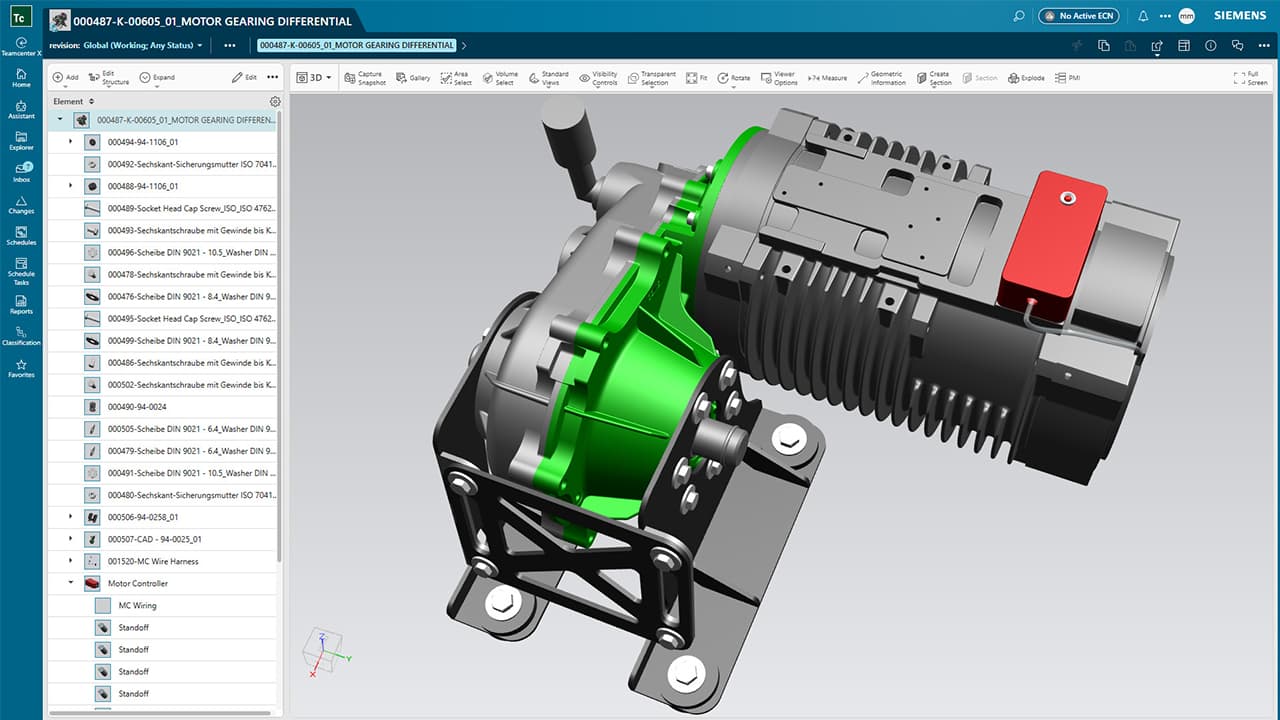
Active Workspace is the modern browser client, added in Teamcenter 11 and progressively replacing the legacy rich client. As of Teamcenter 14.x, most common workflows (BOM management, change management, ECAD/MCAD review) are available in Active Workspace, but some advanced workflows still require the rich client. This is an ongoing migration that Siemens is executing release-by-release.
Windchill Architecture
Windchill is a Java EE application running on Apache Tomcat, backed by Oracle or SQL Server. The core data model uses Windchill's InfoEngine — a query and integration engine that handles cross-application data federation. PTC has maintained a dual-stack approach: the legacy thick-client UI (Navigator) and a modern browser-based interface introduced in Windchill 12+.
Windchill's customization model uses MethodServer — Java method containers that developers extend by overriding base methods. This approach is powerful but creates tight coupling between customizations and the platform version, making upgrades expensive at heavily customized sites.
Windchill PDMLink is the entry-point module. Additional modules add program management (ProjectLink), quality management (Quality Solutions), supplier management (Supplier Management), and manufacturing BOMs (MPMLink). Each module extends the core vault.
Head-to-Head: The Comparison That Matters
| Dimension | Teamcenter (Siemens) | Windchill (PTC) |
|---|---|---|
| Vendor | Siemens Digital Industries Software | PTC |
| Native CAD | Siemens NX, Solid Edge | PTC Creo |
| Multi-CAD breadth | Good (certified connectors for Creo, CATIA, SolidWorks) | Strong (certified connectors for NX, CATIA, SolidWorks, Inventor) |
| BOM management | Best-in-class: multi-view BOMs, variant management, EBOM/MBOM | Strong: EBOM/MBOM, MPMLink for manufacturing process |
| Change management | Comprehensive ECR/ECN/ECO with configurable workflows | Solid ECR/ECN/ECO; Quality Solutions adds regulatory layer |
| Variant management | Industry-leading: product configurator, option/variant rules, 150% BOMs | Adequate for most programs; Windchill ModuleWorks for complex variants |
| Industry dominance | Automotive, aerospace, heavy equipment | Industrial equipment, medical devices, hi-tech/electronics |
| Regulated industries | Strong (AS9100, IATF 16949) | Strong (FDA 21 CFR Part 11, ISO 13485) |
| Deployment options | On-premise, private cloud (Xcelerator as a Service), customer-hosted cloud | On-premise, Windchill+ (PTC-hosted cloud), customer-hosted cloud |
| Modern UI | Active Workspace (browser, progressive rollout) | Windchill 12+ browser UI (more consistent) |
| Digital Thread | Deep: connects to Opcenter MES, Simcenter, DISW factory tools | Strong: ThingWorx IoT, Vuforia AR, Navigate for lightweight access |
| Upgrade complexity | High at customized sites (BMIDE migration required) | High at customized sites (MethodServer coupling) |
| Pricing model | Named user / concurrent user, negotiated | Named user / concurrent user, negotiated |
| Typical 5-year TCO (200 users) | 8M | 7M |
| SI ecosystem | Deloitte, Infosys, IBM, HCL, Tech Mahindra | Accenture, Deloitte, TCS, PTC Partners |
CAD Integration: The Deciding Factor
If you have one CAD system, the decision is usually made for you:
-
Siemens NX users → Teamcenter. The NX–Teamcenter integration is native — they share a data model and NX metadata is first-class inside Teamcenter without translation. Multi-CAD connectors for non-NX tools are an afterthought for Siemens; NX is the home base.
-
PTC Creo users → Windchill. The Creo–Windchill integration is equally native. Creo parametric models, families, and configurations map directly to Windchill's PDMLink data model. Creo Check-In/Check-Out is built into the Creo interface.
-
CATIA-dominant sites → Neither has a clear advantage. Both offer certified CATIA V5 and V6 connectors, but CATIA users often choose 3DEXPERIENCE for the tightest integration.
-
SolidWorks-dominant sites → Windchill has historically had a wider SolidWorks customer base; Teamcenter's SolidWorks connector is also certified but less commonly deployed.
-
Multi-CAD environments → Windchill has a reputation for broader multi-CAD neutrality, particularly in electronics/hi-tech companies with multiple CAD tools across product lines. Teamcenter's multi-CAD capabilities are solid but the center of gravity is NX.
Industry Fit
Where Teamcenter Wins
Automotive OEMs and Tier-1 suppliers — Teamcenter has dominant market share among German automakers (BMW, VW Group, Mercedes-Benz, Bosch) and major US and Korean OEMs. The automotive-specific configurations (variant management for 150% BOMs, supplier collaboration portals, compliance traceability) are mature and widely validated.
Aerospace and defense — Boeing, Airbus suppliers, and major defense primes run Teamcenter. The AS9100 configuration management workflows and design-to-manufacture digital thread (connecting to Opcenter MES) are production-proven at the largest aerospace programs.
Heavy equipment / industrial machinery — Caterpillar, John Deere, and similar OEMs manage their complex configurable product structures in Teamcenter.
Where Windchill Wins
Medical devices and life sciences — Windchill Quality Solutions (WQS) provides audit-trail controls, DHF (Design History File) management, and 21 CFR Part 11 electronic signature capabilities that FDA-regulated manufacturers need. Windchill has a larger installed base in this segment than Teamcenter.
Industrial equipment — PTC's Creo roots and Windchill's history in equipment configuration management make it the default choice at Parker Hannifin, Rockwell Collins, GE Power, and similar industrial OEMs.
Hi-tech / electronics — Windchill's multi-CAD breadth and strong ECAD integration (via a wider connector ecosystem) suit electronics manufacturers with mixed mechanical/electrical designs.
The Digital Thread Vision: Different Approaches
Both vendors have a "digital thread" vision, but the implementation paths differ:
Siemens' approach is closed and deep. The Xcelerator portfolio connects Teamcenter (PLM) → Opcenter (MES) → NX (CAD/simulation) → Teamcenter Manufacturing (MPM) in a single data model. If you are all-Siemens, the digital thread is genuine and verified. If you have mixed vendors on the shop floor, the thread relies on APIs and integration middleware.
PTC's approach is open and modular. ThingWorx provides the IoT platform, Windchill provides the design record, and Navigate provides lightweight access for non-PLM users (service, procurement, suppliers). The vision is a federated thread rather than a monolithic one. This is more realistic for organizations with heterogeneous systems but requires more integration work.
Use Case: When to Choose Which
Choose Teamcenter if:
- Your dominant CAD is Siemens NX or you are considering migrating to NX
- You are in automotive or aerospace with complex variant management requirements (150% BOMs, option rules, effectivity)
- You want a digital thread that connects PLM → MES without a third-party integration
- Your IT organization has existing Siemens competencies
- You need to manage cross-domain BOMs (MCAD + ECAD + software) in a single platform
- Long-term: you want to stay in the Siemens Xcelerator ecosystem
Choose Windchill if:
- Your dominant CAD is PTC Creo or you have a multi-CAD environment with no dominant tool
- You are in medical devices, life sciences, or any FDA-regulated segment
- Your program requires a mature Quality Management System (QMS) integrated with PLM data
- You are in industrial equipment or hi-tech/electronics with mixed ECAD/MCAD data
- You want a path to digital twin via ThingWorx IoT
- Your organization is invested in PTC's Creo + Windchill + ThingWorx ecosystem
Vendor Landscape: Who Uses What
Teamcenter reference customers: BMW Group, Volkswagen Group, General Motors, Ford, Boeing Commercial Airplanes, Caterpillar, John Deere, Hitachi, Panasonic, Honeywell Aerospace
Windchill reference customers: Lockheed Martin (mixed with Teamcenter), GE Aviation, Parker Hannifin, Johnson & Johnson (medical), Boston Scientific, Smith & Nephew, Rockwell Collins, Harley-Davidson
Typical deal size: 5M in first-year license + implementation for 50–500 users. Multi-year enterprise agreements at large OEMs can run $10M+ annually.
What the Evaluators Get Wrong
1. Believing the "one version of the truth" pitch. Both vendors will tell you their platform is the single source of truth for product data. In practice, both coexist with ERP (SAP, Oracle), MES, and CAD systems. The integration and governance work is what makes truth singular, not the PLM platform itself.
2. Underestimating upgrade costs. Heavily customized Teamcenter or Windchill sites can spend 30–50% of the original implementation cost on each major upgrade. The BMIDE migration (Teamcenter) and MethodServer refactoring (Windchill) are real budget items.
3. Evaluating features without evaluating the SI ecosystem. The platform is a small fraction of the total delivery. The Siemens or PTC partner network in your geography and industry matters more than which vendor has a specific checkbox in their feature matrix.
4. Choosing the wrong starting module. Both platforms have modular licensing — you can start small (PDMLink for Windchill, Teamcenter PDM for Teamcenter) and expand. The mistake is licensing the full platform scope on day one without organizational readiness to deploy it. Both vendors will sell you the full scope; your job is to start where you can execute.
Related Glossary Terms
- PLM (Product Lifecycle Management) — the enterprise discipline both platforms serve
- Teamcenter — Siemens' enterprise PLM, dominant in automotive and aerospace
- Windchill — PTC's enterprise PLM, dominant in industrial equipment and medical devices
- PDM (Product Data Management) — the CAD data vault layer both platforms include
- eBOM (Engineering BOM) — the product structure both platforms manage
- Digital Thread — the connected data architecture both vendors claim to enable
Related Articles
- Cloud PLM vs On-Premise PLM — deployment model comparison for PLM evaluators
- PLM vs ERP: Understanding the Difference — the boundary question that precedes platform selection
- eBOM vs mBOM: Why MES Lives in the Gap — the BOM translation challenge both platforms must handle
- What is Siemens Teamcenter? — deep dive on Teamcenter architecture, modules, and deployment models
- What is PTC Windchill? — deep dive on Windchill capabilities, PDMLink, and PTC ecosystem
Vendor Deep Dives
- Siemens PLM Spotlight: Teamcenter, NX, and the Xcelerator Portfolio — the full practitioner's guide to Siemens' products, strengths, and automotive dominance
- PTC Spotlight: Creo, Windchill, and the PLM Platform That Built Modern Manufacturing — the full practitioner's guide to PTC's products, pricing, and IoT differentiators
Sources
Want to listen instead of read? 56 DemystifyingPLM articles are available as audio.
Browse audio →Looking up PLM terminology? Browse the canonical reference.
PLM Glossary →Cite this article
Finocchiaro, Michael. “Teamcenter vs Windchill: Which PLM Platform Is Right for Your Organization?.” DemystifyingPLM, November 8, 2023, https://www.demystifyingplm.com/teamcenter-vs-windchill
PLM industry analyst · 35+ years at IBM, HP, PTC, Dassault Systèmes
Firsthand knowledge of the evolution from early 3D modeling kernels to today's cloud-native platforms and agentic AI — the history, strategy, and future of PLM.