Key Takeaways
- Thread-centric architecture is the prerequisite for trustworthy AI in engineering
- Organizations with fragmented PLM data silos cannot achieve thread-centricity without data consolidation
- MBSE and MBD adoption accelerates the transition to thread-centric workflows
- Requirements traceability is where most organizations have the largest gap
Short Answer
Thread-Centric PLM is a PLM architecture in which the Digital Thread—the continuous, traceable data chain from requirements to as-built—is the primary organizing principle. Rather than managing discrete data silos (CAD in one system, BOM in another, requirements in a third), thread-centric architecture links every artifact to its upstream requirement and downstream consequence, making the full product record navigable in both directions.
- Thread-Centric PLM treats traceability as infrastructure, not a reporting exercise
- Every artifact is linked to a requirement and to downstream manufacturing evidence
- The architecture is AI-ready by design—agents can traverse the thread without custom integration
- Model-Based Definition (MBD) is a key enabler, replacing drawing-centric workflows
- Configuration Management governs which thread state is the authoritative product baseline
What Is Thread-Centric PLM?
Thread-Centric PLM is a product lifecycle management architecture where the Digital Thread is the primary organizing principle.
Traditional PLM manages data in modules: a CAD vault, a BOM manager, a requirements tool, a change workflow engine. These modules work. What they typically don't do is stay connected to each other in a navigable, machine-readable way.
Thread-Centric PLM replaces that module-centric model with a graph-structured data architecture where every artifact—requirement, design decision, BOM line, work instruction, test result—is a node linked to what drove it and to what it drives downstream.
Traditional PLM vs. Thread-Centric PLM
The distinction matters in practice, not just in theory.
| Attribute | Traditional PLM | Thread-Centric PLM |
|---|---|---|
| Data model | Module-based silos | Graph-linked thread |
| Traceability | Report-generated, periodic | Structural, always-on |
| AI readiness | Low (fragmented context) | High (traversable graph) |
| Integration pattern | Point-to-point interfaces | Thread-native federation |
In traditional PLM, traceability is a report. Someone runs a query, exports a spreadsheet, and manually validates that requirements are covered. In thread-centric PLM, traceability is structural—asking "what requirement drove this design choice?" returns an answer instantly because the link exists in the data model, not in a report.
The Thread from Requirements to As-Built
The canonical scope of a Digital Thread runs from requirements through as-built evidence.
Requirements define what the product must do: performance specifications, regulatory compliance mandates, customer contractual commitments. In a thread-centric architecture, requirements are first-class objects in PLM, not documents in a SharePoint folder.
Design satisfies requirements. Each design decision traces to the requirement it addresses. In Model-Based Definition (MBD), that relationship is embedded directly in the 3D model—not inferred from a drawing title block.
Manufacturing produces the design. The Manufacturing BOM links to the EBOM, which links to requirements. Work instructions link to BOM lines. The thread extends into the factory.
Verification closes the loop. Test results and inspection records link back to the requirements they validate. The thread becomes a closed circuit, not an open chain.
Why It Matters for AI
AI agents operating in PLM need context, not data fragments.
An agent asked "can I substitute this component?" needs to know what requirement the original component satisfies, what tolerances it must meet, what the downstream assembly constraints are, and what verification tests will need to be re-run after the change. That is a graph traversal problem.
In a fragmented, module-centric PLM architecture, that context is spread across five systems with no formal links. An AI agent cannot retrieve it reliably. It guesses, or it escalates to a human for every step.
In a thread-centric architecture, the agent traverses the thread. The answer is mechanical: follow the links, read the constraints, assess the change. This is why thread-centricity is the prerequisite for trustworthy AI Copilot and agent capabilities in engineering.
Model-Based Definition as Enabler
Thread-Centric PLM and Model-Based Definition (MBD) are deeply related.
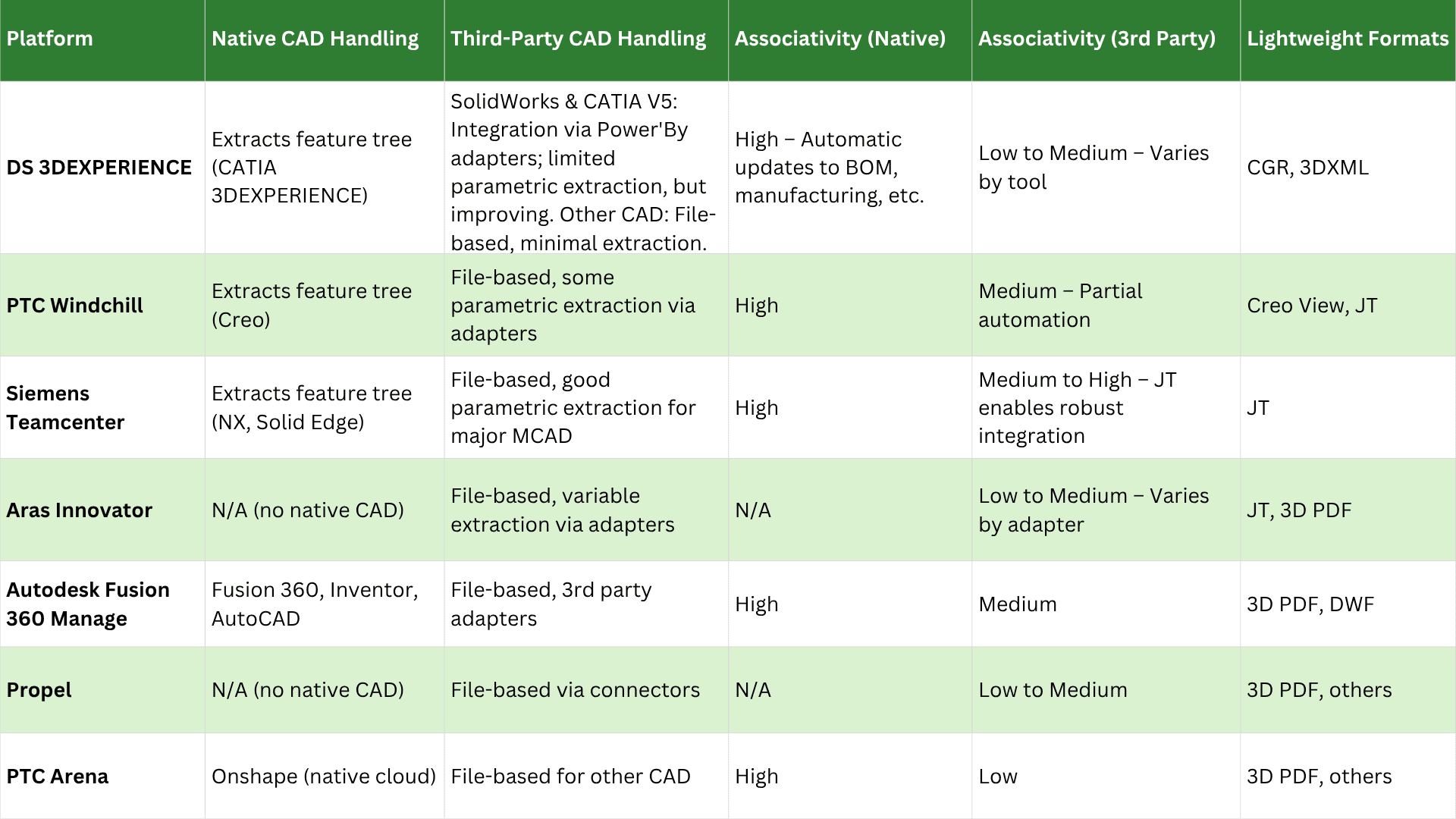
Drawing-based workflows fragment the thread. Information encoded in a 2D PDF drawing is machine-readable only to a human who reads and interprets it. It cannot be traversed by an AI agent, queried by a downstream system, or linked to a requirement automatically.
MBD replaces the drawing with a semantically rich 3D model. Manufacturing and inspection information is structured, linked, and machine-readable. The thread from design to manufacturing data stays intact because both sides speak the same data language.
Organizations still operating in drawing-centric workflows face a significant barrier to thread-centricity. MBD adoption is not optional for mature thread implementations.
Configuration Management and Thread Integrity
The Digital Thread has no value if its version state is ambiguous.
Configuration Management (CM) is what gives the thread integrity. CM defines which version of each artifact—requirement, CAD model, BOM, test record—constitutes the authoritative product baseline at any given moment.
Without CM discipline, a thread-centric architecture becomes a tangle of mismatched versions. Engineering is working on design rev B while manufacturing is building to rev A, and neither knows with certainty whether the test records apply to the current configuration.
Thread-Centric PLM requires mature CM. Not as a governance overhead, but as the mechanism that makes the thread coherent.
The Digital Thread and the Digital Twin
Thread-Centric PLM is the foundation for Digital Twin programs.
A digital twin needs to know what the product was designed to do (requirements), how it was built (MBOM, work instructions), and how it has been maintained (service records). All of that data lives in the thread.
Without a connected thread, digital twin programs must reconstruct product context manually from disparate systems—a fragile, expensive process that limits the twin's fidelity and usefulness.
The thread provides the lineage. The twin provides the live operational state. Together, they enable closed-loop product intelligence from design intent to real-world behavior.
Implementation Roadmap
Thread-centric transformation is a multi-year program, not a tool purchase.
Stage 1: Requirements foundation. Establish requirements management in PLM with a defined linkage schema. Every requirement gets a unique identifier and a linkage mechanism to downstream design artifacts.
Stage 2: Design traceability. Connect CAD models and BOM items to requirements through formal, system-enforced links. Adopt MBD for new programs to make design data machine-readable.
Stage 3: Manufacturing extension. Extend the thread into MBOM, process plans, and work instructions. Every manufacturing operation should trace to the design element it realizes and the requirement it satisfies.
Stage 4: Verification closure. Link test results and inspection records back to requirements. The thread becomes a closed, auditable circuit.
Most organizations achieve stage 2 within two to three years. Stages 3 and 4 require manufacturing operations system integration and are typically five-year programs.
Summary
Thread-Centric PLM is not a product—it is an architectural discipline.
It transforms PLM from a collection of specialized tools into a coherent, navigable product intelligence graph. The payoff is traceability that is structural rather than report-generated, AI readiness by design, and compliance evidence that is machine-readable rather than manually assembled.
The organizations building thread-centric architectures now are building the data infrastructure that makes autonomous engineering assistance possible. The architecture is the investment. The AI capability is the return.
Related reading:
Want to listen instead of read? 56 DemystifyingPLM articles are available as audio.
Browse audio →Looking up PLM terminology? Browse the canonical reference.
PLM Glossary →Cite this article
Finocchiaro, Michael. “What is Thread-Centric PLM?.” DemystifyingPLM, June 10, 2024, https://www.demystifyingplm.com/what-is-thread-centric-plm
PLM industry analyst · 35+ years at IBM, HP, PTC, Dassault Systèmes
Firsthand knowledge of the evolution from early 3D modeling kernels to today's cloud-native platforms and agentic AI — the history, strategy, and future of PLM.