Key Takeaways
- Product Memory is emerging as critical infrastructure for AI-powered manufacturing
- Companies building Product Memory capabilities gain advantage in automation and compliance
- Integration with Digital Thread initiatives multiplies value significantly
- Implementation spans data modeling, governance, and AI/ML integration
Short Answer
Product Memory is the semantic layer that captures not just product structure (BOM) but the intent, decisions, and context behind that structure. It bridges PLM, Digital Thread, and AI agents by maintaining machine-readable understanding of why a product is configured the way it is.
- Product Memory captures design intent and decision context, not just data structure
- Enables AI agents to understand why products are configured the way they are
- Bridges the gap between traditional PLM and next-generation intelligence
- Supports compliance, traceability, and variant management at scale
- Foundation for autonomous engineering workflows
What Is Product Memory?
Product Memory is the semantic layer that sits above your PLM system's data structures.
Where a BOM records what is in a product, Product Memory records why. It captures design intent, decision rationale, requirement traceability, and configuration history in a machine-readable form that AI systems can reason over.
The term is gaining traction as engineering teams realize that AI agents cannot meaningfully assist with product decisions if they only have access to part numbers and attribute tables. Agents need context.
Why Traditional PLM Falls Short
Most PLM systems store two things well: product structure and change history.
What they don't capture is the reasoning behind both. An engineer changes a fastener from M8 to M10. The change order records the who and the when. Nothing records the why—the fatigue analysis that triggered it, the standard it had to comply with, or the three alternatives that were evaluated and rejected.
That missing context is the gap Product Memory fills.
When a new engineer inherits a product, or when an AI agent tries to assist with a derivative design, they're working without the accumulated reasoning of the people who built the original. Product Memory is the mechanism for preserving and transmitting that reasoning.
The Three Layers of Product Memory
1. Structured Data Layer
The first layer extends your existing PLM schema.
Standard part attributes (material, weight, tolerance) are joined by decision attributes: requirement references, trade-off notes, rejected alternatives, governing standards, and approval rationale. This data lives alongside—not separate from—the existing BOM in your PLM system.
2. Semantic Relationship Layer
The second layer connects data as a knowledge graph.
Parts are linked to requirements. Requirements are linked to standards. Standards are linked to test records. Design decisions are linked to the constraints that drove them. This graph structure lets AI agents traverse relationships the way an experienced engineer would—not by querying flat tables, but by following chains of meaning.
The Digital Thread concept is adjacent: where Digital Thread connects data across lifecycle stages, Product Memory connects data across decision dimensions within a stage.
3. AI and Inference Layer
The third layer applies machine learning to the accumulated record.
Agents trained on Product Memory can answer questions like "why was this supplier selected?" or "what other assemblies share this design pattern?" They can flag when a proposed change would violate a constraint that was captured six design generations ago. They can generate documentation by reading intent rather than reverse-engineering structure.
This is the layer that justifies the investment in the first two.
Product Memory vs. Digital Thread
These concepts overlap but are distinct.
| Digital Thread | Product Memory | |
|---|---|---|
| Focus | Data connectivity across lifecycle | Semantic meaning within lifecycle |
| Primary axis | Time / lifecycle stage | Decision / intent dimension |
| Storage | Federated data links | Enriched PLM schema + knowledge graph |
| Primary consumer | Process orchestration, traceability | AI agents, knowledge-based engineering |
The Digital Thread vs Digital Twin distinction is a useful reference point: Digital Thread is the connection, Product Memory is the meaning attached to what flows through that connection.
Core Use Cases
Variant Management at Scale
Complex product families accumulate thousands of configuration rules. Product Memory preserves the engineering reasoning behind each rule, so variant management doesn't devolve into reverse-engineering your own product. See also: what is PLM configuration management.
Compliance Traceability
Regulated industries (aerospace, automotive, medical devices) need to prove that every design decision traces to a requirement. Product Memory makes that trace machine-readable and auditable, rather than buried in change order comments.
AI-Assisted Design
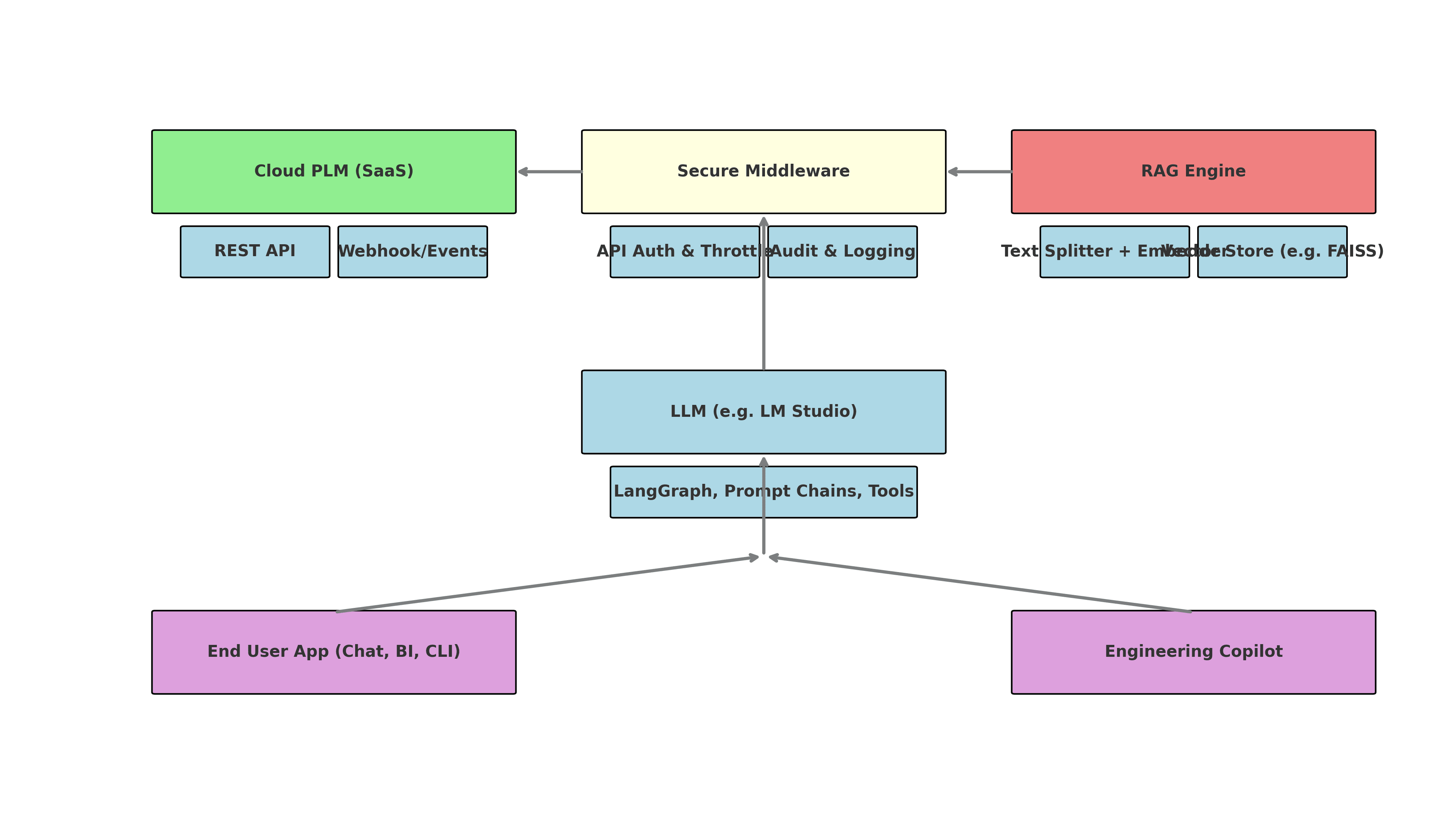
When an engineer asks an AI Copilot "can I use this alternative part?", the copilot needs to know what constraints the original part was satisfying. Product Memory provides that context.
Onboarding and Knowledge Transfer
Senior engineers carry enormous implicit knowledge about why products are the way they are. Product Memory is the mechanism for making that knowledge explicit and persistent before it walks out the door.
Implementation Roadmap
Most successful Product Memory initiatives follow a staged approach.
Stage 1 — Capture decisions for new work. Start with active programs. Require engineers to record decision rationale in structured fields, not free-text comments. Define a vocabulary for decision types (requirement-driven, cost-driven, supplier-driven, standard-mandated).
Stage 2 — Retrofit high-value existing products. For critical platforms, invest in retrospective capture. Interview senior engineers. Mine change history. Reconstruct the reasoning chain for major configuration choices.
Stage 3 — Connect to AI and automation. Once a semantic record exists, expose it to AI tooling. Build retrieval-augmented agents that can query the knowledge graph. Start with read-only assistance, then graduate to draft-and-review, then to autonomous execution for well-defined routine decisions.
Data Governance Considerations
Product Memory raises the governance bar compared to traditional BOMs.
A BOM entry is validated if the part exists and the quantity is correct. A Product Memory entry is valid if the decision rationale is accurate, the requirement reference is current, and the reasoning still applies after subsequent design changes.
That means governance processes need to include:
- Decision metadata standards: Controlled vocabulary for decision types, outcomes, and references
- Expiry and review triggers: When a requirement changes, flag all decisions that cited it
- Ownership: Decisions should have accountable authors, not just "the system"
- Audit trails: Full history of what was claimed and when—especially for compliance-critical records
The Connection to AI Agent Autonomy
The most forward-looking reason to build Product Memory now is to enable autonomous agents later.
Current AI copilots in PLM are assistants—they answer questions and draft suggestions. The next generation will execute decisions autonomously within defined boundaries. But autonomous execution requires the agent to understand constraints deeply enough to know when it's inside the boundary and when it's approaching an edge.
Product Memory is the constraint map. Without it, autonomous agents in engineering are guessing.
The investment in semantic capture today is the foundation that makes trustworthy autonomy possible at scale tomorrow.
Summary
Product Memory fills the gap between what PLM systems record (structure and history) and what AI systems need (intent and context).
It spans three layers: structured data capture, semantic knowledge graph, and AI inference. The payoff is compounding: every decision captured makes your AI agents smarter, your compliance traces cleaner, and your knowledge transfer more reliable.
Organizations building Product Memory now are laying the infrastructure that will separate AI-enabled engineering from AI-adjacent engineering over the next five years.
Related reading:
Want to listen instead of read? 56 DemystifyingPLM articles are available as audio.
Browse audio →Looking up PLM terminology? Browse the canonical reference.
PLM Glossary →Cite this article
Finocchiaro, Michael. “What is Product Memory?.” DemystifyingPLM, March 22, 2024, https://www.demystifyingplm.com/what-is-product-memory
PLM industry analyst · 35+ years at IBM, HP, PTC, Dassault Systèmes
Firsthand knowledge of the evolution from early 3D modeling kernels to today's cloud-native platforms and agentic AI — the history, strategy, and future of PLM.