Overview of Agentic AI in PLM/Engineering Context
Definition
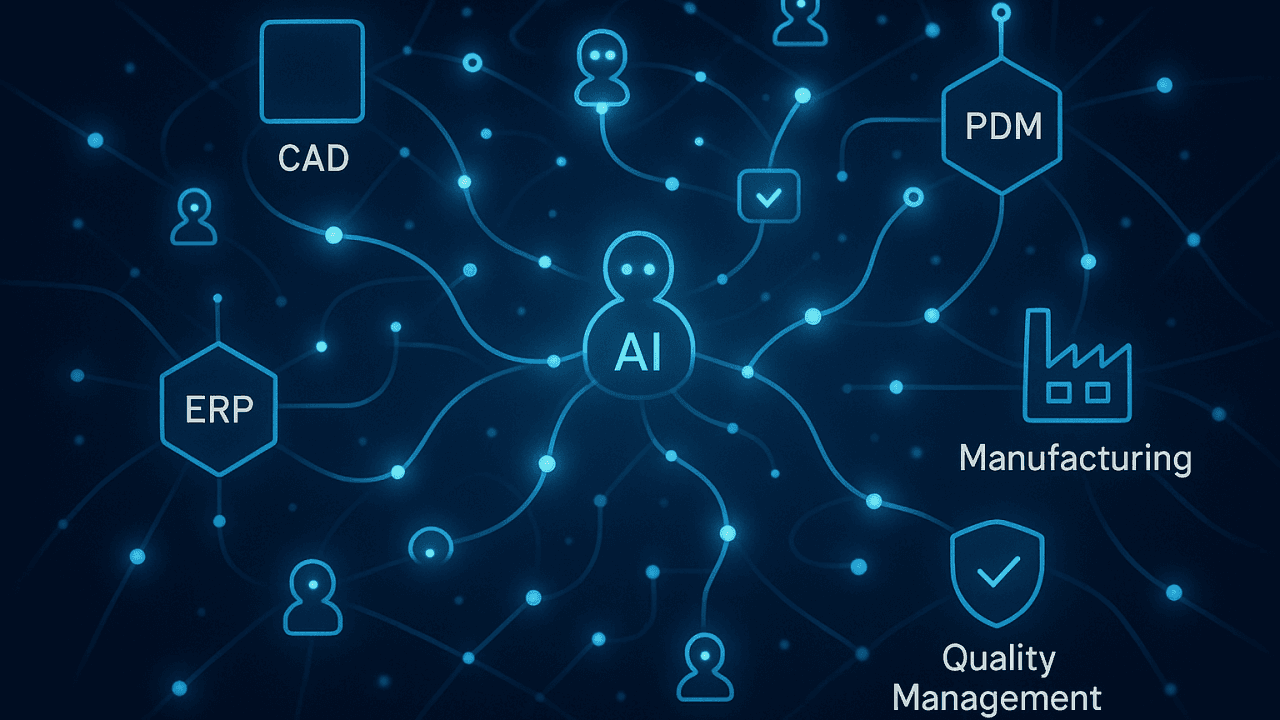
Agentic Artificial Intelligence (AI) refers to a form of advanced artificial intelligence that acts autonomously or semi-autonomously within its environment, making decisions and taking actions without explicit human intervention. In the context of Product Lifecycle Management (PLM), Agentic AI integrates seamlessly with digital threads and other PLM systems to manage complex product development processes, optimize workflows, and enhance decision-making.
History
The concept of Agentic AI has roots in early AI research that focused on autonomy and adaptability. However, it gained prominence as computational capabilities increased and big data analytics became more prevalent. The integration of machine learning (ML) and artificial intelligence (AI) into PLM systems began to enable agentic behaviors, such as automated design, quality assurance, and supply chain optimization.
Key Concepts
- Autonomy: Agentic AI operates with a high degree of independence, making decisions based on predefined goals and context.
- Adaptability: These AI systems can learn from their environment and adjust their behavior accordingly to achieve optimal performance.
- Integration: Agentic AI seamlessly integrates with existing PLM tools and systems, enhancing their functionality without requiring extensive human oversight.
- Predictive Analytics: Utilizing historical data to predict future trends, behaviors, or outcomes in the product development lifecycle.
Current Trends
- Enhanced Automation: Agentic AI is increasingly used to automate routine tasks, freeing up engineers and designers to focus on more complex problem-solving.
- Data-Driven Decision Making: AI systems analyze large datasets to provide actionable insights, optimizing design choices, material selection, and cost reduction.
- Real-Time Monitoring: Agentic AI can continuously monitor the product development process in real-time, alerting stakeholders to potential issues before they become critical.
- Collaborative Tools: Integration with collaborative platforms enables distributed teams to work more efficiently by providing real-time feedback and suggestions.
Relevance to PLM Practitioners
For practitioners in the PLM field, Agentic AI offers several benefits:
- Improved Efficiency: Automation of repetitive tasks reduces manual effort, allowing for faster development cycles.
- Enhanced Quality Control: Predictive analytics can identify potential quality issues early in the design phase, reducing rework and costly errors.
- Optimized Resource Allocation: Real-time monitoring helps in better allocation of resources, ensuring projects stay on track without overburdening teams.
- Innovative Design Solutions: AI-driven insights can lead to innovative designs that might not be immediately apparent to human designers.
Example: Bridging the Gap
The article "Bridging the Gap: Making Agentic AI Practical in Today’s PLM Reality" highlights how Agentic AI can bridge the gap between theoretical advancements and practical implementation. By detailing successful case studies, it provides actionable steps for integrating Agentic AI into existing PLM frameworks.
Beyond Bill of Materials
Another relevant article, "The Bill of Information: Beyond Bill of Materials in the Digital Thread Era," explores how Agentic AI complements traditional BOMs by incorporating a broader range of information throughout the product lifecycle. This approach ensures that all stakeholders have access to up-to-date and comprehensive data, enhancing transparency and traceability.
Conclusion
Agentic AI represents a significant step forward in PLM by enabling smarter, more efficient processes through autonomous decision-making capabilities. As these technologies continue to evolve, they will play an increasingly important role in driving innovation and improving productivity in the engineering and manufacturing sectors.
For further exploration into specific applications and best practices, refer to recent studies and case studies that delve deeper into how Agentic AI is being implemented in various industries.