Show all chapters ▸Hide chapters ▾
- 1Best CAD Software 2026: The Engineer's Honest Guide
- 2Best PLM Software 2026: Q1 Edition (Archived)
- 3Best CAM Software 2026: The Machinist's Independent Guide
- 4Best MES Software 2026: Q1 Edition (Archived)
- 5Best Simulation Software 2026: Incumbents, Specialists, and the New Constellation
- 6Best MES Software 2026: The Manufacturer's Independent Guide
- 7Best PLM Software 2026: The Independent Buyer's Guide
- 8Best Operations & Asset Management Software 2026: The CIO's Independent Buyer's Guide
- 9Best BIM Software 2026: The Independent Buyer's Guide for AEC and Owner Organizations
- 10Best IIoT Platforms 2026: The Manufacturer's Independent Buyer's Guide
- 11Best SCM Software 2026: The Supply Chain Independent Buyer's Guide
Key Takeaways
- Physics depth is not the only selection criterion — workflow fit, solver accessibility, and integration with the broader design and operations stack determine whether simulation creates value or creates bottlenecks
- The license model is the real usability gate for most simulation programs — per-seat HPC licenses that require infrastructure investment are a structural barrier for smaller teams that cloud-native platforms remove
- Simulation data management is the unsexy capability that separates programs where simulation improves products from programs where simulation produces reports — buyers should evaluate where simulation results live, not just where they are generated
- Digital twin programs that bridge simulation to MES require simulation platforms that can publish model state and prediction results into the same data backbone (UNS or PLM) that operations systems consume
- AI-assisted simulation is not a replacement for validated solvers in certified programs — but for design exploration, concept evaluation, and performance screening, it is commercially competitive in 2026 and the productivity gap over traditional solver runs is significant
Short Answer
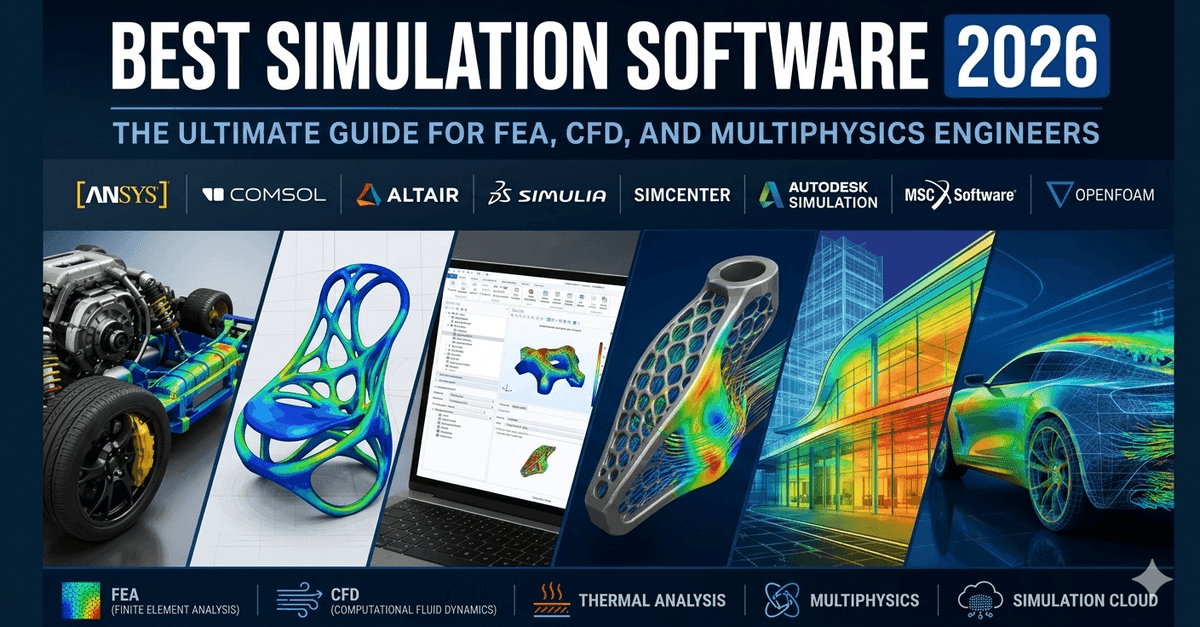
The best simulation software in 2026 depends on your physics requirements, workflow fit, and how tightly simulation needs to integrate with your CAD/PLM/MES stack. For enterprise multiphysics programs: Ansys or Simcenter. For automotive crash, NVH, and durability: Altair or MSC/Hexagon. For CATIA-centric programs with structural and fluids: SIMULIA/Abaqus. For casting, molding, or vertical process simulation: MAGMASOFT, Moldex3D, or COMSOL. For cloud-native accessibility without solver infrastructure: SimScale or Luminary Cloud. For AI-assisted geometry-to-performance prediction: Neural Concept. No single platform wins across all physics domains, team sizes, and integration requirements.
- The SOLVE framework evaluates simulation across five dimensions — Solver domain, Output fidelity (decide this first), Launch infrastructure, Velocity layer (AI surrogates), Ecosystem integration — and O (fidelity) must be defined before S (solver selection)
- Most simulation evaluations start at S (which CAE suite?) and never properly define O (do I need certified validation-grade output or exploration-grade directional feedback?) — this is why teams buy Ansys and mostly use it for first-pass screening
- Simulation has split into three layers — enterprise CAE suites, vertical and process specialists, and a new constellation of cloud-native and AI-assisted tools — and buyers choosing from only one layer are missing the rest of the market
- The enterprise incumbents (Ansys, Simcenter, Abaqus/Simulia, Altair) still own the deepest physics: non-linear structural analysis, turbulent CFD, high-frequency EM, crash, and coupled multiphysics that specialized tools cannot replicate
- The V (Velocity) layer — Neural Concept, Ansys SimAI, Monolith AI — is now commercially deployed for design exploration; AI geometry-to-performance prediction is real in 2026, but it is not a replacement for certified solver output
- Simulation integration with PLM and MES is now an E-layer buying criterion — digital twins that feed operational systems require simulation data to live inside the PLM/MES data model, not on individual workstations
- If you're still thinking 'simulation = one monolithic CAE suite,' you're missing an entire new layer of specialized, cloud, and AI-driven simulation vendors
Best Simulation Software 2026: Incumbents, Specialists, and the New Constellation
Q2 2026 Edition — updated June 2026 with the complete SOLVE framework, AI surrogate model analysis, and O-first fidelity evaluation methodology. Visit threadmoat.com for the full vendor scorecard.
This post presents the key findings from the ThreadMoat Simulation Buyer's Guide 2026. For the full report including all SOLVE profiles and certified solver validation documentation, visit threadmoat.com.
The simulation software market in 2026 is not one market. It is three overlapping ones — and buyers who evaluate only the enterprise CAE suites are making decisions with half the picture.
This guide evaluates seventeen platforms through the SOLVE framework — five dimensions that impose the right evaluation sequence. Most simulation selections fail because they start at S (which solver?) before answering O (what fidelity do I actually need?). Define O first. It determines everything else.
No vendor funding. No analyst-quadrant hedging. Full vendor scorecards and ThreadMoat Extreme Analysis competitive data at threadmoat.com.
Part 1: The Simulation Architecture Shift
From Hand Calculation to AI Surrogate: The Historical Arc
Simulation did not arrive as a category. It accumulated in layers, each one adding capability while compounding complexity and cost.
The pre-digital era (pre-1960s): Engineers validated structural designs using hand calculations — beam theory, fatigue diagrams, conservative safety factors applied to simplified geometries. Accuracy was limited; the physical prototype was the proof. For most programs, physical testing was the simulation.
FEA emergence (1960s–1970s): The finite element method originated in aerospace structural analysis, driven by NASA and Boeing programs that needed to predict stresses in complex geometries before cutting aluminum. Early FEA ran on mainframes, required months of model setup, and was accessible only to specialist analysts with graduate-level mathematics. The solver was not a product; it was a research capability that slowly commercialized through companies like NASTRAN (NASA-developed, later commercialized), MARC, and the early Swanson Analysis Systems work that became ANSYS.
CFD commercialization (1980s–1990s): Computational fluid dynamics followed a parallel path. Aerospace drove early development; automotive manufacturers adopted CFD for external aerodynamics in the late 1980s as wind tunnel time became a cost constraint. FLUENT, STAR-CD, and CFX emerged as commercial solvers. The same pattern repeated: research code to specialist tool to commercial product, with each step requiring dedicated infrastructure and specialist operators.
Workstation CAE and the democratization attempt (1990s–2000s): Unix workstations, then Windows PCs, brought simulation out of the mainframe room and into the engineering office. Meshing tools improved. GUI wrappers reduced the raw mathematics exposure. Ansys, MSC, and Nastran built pre/post-processing environments that made FEA accessible to mechanical engineers without a simulation PhD. But "accessible" is relative — enterprise CAE still required dedicated simulation engineers, per-seat licensing schemes priced for corporate budgets, and HPC clusters for anything beyond small models.
Multiphysics and coupled analysis (2000s–2010s): As product complexity increased, single-physics simulation proved insufficient. A brake disc is a structural problem and a thermal problem and a fluid problem. An antenna is an electromagnetic problem and a thermal problem. Vendors responded by building coupling frameworks — Ansys Workbench, Simcenter's multi-physics environment, SIMULIA's coupled analysis tools — that linked previously isolated solvers. The result was more powerful analysis capability at higher licensing cost, greater model complexity, and longer setup times.
Digital twin architectures (2010s): The industrial IoT wave introduced the concept of simulation models connected to operational data. Instead of running analysis once during design, simulation could run continuously against sensor data to predict remaining life, optimize process parameters, or detect anomalies. The digital twin abstraction put simulation at the center of a data architecture that connected engineering models to operational systems — but it also exposed the weakest link in the simulation ecosystem: simulation data rarely lived in a governed, queryable location that operational systems could consume.
AI-assisted simulation (2020s): The current transition is replacing portions of the solver workflow with trained machine learning models. Rather than running a full physics solver for every design variant, AI surrogates learn the input-output mapping from historical solver results and predict performance quantities for new geometries in seconds. Neural Concept, Ansys SimAI, and Monolith AI represent this layer commercially. The implications are significant — not because AI surrogates replace validated physics (they do not, at least not in certified programs), but because they remove the speed and cost barriers that have kept simulation locked in specialist teams and late-stage design cycles.
Why the Market Split Into Three Layers
The accumulation of capability across six decades of simulation history created a structural tension: each generation of tools became more powerful and more complex, more accurate and more expensive, more capable and more inaccessible to the engineers who most needed simulation feedback.
The three-layer market structure in 2026 is the market's response to that tension:
Layer 1 — Enterprise CAE suites: The physics incumbents. Ansys, Simcenter, Abaqus/SIMULIA, Altair, MSC/Hexagon. These platforms own the certified solver depth that regulated programs require. A 5 in S means the vendor's solver portfolio covers the physics domain with certified validation pedigree appropriate for your program type. Choosing an enterprise suite means buying physics depth, validation documentation, regulatory acceptance history, and a support ecosystem — and accepting licensing costs, implementation complexity, and HPC infrastructure requirements in return.
Layer 2 — Vertical and process specialists: Domain experts. MAGMASOFT for casting, Moldex3D for injection molding, COMSOL for custom multiphysics equations, ESI Group for manufacturing process simulation. These platforms win when the physics domain is narrow enough that a general-purpose suite cannot match the validated process models and application-specific workflows of a domain specialist. Their O-grade is High within their narrow domain; outside it, they do not compete.
Layer 3 — The new constellation: Cloud-native and AI-assisted platforms that solve the access, speed, and integration problems that the incumbents created. SimScale, Luminary Cloud, Neural Concept, Ansys SimAI, Monolith AI, Akselos. These platforms do not try to out-depth the enterprise suites on physics. They make simulation results available to engineers who cannot justify the infrastructure, licensing, or specialist headcount that enterprise CAE requires — and they do it at O = adequate fidelity, which is precisely what design exploration and operational prediction require.
Understanding which layer your use case belongs to is the first decision. Buyers who apply Layer 1 criteria to Layer 3 vendors (demanding certified solver depth from cloud-native platforms) will always be disappointed. Buyers who buy Layer 1 platforms for workflows that only need Layer 3 outputs will always be overpaying.
The O-First Decision Framework
The most important concept in this guide is the O-first evaluation sequence. O — Output fidelity — must be defined before any other dimension of the SOLVE framework is addressed. It determines which layer applies, which platforms compete, and how much the right answer costs.
What "certified grade" actually means:
O = High (certification-grade) is not simply "the simulation result is accurate." It is a compound requirement that involves four separate commitments:
-
Solver validation documentation — the platform vendor has published validation reports demonstrating solver accuracy against experimental data across the physics domain. For structural mechanics, this means published test-analysis correlations across material classes, loading conditions, and geometry types. For CFD, this means turbulence model validation against recognized benchmark cases. These are not marketing documents — they are technical reports that an engineer can scrutinize, and that a certification authority (FAA, EASA, FDA) can evaluate as part of a software quality assurance submission.
-
Code verification — evidence that the numerical implementation of the governing equations is mathematically correct. This is the "is the solver solving the equations it claims to solve?" question, separate from "is the simulation result close to experimental data?"
-
Mesh independence studies — documented evidence that the simulation result does not change materially when the mesh is refined below a certain element size. This is a practitioner requirement, not a vendor deliverable — but certified programs must document it for every significant analysis.
-
Regulatory acceptance — the solver has an established history of accepted use in regulatory submissions within the relevant domain. An Ansys Mechanical result is accepted in FAA structural submissions because hundreds of prior submissions have established that precedent. A cloud-native platform with no submission history does not carry that acceptance, regardless of its technical accuracy.
O = Adequate (exploration-grade) means the output is accurate enough to guide design decisions — to rank alternatives, identify failure modes, and narrow the design space — but is not intended to serve as a regulatory deliverable. AI surrogates, cloud-native platforms, and ROMs operate at this fidelity. The critical insight is that exploration-grade fidelity is sufficient for the majority of simulation runs that actually happen in product development. Programs that run 1,000 solver jobs for design space exploration, then 10 certified runs for submission, are spending 98% of their simulation budget at a fidelity tier they only need for 1% of the runs.
Why most organizations overbuy O = High:
Simulation platform selection is typically driven by the highest-fidelity use case in the program — the certification run, the regulatory submission, the contractual analysis deliverable. The platform that can do that job becomes the platform that every engineer in the organization uses for every simulation task. The result is expensive, specialist-dependent, HPC-requiring infrastructure deployed for first-pass screening tasks that a V-layer tool could do in seconds.
The right approach is O stratification per use case, not per organization. Define the use case first. If it requires certified output, it belongs in an O = High platform. If it requires directional feedback, it belongs in an O = adequate tool. Most programs have both types of use cases. Most programs run both on the same expensive enterprise platform because no one stopped to ask the O question.
The V layer commercial reality in 2026:
The V (Velocity) layer — AI surrogates, reduced-order models, cloud-accessible exploration tools — is no longer experimental. Neural Concept has commercial automotive aerodynamics deployments where geometry-to-drag-coefficient prediction runs in seconds with sufficient accuracy for design exploration. Ansys SimAI is trained on validated Fluent results and available in production. Monolith AI is deployed for test-data correlation use cases at automotive and aerospace programs. The V layer is real. The constraint is not technical maturity — it is organizational willingness to define O per use case rather than applying a single high-fidelity standard across every simulation activity.
Scope of This Guide
This guide covers:
- Structural FEA (linear and non-linear)
- CFD (internal and external flows, thermal, multiphase)
- Multiphysics simulation (coupled structural-thermal-fluid)
- Electromagnetic simulation (high-frequency and low-frequency)
- AI surrogate models and reduced-order models for design exploration and operational digital twins
- Cloud HPC infrastructure for simulation delivery
This guide does not cover:
- 1D systems simulation (Modelica, Amesim, GT-Suite, Simulink/Simscape) — this is a separate ThreadMoat category covering system-level design and controls co-simulation
- CFD for fundamental fluid dynamics research (OpenFOAM in academic research settings, DNS and LES academic codes) — separate category
- EDA simulation (SPICE, signal integrity, power integrity, electromagnetic compatibility at the circuit level) — separate ThreadMoat category covering electronics design and EDA
The SOLVE Framework
| Dimension | What it evaluates | The evaluation sequence |
|---|---|---|
| S — Solver domain | Which physics do you own: structural, CFD, EM, multiphysics, vertical process | Evaluate third — after O determines which fidelity tier you need |
| O — Output fidelity | Certified validation-grade vs. exploration-grade surrogate — decide this first | Evaluate first. It gates every other decision |
| L — Launch infrastructure | On-premise HPC, cloud-burst, fully cloud-native | Evaluate fourth — infrastructure follows physics and fidelity requirements |
| V — Velocity layer | AI surrogates, ROMs, design-space exploration tools — distinct from the solver | Evaluate second — if O is exploration-grade, V may be your primary tool |
| E — Ecosystem integration | CAD geometry, PLM traceability, MES/UNS/digital twin downstream connection | Evaluate fifth — integration requirements constrain platform choice |
A 5 in S means the vendor's solver portfolio covers the physics domain with certified validation pedigree appropriate for your program type. A 5 in E means simulation outputs flow natively into PLM/MES data management without manual export steps. O-grade is not a numeric score — it is a binary determination of whether the platform's outputs are acceptable for certified programs (High) or for exploration-grade workflows (Adequate). The O-grade should be evaluated first, because a platform rated Adequate for O cannot serve regulatory programs regardless of its S score.
SOLVE Scorecard Summary
| Platform | S | O-grade | L | V | E |
|---|---|---|---|---|---|
| Ansys Mechanical / Fluent | 5 | High | 4 | 3 | 4 |
| Siemens Simcenter | 5 | High | 4 | 3 | 5 |
| Dassault Abaqus / SIMULIA | 5 | High | 3 | 2 | 4 |
| Altair HyperWorks | 4 | High | 4 | 3 | 3 |
| MSC Software / Hexagon | 4 | High | 3 | 2 | 3 |
| COMSOL Multiphysics | 5 | High | 3 | 1 | 3 |
| MAGMASOFT | 5 | High | 2 | 1 | 2 |
| Moldex3D | 5 | High | 2 | 1 | 2 |
| ESI Group | 4 | High | 3 | 1 | 3 |
| SimScale | 3 | Adequate | 5 | 2 | 3 |
| Luminary Cloud | 4 | Adequate | 5 | 2 | 3 |
| Neural Concept | N/A | Adequate | 5 | 5 | 3 |
| Ansys SimAI | N/A | Adequate | 4 | 5 | 5 |
| Monolith AI | N/A | Adequate | 4 | 4 | 3 |
| Akselos | 4 | Adequate | 5 | 4 | 4 |
S scores reflect solver portfolio breadth within the platform's stated physics domain. O-grade reflects whether outputs are accepted in certified programs. L reflects infrastructure flexibility. V reflects AI/surrogate maturity. E reflects native integration with CAD, PLM, and MES systems. All scores are ThreadMoat assessments based on disclosed deployments, validation documentation, and integration architecture.
O — Output Fidelity: Start Here
The most consequential simulation question in 2026 is not "which CAE suite?" It is "what fidelity do I actually need from this simulation run?"
This question has two answers, and they lead to completely different platform selections:
Certification-grade output (O = High): You need a validated solver producing results defensible in regulatory submissions, fatigue life certification, crash certification, or contractual analysis deliverables. This means Ansys Mechanical, Simcenter Nastran, Abaqus, or their validated equivalents — full discretization, physics fidelity, solver validation documentation. Nothing in the V layer substitutes for this.
Exploration-grade output (O = Adequate): You need directional performance feedback fast enough to screen hundreds of design candidates, guide generative design iterations, or give design engineers same-day simulation answers without specialist CAE overhead. Neural Concept geometry-to-performance prediction, Ansys SimAI surrogates, SimScale cloud FEA, or Luminary Cloud CFD can deliver this at a fraction of the cost and setup time.
The O-first insight: Most organizations buy high-O platforms (Ansys enterprise) for workflows that only need adequate-O output (design exploration screening), because evaluations start at S instead of O. The result is expensive, specialist-dependent simulation infrastructure used primarily for first-pass checks that a V-layer surrogate could deliver in seconds. Define O per use case — not per organization — before selecting any platform.
Why Simulation Is Being Unbundled
The historic path of simulation software is linear: FEA tools solved structural mechanics in the 1970s and 1980s. CFD tools solved fluid dynamics in the 1980s and 1990s. Multiphysics platforms emerged in the 2000s as programs needed to couple structural, thermal, and fluid behavior. Digital twin architectures in the 2010s connected simulation models to operational data. And now, AI-assisted simulation in the 2020s is accelerating design exploration by replacing solver runs with trained surrogate models.
Each step produced more capable platforms — and more expensive, more specialized, more infrastructure-dependent platforms. The pain points that the new constellation is solving are exactly the friction the incumbent growth path created:
- License sprawl: Enterprise CAE suites bundle 20 or more solver modules under a single license — which means paying for capabilities you never use
- Specialist bottlenecks: HPC-scale CFD and non-linear FEA require dedicated simulation engineers, creating a bottleneck between design teams and simulation results
- Slow design iteration: A full solver run for a complex model can take hours to days — which is incompatible with the iteration cadence of modern product development
- Poor integration: Simulation results often live in solver-specific formats on individual workstations, disconnected from PLM and invisible to the rest of the product data ecosystem
The new constellation solves each of these — not by replacing enterprise physics, but by making simulation accessible earlier, faster, and more integrated with the systems that consume its results.
The 2026 Simulation Landscape at a Glance
| Platform | Vendor | Primary Physics | Layer | Deployment |
|---|---|---|---|---|
| Ansys Mechanical / Fluent / HFSS | Ansys | Structural, CFD, EM, multiphysics | Enterprise suite | Desktop + HPC + cloud |
| Siemens Simcenter | Siemens DISW | Structural (Nastran), CFD (STAR-CCM+), systems, NVH | Enterprise suite | Desktop + HPC + cloud |
| Abaqus / SIMULIA | Dassault Systèmes | Non-linear structural, crash, fatigue, EM (CST) | Enterprise suite | Desktop + HPC + cloud |
| Altair HyperWorks | Altair | Structural optimization, CFD (AcuSolve), crash, EM (FEKO) | Enterprise suite | Desktop + HPC + cloud |
| MSC Software / Hexagon | Hexagon MI | Structural (Adams, Nastran, Marc), acoustics (Actran) | Enterprise suite | Desktop + HPC |
| COMSOL Multiphysics | COMSOL | Custom multiphysics, coupled equations, vertical research | Vertical specialist | Desktop + cloud |
| MAGMASOFT | MAGMA Foundry Technologies | Casting simulation (solidification, filling, defects) | Vertical specialist | Desktop |
| Moldex3D | CoreTech System | Injection molding simulation | Vertical specialist | Desktop + cloud |
| ESI Group | ESI | Crash, welding, virtual prototyping, composites | Vertical specialist | Desktop + HPC |
| SimScale | SimScale | Cloud FEA, CFD, thermal simulation | New constellation | Cloud-native |
| Luminary Cloud | Luminary Cloud | Cloud-native CFD (enterprise-grade) | New constellation | Cloud-native |
| Neural Concept | Neural Concept | AI geometry-to-performance prediction, design exploration | New constellation | Cloud + desktop |
| Ansys SimAI | Ansys | AI surrogate models trained on solver results | New constellation | Cloud |
| Monolith AI | Monolith AI | Data-driven simulation, surrogate modeling, test data correlation | New constellation | Cloud |
| Akselos | Akselos | Reduced-order models for industrial asset digital twins | New constellation | Cloud |
S — Solver Domain: Enterprise CAE Suites (O = High)
Ansys — The Broadest Physics Portfolio
SOLVE Profile: S=5 | O-grade=High | L=4 | V=3 | E=4
Ansys is the largest independent simulation software company and the reference platform for multidisciplinary analysis in aerospace, defense, automotive, and electronics. Its portfolio spans structural mechanics (Ansys Mechanical), fluid dynamics (Fluent, CFX), high-frequency electromagnetics (HFSS), low-frequency EM (Maxwell), embedded software (SCADE), and semiconductor reliability (Ansys RedHawk) — making it the only platform that genuinely covers every major physics domain under one licensing umbrella.
Strengths:
- Widest certified solver breadth across structural, CFD, EM, and multiphysics — a single vendor relationship for programs that require cross-physics coupling
- HFSS and SIwave are the reference EM solvers for electronics and antenna programs with the deepest regulatory acceptance history
- Ansys Workbench coupling framework enables validated fluid-structure interaction, thermal-structural, and EM-thermal workflows without manual data transfer between solver environments
Challenges:
- Breadth creates implementation complexity — deploying a full Ansys environment requires dedicated simulation engineers, HPC infrastructure, and licensing governance
- The V layer (Ansys SimAI) is a separate product that requires its own setup, training, and governance; it does not come pre-integrated with the solver environment for most programs
Best Fit: Programs requiring cross-physics coupling under a single license, electronics and semiconductor programs where Ansys EM tools have established regulatory acceptance, and organizations that want a single simulation vendor for procurement and support simplification.
Reference profile: Aerospace primes (Boeing, Airbus, Lockheed Martin), tier-1 automotive suppliers, semiconductor companies (Intel, TSMC tool qualification), medical device OEMs requiring FDA simulation validation documentation.
Siemens Simcenter — The Digital Thread Simulation Layer
SOLVE Profile: S=5 | O-grade=High | L=4 | V=3 | E=5
Siemens Simcenter is the simulation portfolio embedded in the Siemens Xcelerator ecosystem — which means it is architecturally designed to integrate with NX CAD and Teamcenter PLM in ways that standalone simulation platforms cannot match. Simcenter Nastran is the aerospace structural certification standard. Simcenter STAR-CCM+ is one of the two leading commercial CFD platforms globally. Simcenter Amesim handles systems-level simulation (1D modeling of multi-domain systems) that complements the 3D solvers.
Simcenter earns an E=5 because a 5 in E means simulation outputs flow natively into PLM/MES data management without manual export steps — and for organizations running Teamcenter, that is precisely what Simcenter delivers. Design changes in NX propagate to linked Simcenter models; simulation results are stored in Teamcenter alongside the product record with traceability to the geometry revision that drove them.
Strengths:
- Native Teamcenter integration makes Simcenter the only enterprise CAE suite where simulation data management is not a separate implementation project
- Simcenter Nastran carries the deepest aerospace structural certification acceptance history of any commercial solver
- Simcenter STAR-CCM+ is competitive with Ansys Fluent for automotive thermal management, external aerodynamics, and rotating machinery CFD
Challenges:
- The digital thread story that makes Simcenter compelling assumes NX and Teamcenter — without that ecosystem, Simcenter competes against Ansys without its primary differentiator
- Simcenter Amesim (1D systems simulation) requires a separate evaluation track from the 3D solvers; teams that need systems-level co-simulation should assess the 1D-3D coupling capability explicitly
Best Fit: Programs already running NX and Teamcenter where native geometry-to-simulation propagation and PLM-integrated simulation data management are requirements, not aspirations. Aerospace structural certification programs where Simcenter Nastran is contractually required.
Reference profile: Airbus (primary structural CAE), BMW (NVH and thermal), Rolls-Royce (turbomachinery CFD), tier-1 suppliers in NX-centric supply chains.
SIMULIA / Abaqus — Non-Linear Structural Authority
SOLVE Profile: S=5 (non-linear) | O-grade=High | L=3 | V=2 | E=4
Abaqus (now part of Dassault Systèmes' SIMULIA brand, alongside CST Studio Suite for EM and Isight for process automation) is the reference solver for non-linear structural mechanics — problems where material behavior, geometric non-linearity, or contact mechanics produce responses that linear solvers cannot predict accurately.
Strengths:
- Non-linear structural mechanics depth is unmatched — rubber, foam, polymers, biological tissue, soil, and large-deformation problems where linear solvers produce physically incorrect results
- CATIA-centric programs benefit from native 3DEXPERIENCE integration connecting geometry changes directly to Abaqus models
- CST Studio Suite (EM) and Abaqus (structural) integration under SIMULIA provides coupled EM-structural capability for antenna integration, radar cross-section, and electronics packaging programs
Challenges:
- L=3 reflects that Abaqus's cloud and HPC deployment remains less flexible than Ansys or Simcenter — the platform's strength is desktop and on-premise HPC, not cloud-elastic scaling
- Programs with primarily linear structural requirements often achieve better time-to-insight per analysis dollar with Nastran or Ansys Mechanical; Abaqus's non-linear depth carries computational cost overhead for linear problems
Best Fit: Non-linear structural programs — rubber, foam, polymer, biological material behavior; crash simulation (alongside Radioss and LS-DYNA); CATIA-centric programs where native 3DEXPERIENCE connectivity is a requirement.
Reference profile: Automotive OEMs (non-linear material behavior in body structures, seating, and sealing systems), aerospace composite structural analysis, medical device fatigue analysis where non-linear material response determines failure.
Altair HyperWorks — Optimization-First
SOLVE Profile: S=4 | O-grade=High | L=4 | V=3 | E=3
Altair's simulation portfolio (HyperMesh for meshing, OptiStruct for structural optimization, AcuSolve for CFD, FEKO for EM, HyperCrash for crash) is distinctive because structural optimization is a first-class citizen, not an add-on module. OptiStruct's topology optimization, topography, and size optimization capabilities are production-proven in automotive lightweight programs where mass reduction under structural constraints is the primary design objective.
Strengths:
- Structural optimization depth — OptiStruct's topology, topography, and size optimization capabilities are production-proven at automotive OEMs where mass reduction is a primary design KPI
- FEKO is the reference platform for antenna placement, radar cross-section, and electromagnetic compatibility in aerospace and automotive programs — a solver depth that Ansys Maxwell and Simcenter match only in specific sub-domains
- Altair's HPC cloud partnership and licensing flexibility (Altair Units) means teams can scale compute without per-solver license restrictions
Challenges:
- S=4 reflects that Altair's CFD (AcuSolve) and structural solver (OptiStruct) do not reach the validation depth of Fluent, STAR-CCM+, or Nastran in programs with established solver precedent requirements
- E=3 reflects that Altair's PLM and MES integration story is less native than Simcenter's — simulation results management requires third-party SDM or manual workflow governance
Best Fit: Lightweight design programs where topology and structural optimization drive the design. Automotive body structures, aerospace brackets, consumer products where mass and stiffness are competing constraints. EM simulation programs requiring antenna placement and RCS analysis.
Reference profile: Automotive OEMs (BMW, Daimler, Ford lightweight body programs), aerospace bracket and secondary structure programs, defense antenna placement.
MSC Software / Hexagon — Multi-body Dynamics and Acoustics
SOLVE Profile: S=4 | O-grade=High | L=3 | V=2 | E=3
MSC Software (now Hexagon Manufacturing Intelligence) owns a portfolio that covers several structural simulation niches with exceptional depth: Adams for multi-body dynamics (MBD), Marc for advanced non-linear FEA, MSC Nastran for aerospace structural, and Actran for acoustics and vibro-acoustics. Hexagon's acquisition of MSC in 2017 added simulation to a broader metrology and manufacturing intelligence portfolio.
Strengths:
- Adams is the reference platform for multi-body dynamics — vehicle handling, mechanism design, robotics kinematic validation, and any system where rigid and flexible body motion under loads is the simulation objective
- Actran is the reference platform for acoustic simulation — NVH analysis in automotive and aerospace where acoustic performance is a certification or customer experience requirement
- Marc's non-linear FEA competes directly with Abaqus for advanced material models and manufacturing process simulation
Challenges:
- L=3 reflects that MSC/Hexagon's cloud and HPC deployment flexibility lags Ansys and Simcenter — the portfolio strength is on-premise and workstation-based
- V=2 reflects limited AI surrogate or ROM capability compared to platforms that have invested earlier in the velocity layer
Best Fit: Programs requiring multi-body dynamics alongside structural FEA — vehicle handling and suspension design, mechanism validation, robotics. Aerospace and automotive NVH programs where acoustic simulation is a required deliverable alongside structural analysis.
Reference profile: Automotive OEMs and tier-1 suppliers for vehicle dynamics programs, aerospace primes for acoustic and vibro-acoustic certification, heavy equipment manufacturers for mechanism and durability analysis.
S — Solver Domain: Vertical and Process Specialists (O = High, narrow physics)
MAGMASOFT — Casting Simulation Authority
SOLVE Profile: S=5 (casting only) | O-grade=High | L=2 | V=1 | E=2
MAGMASOFT is the simulation platform purpose-built for foundry and casting processes. It models mold filling, solidification, porosity formation, residual stress, distortion, and heat treatment with validated casting-specific material databases and process models that general-purpose FEA/CFD platforms cannot replicate with equivalent accuracy.
Strengths:
- Casting physics depth — validated models for mold filling, solidification, porosity, shrinkage, residual stress, and distortion that general CAE suites approximate but cannot match for process-specific accuracy
- Casting-specific material database covers hundreds of alloy compositions with validated thermal and mechanical properties — the data infrastructure that general-purpose solvers lack
- MAGMASOFT's Virtual Design of Experiments workflow allows process parameter optimization (gate design, cooling channel placement, pour temperature) without running physical trials
Challenges:
- L=2 and E=2 reflect that MAGMASOFT is desktop-native with limited cloud scaling and minimal native PLM/MES integration — simulation results live in MAGMASOFT's own data model and require manual handoff to PLM or production systems
- Outside of casting physics, MAGMASOFT does not compete — evaluations that require structural performance of the cast part post-solidification require a separate FEA platform
Best Fit: Any program where casting is the primary manufacturing process and defect prediction, yield improvement, or process parameter optimization are real KPIs — not background concerns.
Reference profile: Foundries supplying automotive, aerospace, and industrial equipment programs; HPDC programs for aluminum and magnesium structural components; investment casting for turbine blades and aerospace brackets.
Moldex3D — Injection Molding Simulation Authority
SOLVE Profile: S=5 (injection molding) | O-grade=High | L=2 | V=1 | E=2
Moldex3D (CoreTech System) is the simulation platform for injection molding processes. It models fill, pack, cool, warp, fiber orientation, and residual stress with a validated process physics library that general-purpose solvers cannot match for production-grade injection molding optimization.
Strengths:
- Injection molding process physics — fill dynamics, packing pressure, cooling time, warp prediction, and fiber orientation modeling at a depth that Ansys or Simcenter thermal/flow modules cannot replicate without significant modeling effort and validated material data
- Moldex3D's material database for polymer resins covers rheological, thermal, and mechanical properties calibrated to injection molding conditions — the same data infrastructure advantage that MAGMASOFT brings to casting
- Integration with major CAD platforms (SolidWorks, CATIA, NX, Creo) enables mold design teams to close the loop between part geometry, gate location, and predicted warpage within a connected workflow
Challenges:
- L=2 and E=2 — the same profile as MAGMASOFT: desktop-native, limited cloud scaling, minimal PLM/MES native integration
- Post-molding structural analysis requires handoff to a separate FEA platform; Moldex3D produces warped geometry and residual stress fields but does not cover in-service structural performance
Best Fit: Plastic part programs where dimensional quality, warpage, weld line location, and cycle time optimization are engineering deliverables. Consumer products, medical devices, automotive plastic components.
Reference profile: Plastic part manufacturers, automotive interior and exterior trim programs, medical device housing and connector programs, consumer electronics enclosure design.
COMSOL Multiphysics — Custom Physics Engine
SOLVE Profile: S=5 (custom) | O-grade=High | L=3 | V=1 | E=3
COMSOL occupies a unique position: it is broad enough to be called a multiphysics suite, but its actual deployment pattern is vertical. COMSOL's equation-based modeling environment allows users to define custom physics equations — making it the platform of choice for problems where standard solver templates do not exist.
Strengths:
- Equation-level flexibility — users can define custom PDEs, couple arbitrary physics, and build application-specific simulation tools on top of the COMSOL platform; this is not a capability that any enterprise CAE suite replicates
- COMSOL Application Builder enables simulation specialists to create GUIs for non-specialist users — effectively productizing a custom simulation model for use by engineers who cannot operate the underlying solver
- Broad physics module coverage (structural, CFD, EM, chemical, acoustics, thermal, electrochemistry, plasma) — deeper than any vertical specialist but organized around physics customization rather than validated application workflows
Challenges:
- V=1 reflects that COMSOL has not built a velocity layer — there are no AI surrogate or ROM capabilities comparable to what Neural Concept, Ansys SimAI, or Akselos provide
- Industrial programs with standard structural or CFD requirements find Ansys, Simcenter, or Abaqus faster and more cost-efficient for mainstream analysis types — COMSOL's equation-level flexibility is a strength only when standard solvers cannot address the physics
Best Fit: Research institutions and specialized engineering teams where the physics problem requires custom formulation — induction heating, electrochemical systems, microfluidics, bioreactors, porous media flow, biomedical device simulation, and any domain where standard solver templates do not exist.
Reference profile: Universities and research institutes, medical device R&D programs (bioelectromagnetics, drug delivery, implant heating), industrial R&D departments (electrochemical processing, non-standard material behavior, novel thermal systems).
ESI Group — Virtual Prototyping for Manufacturing Processes
SOLVE Profile: S=4 | O-grade=High | L=3 | V=1 | E=3
ESI Group's portfolio (PAM-CRASH for crash simulation, Sysweld for welding, QuikCAST for casting, PAM-COMPOSITES for composite manufacturing) addresses a specific gap that general CAE suites leave open: manufacturing process simulation — predicting what happens to material properties and geometry during the manufacturing process itself, not just during service loading.
Strengths:
- Welding simulation depth — Sysweld's validated residual stress and distortion models for arc welding, laser welding, and friction stir welding are the reference for programs where weld quality affects fatigue life
- Composite manufacturing simulation — PAM-COMPOSITES models curing, resin flow, fiber orientation, and spring-back in composite layup and autoclave processes; general CAE suites address composite structural performance but not composite manufacturing process physics
- ESI's crash solver (PAM-CRASH) competes with Altair Radioss and LS-DYNA for automotive crash certification programs
Challenges:
- V=1 reflects that ESI has not built a velocity layer — no AI surrogate or ROM capability in the portfolio
- ESI's market position has been compressed by Altair (crash), Dassault (composites through SIMULIA), and MAGMASOFT (casting) in their respective domains; ESI's portfolio breadth across these domains is its strategic argument
Best Fit: Manufacturing engineering programs where residual stress, distortion, or material property change during the manufacturing process is a structural performance requirement — welded assemblies, composite structures, and multi-process manufacturing chains.
Reference profile: Aerospace composite programs, automotive weld-intensive body structures, defense programs where manufacturing process physics drive structural performance predictions.
V + L — Velocity Layer and Cloud Launch: The New Constellation (O = Adequate)
SimScale — Cloud-Native FEA and CFD
SOLVE Profile: S=3 | O-grade=Adequate | L=5 | V=2 | E=3
ThreadMoat SDP: 3.5 — democratization angle is real; solver depth limit is the actual constraint for industrial programs. SimScale is the most mature cloud-native simulation platform for teams that need accessible FEA and CFD without HPC infrastructure. Built on OpenFOAM for CFD and Code_Aster for structural analysis, SimScale provides browser-based simulation with collaborative features — multiple engineers can work on the same simulation model simultaneously, which is genuinely difficult in desktop-based CAE workflows.
Strengths:
- L=5 — fully cloud-native delivery with browser-based workflow, no HPC infrastructure required, collaborative simulation workspace enabling multiple engineers on the same model
- Accessible pricing model removes the per-seat HPC licensing barrier that keeps simulation locked in specialist teams; design engineers can run airflow and thermal checks without a CAE specialist license
- Proven for concept validation, electronic enclosure thermal analysis, HVAC airflow, and structural screening where solver depth is secondary to fast, accessible results
Challenges:
- S=3 and O=Adequate reflect the constraint clearly: OpenFOAM-based CFD and Code_Aster FEA do not carry the validated certification history of Fluent, Nastran, or Abaqus; SimScale is not an acceptable platform for regulatory submissions or contractual certified analysis
- For complex turbulence models, non-linear structural mechanics, or multiphysics coupling, SimScale's solver depth reaches its practical limits before enterprise CAE platforms do
Best Fit: Design teams that need simulation feedback in hours without dedicated HPC infrastructure or specialist CAE licensing. Concept validation, first-pass airflow studies, thermal analysis of electronics enclosures, structural screening.
Reference profile: Product design firms, SMB manufacturers, hardware startups requiring simulation access before CAE specialist headcount can be justified.
Luminary Cloud — Enterprise CFD in the Cloud
SOLVE Profile: S=4 (CFD) | O-grade=Adequate | L=5 | V=2 | E=3
ThreadMoat SDP: 4.1 — $115M raised; former OpenFOAM contributors; targeting enterprise CFD programs that run on costly on-premises HPC clusters.
Luminary Cloud was founded by former OpenFOAM contributors and has built an enterprise-grade CFD platform delivered entirely via cloud infrastructure. Unlike SimScale (which wraps existing open-source solvers in a browser interface), Luminary has developed its own solvers and meshing pipeline, targeting the automotive and aerospace aerodynamics programs that currently run STAR-CCM+ or Fluent on costly on-premises HPC clusters.
Strengths:
- L=5 reflects Luminary's cloud-native architecture — automotive and aerospace external aerodynamics programs that run 500+ CFD cases per program can scale compute elastically rather than sizing HPC infrastructure for peak demand
- Solver quality and meshing pipeline are designed for enterprise aerodynamics fidelity — Luminary is positioning against STAR-CCM+ and Fluent for external aero, not against SimScale for concept work
- The former OpenFOAM contributor founding team brings solver development credibility that distinguishes Luminary from cloud platforms that wrap open-source solvers without solver development capability
Challenges:
- O=Adequate reflects that Luminary's regulatory acceptance history is shorter than Fluent or STAR-CCM+ — programs with established certified CFD precedent will face change-management barriers adopting a newer platform for certified deliverables
- Luminary's current portfolio depth is CFD-focused; structural and multiphysics coupling is not a 2026 differentiator
Best Fit: Enterprise aerodynamics, thermal management, and HVAC CFD programs where on-premises HPC infrastructure cost is a constraint and the computational scale of production CFD campaigns (hundreds of runs per program) makes cloud elastic scaling economically compelling.
Reference profile: Automotive OEM aerodynamics programs, aerospace external aero programs, commercial HVAC simulation programs seeking to move compute off on-premises HPC clusters.
Neural Concept — AI Geometry-to-Performance Prediction
SOLVE Profile: S=N/A | O-grade=Adequate | L=5 | V=5 | E=3
ThreadMoat SDP: 4.4 — $100M Goldman Sachs investment; commercial automotive aerodynamics deployments verified; geometry-to-result in seconds with sufficient accuracy for design exploration confirmed by disclosed customer programs.
Neural Concept is the clearest example of AI simulation that has crossed from research concept to commercial deployment. Its platform trains deep learning models on existing simulation datasets (typically from Ansys, Simcenter, or Abaqus runs) to predict performance quantities — aerodynamic drag, stress concentrations, flow coefficients — for new geometries in seconds rather than hours.
V=5 is appropriate here because Neural Concept's commercial deployments demonstrate exactly what a fully realized velocity layer delivers: design engineers exploring hundreds of geometry variants in a day's work, receiving directional performance feedback that previously required weeks of specialist CAE time.
Strengths:
- V=5 reflects genuinely deployed commercial AI surrogate capability — automotive aerodynamics programs are using Neural Concept to screen thousands of exterior geometry variants before booking wind tunnel time
- Geometry-to-result prediction in seconds enables design exploration at a cadence that changes the design process, not just the analysis process — design engineers can iterate on geometric parameters interactively with live performance feedback
- The Goldman Sachs-backed investment scale reflects commercial validation that goes beyond pilot programs
Challenges:
- S=N/A is the most important score in the profile — Neural Concept does not run physics solvers. Its outputs are only as accurate as the training data and only as reliable as the distribution of geometries the model was trained on. Extrapolation to significantly different geometry topology degrades prediction quality without warning
- E=3 reflects that Neural Concept integrates with CAD geometry pipelines and exports results, but does not natively manage simulation data within PLM systems or feed digital twin architectures at the same depth as enterprise platform integrations
Best Fit: Programs with large design spaces where screening thousands of geometry variants is the bottleneck — automotive exterior aerodynamics, turbomachinery blade design, heat exchanger geometry optimization. Teams that have accumulated significant simulation history (thousands of validated solver runs) and want to leverage that data as a training corpus for rapid design feedback.
Reference profile: Tier-1 automotive suppliers and OEMs with established CFD programs (existing validated solver history as training data), aerospace design exploration programs, consumer product programs with high geometry variation between designs.
Ansys SimAI — AI Surrogates on Validated Solver Data
SOLVE Profile: S=N/A | O-grade=Adequate | L=4 | V=5 | E=5
Ansys SimAI is Ansys's AI-powered simulation platform that trains neural network surrogate models on historical simulation results to predict field quantities (stress, temperature, fluid velocity) for new geometries without running a full solver. E=5 is earned because SimAI sits inside the Ansys ecosystem — the same ecosystem that connects to Ansys Mechanical, Fluent, and HFSS — which means surrogate model outputs can be managed alongside validated solver results in Ansys Minerva or Teamcenter Simulation with less integration friction than third-party surrogate platforms.
Strengths:
- V=5 and E=5 together mean SimAI delivers velocity-layer speed with enterprise-layer integration — the most architecturally coherent AI surrogate play in the market because the training data (Ansys solver runs) and the consumption infrastructure (Ansys Minerva, Teamcenter) are from the same ecosystem
- Organizations already running Ansys can generate SimAI training datasets from existing solver history without additional data infrastructure investment
- Ansys's enterprise customer base provides SimAI with the richest deployment context of any surrogate platform
Challenges:
- S=N/A — SimAI is not a solver. It is an approximation layer. The O=Adequate ceiling applies: SimAI outputs are not acceptable substitutes for certified solver results in regulatory programs
- L=4 reflects that SimAI is cloud-delivered but requires an existing Ansys license context — teams without Ansys solver infrastructure cannot independently use SimAI as a standalone platform
Best Fit: Ansys customers who want to leverage existing simulation history as training data for design exploration acceleration. Programs where the bottleneck is the time required to run full solver jobs for large design spaces, not the accuracy of individual results.
Reference profile: Ansys enterprise customers in automotive, aerospace, and electronics who have accumulated multi-year solver run histories and want to convert that investment into faster design exploration.
Monolith AI — Test-Data Correlation and Surrogate Modeling
SOLVE Profile: S=N/A | O-grade=Adequate | L=4 | V=4 | E=3
ThreadMoat SDP: 3.6 — test-data correlation use case is an underserved gap; the value proposition of learning from physical test data rather than simulation data is differentiated from Neural Concept and SimAI.
Monolith AI takes a different angle than Neural Concept and Ansys SimAI: its platform learns surrogate models from physical test data — not just from simulation results. This is architecturally significant because it means Monolith can serve programs that have rich physical test histories but limited simulation histories, and it enables test-simulation correlation workflows that neither Neural Concept nor SimAI address natively.
Strengths:
- V=4 reflects genuine deployed surrogate capability in automotive and aerospace programs; the test-data learning angle is differentiated and serves programs where test data is the authoritative record
- Test-simulation correlation workflow — Monolith can train models that predict physical test outcomes from simulation inputs (or vice versa), which is the most direct approach to model validation that any AI surrogate platform offers
- Accessible cloud deployment and a workflow designed for program engineers rather than simulation specialists
Challenges:
- V=4 rather than V=5 reflects that Monolith's deployment depth in production programs is narrower than Neural Concept's disclosed automotive aerodynamics deployments
- E=3 reflects that integration with PLM and simulation data management systems is present but not at the depth of Ansys SimAI's native ecosystem embedding
Best Fit: Programs with rich physical test histories that want AI-assisted model correlation, surrogate modeling for multi-parameter design space exploration, and test-to-simulation gap analysis. Particularly relevant for programs where physical testing is the primary validation method and simulation is secondary.
Reference profile: Automotive durability and NVH programs with extensive physical test libraries, aerospace programs requiring test-analysis correlation for certification support, consumer products with physical performance characterization data.
Akselos — Reduced-Order Models for Industrial Digital Twins
SOLVE Profile: S=4 (structural) | O-grade=Adequate | L=5 | V=4 | E=4
ThreadMoat SDP: 3.8 — ROM approach is architecturally unique; offshore/wind structural digital twin deployments are validated in production; the combination of simulation fidelity and real-time operational prediction speed is genuinely differentiated.
Akselos takes a different AI/ML approach: rather than training neural networks on simulation data, it builds reduced-order models (ROMs) — mathematically reduced representations of physical systems that run in real time while preserving the fidelity of the original high-fidelity FEA model.
Strengths:
- V=4 reflects that ROMs are a more rigorous mathematical approach to velocity-layer performance than neural surrogates — they preserve physical interpretability and error bounds that neural network surrogates do not provide
- E=4 reflects that Akselos has built the integration architecture that connects ROM outputs to operational data sources and asset management systems — the operational digital twin pattern that the MINT Stack requires
- Offshore and wind energy structural digital twin deployments are production-validated, with real-time structural health monitoring against live sensor data demonstrated at scale
Challenges:
- O=Adequate reflects that ROMs, while mathematically rigorous, are still approximations of the full FEA model — they are not substitutes for full solver runs in certified structural programs, though they carry more physical validity than neural surrogates
- S=4 (structural) reflects that Akselos's deployment depth is in structural digital twins, not CFD or EM; the platform is not a general-purpose simulation tool
Best Fit: Structural digital twins of large industrial assets — offshore platforms, wind turbine structures, bridges, storage tanks, large pressure vessels — where real-time structural health monitoring requires simulation-derived predictions against live sensor data at operational timescales.
Reference profile: Offshore oil and gas operators (jacket structure monitoring), wind energy operators (turbine tower and blade structural monitoring), power generation (pressure vessel and piping structural health monitoring).
E — Ecosystem Integration: What Good Looks Like
The simulation buying decision in 2026 is not complete without addressing how simulation connects to the broader product and operations architecture:
| Integration point | What it requires | Why it matters |
|---|---|---|
| CAD ↔ Simulation | Associative geometry links (NX→Simcenter, CATIA→Abaqus, Creo→Ansys) | Design changes propagate to simulation without manual re-import; simulation mesh reflects current geometry |
| Simulation ↔ PLM | Simulation data management (Teamcenter Simulation, 3DEXPERIENCE, Ansys Minerva) | Simulation results stored alongside product record; traceable, searchable, reusable across programs |
| Simulation ↔ MES / Digital Twin | Model outputs published to UNS or accessed via API | Simulation-derived predictions (fatigue life remaining, thermal margin, structural health) inform operational decisions |
| Simulation ↔ Test | Test-analysis correlation, model validation workflows | Validated models are more credible than unvalidated models; test-simulation correlation is a certification requirement in many regulated programs |
The E-layer buying criterion most often overlooked: Simulation data management — where simulation results live after they are generated. Results that live on individual workstations in solver-specific formats are invisible to PLM, inaccessible to downstream analysis, and untraceable when the program needs to answer "which simulation justified this design decision?" Buyers evaluating simulation platforms should ask not just "can this platform solve the physics?" but "where does the result live, who can search it, and can it flow into the systems that downstream programs need?"
SOLVE Evaluation Checklist
Evaluate in this sequence — O before S:
- O first: what fidelity does each use case actually require? Certified regulatory output, or directional exploration feedback? Answer per use case, not per organization. Resist the organizational tendency to apply the highest-fidelity requirement to every simulation activity.
- S: which physics domains must be covered at high-O fidelity? Multi-physics coupling, specific solver validation pedigree, certification standard requirements. Match solver depth to the use cases that require certified output, not to the full program scope.
- V: is design exploration speed a bottleneck? If O = adequate for exploration workflows, evaluate Neural Concept, Ansys SimAI, or Luminary before assuming you need full solver infrastructure for those use cases.
- L: infrastructure model — per-seat HPC, cloud-burst for peak demand, or fully cloud-native. How does cost scale as more engineers need simulation access? Is infrastructure availability creating a simulation specialist bottleneck?
- E: downstream integration — is CAD geometry associativity native or import-dependent? Where do simulation results live — workstation, PLM data management, or cloud? Can outputs flow into MES, UNS, or digital twin systems?
Startups to Watch: ThreadMoat Extreme Analysis
The major CAE suites above own the deep physics. The following startups are solving the access, speed, and integration problems that have kept simulation locked in specialist teams — five picks from the ThreadMoat Extreme Analysis category, evaluated against the SOLVE framework:
| Startup | ThreadMoat SDP | What they do | SOLVE angle |
|---|---|---|---|
| Neural Concept | 4.4 | AI geometry-to-performance prediction — 100x speed-up on design exploration | V=5; the deployed V-layer leader |
| Luminary Cloud | 4.1 | Cloud-native enterprise CFD — former OpenFOAM contributors, $115M raised | L=5 for enterprise aerodynamics |
| Akselos | 3.8 | Reduced-order models for structural digital twins — offshore, wind, power | V+E combination for operational digital twins |
| Monolith AI | 3.6 | Test-data surrogate modeling — learns from physical test history, not just simulation | V-layer for test-data-rich programs |
| SimScale | 3.5 | Cloud FEA and CFD — browser-native, accessible, collaborative | L=5 for the design-team access problem |
ThreadMoat tracks 13 companies in the Extreme Analysis category across simulation, AI surrogates, and cloud HPC. Full vendor scorecards, SDP ratings, and investment data at threadmoat.com.
ThreadMoat Recommendation
Organizations should stop asking: Which CAE platform has the most physics?
Instead ask: Which fidelity does each workflow require — and am I paying for O = High everywhere when O = Adequate tools would close the same gaps faster and cheaper?
The strongest simulation architectures in 2026 combine:
- An O = High platform (Ansys, Simcenter, Abaqus, Altair, or a domain specialist) for the use cases that genuinely require certified solver output — regulatory submissions, contractual analysis deliverables, fatigue certification
- An O = Adequate V-layer tool (Neural Concept, Ansys SimAI, SimScale, or Luminary Cloud) for the design exploration, concept screening, and rapid feedback workflows that consume the majority of simulation runs but do not require certified output
- A simulation data management strategy that makes results searchable, traceable, and reusable — whether in Teamcenter, Ansys Minerva, or a governed simulation results database
- Clear O-layer ownership at the use-case level, not just at the organizational level — documented by use case, not assumed based on industry or program type
ThreadMoat 2026 Simulation Watchlist
The highest-Strategic-Disruption-Potential vendors in this report. Watch these over the next 24 months.
| Vendor | SDP Score | Why It Matters |
|---|---|---|
| Neural Concept | 4.4 | The V-layer leader with proven commercial automotive deployments. Goldman Sachs investment validates commercial traction. Geometry-to-result in seconds changes the design iteration cadence. |
| Luminary Cloud | 4.1 | Enterprise CFD cloud migration is structurally inevitable as HPC infrastructure costs continue rising. Luminary is the platform best positioned for that transition. |
| Akselos | 3.8 | ROMs for operational digital twins are the MINT Stack's simulation layer. The offshore and wind deployments establish proof of production-scale structural health monitoring. |
| Monolith AI | 3.6 | Test-data correlation is an underserved V-layer use case. Programs with rich physical test histories and limited simulation histories have no comparable alternative. |
| SimScale | 3.5 | Democratization is real. The design-team access problem is real. SimScale is the most mature platform addressing both, with the largest installed base of accessible simulation users. |
ThreadMoat Conclusion
The future of simulation will not be built around a single dominant CAE suite.
It will be built around architectures that clearly define O per use case — distinguishing programs that require certified validation-grade output from workflows that need only directional exploration feedback — and that deploy O = High and O = Adequate tools in each role.
The enterprise incumbents are not going away. Ansys, Simcenter, Abaqus, and Altair own the physics that certified programs require, and that ownership is protected by decades of solver validation documentation, regulatory acceptance history, and application-specific expertise that the new constellation cannot replicate quickly.
The new constellation is not a threat to certified physics. It is the infrastructure that makes simulation accessible, fast, and integrated for the majority of simulation activity that does not require certified output.
The most consequential simulation decision an organization makes in 2026 is not which CAE platform to purchase.
It is the decision to define O per use case — and to stop applying the most expensive, most infrastructure-intensive fidelity tier to every simulation activity in the program, regardless of whether that fidelity is required.
The solver is secondary. The O-first decision architecture is the product.
Related Articles
- What is Simulation Governance? — the verification, validation, and accreditation framework that determines when simulation output can be trusted
- What is a Digital Twin? — how simulation feeds operational digital twins and closes the product loop
Related Buyer's Guides
The ThreadMoat Buyer's Guide series covers the full engineering and manufacturing software stack — nine guides, one framework per category:
- Best PLM Software 2026 — VAULT framework · product lifecycle, BOM, change management
- Best CAD Software 2026 — design tool selection matched to supply chain and program complexity
- Best CAM Software 2026 — SWARF framework · CNC programming, postprocessor quality, AI machining stack
- Best Simulation Software 2026 — SOLVE framework · FEA, CFD, AI surrogates, O-first fidelity evaluation
- Best MES Software 2026 — MINT Stack · manufacturing execution, IIoT, unified namespace
- Best EAM/APM Software 2026 — FIELD framework · asset management, predictive maintenance, connected worker
- Best BIM Software 2026 — BUILD framework · AEC authoring, construction coordination, digital twin
- Best SCM Software 2026 — CHAIN framework · supply chain planning, horizon ownership, risk visibility
- Best IIoT Platforms 2026 — PULSE framework · industrial connectivity, unified namespace, edge, historian
All guides: no vendor funding, no analyst-quadrant hedging. Full vendor scorecards and competitive data at threadmoat.com.
Appendix: Glossary of Key Terms
AI Surrogate Model — A machine learning model trained on historical simulation results to predict physics quantities (stress, drag, temperature) for new geometries without running a full solver. Appropriate for O = Adequate workflows; not acceptable for certified regulatory submissions.
CAE (Computer-Aided Engineering) — The discipline of using simulation software to predict product performance before physical prototyping. CAE encompasses FEA, CFD, multiphysics, EM simulation, and related methods.
CFD (Computational Fluid Dynamics) — Simulation of fluid flow, heat transfer, combustion, and related phenomena using numerical methods. Distinct from structural FEA; requires separate solvers and meshing workflows.
Certified Solver Output — Simulation output produced by a validated solver with documentation acceptable for regulatory submission, contractual deliverable, or certification authority review. O = High in the SOLVE framework.
Digital Twin — A simulation model synchronized with operational data from a deployed physical asset. The bridge between simulation investment and operational value. Requires E-layer integration between the simulation platform and the operational data architecture.
FEA (Finite Element Analysis) — The computational method for predicting structural mechanics behavior — stresses, deformations, vibrations, and thermal distributions in solid bodies. The foundation of structural simulation in enterprise CAE suites.
Mesh Independence — The property of a simulation result being insensitive to further mesh refinement below a given element size. A required demonstration in certified programs; mesh independence studies must be documented alongside certified analysis results.
Reduced-Order Model (ROM) — A mathematically reduced representation of a full high-fidelity simulation model that preserves physical accuracy while enabling real-time computation. More physically rigorous than neural surrogate models; used by Akselos for operational structural digital twins.
SDP (Strategic Disruption Potential) — ThreadMoat's 1–5 rating of the likelihood a vendor will reshape its category over five years.
SOLVE — ThreadMoat's five-dimension framework for simulation platform evaluation: Solver domain, Output fidelity, Launch infrastructure, Velocity layer, Ecosystem integration. O must be evaluated first.
Solver Validation Documentation — Published technical reports from the simulation vendor demonstrating solver accuracy against experimental data across the physics domain. Required for O = High assessment. Not marketing documentation — technical reports that engineers and certification authorities can scrutinize.
Surrogate Model — See AI Surrogate Model.
UNS (Unified Namespace) — An industrial data architecture pattern in which all systems publish and subscribe to a shared namespace of operational events. For simulation buyers, UNS compatibility in the E layer determines whether simulation-derived predictions can flow into operational systems (MES, analytics, maintenance) without custom integration.
Want to listen instead of read? 56 DemystifyingPLM articles are available as audio.
Browse audio →Show all chapters ▸Hide chapters ▾
- 1Best CAD Software 2026: The Engineer's Honest Guide
- 2Best PLM Software 2026: Q1 Edition (Archived)
- 3Best CAM Software 2026: The Machinist's Independent Guide
- 4Best MES Software 2026: Q1 Edition (Archived)
- 5Best Simulation Software 2026: Incumbents, Specialists, and the New Constellation
- 6Best MES Software 2026: The Manufacturer's Independent Guide
- 7Best PLM Software 2026: The Independent Buyer's Guide
- 8Best Operations & Asset Management Software 2026: The CIO's Independent Buyer's Guide
- 9Best BIM Software 2026: The Independent Buyer's Guide for AEC and Owner Organizations
- 10Best IIoT Platforms 2026: The Manufacturer's Independent Buyer's Guide
- 11Best SCM Software 2026: The Supply Chain Independent Buyer's Guide
Looking up PLM terminology? Browse the canonical reference.
PLM Glossary →Cite this article
Finocchiaro, Michael. “Best Simulation Software 2026: Incumbents, Specialists, and the New Constellation.” DemystifyingPLM, May 30, 2026, https://www.demystifyingplm.com/best-simulation-software-2026
Michael Finocchiaro (opens in a new tab)
PLM industry analyst · 35+ years at IBM, HP, PTC, Dassault Systèmes
Firsthand knowledge of the evolution from early 3D modeling kernels to today's cloud-native platforms and agentic AI — the history, strategy, and future of PLM.