Show all chapters ▸Hide chapters ▾
- 1Best CAD Software 2026: The Engineer's Honest Guide
- 2Best PLM Software 2026: Q1 Edition (Archived)
- 3Best CAM Software 2026: The Machinist's Independent Guide
- 4Best MES Software 2026: Q1 Edition (Archived)
- 5Best Simulation Software 2026: Incumbents, Specialists, and the New Constellation
- 6Best MES Software 2026: The Manufacturer's Independent Guide
- 7Best PLM Software 2026: The Independent Buyer's Guide
- 8Best Operations & Asset Management Software 2026: The CIO's Independent Buyer's Guide
- 9Best BIM Software 2026: The Independent Buyer's Guide for AEC and Owner Organizations
- 10Best IIoT Platforms 2026: The Manufacturer's Independent Buyer's Guide
- 11Best SCM Software 2026: The Supply Chain Independent Buyer's Guide
Key Takeaways
- Buying MES without a data architecture strategy is a trap — the platform that fits your ISA-95 model may still create integration debt if it does not publish clean events into a UNS
- The MINT Stack framing reframes the buying decision from "which MES" to "which execution architecture" — ownership of each layer must be clear before vendor selection begins
- Velotic's portfolio consolidation means manufacturers can now buy connectivity, SCADA, historian, MES, and IIoT application development from one vendor — the trade-off is the same as any horizontal platform: breadth vs. depth
- Connected worker tools are not a replacement for MES — they are the human-facing execution layer that sits next to it, and should be evaluated as part of the same architecture decision
- The best MES implementation is the one where every other system in the stack knows exactly what MES owns — and what it does not
Short Answer
The best MES software in 2026 is not a single-system answer. It is an architecture answer. For enterprise discrete and regulated manufacturing aligned to ISA-95: Siemens Opcenter. For global multi-site programs needing model-driven standardization: DELMIA Apriso. For modular deployment with strong quality and OEE: AVEVA MES. For a unified Level 1–3 ecosystem (connectivity + SCADA + MES + historian + IIoT): Velotic (formerly Proficy + Kepware + ThingWorx). For composable, low-code frontline execution: Tulip. For a commercial, UNS-native ISA-95 MES with GraphQL APIs and full stack ownership: Rhize. No single platform wins across all production modes and data architectures.
- MES sits at ISA-95 Level 3 — it is the operational layer between ERP business planning and SCADA/PLC plant control, managing execution, genealogy, quality, OEE, and material workflows
- The MINT Stack (MES + IIoT data layer + Namespace/UNS + Tools) is the organizing concept for modern manufacturing architecture — buying MES without a data strategy produces digital spaghetti
- Velotic (the 2026 rebrand of GE Digital / Emerson's Proficy, Kepware, and ThingWorx) is one of the most architecturally significant moves in the market — a single vendor covering Levels 1–3 under one portfolio
- The ownership model is the real deliverable of a good MES selection: PLM defines the MBOM, ERP plans and costs, MES executes on the floor, EAM owns assets, and the UNS distributes real-time events to everything else
- Connected worker platforms (Augmentir, Parsable, Workerbase) are increasingly the innovation layer around enterprise MES — they provide the frontline orchestration, AI-guided instructions, and performance analytics that legacy suites do not
- Composable MES alternatives (Tulip, Rhize, Fuuz, Litmus) are winning first-use-case deployments at manufacturers who cannot justify a big-bang enterprise MES rollout
- OPC UA structures the industrial language near machines; MQTT carries events at scale; UNS becomes the shared backbone across MES, analytics, AI, and enterprise consumers — all three are now buying criteria, not IT decisions
Best MES Software 2026: The Manufacturer's Independent Guide
Q2 2026 Edition — updated June 2026 with the complete MINT Stack framework, 34-vendor scorecard, full Part 1 manufacturing architecture evolution, emerging challengers section, and scenario-based vendor selection matrix. The Q1 2026 archived edition is also available.
This post presents the key findings from the ThreadMoat MES Buyer's Guide 2026. For the full report including all vendor scorecards and the complete MINT Vendor Scorecard across 30+ platforms, visit threadmoat.com.
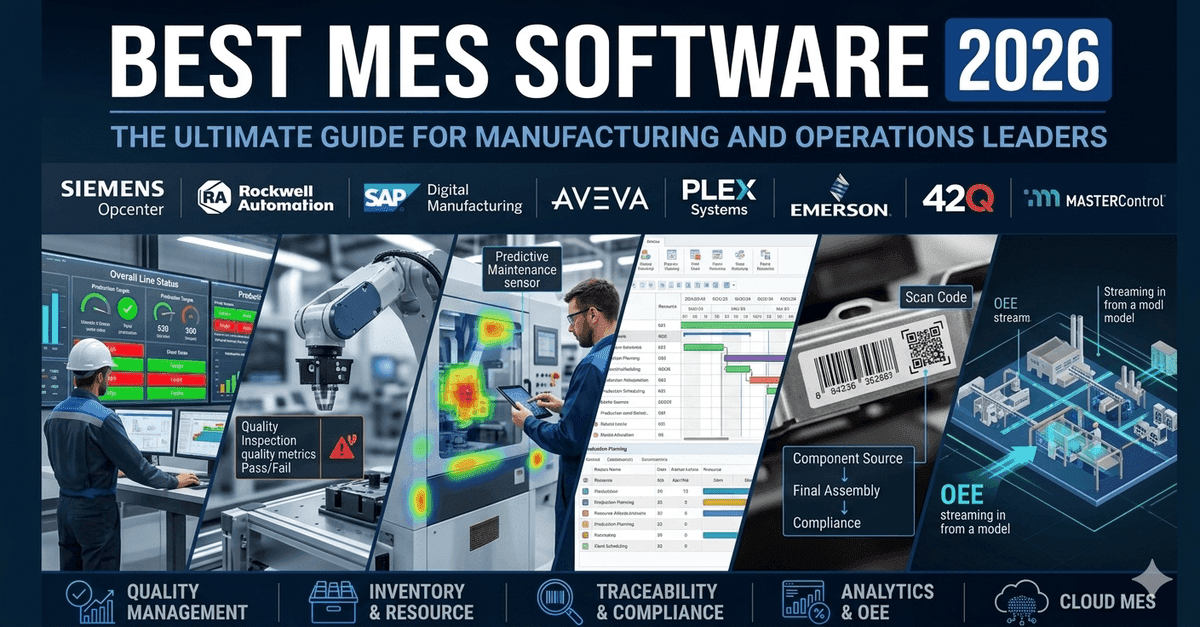
MES selection in 2026 is no longer a question of which platform has the best feature checklist. It is a question of which execution architecture fits your production model, your data strategy, and how you want your stack to behave across plants, shifts, and systems for the next decade.
The market has reorganized around a useful concept: the MINT Stack — MES + IIoT data layer + Namespace/UNS (Unified Namespace) + Tools (connected worker, OEE, analytics). It reflects how manufacturers are actually building execution programs today: not as isolated MES software projects, but as coordinated data-and-execution transformation initiatives where each layer has a clear owner.
Short Answer: The best MES in 2026 is not a single-system answer — it is an architecture answer.
For enterprise discrete: Siemens Opcenter. For global multi-site standardization: DELMIA Apriso. For modular OEE-first: AVEVA MES. For unified Level 1-3 ecosystem: Velotic. For composable, low-code: Tulip. For commercial ISA-95 MES, UNS-native: Rhize.
No single platform wins across all production modes.
Part 1: The Manufacturing Architecture Shift
Why MES Projects Keep Failing
The MES market has spent the last twenty years solving the wrong problem.
Most vendors have focused on expanding functionality: more workflows, more dashboards, more forms, more modules, more integrations.
Yet MES projects remain among the most difficult and expensive initiatives in manufacturing IT.
The reason is not technology.
The reason is ownership.
When MES initiatives struggle, the root cause is usually one of three problems:
- Multiple systems claim ownership of the same information.
- Integration becomes the primary implementation activity.
- The organization cannot agree where business decisions should occur.
The result is familiar.
ERP stores production orders. MES stores execution status. SCADA stores machine data. Quality systems store inspection results. PLM stores manufacturing definitions. Analytics platforms store copied data from all of them.
Every new initiative creates another integration project. Every integration creates another maintenance burden. Every maintenance burden reduces agility.
The challenge facing manufacturers in 2026 is no longer how to collect data. It is how to assign ownership.
The Evolution of Manufacturing Architectures
Manufacturing software has evolved through three distinct generations.
Generation 1: Monolithic Automation
In the first generation, manufacturing systems were largely isolated. PLCs controlled machines. SCADA systems visualized equipment. ERP managed planning and financials. Most information moved through batch exports, spreadsheets, or manual processes. Integration was limited. Visibility was poor. Change was slow.
Generation 2: Integrated MES
The second generation introduced MES as the coordination layer between enterprise systems and factory operations. MES became responsible for dispatching work orders, tracking production, collecting quality data, recording genealogy, managing operators, and monitoring performance.
This architecture created substantial value. For the first time, manufacturers could establish end-to-end visibility across production operations.
However, integration complexity increased dramatically. MES became responsible not only for execution but also for integration, contextualization, workflow management, reporting, and often analytics. The result was a growing concentration of responsibilities inside a single platform.
Generation 3: Composable Manufacturing
The industry is now entering a third phase. Instead of centralizing everything inside MES, organizations are distributing responsibilities across specialized architectural layers.
This shift is enabled by: MQTT, OPC UA, Sparkplug B, Unified Namespace (UNS), event-driven architectures, cloud-native applications, and industrial DataOps platforms.
In this model, MES remains important. But MES is no longer expected to solve every problem. Execution becomes one layer within a larger architecture.
ISA-95: Still Relevant After Twenty-Five Years
Despite frequent claims that ISA-95 is obsolete, the standard remains highly relevant. Its value was never the hierarchy itself. Its value was the recognition that manufacturing responsibilities exist at different levels.
Simplified ISA-95 model:
- Level 4: Enterprise Planning
- Level 3: Manufacturing Operations (MES/MOM)
- Level 2: Supervisory Control (SCADA)
- Level 1: Basic Control (PLCs, DCS)
- Level 0: Physical Process
The challenge is that many implementations interpreted ISA-95 as a software architecture rather than a responsibility model. Organizations attempted to map entire software categories directly onto ISA-95 levels. This frequently produced rigid architectures.
The modern interpretation is different. ISA-95 should define ownership boundaries. It should not dictate product selection.
The Rise of Unified Namespace
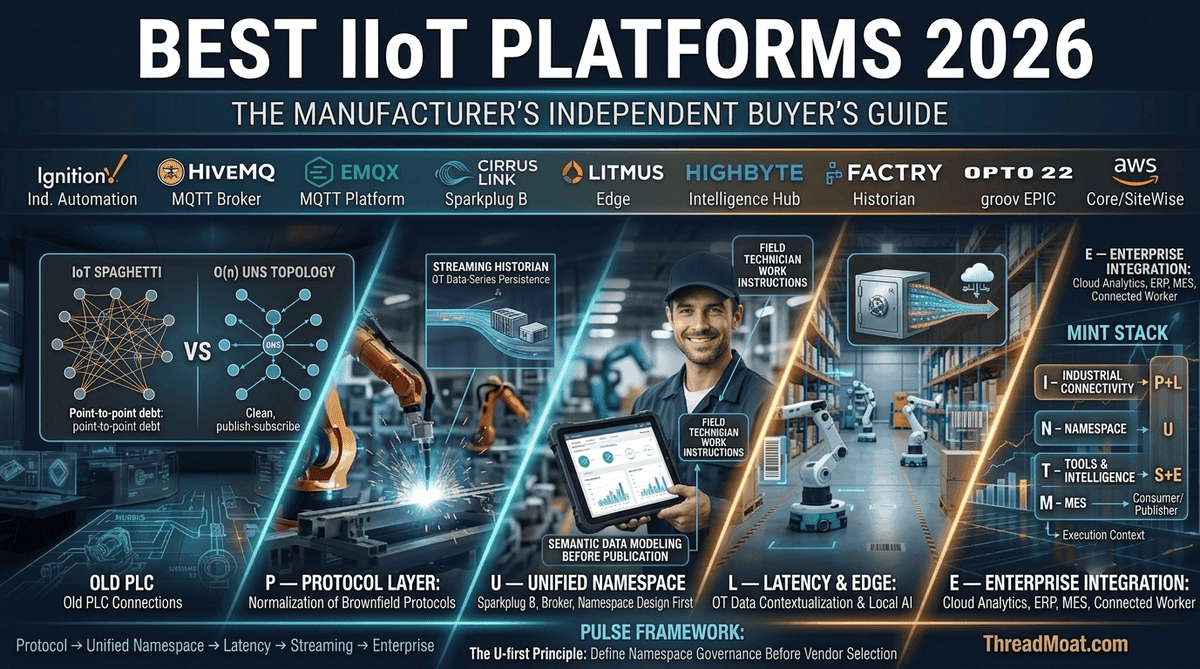
One of the most important developments in manufacturing architecture is the rise of the Unified Namespace (UNS).
Historically, information moved through point-to-point integrations. MES connected to ERP. MES connected to SCADA. SCADA connected to historians. Analytics connected separately to each system. As the number of systems increased, integration complexity grew exponentially.
Unified Namespace addresses this problem by creating a shared information layer. Instead of applications communicating directly with each other, applications publish and consume events through a common namespace.
The benefits include: reduced integration complexity, improved scalability, real-time visibility, easier AI deployment, and greater vendor flexibility.
A Unified Namespace does not replace MES. It changes how MES interacts with the rest of the architecture.
MQTT, OPC UA and Sparkplug B
MQTT
MQTT provides lightweight event transport. Its simplicity makes it ideal for industrial environments. It has become one of the dominant communication mechanisms for modern manufacturing architectures.
OPC UA
OPC UA provides semantic interoperability. Rather than merely transmitting data, OPC UA provides context and structure, making information easier to interpret and reuse across systems.
Sparkplug B
Sparkplug B extends MQTT with industrial semantics. It standardizes device discovery, state awareness, birth certificates, and data models. Sparkplug significantly reduces custom integration work.
Together, MQTT, OPC UA, and Sparkplug B are becoming the backbone of modern manufacturing data architectures.
The MINT Framework
Traditional MES evaluations focus on functionality. The MINT framework focuses on ownership. Rather than asking which vendor provides the most features, MINT asks which layer should own each responsibility.
M — Manufacturing Execution
The execution layer owns: production dispatching, work instructions, genealogy, traceability, operator workflows, and production reporting.
Representative vendors: Opcenter, Apriso, Critical Manufacturing, PAS-X, FactoryLogix.
I — Industrial Connectivity
The connectivity layer owns: device connectivity, protocol translation, data acquisition, and edge integration.
Representative vendors: Kepware, Litmus, HighByte, Ignition, HiveMQ.
N — Namespace and Context
The namespace layer owns: contextualization, event distribution, semantic consistency, and Unified Namespace governance.
Representative technologies: MQTT, Sparkplug B, Unified Namespace architectures.
This layer is increasingly strategic. Many organizations still underestimate its importance.
T — Tools and Intelligence
The tools layer owns: analytics, AI applications, digital twins, maintenance intelligence, scheduling optimization, and decision support.
Representative vendors: TwinThread, InUse, MaintainX, Augmentir, XMPro.
Why Ownership Beats Features
Most software comparisons ask: "Which platform has the most functionality?"
The better question is: "Which platform owns this responsibility?"
For example: Who owns production scheduling? ERP? APS? MES? A specialized scheduling platform?
Different organizations will answer differently. What matters is that ownership is explicit. When ownership is unclear, duplication emerges. When duplication emerges, complexity follows.
The New Evaluation Question
Historically, manufacturers evaluated MES vendors by asking:
- Which platform has the most features?
- Which platform has the largest installed base?
- Which platform integrates with our ERP?
Those questions still matter. But they are no longer sufficient.
The more important questions are:
- Which architecture supports future AI initiatives?
- Which architecture minimizes integration debt?
- Which architecture supports composability?
- Which architecture allows vendor substitution?
- Which architecture creates clear ownership boundaries?
The organizations that answer these questions first consistently outperform those that focus exclusively on software functionality.
Part 2: The Vendor Landscape
The End of the Traditional MES Market
For most of its history, the MES market was relatively easy to understand. A small number of enterprise vendors competed on functionality, industry expertise, implementation methodology, and global support capabilities. Buyers evaluated feature checklists. Analysts published Magic Quadrants. System integrators built implementation practices around a handful of dominant platforms.
That world is disappearing.
In 2026, manufacturers are no longer choosing between ten MES products that solve the same problem. They are choosing between fundamentally different operating models: some platforms prioritize governance and standardization, some prioritize industry specialization, some prioritize composability, some prioritize ERP alignment, others attempt to become manufacturing operating systems.
As a result, vendor selection increasingly begins with architecture rather than functionality.
This report organizes the market into four primary categories and one emerging category.
Tier 1: Enterprise Manufacturing Platforms
Enterprise Manufacturing Platforms support large-scale manufacturing operations spanning multiple facilities, regions, and business units. These platforms are designed to standardize execution across complex organizations while providing governance, traceability, compliance, and operational visibility.
Typical characteristics: global deployments, multi-site governance, ISA-95 alignment, extensive partner ecosystems, long implementation histories, broad manufacturing coverage.
Siemens Opcenter
Siemens remains one of the strongest enterprise manufacturing software providers in the market.
The Opcenter portfolio spans: Manufacturing Execution, Quality Management, Advanced Planning, Laboratory Operations, Electronics Manufacturing, and Process Manufacturing.
The platform benefits from integration across Siemens' broader industrial software portfolio, including Teamcenter, NX, Simcenter, Mendix, Industrial Edge, and Insights Hub.
Strengths: Broad manufacturing coverage; strong process and discrete capabilities; deep ISA-95 alignment; extensive global footprint.
Challenges: Significant implementation complexity; multiple acquired product lines; requires strong governance for large deployments.
Best Fit: Global manufacturers seeking a standardized enterprise execution platform.
DELMIA Apriso
Apriso remains one of the most mature and capable enterprise MES platforms. Its strongest differentiator continues to be governance.
Apriso excels at: global process standardization, multi-site deployments, manufacturing orchestration, traceability, and compliance. The platform is particularly strong in automotive, industrial equipment, aerospace, and complex discrete manufacturing.
Strengths: Strong governance model; multi-site standardization; mature process framework; deep manufacturing expertise.
Challenges: Significant implementation effort; less cloud-native than newer challengers.
Best Fit: Organizations prioritizing process consistency across multiple facilities.
AVEVA Manufacturing Operations
AVEVA occupies a unique position. Unlike most MES vendors, AVEVA participates across multiple operational layers. Its portfolio includes MES, SCADA, Historian, Asset Management, Operations Control, and Industrial Analytics. As a result, buyers frequently evaluate AVEVA as an operational platform rather than simply an MES solution.
Strengths: Strong operational data architecture; broad OT coverage; excellent historian capabilities; process manufacturing expertise.
Challenges: Portfolio complexity; product overlap from acquisitions.
Best Fit: Organizations seeking a unified operational technology stack.
SAP Digital Manufacturing
SAP is no longer simply an ERP vendor extending into manufacturing. Digital Manufacturing has evolved into a legitimate enterprise execution platform combining: production execution, traceability, quality, resource management, and operational analytics — with deep integration into S/4HANA.
Strengths: Tight ERP integration; strong enterprise governance; cloud-first strategy; broad enterprise footprint.
Challenges: SAP-centric architecture; less flexibility than composable alternatives.
Best Fit: Organizations heavily invested in SAP's enterprise ecosystem.
Plex
Plex pioneered cloud-native MES long before many incumbents adopted SaaS delivery models. Today, Plex combines MES, Quality, ERP capabilities, and supply chain functionality within a unified cloud environment.
Strengths: Cloud maturity; faster deployment; strong mid-market penetration.
Challenges: Less depth than some enterprise specialists; limited penetration in highly regulated sectors.
Best Fit: Manufacturers prioritizing cloud deployment and operational simplicity.
Critical Manufacturing
Critical Manufacturing has become one of the most important MES success stories of the last decade. Originally focused on semiconductor manufacturing, the platform has expanded into electronics, medical devices, industrial equipment, and high-tech manufacturing. Its cloud-native architecture and modern technology stack have enabled it to compete directly against much larger incumbents.
Strengths: Modern architecture; semiconductor expertise; strong genealogy and traceability; excellent usability.
Challenges: Smaller partner ecosystem; less penetration outside targeted industries.
Best Fit: Semiconductor, electronics, and highly complex discrete manufacturing.
Velotic
Velotic is one of the most strategically interesting developments in industrial software. Unlike traditional MES vendors, Velotic owns significant assets across multiple MINT layers. Its portfolio includes: Proficy MES, Proficy Historian, Proficy SCADA, ThingWorx, and Kepware — giving Velotic coverage across Manufacturing Execution, Connectivity, Context, and Industrial Applications.
Few competitors can claim similar breadth.
Strengths: MINT coverage across multiple layers; strong industrial connectivity; extensive installed base; broad operational portfolio.
Challenges: Newly assembled portfolio; product integration remains a strategic priority.
Best Fit: Manufacturers seeking broad operational technology capabilities beyond MES alone.
Tier 2: Industry Specialists
Not every manufacturer needs a broad enterprise platform. Many industries require specialized functionality that general-purpose platforms struggle to replicate. Industry specialists win because they understand specific manufacturing processes better than anyone else.
Körber PAS-X
The dominant MES platform in pharmaceutical manufacturing.
Strengths: Electronic batch records; regulatory compliance; validation support; global pharmaceutical adoption.
Best fit: Pharmaceutical and life sciences manufacturers.
iBASEt Solumina
A leading platform for aerospace and defense.
Strengths: Complex assembly processes; quality control; compliance management; serialized manufacturing.
Best fit: Aerospace, defense, and highly regulated manufacturing.
Aegis FactoryLogix
One of the strongest platforms in electronics manufacturing.
Strengths: SMT operations; electronics traceability; process control; manufacturing analytics.
Best fit: Electronics and contract manufacturing.
MPDV HYDRA X
A long-established manufacturing platform with strong penetration in the DACH region.
Strengths: Discrete manufacturing; production monitoring; workforce integration.
Best fit: European industrial manufacturers.
42Q
One of the earliest cloud-native MES platforms.
Strengths: Electronics manufacturing; contract manufacturing; SaaS delivery.
Best fit: High-volume electronics production.
Eyelit Technologies
A semiconductor and electronics MES that has spent three years buying its way into planning. Eyelit now sells the suite as Eyelit SIOP, Eyelit APS, Eyelit MES and Agent EyeQ, delivered on a single data platform.
Strengths: Wafer-fab and back-end semiconductor execution, with genealogy that runs from ingot through wafer, lot, batch and die; genealogy and traceability for high-mix, high-reliability production in medical devices, aerospace and defense, and electronics; MESTEC, the UK multi-tenant cloud MES acquired in 2022, for faster mid-market deployments; finite scheduling from Optessa (acquired 2024, with automotive OEM references) and supply chain planning from Adexa (acquired January 2025). Reference deployments include Raytheon and LFoundry, the semiconductor foundry in Avezzano, Italy, which runs more than 40,000 wafers a month and migrated from its legacy MES to Eyelit MES. That deployment is held to 99.999% uptime and keeps seven years of data online.
Watch for: Eyelit is now a Banneker Partners roll-up of four codebases: Eyelit MES, MESTEC, Optessa and Adexa. The pitch, closing the loop between planning, scheduling and execution, is the right one, and few MES vendors can make it credibly. Eyelit says the suite runs on a single data platform; whether the products behave like one platform or four is still the diligence question, and it should be answered at the demo rather than after go-live.
Best fit: Semiconductor fabs and OSATs, electronics, medical device and A&D manufacturers that want MES and finite scheduling from one vendor, and mid-market plants that want a cloud MES with a short implementation.
TrakSYS (Parsec)
TrakSYS occupies an interesting position between traditional MES and modern manufacturing operations platforms.
Strengths: Process manufacturing; Food & Beverage; Consumer Packaged Goods; Life Sciences; Energy; operational visibility; rapid deployment.
Unlike some enterprise platforms, TrakSYS is often selected because manufacturers want strong manufacturing functionality without the complexity associated with large-scale enterprise rollouts.
Strategic Significance: TrakSYS has quietly become one of the most successful independent MES platforms in the market. While it receives less analyst attention than Siemens, SAP, or Dassault Systèmes, it consistently appears on shortlists across process manufacturing industries and has developed a strong partner ecosystem.
Best Fit: Food & Beverage, Life Sciences, Chemicals, Process Manufacturing, mid-sized to large manufacturers seeking execution capability without enterprise-suite complexity.
Tier 3: Composable Manufacturing Platforms
Composable platforms represent the most important architectural shift in manufacturing software. These vendors do not attempt to own every manufacturing responsibility. Instead, they provide flexible building blocks that participate within broader architectures. This model aligns naturally with MQTT, OPC UA, Sparkplug B, Unified Namespace, and event-driven architectures.
Tulip Interfaces
Tulip pioneered the no-code manufacturing movement. The platform enables manufacturers to rapidly create applications for work instructions, quality workflows, operator guidance, and production tracking — without extensive software development.
Best Fit: Manufacturers seeking agility and rapid deployment.
Rhize
Rhize represents one of the clearest implementations of composable manufacturing principles. The platform emphasizes ISA-95 semantics, manufacturing data models, Unified Namespace concepts, and reusable manufacturing services.
Best Fit: Organizations building next-generation manufacturing architectures.
Ignition
Ignition has become one of the most important software platforms in modern manufacturing. Its flexibility enables deployment across SCADA, MES, dashboards, data collection, and custom applications.
Best Fit: Organizations seeking maximum flexibility.
HighByte
HighByte is helping define the Industrial DataOps category. Its focus is not execution — its focus is contextualized manufacturing data.
Best Fit: Manufacturers implementing UNS architectures.
Litmus
Litmus focuses on industrial edge computing and connectivity.
Best Fit: Organizations modernizing factory connectivity infrastructure.
Fuuz
Fuuz provides a composable manufacturing data and application platform designed to simplify industrial integration.
Best Fit: Organizations pursuing modular architectures.
Tier 4: ERP-Centric Manufacturing Suites
These platforms approach manufacturing through the ERP lens. Their primary value proposition is simplicity — rather than maximizing execution capability, they minimize platform sprawl.
DELMIAworks — The evolution of IQMS continues to appeal to manufacturers seeking integrated ERP and MES capabilities. Best fit: Mid-sized discrete manufacturers.
Epicor Manufacturing — Strong ERP-centered manufacturing functionality. Best fit: Manufacturers prioritizing operational simplicity.
IFS Manufacturing — Combines manufacturing, service, asset management, and ERP functionality. Best fit: Asset-intensive industries.
Oracle Manufacturing Cloud — Part of Oracle's broader enterprise applications ecosystem. Best fit: Organizations standardizing on Oracle technologies.
Key Takeaway
The MES market is no longer a single market. It is a collection of competing architectural philosophies.
Before evaluating vendors, manufacturers should determine which category best aligns with their operating model. Only then does vendor selection become meaningful.
Part 3: Emerging Challengers and the Future of Manufacturing Execution
Innovation Is Moving Outside Traditional MES
For decades, manufacturing software innovation was concentrated inside the MES layer. Vendors competed by adding more functionality. That era is ending.
The most interesting innovation in manufacturing software is increasingly occurring around MES rather than inside MES. A new generation of vendors is attacking specific problems: workflow orchestration, industrial data infrastructure, robot automation, maintenance intelligence, connected workers, and AI-driven operations.
Most of these companies are not trying to become the next Opcenter or Apriso. Instead, they are redefining individual layers of the manufacturing technology stack. This shift aligns closely with the MINT framework — rather than building larger monolithic platforms, these companies focus on owning a specific responsibility exceptionally well.
Manufacturing Operating Systems
One of the most important emerging categories is the Manufacturing Operating System. These platforms sit somewhere between traditional MES, workflow orchestration, product traceability, and manufacturing collaboration. Rather than attempting to replicate legacy MES architectures, they are designed around modern cloud-native principles.
First Resonance
First Resonance is arguably the most important company in this category. Its ION Factory OS platform combines digital travelers, product genealogy, traceability, work instructions, production orchestration, and quality workflows. The company's strongest traction has been within space, aerospace, defense, and advanced hardware startups.
What makes First Resonance particularly interesting is that it is not simply digitizing existing manufacturing processes — it is attempting to redefine how manufacturing organizations operate.
Strategic Significance: First Resonance represents one of the clearest examples of a next-generation Manufacturing Operating System. Among startup challengers, it may currently possess the strongest long-term potential to influence manufacturing execution architectures.
Epsilon3
Epsilon3 emerged from the aerospace and space sectors where procedure execution is mission-critical. The platform focuses on digital procedures, execution workflows, validation, compliance, and operational coordination. Its heritage reflects environments where mistakes carry significant operational consequences.
Rather than replacing MES, Epsilon3 often complements or extends execution environments by improving procedural rigor.
Strategic Significance: Epsilon3 demonstrates how specialized workflow platforms can address execution challenges that traditional MES platforms were never designed to solve.
Authentise
Authentise initially established itself in additive manufacturing but has expanded significantly beyond its origins. Today, the platform provides workflow orchestration, digital manufacturing processes, production coordination, and traceability.
Strategic Significance: Authentise highlights how cloud-native manufacturing platforms can evolve from niche applications into broader operational environments.
Industrial Data Infrastructure
If Manufacturing Operating Systems represent the future of execution, Industrial Data Infrastructure represents the future of connectivity and context. Manufacturers increasingly recognize that AI, analytics, digital twins, and optimization systems are only as effective as the data architectures supporting them.
HighByte
HighByte has emerged as one of the most important companies in Industrial DataOps. Its platform focuses on data modeling, contextualization, transformation, and distribution. Rather than creating another system of record, HighByte helps establish consistency across existing systems.
Strategic Significance: HighByte is becoming a foundational component within many Unified Namespace architectures.
TDengine
TDengine represents a new generation of industrial time-series infrastructure. The platform is optimized for high-volume industrial telemetry, time-series analytics, and edge-to-cloud architectures. As industrial data volumes continue to grow, specialized time-series platforms become increasingly relevant.
Strategic Significance: Industrial AI initiatives frequently depend on scalable telemetry architectures. TDengine addresses this challenge directly.
HiveMQ and EMQX
Both HiveMQ and EMQX have become central to MQTT-based architectures. Their platforms provide event distribution, broker services, scalability, and reliability. As Unified Namespace adoption accelerates, MQTT brokers increasingly become strategic infrastructure rather than technical utilities.
Strategic Significance: Many future manufacturing architectures will depend on capabilities delivered by platforms such as HiveMQ and EMQX.
Quix
Quix focuses on real-time industrial data streaming. Its architecture enables event processing, stream analytics, and real-time operational intelligence.
Strategic Significance: The company reflects the broader shift toward event-driven manufacturing.
Industrial Automation Orchestration
Traditional manufacturing software was designed around people and processes. The next generation increasingly includes autonomous equipment, robots, and intelligent automation systems. This creates new orchestration challenges.
Flexxbotics
Flexxbotics occupies a unique position within the manufacturing technology landscape. Rather than functioning as an MES platform, Flexxbotics focuses on robot orchestration, robot connectivity, automated process coordination, and enterprise integration. The platform enables robots to participate directly within enterprise workflows.
This distinction is important: Flexxbotics is not attempting to replace MES. It is attempting to make automation assets first-class participants within the digital thread.
Strategic Significance: As robotic deployments increase, orchestration may become as important as execution itself. Flexxbotics is one of the earliest companies focused specifically on this challenge.
Asset and Operations Intelligence
Manufacturing execution generates data. The next challenge is turning that data into decisions.
MaintainX
MaintainX has rapidly become one of the most successful modern maintenance platforms. The platform combines work orders, asset management, inspections, mobile workflows, and maintenance intelligence. Its growth demonstrates strong demand for operational software designed around frontline users.
Strategic Significance: MaintainX represents one of the strongest examples of modern operational software disrupting legacy categories. Note: Autodesk acquired MaintainX in May 2026 for $3.6B — the largest acquisition in Autodesk's history — placing the platform inside a new "Autodesk Operations Solutions" division alongside Fusion Operations and Tandem.
InUse
InUse focuses on asset intelligence and operational performance. The platform helps manufacturers move beyond reactive maintenance toward predictive and outcome-based approaches.
Strategic Significance: The company highlights the growing convergence of operational data, AI, and asset management.
TwinThread
TwinThread combines industrial AI, digital twins, and operational optimization. The platform focuses on extracting actionable intelligence from manufacturing data.
Strategic Significance: TwinThread illustrates how AI-native manufacturing platforms are beginning to move from experimentation into production.
XMPro
XMPro provides industrial decision intelligence and orchestration capabilities. Its focus is not simply monitoring systems — its focus is helping organizations automate decisions.
Strategic Significance: Decision automation may ultimately become one of the most valuable applications of industrial AI.
Connected Worker Platforms
Many manufacturing transformation initiatives focus heavily on machines while overlooking people. Connected Worker platforms attempt to address this imbalance by improving communication, guidance, training, and operational awareness for frontline personnel.
Augmentir
Augmentir combines connected worker functionality with AI-driven assistance. Capabilities include digital work instructions, skills management, workforce guidance, and operational intelligence.
Strategic Significance: Augmentir represents one of the strongest examples of AI applied directly to frontline operations.
Parsable
Parsable focuses on digital work execution and operational consistency. Its platform helps organizations standardize procedures and improve workforce productivity.
Strategic Significance: The company demonstrates how workflow execution remains a critical manufacturing challenge.
Workerbase
Workerbase focuses on frontline applications and manufacturing communication. Its platform connects workers, systems, and operational processes through mobile-first experiences.
Strategic Significance: Workerbase reflects the growing importance of human-centered manufacturing software.
ThreadMoat Perspective
The most important lesson from this emerging landscape is that innovation is no longer concentrated within traditional MES. The next generation of manufacturing software leaders may emerge from Manufacturing Operating Systems, Industrial Data Infrastructure, Automation Orchestration, Operations Intelligence, and Connected Worker platforms — rather than from conventional execution systems.
For manufacturers, this creates both opportunity and complexity. The opportunity is access to far more specialized and capable solutions. The complexity is determining how those solutions fit within a coherent architecture. This is precisely why ownership matters. The organizations that understand where these emerging platforms belong within the MINT framework will be best positioned to adopt innovation without recreating the integration challenges of the past.
Part 4: MINT Vendor Evaluation and Architecture Positioning
Why Traditional Scorecards Fail
Most MES evaluations still rely on feature matrices. These factors remain important. However, they rarely explain why some architectures scale successfully while others accumulate technical debt.
The MINT framework evaluates vendors differently. Instead of asking: "How many features does this vendor provide?" MINT asks: "Which responsibilities does this vendor own?"
A vendor that performs exceptionally well within a clearly defined layer may ultimately provide more value than a vendor attempting to own every layer simultaneously.
How to Read This Report: The MINT and SDP Framework
| Dimension | What It Measures | Scale |
|---|---|---|
| M — Manufacturing Execution | Work execution, traceability, genealogy, quality workflows, production management | 1-5 (ownership intensity) |
| I — Industrial Connectivity | Device integration, edge connectivity, protocol translation, machine communications | 1-5 (ownership intensity) |
| N — Namespace & Context | Data contextualization, UNS participation, event architecture, semantic consistency | 1-5 (ownership intensity) |
| T — Tools & Intelligence | Analytics, optimization, AI applications, decision support, operational intelligence | 1-5 (ownership intensity) |
| Cloud | Cloud-native architecture, SaaS delivery, infrastructure independence | 1-5 (maturity) |
| SDP — Strategic Disruption Potential | Likelihood of materially changing manufacturing software architecture by 2030 | 1-5 (potential) |
Rating Scale:
- 5 = Potential category creator / Potential market shaper
- 4 = Strong architectural innovator
- 3 = Important challenger
- 2 = Incremental innovator
- 1 = Primarily established execution model
Table 1: MINT Vendor Scorecard with Strategic Disruption Potential
| Vendor | M | I | N | T | Cloud | SDP | Primary Category |
|---|---|---|---|---|---|---|---|
| Opcenter | 5 | 2 | 2 | 2 | 3 | 2 | Enterprise Platform |
| Apriso | 5 | 2 | 2 | 2 | 3 | 2 | Enterprise Platform |
| AVEVA | 4 | 4 | 2 | 4 | 3 | 3 | Enterprise Platform |
| SAP DMC | 5 | 2 | 2 | 3 | 5 | 3 | Enterprise Platform |
| Plex | 4 | 2 | 1 | 2 | 5 | 3 | Enterprise Platform |
| Critical Manufacturing | 5 | 2 | 2 | 3 | 5 | 4 | Enterprise Platform |
| Velotic | 4 | 5 | 4 | 4 | 4 | 5 | Enterprise Platform |
| TrakSYS | 4 | 2 | 2 | 3 | 4 | 3 | Industry Specialist |
| PAS-X | 5 | 1 | 1 | 1 | 2 | 2 | Industry Specialist |
| Solumina | 5 | 1 | 1 | 1 | 3 | 2 | Industry Specialist |
| FactoryLogix | 5 | 2 | 1 | 2 | 3 | 2 | Industry Specialist |
| HYDRA X | 4 | 2 | 2 | 3 | 3 | 2 | Industry Specialist |
| 42Q | 4 | 2 | 1 | 2 | 5 | 3 | Industry Specialist |
| Eyelit | 5 | 2 | 1 | 3 | 4 | 3 | Industry Specialist |
| Tulip Interfaces | 3 | 2 | 2 | 5 | 5 | 5 | Composable Platform |
| Rhize | 4 | 3 | 5 | 4 | 5 | 5 | Composable Platform |
| Ignition | 2 | 5 | 3 | 3 | 3 | 4 | Composable Platform |
| HighByte | 1 | 5 | 5 | 2 | 5 | 5 | Data Infrastructure |
| Litmus | 1 | 5 | 3 | 2 | 5 | 4 | Composable Platform |
| Fuuz | 3 | 3 | 4 | 3 | 5 | 4 | Composable Platform |
| First Resonance | 4 | 1 | 2 | 4 | 5 | 5 | Manufacturing OS |
| Epsilon3 | 4 | 1 | 1 | 3 | 5 | 4 | Manufacturing OS |
| Authentise | 4 | 1 | 1 | 3 | 5 | 4 | Manufacturing OS |
| Flexxbotics | 1 | 4 | 2 | 4 | 5 | 5 | Automation Orchestration |
| MaintainX | 2 | 1 | 1 | 5 | 5 | 5 | Asset Intelligence |
| InUse | 1 | 1 | 1 | 5 | 5 | 4 | Asset Intelligence |
| TwinThread | 1 | 1 | 2 | 5 | 5 | 5 | Asset Intelligence |
| XMPro | 2 | 1 | 2 | 5 | 5 | 4 | Decision Intelligence |
| Augmentir | 2 | 1 | 1 | 5 | 5 | 5 | Connected Worker |
| Parsable | 2 | 1 | 1 | 4 | 5 | 4 | Connected Worker |
| Workerbase | 2 | 1 | 1 | 4 | 5 | 4 | Connected Worker |
| HiveMQ | 1 | 4 | 5 | 1 | 5 | 4 | Infrastructure |
| EMQX | 1 | 4 | 5 | 1 | 5 | 4 | Infrastructure |
| TDengine | 1 | 2 | 4 | 2 | 5 | 4 | Infrastructure |
| Quix | 1 | 2 | 5 | 2 | 5 | 4 | Infrastructure |
Table 2: ThreadMoat Architecture Positioning Matrix
| Vendor | Primary Category | Industry Focus | Architectural Style | MINT Profile |
|---|---|---|---|---|
| Opcenter | Enterprise Platform | Cross-industry | MES-centric | M-dominant |
| Apriso | Enterprise Platform | Discrete Manufacturing | MES-centric | M-dominant |
| Critical | Enterprise Platform | Semiconductor/Electronics | MES-centric | M-dominant |
| Velotic | Enterprise Platform | Cross-industry | Platform-centric | Multi-layer |
| SAP DMC | Enterprise Platform | Cross-industry | ERP-integrated | M-dominant |
| AVEVA | Enterprise Platform | Cross-industry | Data-first | Multi-layer |
| Plex | Enterprise Platform | Cloud-first | Cloud-centric | M-cloud-heavy |
| TrakSYS | Industry Specialist | Process Manufacturing | Operations-centric | M-dominant |
| PAS-X | Industry Specialist | Pharma | Industry-specific | M-specialist |
| Solumina | Industry Specialist | Aerospace | Industry-specific | M-specialist |
| FactoryLogix | Industry Specialist | Electronics | Industry-specific | M-specialist |
| HYDRA X | Industry Specialist | Discrete Manufacturing | Workflow-centric | M-domain |
| 42Q | Industry Specialist | Electronics | Cloud-native | M-cloud |
| Eyelit | Industry Specialist | Semiconductor/Electronics | Planning-integrated | M-specialist |
| Tulip | Composable Platform | Cross-industry | App-centric | T-dominant |
| Rhize | Composable Platform | Cross-industry | Namespace-centric | Multi-layer N-centric |
| Ignition | Composable Platform | Cross-industry | Flexibility-first | I-centric |
| HighByte | Data Infrastructure | Cross-industry | Data-centric | N-dominant |
| Litmus | Composable Platform | Cross-industry | Connectivity-first | I-dominant |
| Fuuz | Composable Platform | Cross-industry | Integration-centric | Multi-layer N+I |
| First Resonance | Manufacturing OS | Aerospace/Space | Workflow-centric | M-cloud-native |
| Epsilon3 | Manufacturing OS | Aerospace/Space | Procedure-centric | M-specialized |
| Authentise | Manufacturing OS | Aerospace/Space | Digital-native | M-cloud |
| Flexxbotics | Automation Orchestration | Robotics | Automation-centric | I-specialized |
| MaintainX | Asset Intelligence | Cross-industry | Maintenance-centric | T-dominant |
| InUse | Asset Intelligence | Cross-industry | Performance-centric | T-dominant |
| TwinThread | Asset Intelligence | Cross-industry | AI-centric | T-dominant |
| XMPro | Decision Intelligence | Cross-industry | Decision-centric | T-dominant |
| Augmentir | Connected Worker | Cross-industry | AI-enabled | T-dominant |
| Parsable | Connected Worker | Cross-industry | Execution-centric | M-light |
| Workerbase | Connected Worker | Cross-industry | Mobile-first | M-light |
Architectural Observations
Observation 1: Most MES Vendors Only Own M
Traditional MES leaders dominate the Manufacturing Execution layer but provide relatively limited ownership of connectivity, namespace, and intelligence. This is not a criticism — it is simply a reflection of their historical role. For example: Opcenter, Apriso, PAS-X, Solumina remain execution-centric platforms. Manufacturers often need complementary technologies to address the remaining layers.
Observation 2: Velotic Is Unusually Broad
Velotic stands out because it owns significant portions of Manufacturing Execution, Connectivity, Context, and Tools. The combination of Proficy, Kepware, and ThingWorx creates one of the broadest operational technology portfolios currently available. Few vendors span as much of the MINT framework.
Observation 3: HighByte and Rhize Own the Namespace
Most vendors discuss data. Very few vendors explicitly focus on contextualization. HighByte and Rhize are notable because they treat the Namespace layer as a first-class architectural concern. This aligns strongly with Unified Namespace adoption trends.
Observation 4: AI Lives Primarily in T
Many AI initiatives fail because organizations attempt to place AI inside systems that should not own intelligence. The Tools layer is the natural home for predictive maintenance, optimization, scheduling intelligence, digital twins, and generative AI assistants. This explains why vendors such as TwinThread, MaintainX, XMPro, and Augmentir are becoming increasingly important.
Vendor Selection by Manufacturing Scenario
No single platform is optimal for every manufacturer. The correct choice depends heavily on industry, architecture, scale, and operating model.
| Manufacturing Scenario | Recommended Platforms | Primary Requirement |
|---|---|---|
| Global Multi-Site | Opcenter, Apriso, SAP DMC, AVEVA | Global standardization and governance |
| Semiconductor | Critical Manufacturing, Eyelit, Opcenter, FactoryLogix | Genealogy, traceability, process control |
| Electronics | Critical Manufacturing, FactoryLogix, 42Q, Eyelit | High-volume traceability, electronics process expertise |
| Aerospace and Defense | Solumina, Apriso, First Resonance | Complex assembly, quality, compliance, traceability |
| Pharmaceutical | PAS-X, Opcenter Execution Pharma, AVEVA | Regulatory compliance, electronic batch records |
| Cloud-First | Plex, Critical Manufacturing, SAP DMC | Rapid deployment, reduced infrastructure complexity |
| Composable Architecture | Rhize, Tulip, Ignition, HighByte, Litmus, Fuuz | Flexibility and architectural independence |
| Startups and New Factories | First Resonance, Tulip, Epsilon3, Authentise | Agility and rapid iteration |
| Robot-Centric | Flexxbotics, Ignition, Velotic | Automation orchestration, machine integration |
| Maintenance-Led Transformation | MaintainX, InUse, TwinThread | Asset intelligence and operational performance |
Architecture Selection Framework
Before selecting a vendor, manufacturers should answer five questions.
Question 1: Do we want a platform-centric architecture or a composable architecture?
Question 2: Where will operational context be managed? ERP? MES? Namespace? DataOps platform?
Question 3: Who owns industrial connectivity? MES? SCADA? Dedicated connectivity platform?
Question 4: Where will AI applications live? Inside MES? Inside ERP? Or within a dedicated intelligence layer?
Question 5: How easily can individual components be replaced? The answer often determines long-term flexibility more than any individual software capability.
ThreadMoat Recommendation
Organizations should stop asking: Which MES platform is best?
Instead ask: Which architecture creates the clearest ownership model?
The strongest manufacturing architectures increasingly combine:
- An execution layer (M)
- A connectivity layer (I)
- A namespace layer (N)
- An intelligence layer (T)
with clearly defined responsibilities. Once those boundaries are established, vendor selection becomes significantly easier.
2026 Watchlist: Highest Strategic Disruption Potential
| Vendor | SDP Score | Why It Matters |
|---|---|---|
| Rhize | 5 | Namespace-centric architecture that could redefine how manufacturers approach data ownership and composability |
| HighByte | 5 | DataOps leadership positioning it as foundational infrastructure for Unified Namespace implementations |
| Velotic | 5 | Cross-layer ownership spanning execution, connectivity, and intelligence — unprecedented breadth |
| First Resonance | 5 | Manufacturing OS reimagining how execution is orchestrated, not just managed |
| Tulip Interfaces | 5 | Composable execution removing traditional barriers to rapid app deployment |
| Flexxbotics | 5 | Robot orchestration creating a new software category as automation expands |
| MaintainX | 5 | Maintenance intelligence disrupting legacy CMMS and asset management categories |
| Augmentir | 5 | Connected worker AI that could reshape frontline operations as industrial AI matures |
| TwinThread | 5 | AI-native platform moving industrial twins from concept to operational reality |
Part 5: The Future of Manufacturing Execution (2026–2030)
MES Is Not Dying
Every few years, someone predicts the death of MES. The prediction is usually wrong.
Manufacturing execution remains essential. Factories still need to execute production, manage genealogy, track traceability, coordinate quality, guide operators, and monitor performance. None of those requirements are going away.
What is changing is MES's role within the broader architecture. Historically, MES attempted to become the center of manufacturing software. Increasingly, it is becoming one component within a larger ecosystem. The future belongs not to the elimination of MES, but to its specialization.
Prediction 1: Architecture Will Matter More Than Vendors. By 2030, architecture diagrams will matter more than feature matrices. Organizations that establish clear ownership boundaries will consistently outperform those that accumulate overlapping systems and responsibilities.
Prediction 2: Unified Namespace Will Move Into the Mainstream. Today, Unified Namespace remains a relatively advanced concept. By 2030, many manufacturers will view traditional point-to-point integration strategies the same way they now view proprietary networking protocols: technically possible but strategically undesirable. The Namespace layer will become a recognized architectural responsibility.
Prediction 3: Industrial Connectivity Will Become Strategic. The rise of edge computing, industrial AI, digital twins, robotics, and real-time analytics has transformed connectivity into a competitive advantage. Manufacturers increasingly recognize that poor connectivity limits every downstream initiative. Platforms such as Kepware, HighByte, Litmus, HiveMQ, and EMQX will become more strategically important.
Prediction 4: AI Will Not Replace MES. AI requires structure — MES provides structure. AI requires context — manufacturing systems provide context. AI requires traceability — execution systems provide traceability. Rather than replacing MES, AI will increasingly consume information generated by MES. The T layer of MINT becomes the intelligence layer that sits on top of M, not a replacement for it.
Prediction 5: Industrial Copilots Will Become Commonplace. Today's industrial copilots remain relatively immature. The next generation will become operational assistants: maintenance copilots, production copilots, quality copilots. The most successful copilots will not be the most intelligent — they will be the most grounded. Data quality, traceability, and governance will determine success far more than model size.
Prediction 6: Manufacturing Operating Systems Will Emerge as a Major Category. Companies such as First Resonance, Epsilon3, and Authentise are already demonstrating alternative approaches to manufacturing execution — cloud-native architectures, workflow-centric design, rapid configurability, developer-friendly environments, and API-first integration models. The category is particularly attractive to new factories, advanced hardware startups, space companies, and emerging manufacturers.
Prediction 7: Robot Orchestration Will Become a Software Category. The rise of collaborative robots, autonomous mobile robots, flexible automation, and AI-assisted robotics creates a new challenge: who coordinates them? This is where platforms such as Flexxbotics become strategically important. Robot orchestration is likely to become a recognized software category over the next decade.
Prediction 8: Asset Intelligence Will Converge with Manufacturing Intelligence. Production performance depends on asset performance. Asset performance depends on operational behavior. The result is growing convergence between MES, CMMS, APM, and Industrial AI. Platforms such as MaintainX, InUse, TwinThread, and XMPro are already moving in this direction.
Prediction 9: The Winning Platforms Will Be Open. Manufacturers increasingly reject vendor lock-in. As a result, the most successful platforms will increasingly embrace open APIs, event-driven architectures, MQTT, OPC UA, Sparkplug B, and interoperability. Closed ecosystems will continue to exist but will face increasing pressure from customers seeking architectural freedom.
Prediction 10: MINT Will Matter More Than MES. Manufacturing leaders should stop thinking about MES as a standalone category. The future belongs to architectures that clearly define Manufacturing Execution, Industrial Connectivity, Namespace and Context, and Tools and Intelligence. Organizations that optimize individual software products while ignoring architectural ownership will continue to struggle with complexity. Organizations that optimize ownership first will build architectures capable of supporting AI, automation, digital twins, and future innovations.
Final Verdict
The manufacturing software market is entering its most significant transition since the emergence of MES itself. Enterprise platforms remain essential. Industry specialists continue to dominate regulated sectors. Composable architectures are gaining momentum. Manufacturing Operating Systems are challenging established assumptions. Industrial AI is moving from experimentation to execution.
The question facing manufacturers is no longer: Which MES should we buy?
The better question is: What architecture will allow us to adapt fastest over the next decade?
The answer will vary by industry, scale, and strategy. But one principle remains universal.
Technology changes. Vendors change. Architectures endure.
The manufacturers that define ownership clearly, embrace interoperability, and build around adaptable architectural principles will be best positioned to succeed in the decade ahead.
The ThreadMoat Final Conclusion
The future manufacturing software stack will not be built around a single dominant MES.
It will be built around architectures that clearly define ownership across execution, connectivity, context, and intelligence.
The winners of the next decade may come from traditional MES, Industrial DataOps, Manufacturing Operating Systems, Connected Worker platforms, or Industrial AI. The common denominator is not software functionality.
It is architectural clarity.
This report provides the framework to evaluate not which platform to buy today, but which architecture to build for tomorrow.
Related Buyer's Guides
The ThreadMoat Buyer's Guide series covers the full engineering and manufacturing software stack — nine guides, one framework per category:
- Best PLM Software 2026 — VAULT framework · product lifecycle, BOM, change management
- Best CAD Software 2026 — design tool selection matched to supply chain and program complexity
- Best CAM Software 2026 — SWARF framework · CNC programming, postprocessor quality, AI machining stack
- Best Simulation Software 2026 — SOLVE framework · FEA, CFD, AI surrogates, O-first fidelity evaluation
- Best MES Software 2026 — MINT Stack · manufacturing execution, IIoT, unified namespace
- Best EAM/APM Software 2026 — FIELD framework · asset management, predictive maintenance, connected worker
- Best BIM Software 2026 — BUILD framework · AEC authoring, construction coordination, digital twin
- Best SCM Software 2026 — CHAIN framework · supply chain planning, horizon ownership, risk visibility
- Best IIoT Platforms 2026 — PULSE framework · industrial connectivity, unified namespace, edge, historian
All guides: no vendor funding, no analyst-quadrant hedging. Full vendor scorecards and competitive data at threadmoat.com.
A ThreadMoat Independent Research Report | Author: Michael Finocchiaro | Edition: 2026 Q2 | Last Updated: 2026-06-10
Source: Demystifying PLM / ThreadMoat — For advisory services, strategic briefings, market maps, startup intelligence, and research subscriptions, visit ThreadMoat.com.
Want to listen instead of read? 56 DemystifyingPLM articles are available as audio.
Browse audio →Show all chapters ▸Hide chapters ▾
- 1Best CAD Software 2026: The Engineer's Honest Guide
- 2Best PLM Software 2026: Q1 Edition (Archived)
- 3Best CAM Software 2026: The Machinist's Independent Guide
- 4Best MES Software 2026: Q1 Edition (Archived)
- 5Best Simulation Software 2026: Incumbents, Specialists, and the New Constellation
- 6Best MES Software 2026: The Manufacturer's Independent Guide
- 7Best PLM Software 2026: The Independent Buyer's Guide
- 8Best Operations & Asset Management Software 2026: The CIO's Independent Buyer's Guide
- 9Best BIM Software 2026: The Independent Buyer's Guide for AEC and Owner Organizations
- 10Best IIoT Platforms 2026: The Manufacturer's Independent Buyer's Guide
- 11Best SCM Software 2026: The Supply Chain Independent Buyer's Guide
Looking up PLM terminology? Browse the canonical reference.
PLM Glossary →Cite this article
Finocchiaro, Michael. “Best MES Software 2026: The Manufacturer's Independent Guide.” DemystifyingPLM, June 9, 2026, https://www.demystifyingplm.com/best-mes-software-2026
Michael Finocchiaro (opens in a new tab)
PLM industry analyst · 35+ years at IBM, HP, PTC, Dassault Systèmes
Firsthand knowledge of the evolution from early 3D modeling kernels to today's cloud-native platforms and agentic AI — the history, strategy, and future of PLM.