Show all chapters ▸Hide chapters ▾
- 1Best CAD Software 2026: The Engineer's Honest Guide
- 2Best PLM Software 2026: Q1 Edition (Archived)
- 3Best CAM Software 2026: The Machinist's Independent Guide
- 4Best MES Software 2026: Q1 Edition (Archived)
- 5Best Simulation Software 2026: Incumbents, Specialists, and the New Constellation
- 6Best MES Software 2026: The Manufacturer's Independent Guide
- 7Best PLM Software 2026: The Independent Buyer's Guide
- 8Best Operations & Asset Management Software 2026: The CIO's Independent Buyer's Guide
- 9Best BIM Software 2026: The Independent Buyer's Guide for AEC and Owner Organizations
- 10Best IIoT Platforms 2026: The Manufacturer's Independent Buyer's Guide
- 11Best SCM Software 2026: The Supply Chain Independent Buyer's Guide
Key Takeaways
- Buying MES without a data architecture strategy is a trap
- The MINT Stack framing reframes the buying decision from "which MES" to "which execution architecture"
- Connected worker tools are not a replacement for MES — they are the human-facing execution layer that sits next to it
- The best MES implementation is the one where every other system in the stack knows exactly what MES owns
Short Answer
This is the Q1 2026 archived edition. The current Q2 2026 guide — including the full MINT Stack framework, 34-vendor scorecard, and complete emerging challengers analysis — is at /best-mes-software-2026.
- This is the archived Q1 2026 edition — see /best-mes-software-2026 for the current Q2 guide
- MES sits at ISA-95 Level 3 — it is the operational layer between ERP and SCADA/PLC
- The MINT Stack (MES + IIoT + Namespace/UNS + Tools) is the organizing concept for modern manufacturing architecture
- Velotic (the 2026 rebrand of Proficy + Kepware + ThingWorx) is one of the most architecturally significant moves in the market
- The ownership model is the real deliverable of a good MES selection
Best MES Software 2026: Q1 Edition (Archived)
This is the archived Q1 2026 edition. The current Q2 2026 edition — with the full MINT Stack framework, complete 34-vendor scorecard, Part 1 manufacturing architecture evolution, full emerging challengers analysis (First Resonance, Epsilon3, HighByte, Flexxbotics, Augmentir, and more), and the complete vendor selection matrix across 10 manufacturing scenarios — is at Best MES Software 2026 (Q2).
This post presents the key findings from the ThreadMoat MES Buyer's Guide 2026 Q1 edition. For the full report including all vendor scorecards and the complete MINT Vendor Scorecard across 30+ platforms, visit threadmoat.com.
Executive Summary
MES selection in 2026 is no longer a question of which platform has the best feature checklist. It is a question of which execution architecture fits your production model, your data strategy, and how you want your stack to behave across plants, shifts, and systems for the next decade.
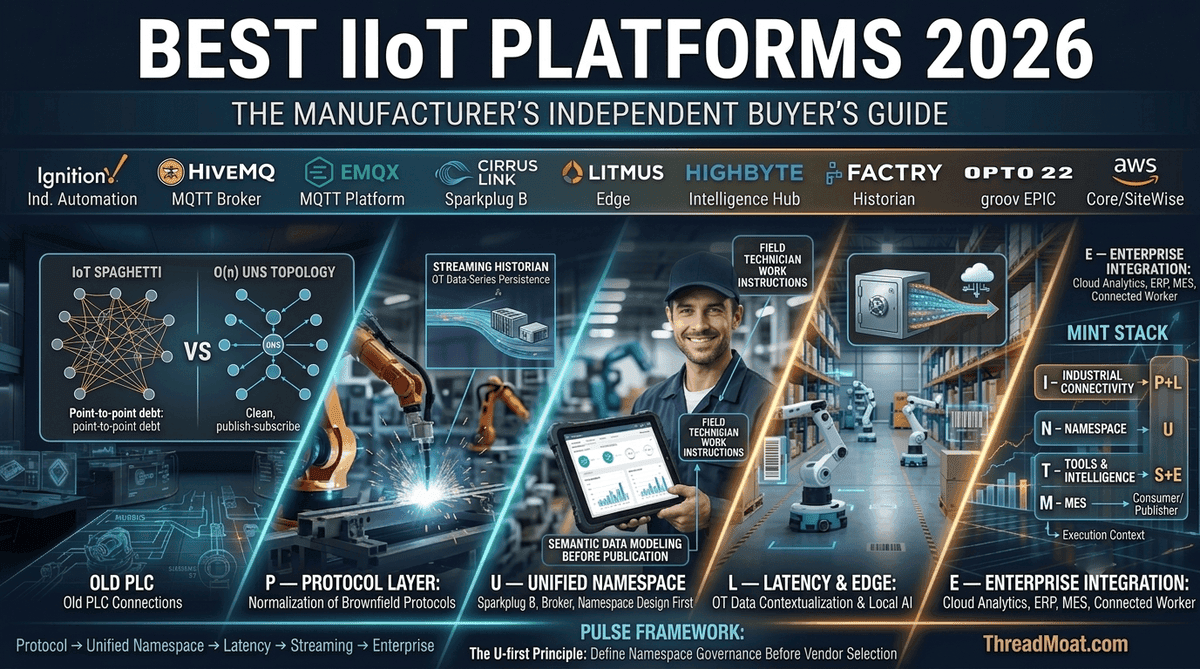
The market has reorganized around the MINT Stack:
- M — Manufacturing Execution: Production dispatching, work instructions, genealogy, traceability, operator workflows, production reporting
- I — Industrial Connectivity: Device connectivity, protocol translation, data acquisition, edge integration
- N — Namespace and Context: Contextualization, event distribution, semantic consistency, Unified Namespace governance
- T — Tools and Intelligence: Analytics, AI applications, digital twins, maintenance intelligence, scheduling optimization
Short Answer: The best MES in 2026 is not a single-system answer — it is an architecture answer.
Tier 1: Enterprise Manufacturing Platforms
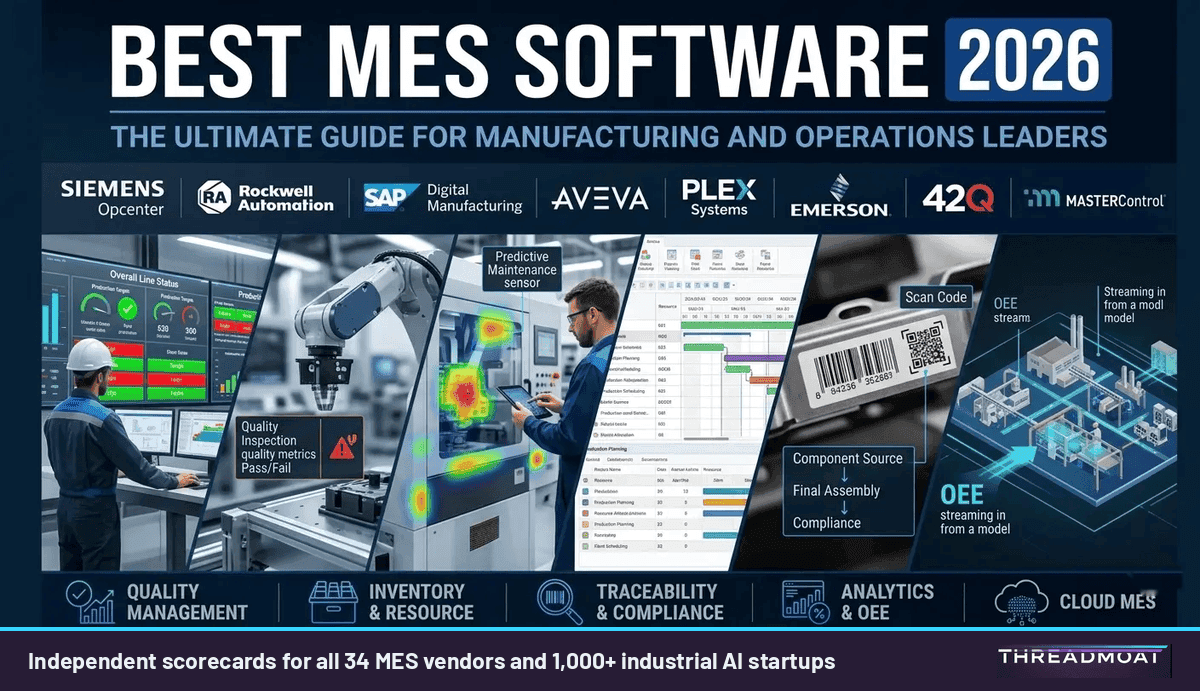
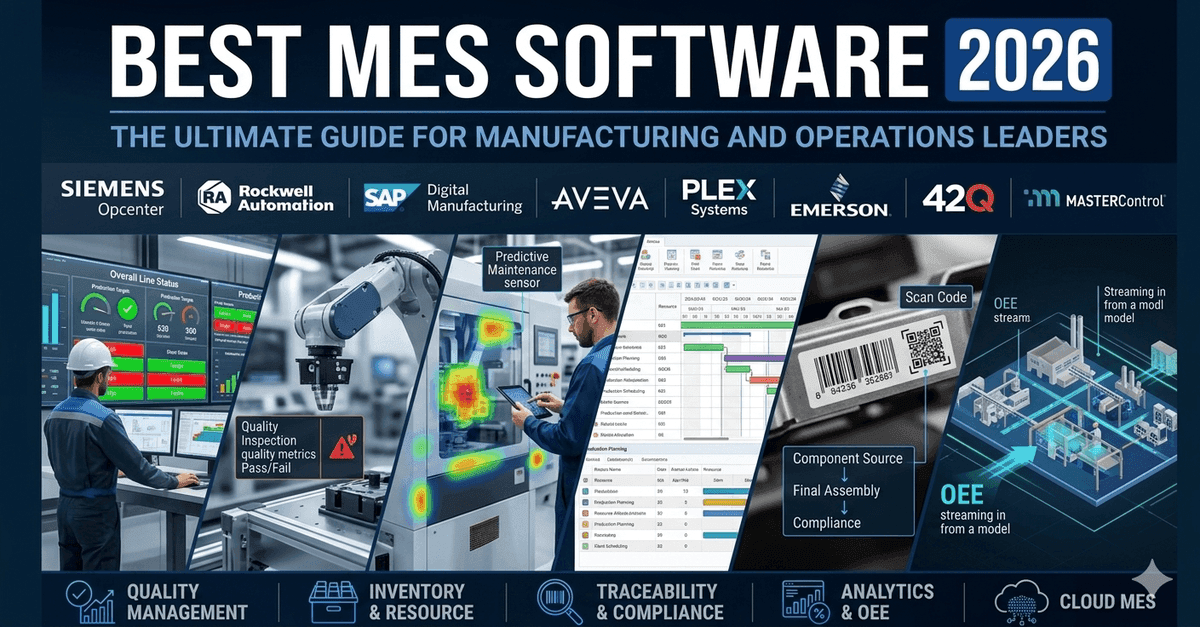
Siemens Opcenter
Broad manufacturing coverage spanning discrete, process, electronics, and laboratory operations. Strongest ISA-95 alignment. Benefits from integration across Siemens' broader industrial software portfolio including Teamcenter, NX, Simcenter, Mendix, and Insights Hub.
Best fit: Global manufacturers seeking a standardized enterprise execution platform.
DELMIA Apriso
One of the most mature enterprise MES platforms. Its strongest differentiator is governance — multi-site process standardization, manufacturing orchestration, and traceability. Particularly strong in automotive, industrial equipment, and aerospace.
Best fit: Organizations prioritizing process consistency across multiple facilities.
AVEVA Manufacturing Operations
Participates across multiple operational layers including MES, SCADA, Historian, Asset Management, and Industrial Analytics. Strong operational data architecture and process manufacturing expertise.
Best fit: Organizations seeking a unified operational technology stack.
SAP Digital Manufacturing
Deep integration into S/4HANA. Cloud-first strategy. Production execution, traceability, quality, and resource management.
Best fit: Organizations heavily invested in SAP's enterprise ecosystem.
Velotic
One of the most strategically significant developments in industrial software. Portfolio spans Proficy MES, Proficy Historian, Proficy SCADA, ThingWorx, and Kepware — coverage across Manufacturing Execution, Connectivity, Context, and Industrial Applications. MINT Score: M=4, I=5, N=4, T=4.
Best fit: Manufacturers seeking broad operational technology capabilities beyond MES alone.
Critical Manufacturing
Cloud-native architecture that has enabled it to compete directly against much larger incumbents. Originally focused on semiconductor manufacturing, now covering electronics, medical devices, and industrial equipment.
Best fit: Semiconductor, electronics, and highly complex discrete manufacturing.
Plex
Cloud-native MES with combined MES, Quality, ERP, and supply chain functionality.
Best fit: Manufacturers prioritizing cloud deployment and operational simplicity.
Tier 2: Industry Specialists
| Platform | Industry | Key Strength |
|---|---|---|
| Körber PAS-X | Pharmaceutical | Electronic batch records, regulatory compliance |
| iBASEt Solumina | Aerospace / Defense | Complex assembly, serialized manufacturing |
| Aegis FactoryLogix | Electronics | SMT operations, electronics traceability |
| MPDV HYDRA X | DACH industrial | Discrete manufacturing, workforce integration |
| 42Q | High-volume electronics | Cloud-native, contract manufacturing |
| TrakSYS (Parsec) | Process / F&B / Life Sciences | Operations visibility, rapid deployment |
Tier 3: Composable Manufacturing Platforms
Tulip Interfaces — No-code manufacturing app platform. Work instructions, quality workflows, operator guidance, production tracking without extensive software development.
Rhize — ISA-95 semantics, manufacturing data models, UNS-native architecture.
Ignition — Maximum flexibility across SCADA, MES, dashboards, data collection, and custom applications.
HighByte — Industrial DataOps category. Data modeling, contextualization, transformation, and distribution for UNS architectures.
Litmus — Industrial edge computing and connectivity.
Fuuz — Composable manufacturing data and application platform.
Tier 4: ERP-Centric Manufacturing Suites
DELMIAworks, Epicor Manufacturing, IFS Manufacturing, Oracle Manufacturing Cloud — for manufacturers where minimizing platform sprawl is the primary requirement.
Q1 MINT Scorecard (Selected Vendors)
| Vendor | M | I | N | T | Cloud | SDP |
|---|---|---|---|---|---|---|
| Opcenter | 5 | 2 | 2 | 2 | 3 | 2 |
| Apriso | 5 | 2 | 2 | 2 | 3 | 2 |
| AVEVA | 4 | 4 | 2 | 4 | 3 | 3 |
| SAP DMC | 5 | 2 | 2 | 3 | 5 | 3 |
| Velotic | 4 | 5 | 4 | 4 | 4 | 5 |
| Critical Manufacturing | 5 | 2 | 2 | 3 | 5 | 4 |
| Tulip | 3 | 2 | 2 | 5 | 5 | 5 |
| Rhize | 4 | 3 | 5 | 4 | 5 | 5 |
| HighByte | 1 | 5 | 5 | 2 | 5 | 5 |
The Q2 edition covers all 34 vendors including First Resonance, Epsilon3, Authentise, Flexxbotics, MaintainX, InUse, TwinThread, XMPro, Augmentir, Parsable, Workerbase, HiveMQ, EMQX, TDengine, and Quix.
The Ownership Model
The real deliverable of a good MES selection is a clear ownership model:
- PLM defines the MBOM and process plan
- ERP plans and costs
- MES executes on the floor
- EAM owns assets
- UNS distributes real-time events to everything else
When ownership is unclear, duplication emerges. When duplication emerges, complexity follows.
Related Articles
Want to listen instead of read? 56 DemystifyingPLM articles are available as audio.
Browse audio →Show all chapters ▸Hide chapters ▾
- 1Best CAD Software 2026: The Engineer's Honest Guide
- 2Best PLM Software 2026: Q1 Edition (Archived)
- 3Best CAM Software 2026: The Machinist's Independent Guide
- 4Best MES Software 2026: Q1 Edition (Archived)
- 5Best Simulation Software 2026: Incumbents, Specialists, and the New Constellation
- 6Best MES Software 2026: The Manufacturer's Independent Guide
- 7Best PLM Software 2026: The Independent Buyer's Guide
- 8Best Operations & Asset Management Software 2026: The CIO's Independent Buyer's Guide
- 9Best BIM Software 2026: The Independent Buyer's Guide for AEC and Owner Organizations
- 10Best IIoT Platforms 2026: The Manufacturer's Independent Buyer's Guide
- 11Best SCM Software 2026: The Supply Chain Independent Buyer's Guide
Looking up PLM terminology? Browse the canonical reference.
PLM Glossary →Cite this article
Finocchiaro, Michael. “Best MES Software 2026: Q1 Edition (Archived).” DemystifyingPLM, May 30, 2026, https://www.demystifyingplm.com/best-mes-software-2026
Michael Finocchiaro (opens in a new tab)
PLM industry analyst · 35+ years at IBM, HP, PTC, Dassault Systèmes
Firsthand knowledge of the evolution from early 3D modeling kernels to today's cloud-native platforms and agentic AI — the history, strategy, and future of PLM.