Key Takeaways
- AI works best in manufacturing on tasks with high volume, clear success criteria, and low tolerance for missed edge cases.
- CAM programming for standard features is the clearest early win — AI can generate 80% of the toolpath for a known feature family in seconds.
- Work instruction generation from engineering BOMs and process plans is a force multiplier that compounds with documentation volume.
- The irreducible 20% — first-article sign-off, exception handling, tribal knowledge judgment calls — stays with experienced machinists and process engineers.
- Tribal knowledge is not a barrier to AI adoption; it is the training signal that makes AI reliable in domain-specific manufacturing contexts.
Short Answer
AI in manufacturing follows a clear 80/20 split: it owns high-volume, well-defined, repetitive tasks like standard CAM programming, work instruction generation, and visual inspection classification. The remaining 20% — first-article judgment calls, supplier exception handling, and domain-specific tribal knowledge decisions — requires experienced humans. Companies that deploy AI correctly in the 80% free up engineers for the 20%, compressing cycle times without losing quality gates.
- The 80% that AI owns: standard feature CAM toolpath generation, work instruction drafting, visual inspection pass/fail classification, documentation from structured data.
- The 20% that humans keep: first-article sign-off decisions, supplier deviation exceptions, novel material or tolerance stack-ups, process debugging when root cause is ambiguous.
- Tribal knowledge is the training corpus, not the bottleneck — AI tools trained on expert decisions become better at the 80% when fed high-quality examples.
- The risk in AI manufacturing deployments is not automation going too far; it's automation deployed without clear success criteria producing confident-sounding wrong answers.
- Force multiplier framing matters: AI that handles 80% of CAM prep lets CNC programmers focus on the 20% that requires judgment, not the other way around.
Manufacturing AI conversations tend to split into two camps: the utopians (AI will fully automate the factory floor) and the skeptics (AI can't replace the experienced machinist). Both are wrong about the same thing: the question is not whether AI can handle a task, but which fraction of which tasks it can handle reliably, and what that unlocks for the humans doing the rest.
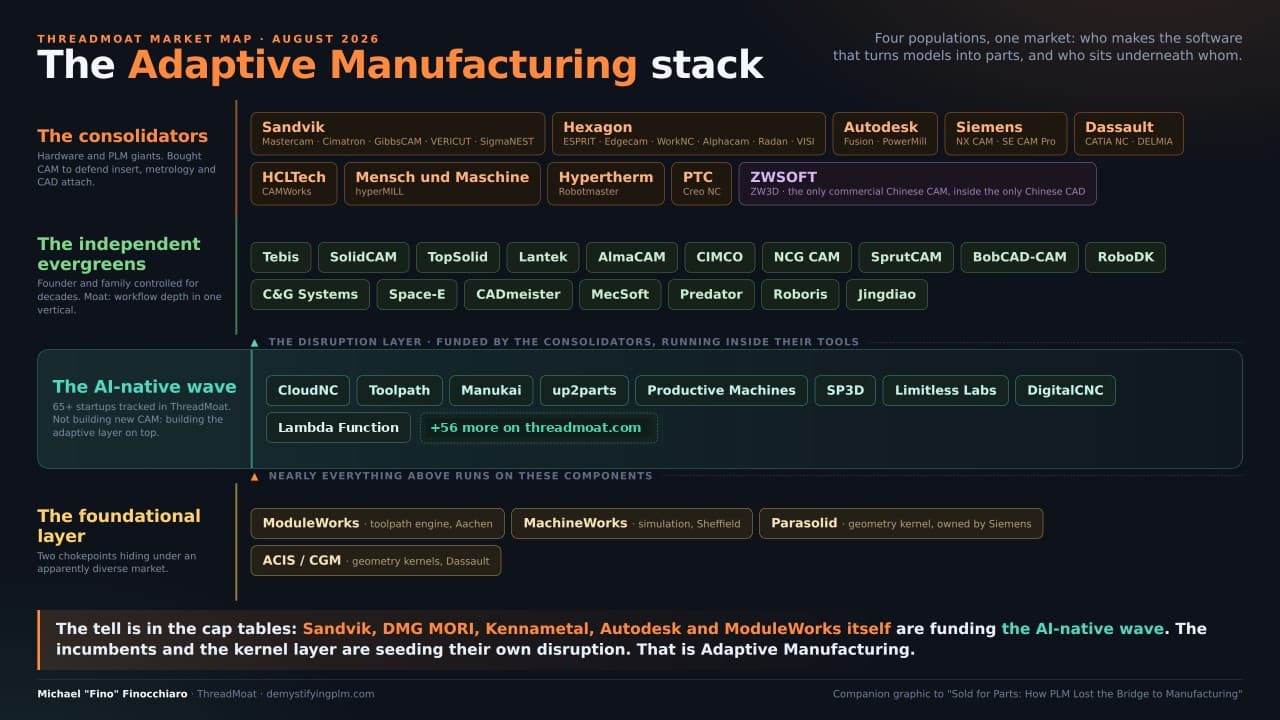
Dirac and LimitlessCNC gave us a precise frame in our conversation: the 80/20 rule. AI owns 80% of specific, well-defined manufacturing tasks. Humans keep the 20% that requires judgment, context, and exception handling. The value isn't in replacing the human — it's in freeing the human for the 20% where their expertise is irreplaceable.
The 80%: Tasks Where AI Earns Its Place
Three manufacturing task families fall clearly on the AI side of the line.
CAM programming for standard features. Pocket milling, boring operations, turned profiles, and standard contours follow deterministic rules: feature geometry determines the toolpath family, material determines cutting parameters, machine capability determines the post-processing constraints. AI trained on a manufacturer's historical programs can generate first-draft toolpaths for a new part in seconds. A programmer reviews, corrects, and approves — rather than authoring from scratch. LimitlessCNC's core thesis is that this isn't theoretical: it's working in production shops today.
Work instruction generation. Assembly and machining work instructions are documentation-intensive. A typical factory processes dozens of new part numbers per month, each requiring step-by-step procedure documentation. AI trained on existing instructions, fed a structured BOM and process plan, generates a first draft that a manufacturing engineer reviews in minutes rather than authors in hours. At scale — 50 new part numbers per month — this is thousands of hours of documentation effort recovered annually.
Visual inspection classification. Pass/fail inspection decisions on standard defect types (surface finish, dimensional conformance on measured features, solder joint quality) are pattern-matching problems that AI handles well when given sufficient labeled training data. Dirac's work instruction platform connects this to downstream quality loops: the inspection result feeds back into the work instruction, flagging which steps correlate with quality escapes.
The 20%: Where Humans Stay in the Loop
The irreducible 20% is not AI failure — it is the structural limit of pattern matching when applied to genuinely novel situations.
First-article sign-off. The first article is not a pattern-matching problem. It is a judgment call: does this part, as machined, meet intent — and would an experienced engineer stake their reputation on approving it? That judgment incorporates material behavior the AI has never seen, supplier history the AI doesn't have, and manufacturing risk tolerance that varies by program. AI can prep the first-article inspection report. A human makes the call.
Exception handling with real stakes. When a supplier calls at 4pm to say the material cert is non-conforming and production is scheduled for Monday, the decision tree involves supplier relationship history, program schedule risk, engineering judgment on the non-conformance, and commercial consequences. These inputs aren't in any training dataset.
Tribal knowledge at the edge of the distribution. Experienced process engineers know that this material chatters at high spindle speeds in humid summer conditions. That this particular fixture has 0.003" of compliance that must be pre-loaded before the first pass. AI trained on historical programs learns the average pattern. The expert knows the exceptions — and the exceptions are where quality escapes happen.
Tribal Knowledge Is the Training Signal, Not the Obstacle
One of the most practically important points from the Dirac conversation: tribal knowledge doesn't have to die with the expert who holds it.
The engineering teams with the richest training data — annotated exception logs, quality escape root-cause records, expert correction histories on AI drafts — produce the best AI tools. Tribal knowledge, properly documented, becomes the training signal that pushes AI performance in the 80% from acceptable to excellent.
The deployment implication: AI rollout in manufacturing should include structured knowledge capture from experienced engineers. Every time an expert corrects an AI-generated work instruction or approves an AI-generated toolpath with modifications, that correction is a training example. Systems that capture those corrections compound over time.
Deploying in the Right Order
The failure mode in manufacturing AI deployments is not automation going too far — it's automation deployed without clear success criteria, producing confident-sounding wrong answers on tasks where "wrong" means a scrapped part or a quality escape.
The practical deployment sequence:
-
Define the success criteria first. For CAM programming, it might be: AI-generated toolpath requires fewer than 20% of lines edited by a programmer. For work instructions: engineer reviews average under 30 minutes. Without measurable criteria, there is no signal for improvement.
-
Start with the highest-volume, most standardized task family. Companies with 200 similar turned parts have a clear AI deployment target. Companies with 5 highly customized parts per year do not.
-
Instrument every correction. Every time a human improves on an AI output, that improvement is training data. Systems that throw away human corrections are wasting their best signal.
-
Expand the AI boundary incrementally. Once AI owns 80% of standard CAM, measure its performance on slightly more complex features. Don't push into the 20% until the 80% is solid.
The 80/20 frame is not a ceiling — it's a starting point. As AI systems accumulate more training signal from expert corrections, the effective percentage of automatable work expands. The path from 80% to 90% runs through the quality of the feedback loop, not the capability of the base model.
Cite this article
Finocchiaro, Michael. “The 80/20 Rule for AI in Manufacturing: Which Tasks AI Owns and Which Humans Keep.” DemystifyingPLM, May 23, 2026, https://www.demystifyingplm.com/insights/podcast-companion-ai-manufacturing-8020