Key Takeaways
- PLM owns the engineering record: what was designed, changed, configured, and released. It provides lifecycle traceability from requirement to design to manufacturing handoff.
- QMS owns the compliance record: what was validated, audited, and corrected. It manages nonconformances, CAPA events, audit findings, and regulatory submissions.
- In regulated industries (medical, automotive, aerospace), both systems are mandatory. The integration between them — connecting engineering change to CAPA records and design history to regulatory submissions — is a compliance architecture.
- CAPA (Corrective and Preventive Action) is the most frequent integration point: a quality event in QMS triggers an engineering change in PLM, which must be formally linked for regulatory traceability.
- Organizations that try to use one system as a substitute for the other end up with compliance gaps, audit findings, and traceability records that cannot be defended under regulatory scrutiny.
Short Answer
PLM (Product Lifecycle Management) governs the engineering lifecycle: design history, change management, configuration baselines, and manufacturing release. QMS (Quality Management System) governs the compliance lifecycle: validation records, nonconformances, CAPA events, audit readiness, and regulatory submissions. In regulated industries, both are required. PLM provides the authoritative engineering record that QMS regulatory submissions are built on; QMS provides the quality event records that drive engineering changes back through PLM. The integration between them is a compliance obligation, not an optional IT enhancement.
- PLM owns engineering change; QMS owns corrective action.
- Both are required in regulated industries — neither substitutes for the other.
- CAPA-to-ECO is the most architecturally significant integration between QMS and PLM.
- Design history files (medical) and PPAP/APQP records (automotive) depend on PLM data feeding QMS regulatory submission workflows.
- Organizations without a clear QMS-PLM boundary frequently fail quality audits on traceability grounds.
Why it matters: In regulated industries, the QMS-PLM boundary is not an IT architecture question — it is a compliance question. A medical device manufacturer without a formal design history file (DHF) linked to engineering change records in PLM will fail a 21 CFR Part 820 audit. An automotive supplier without PPAP documentation connected to the approved engineering configuration in PLM will fail an IATF 16949 customer audit. The integration between QMS and PLM is the mechanism by which engineering rigor translates into regulatory defensibility. Getting it right from the start costs a fraction of the remediation cost after a regulatory finding.
QMS vs PLM: Who Owns Quality?
The question "who owns quality" sounds deceptively simple. In regulated industries, it has a precise answer: both systems own a different half of it, the integration between them is a compliance requirement, and getting the boundary wrong produces audit findings.
Here is the working definition: PLM owns the engineering record of what was designed, changed, and approved. QMS owns the compliance record of what was validated, audited, and corrected.
What PLM Owns
PLM (Product Lifecycle Management) is the system of record for the product's engineering lifecycle. In a quality and compliance context, PLM contributes:
- Design history — all engineering changes, design reviews, and revision records tied to the product's evolution
- Requirements management — formal traceability from customer or regulatory requirement to design feature
- Configuration baselines — approved configurations tied to serial numbers, lots, or effectivity records
- Manufacturing release — the formal release of the engineering record to manufacturing (the source of the Design History File in medical device contexts)
- Engineering change governance — the ECO/ECN process that governs every revision and links it to its justification
PLM operates on change cycles. Engineering change is a governed, asynchronous process — a problem is identified, an affected-item analysis is run, a change is designed and reviewed, an ECO is approved, and a new revision is released. This cycle is measured in days or weeks.
See [[plm-vs-pdm]] for where PLM's engineering change governance begins relative to simpler PDM systems, and [[what-is-plm-configuration-management]] for a detailed look at how PLM manages configuration baselines.
What QMS Owns
QMS (Quality Management System) is the system of record for the product's compliance lifecycle. It owns:
- Nonconformance management — formal records of quality failures, deviations, and out-of-specification events
- CAPA management — Corrective and Preventive Action: the investigation, root cause analysis, and resolution process for quality events
- Audit management — internal audit schedules, audit findings, and closure records
- Document control — controlled versions of SOPs, work instructions, and quality plans that regulatory bodies audit
- Regulatory submission workflows — Design History Files (medical), PPAP packages (automotive), and similar regulatory artifacts
- Training records — evidence that operators were qualified for the processes they performed
QMS operates on audit cycles and regulatory submission timelines. The pace is different from PLM's change cycle — quality events and audits are event-driven, but regulatory submissions have fixed calendar deadlines.
The Integration Architecture
The QMS-PLM integration has three primary connection points:
CAPA-to-ECO (the most frequent integration)
A field complaint, nonconformance, or audit finding is opened as a CAPA in QMS. The investigation concludes that the root cause requires a design or process change. A formal ECO is opened in PLM. The link between the QMS CAPA record and the PLM ECO number is the regulatory traceability artifact — auditors trace from the quality event to the engineering change to the validation that confirms the fix. Without this link, the CAPA is not auditably closed.
Design History File (DHF) assembly
Medical device manufacturers are required by 21 CFR Part 820 to maintain a DHF for each device type. The DHF includes design inputs (requirements from PLM), design outputs (drawings and specifications from PLM), design reviews (PLM workflow records), design verification (test records from QMS), design validation (clinical or operational validation records from QMS), and design transfer (manufacturing release from PLM). The DHF is assembled from both systems — it is not a PLM artifact or a QMS artifact; it is a compiled regulatory record that draws from both.
Requirements traceability across the compliance lifecycle
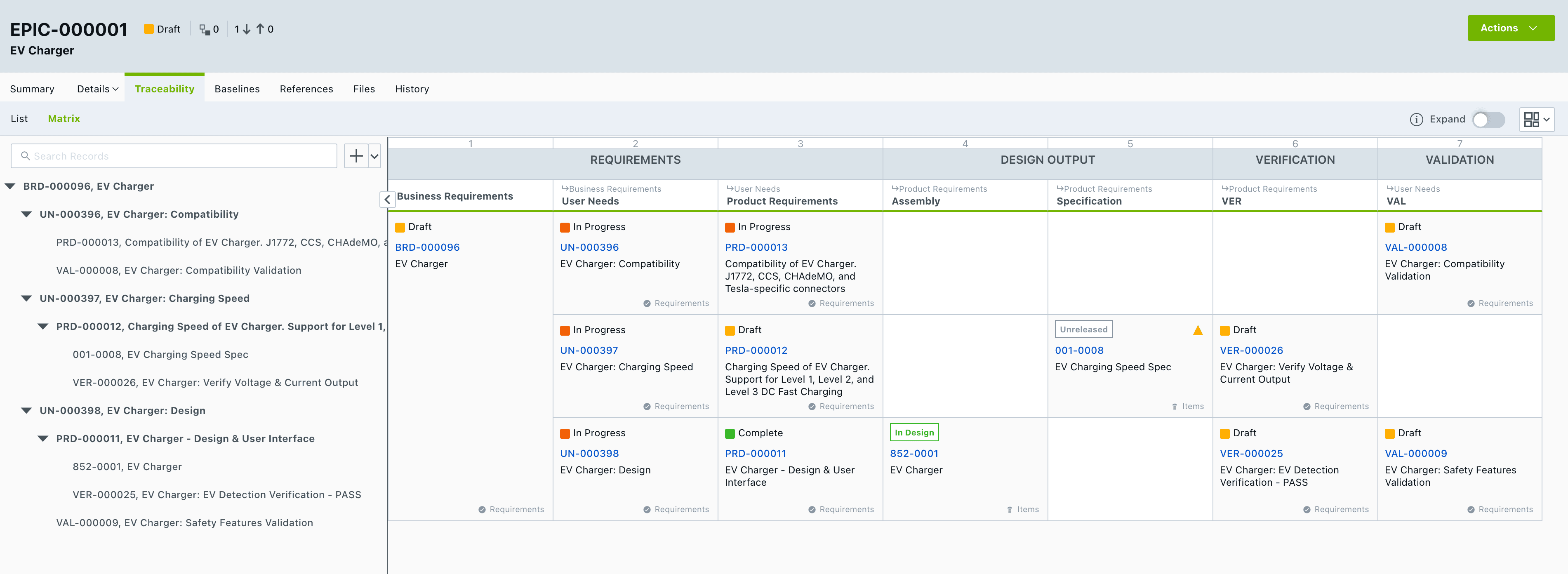
Requirements traceability connects the regulatory requirement or customer specification (PLM) to the design feature that satisfies it (PLM), to the verification test that confirms it (QMS), to the validation evidence that proves it in use (QMS). This chain is the backbone of a regulatory submission and the most commonly deficient area in FDA warning letters related to design controls.
Configuration governance in PLM is the enabling discipline: without formal configuration baselines tied to approved design states, the requirements traceability chain cannot be reliably anchored to a specific product configuration.
Where Organizations Go Wrong
Using PLM as a QMS substitute: PLM workflow tools can manage change approval and document version control, but they are not designed for CAPA investigation workflows, audit management, nonconformance disposition under regulatory standards, or the specific document control requirements of ISO 13485 or 21 CFR Part 820. Organizations that try to use PLM as a QMS end up with a change management system that cannot produce a defensible DHF or CAPA record.
Using QMS as a PLM substitute: QMS document control modules can hold drawings and specifications in approved versions, but they were not designed for product structure management, eBOM-to-mBOM transformation, engineering change governance with affected-item analysis, or configuration baseline management. Organizations that manage engineering data in QMS typically do so because PLM was not implemented — and they pay for it in audit findings that cite inadequate design control.
Treating the integration as optional: In regulated industries, the CAPA-to-ECO link and the DHF assembly process are not optional integrations — they are regulatory requirements. Organizations that defer the integration create a gap that is both a compliance liability and a technical debt that grows with every quality event that is not formally linked to an engineering change record.
Industry-Specific Requirements
Medical devices (21 CFR Part 820, ISO 13485): The DHF requirement is the most explicit mandate for PLM-QMS integration in any regulatory framework. Every design change must be documented, reviewed, and linked to validation records. The FDA's Quality System Regulation treats design control as a system — not a collection of individual records — and the systems integration between PLM and QMS is the mechanism that makes the system legible under audit.
Automotive (IATF 16949, APQP/PPAP): The Production Part Approval Process (PPAP) requires a package of engineering and quality records — including DFMEA, PFMEA, control plan, measurement system analysis, and dimensional results — that draws from both PLM (engineering configuration, FMEA inputs) and QMS (validation records, control plan approvals). APQP (Advanced Product Quality Planning) is the process framework that spans both systems from concept through production launch.
Aerospace (AS9100, AS9102): First Article Inspection (FAI) requirements mandate that the as-built unit of a new design or a design change be inspected against the approved engineering record and the result formally documented. The FAI report connects the as-built configuration (from the shop floor, via MES) to the approved design baseline (from PLM) to the quality record (in QMS) — a three-system traceability chain.
Capability Comparison
| Capability | PLM | QMS |
|---|---|---|
| Engineering change governance | Yes | No |
| Requirements management | Yes | Partial |
| Configuration baselines | Yes | No |
| Manufacturing BOM release | Yes | No |
| Nonconformance management | No | Yes |
| CAPA management | No | Yes |
| Audit management | No | Yes |
| Design History File | Contributes | Owns |
| PPAP / APQP | Contributes | Owns |
| Document control (SOPs) | No | Yes |
| Training records | No | Yes |
| Regulatory submissions | Source | Owns |
Summary
PLM and QMS are not competing systems. In regulated industries, both are required by law or customer contract, and the integration between them is the architecture that makes regulatory compliance defensible under audit.
PLM owns the engineering record: what was designed, changed, approved, and released for manufacturing. QMS owns the compliance record: what was validated, audited, and corrected. The CAPA-to-ECO integration is the most frequent and most architecturally significant connection — it is the mechanism by which quality events drive engineering improvements and engineering improvements close quality records.
Organizations that invest in a clean PLM-QMS integration early save substantial remediation cost when the first serious audit arrives. The integration is not an IT convenience — it is the compliance architecture.
Want to listen instead of read? 56 DemystifyingPLM articles are available as audio.
Browse audio →Looking up PLM terminology? Browse the canonical reference.
PLM Glossary →Cite this article
Finocchiaro, Michael. “QMS vs PLM: Who Owns Quality in a Product Organization?.” DemystifyingPLM, January 25, 2024, https://www.demystifyingplm.com/qms-vs-plm
Michael Finocchiaro (opens in a new tab)
PLM industry analyst · 35+ years at IBM, HP, PTC, Dassault Systèmes
Firsthand knowledge of the evolution from early 3D modeling kernels to today's cloud-native platforms and agentic AI — the history, strategy, and future of PLM.