Key Takeaways
- Technology does not transform companies — people do
- 80% of environmental impact is determined early in design through connected data ecosystems
- AI accelerates execution, not creativity — restrict it to narrow, repetitive tasks
- Enterprise PLM transformations require realistic 3-5 year timelines with sustained C-suite sponsorship
- The digital thread is as much political as it is technical
Short Answer
The central theme was human-centric digital transformation: technology changes are manageable, but successfully transforming people and culture is the hardest part. Every session reinforced that PLM transformation fails due to organizational change outpacing the roadmap, not technology limitations.
110+ PLM leaders. Two days. Jerez, Spain. The second Share PLM Summit delivered something rare for a PLM conference: honest, practitioner-led conversations about what actually works — and what doesn't — in enterprise digital transformation.
I was there for both days. Here is what emerged.
Four Pillars of Successful Digital Transformation
The sessions organized naturally around four recurring themes. Not four vendor pitches. Four structural truths that companies either learned the hard way or haven't learned yet.
Pillar 1: PLM as Foundation, Not Afterthought
The keynote set the tone immediately. Beatriz González Pedraza and Thomas Winden opened not with software features but with organizational diagnosis: geopolitical instability, energy constraints, supply chain fragility, rising product complexity. These are the pressures companies are navigating when they decide to transform.
Their central argument: "Technology does not transform companies. People do."
That framing held throughout Day 1. Javier Sánchez Jiménez from Kerry went further: "People do not resist PLM, Lean, AI, or any other methodology. They resist uncertainty." His case study from Kerry Sevilla showed employee engagement jumping from 24% to 65% after implementing a transformation with an inverted org chart — operators at the top, management in the role of obstacle removal.
Andreas Wank from Pepperl+Fuchs walked through what consolidating 130+ legacy systems and 200 colleagues actually looks like: 17 departments, 42 major issues identified during validation, and a "mood curve" tracking employee sentiment across implementation phases. Their lesson: "People do not only want to know benefits; they want daily work impact." Authentic adoption requires more than change communication.
Matthias Gabriel from SMS Group described PLM transformation during M&A crisis — a 12-month TSA deadline, 180 employees across 4 countries, migrating from Autodesk/Vault/ENOVIA to an SAP-centric architecture. They retained Inventor specifically to reduce adoption fear. "Technology migration is relatively predictable. Human migration is not."
Susanna Mäentausta from Novartis (year 4 of their transformation at a 75,000-person pharmaceutical company) described a startup survival mindset inside a large enterprise: changing sponsors, departing champions, shifting priorities. Their strategic pivot — fix the data backbone first, embed standardization directly into SAP S/4HANA — made removal nearly impossible once operational systems depended on it. "We brought a small elephant through the back door."
Pillar 2: The Digital Thread Becomes Non-Negotiable at Scale
Henri Syrjäläinen from SSAB gave one of the sharpest talks of the summit. His point was brutally practical: if you want AI in operations, you first need to manage the lifecycle of information. Not just collect data. Manage it.
"The digital thread is not a dashboard. It is the governed lifecycle of the information needed to operate, improve, maintain, and transform the plant."
That means knowing which information matters, assigning ownership, managing versions and context, connecting engineering, ERP, MES, maintenance, and operations, preserving process history, and making changes traceable. In capital projects, OEMs and EPCs still deliver documents. The owner-operator then converts those documents into usable plant data. That handoff is broken.
Manuel Oliva from Airbus Defence and Space showed the aerospace version of this problem: coordinating teams across 15+ countries, with manufacturing engineers forced to simultaneously consider "process feasibility, machine constraints, assembly sequencing, cost, compliance, logistics across countries, lifecycle maintainability." The value of model-based engineering lies in creating machine-readable enterprise knowledge — enabling simulations, AI scenario exploration, and earlier verification.
Ankit Talati and Evgenii Egorov from Cadmatic demonstrated why shipbuilding exposes weaknesses in traditional PLM thinking: each ship differs slightly, document-centricity remains high, lifecycle support spans decades, and data must persist beyond the original shipyard. Generic EBOM/MBOM concepts don't map cleanly. Cadmatic builds shipbuilding-specific data models rather than forcing yards into generic frameworks. Their principle: "Users don't want to search for data. They want to see the right data in the right context with the right maturity."
The Aras and XPLM joint session made the environmental stakes explicit: up to 80% of a product's environmental impact is determined early in the design phase. Sustainability in engineering is not a reporting problem. It is a decision-timing problem. Critical information exists across PLM, ERP, CAD, and spreadsheets — but lacks connectivity at the actual decision points.
Pillar 3: AI Accelerates Execution, Not Creativity
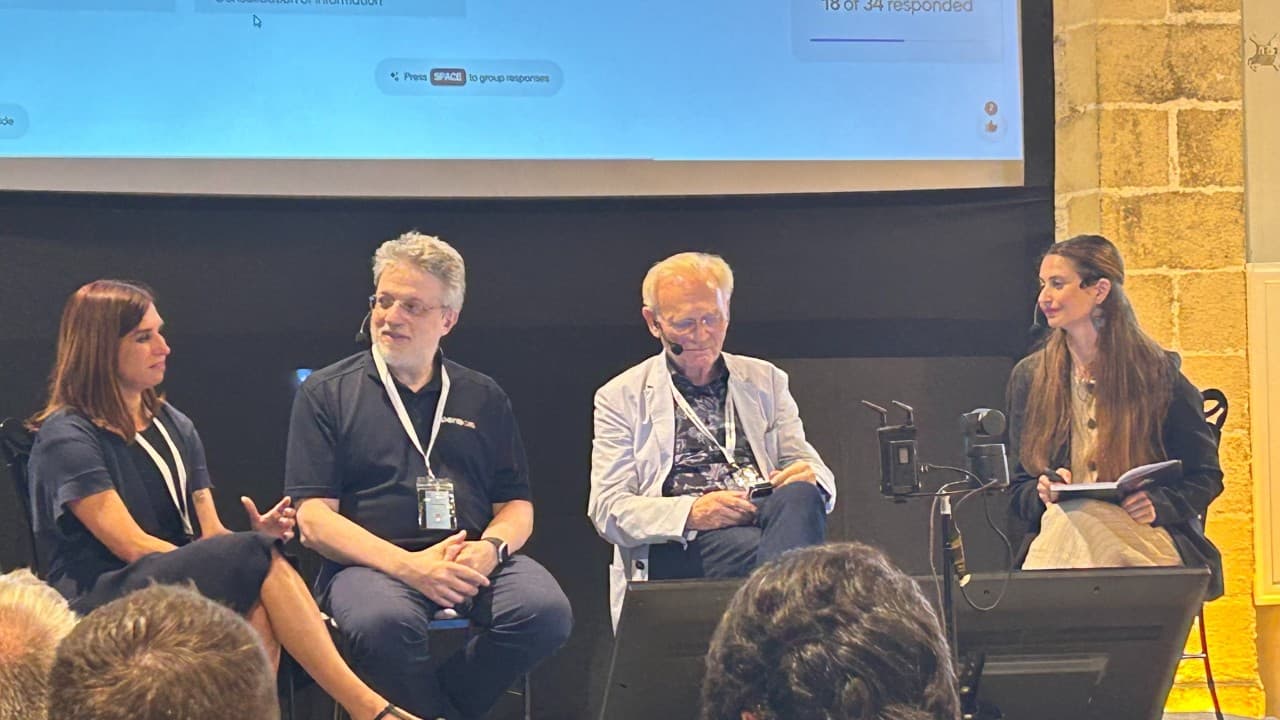
The AI panel on Day 2 — Oleg Shilovitsky, Martin Eigner, Helena Gutierrez, moderated by Viktoria Tsiokou — was the most intellectually honest AI conversation I've heard at a PLM conference.
Notable quotes:
- "The real battle isn't PLM vs AI. It's AI vs Excel."
- "Responsibility cannot be outsourced to ChatGPT."
- "The danger isn't AI replacing engineers. It's engineers losing expertise by over-trusting AI."
Dennis Götting from PTC framed the core problem: "Plausible is not trusted." AI anchored in enterprise PLM data and organizational semantics is useful. Generic AI is plausible but useless. His Volkswagen Codebeamer example — 53% effort reduction on specific requirements tasks through AI-generated requirements and dependency analysis — showed what grounded AI looks like in practice.
Helena Gutierrez (the Day 2 keynote) confronted uncomfortable realities: AI already performs significant portions of work professionals spent years mastering. Business models built around hourly knowledge work are deteriorating. Her enterprise AI harness concept — encoding operational DNA, workflows, organizational memory, and contextual data rather than simply using ChatGPT — is the right frame for industrial adoption.
James Wright from CONTACT Software identified the real bottleneck: the constraint has shifted from data availability to organizational knowledge management and accessibility. "No one person is that smart anymore." AI functions best as an expertise amplifier — surfacing tacit knowledge, guiding workflows, connecting stakeholders — not replacing experts.
Pillar 4: Scale Demands Discipline
Dennys Gomes from Vestas delivered the most quantified case study of the summit. Vestas discovered suppliers utilized only a fraction of provided engineering documentation. The pivot: optimize the data, not the drawings.
Results:
- Tower documentation: 400 hours → 35 hours
- ~850 drawings replaced with automated model generation
- Tower delivery timelines shortened by 11 weeks
- First-wave savings exceeded €1M annually
The path required legal changes (making data the contractual authority), procurement alignment, supplier onboarding, and manufacturing participation. Strategic sequencing mattered: simplification, semantic data structuring, interoperability, and machine-readable engineering information — all before layering AI.
Antonio Casaschi from ASSA ABLOY (400+ acquisitions, 65,000+ employees, 200+ R&D sites, 200+ production plants) abandoned traditional top-down PLM standardization entirely. User-centered design, behavioral science, and trust-building replaced mandates. Their finding: adoption succeeds when tools are intuitive, feature modern UX, align with peer usage, and integrate naturally into workflows.
Alex Sampedro from SKF articulated the C-suite translation problem: PLM teams fail by "trying to sell PLM" instead of business outcomes. The C-suite prioritizes faster decisions, shorter sales cycles, AI readiness, and operational agility — not CAD integrations or BOM structures. The real skill is asking better questions of people, not mastering technical tools.
The Honest AI Workshop Conclusion
The final workshop summary said it plainly: AI won't eliminate engineering. It will force the profession to redefine human engineering value. The question is whether companies get ahead of that shift intentionally — or discover it through a slow erosion of expertise.
The digital thread is as much political as it is technical. That was the most important line of the conference, and it applied to everything: AI adoption, MBE rollout, cloud migration, sustainability reporting. Every technical architecture decision has an organizational politics problem underneath it.
Six Takeaways
- Audit data silos first. Quantify integration points as your entry strategy — not as a diagnostic exercise but as a budget and priority argument.
- Map digital threads before selecting tools. Define required information flows; tools are secondary to the information architecture.
- Invest seriously in change management. Employee surveys, stakeholder engagement, bottom-up business scenario building. These are not soft extras — they are the primary differentiator.
- Narrow your AI ambitions. Focus AI on repetitive work and data-driven decisions. Protect domain expertise, don't erode it.
- Plan 3-5 year transformations. Budget, staff, and communicate accordingly. The companies that fail are the ones that expected 18 months.
- Extend data flows beyond internal PLM. Include customers and suppliers. SSAB and Vestas both demonstrated that external data flows are where the real operational leverage lives.
For session-by-session summaries and links to all 25 posts, see the Share PLM Summit 2026 Post Index.
The inaugural SharePLM Summit in Jerez, Spain (2025) started this conversation — see the SharePLM Summit 2025 Post Index for the full session archive.
Want to listen instead of read? 56 DemystifyingPLM articles are available as audio.
Browse audio →Looking up PLM terminology? Browse the canonical reference.
PLM Glossary →Cite this article
Finocchiaro, Michael. “Share PLM Summit 2026 — From Data Silos to Digital Transformation.” DemystifyingPLM, May 10, 2026, https://www.demystifyingplm.com/share-plm-summit-2026-conference-report
Michael Finocchiaro (opens in a new tab)
PLM industry analyst · 35+ years at IBM, HP, PTC, Dassault Systèmes
Firsthand knowledge of the evolution from early 3D modeling kernels to today's cloud-native platforms and agentic AI — the history, strategy, and future of PLM.