Key Takeaways
- 25 session summaries from Share PLM Summit 2026 in Jerez, Spain
- Day 1 covers keynote, people-centric PLM, digital thread, and sustainability
- Day 2 covers AI keynote, MBE, knowledge management, and the AI workshop panel
- Full analysis article available separately
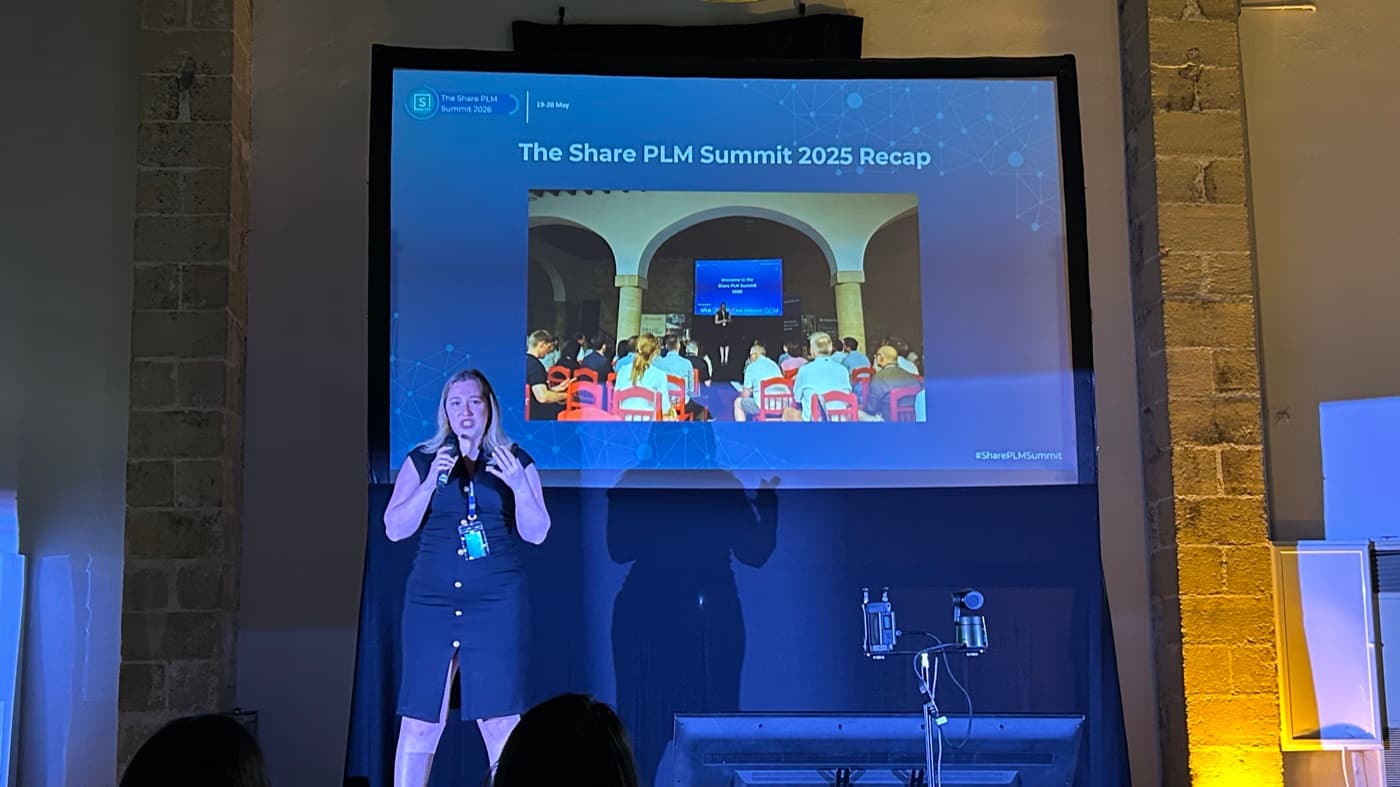
Share PLM Summit 2026 took place May 19–20 in Jerez, Spain. 110+ PLM leaders, practitioners, vendors, and consultants — two days of unusually honest conversations about what enterprise digital transformation actually requires.
For the full synthesis, see the conference analysis article.
Below is the chronological index of all 25 session summaries, linked to the original LinkedIn posts.
Day 1 — May 19, 2026
Keynote
Beatriz González Pedraza and Thomas Winden (Share PLM) PLM Transformation as a People, Leadership, and Culture Problem
"Culture is not what's written on posters. It's how leaders behave." The 2026 keynote shifted focus from software to organizational challenges — geopolitical instability, energy constraints, supply chain issues, rising complexity — and argued that transformation requires embedding change directly into implementation phases.
Session 1
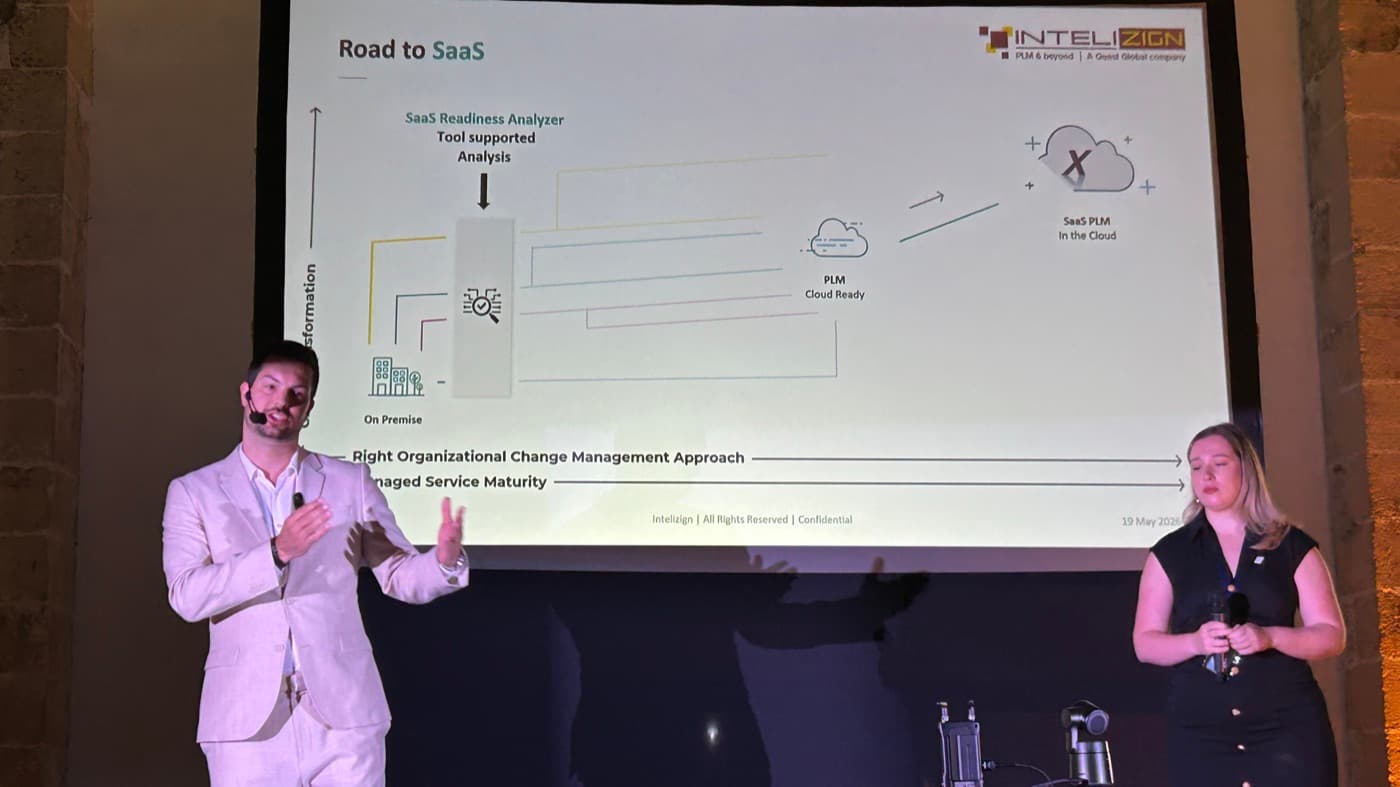
Julian Wiese (Intelizign) and Maria Morris (Share PLM) The Road to SaaS in PLM — Organizational Redesign, Not Software Upgrade
Moving legacy Teamcenter environments to cloud platforms isn't a software upgrade — it's an organizational redesign exercise. Intelizign presented a data-driven approach: automated code analysis, SaaS compatibility benchmarking, and roadmap sequencing. An environment showing 75% SaaS compatibility can still contain blocking rich-client customizations requiring underlying business process changes.
Session 2
Henri Syrjäläinen (SSAB) Industrial AI is Blocked by Bad Lifecycle Information, Not Bad Algorithms
The most practically grounded talk of Day 1. SSAB's journey through fossil-free steelmaking, greenfield mills, brownfield modernization, and decades of legacy systems. "The digital thread is not a dashboard. It is the governed lifecycle of the information needed to operate, improve, maintain, and transform the plant."
Session 3
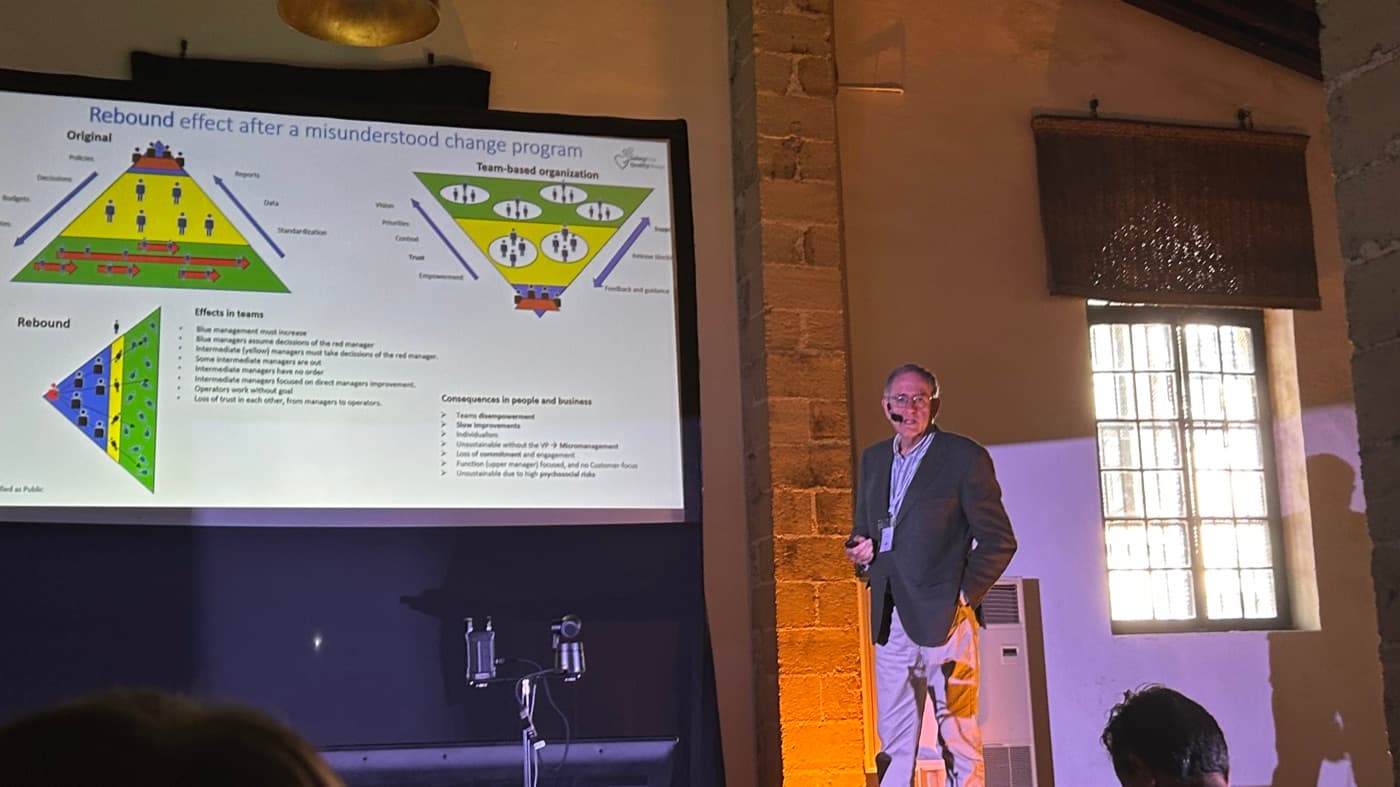
Javier Sánchez Jiménez (Kerry) People Don't Resist PLM — They Resist Uncertainty
Kerry Sevilla: employee engagement from 24% to 65% after the One Kerry Plant System implementation. An inverted org chart positioned operators at the top with management below — leadership's role is removing obstacles, not mandating adoption. "The C-suite does not buy PLM. They buy outcomes."
Session 4
Marcellus Menges (SICK Sensor Intelligence) Data is the New Oil — But Only After It's Refined
Customers don't pay for data — they pay for performance, automation, compliance, and faster decisions. The proposed model: PLM as a business-relevant information layer built around an adaptive digital thread. "PLM has discussed this vision since the 1990s. Now the technology may finally exist to build it."
Session 5
Ankit Talati and Evgenii Egorov (Cadmatic) Shipbuilding as the Stress Test for PLM Generalism
Ships require years to design and build; each differs slightly; lifecycle support spans decades. Generic EBOM/MBOM concepts don't map cleanly to shipbuilding reality. Cadmatic builds domain-specific data models rather than forcing yards into generic frameworks. "Users don't want to search for data. They want to see the right data in the right context with the right maturity."
Session 6
Paula Garcia (Share The Nest) Intentional Spaces for Human Connection in the AI Era
One of the most unexpected talks — and that's exactly why it worked. As AI automates more cognitive tasks, competitive advantage shifts toward creativity, emotional intelligence, collaboration, adaptability, and human trust. "The most valuable asset in the AI era is still the human being."
Session 7
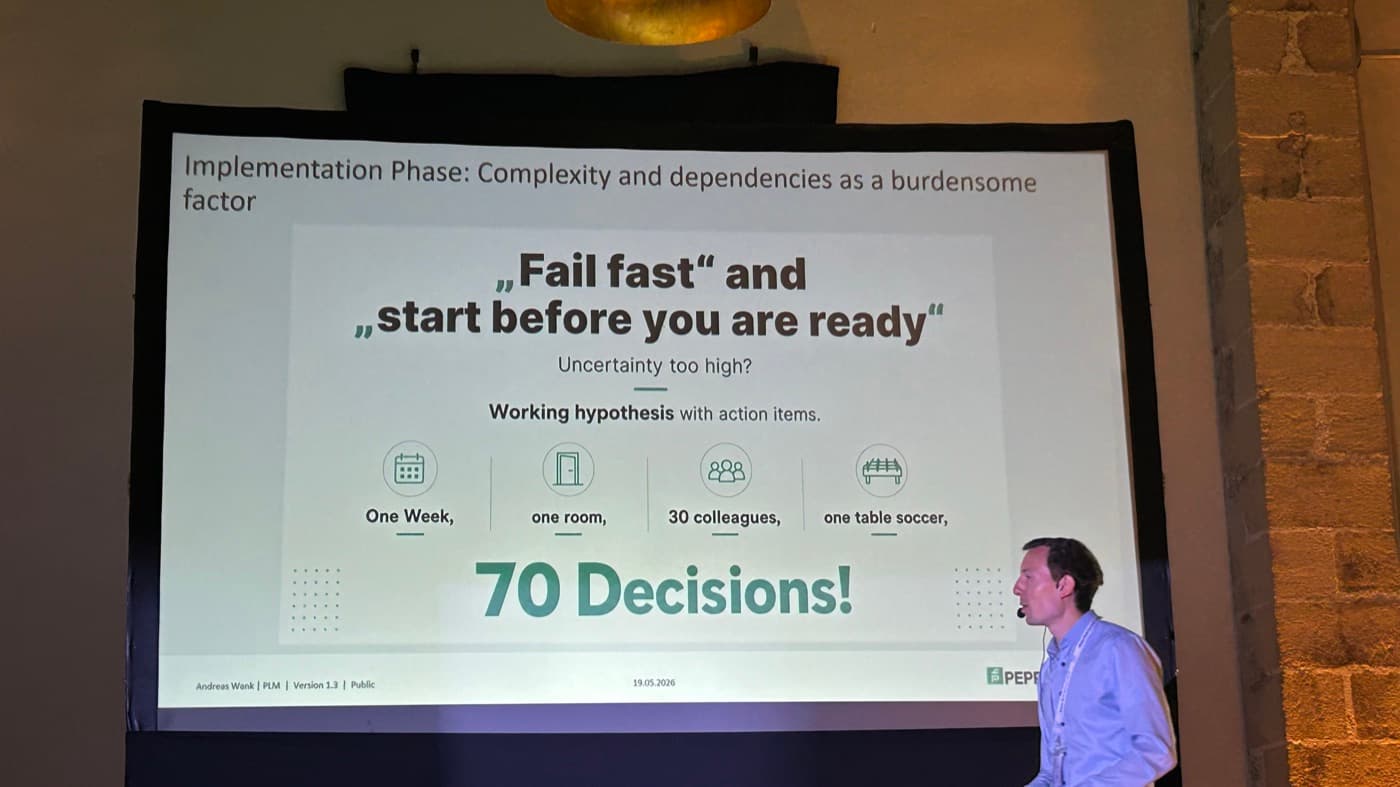
Dr.-Ing. Andreas Wank (Pepperl+Fuchs) PLM at Scale — 130 Systems, 200 Colleagues, One Transformation
17 departments, 600 features, 42 major issues identified during validation. Moving to 3DEXPERIENCE cloud required accepting out-of-the-box functionality and reducing customization as governance decisions. The "mood curve" tracked employee sentiment throughout — transformation is non-linear. "In PLM, waiting for perfect certainty kills momentum."
Session 8
Ruth B. and Patrick Willemsen (Aras) with XPLM Sustainability in Engineering is a Decision-Timing Problem
80% of a product's environmental impact is determined early in design. Yet sustainability data typically arrives too late in the process. "Rather than centralizing everything into one system, the goal is delivering the right insight to the right person at the right time." Successful companies differentiate through specific processes, not one-size-fits-all PLM.
Discussion Panel
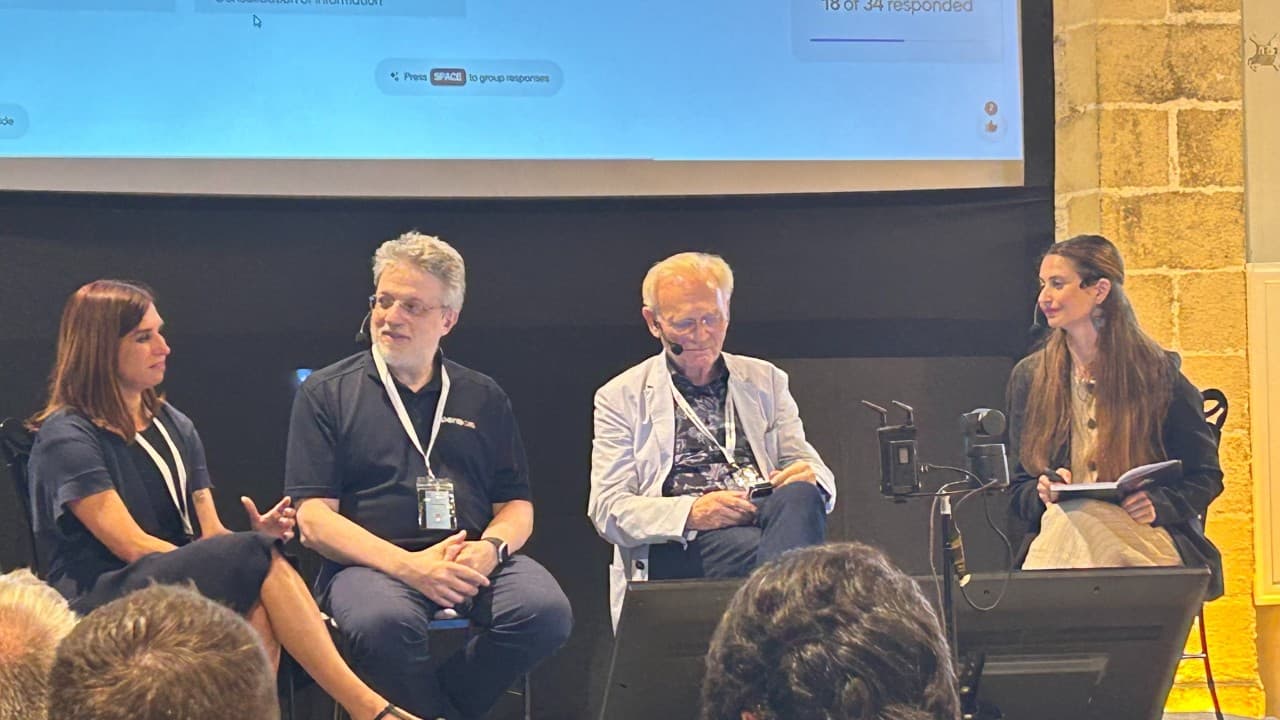
Discussion Panel — Moderated by Michael Finocchiaro (link coming soon) Featuring: Cristina Jimenez Pavo, Linda Kangastie, Susanna Mäentausta, Martin Eigner, Rob Ferrone, Oleg Shilovitsky
A live panel exploring the human, organizational, and strategic dimensions of PLM transformation — with perspectives from practitioners, consultants, and thought leaders.
Session 9
Matthias Gabriel (SMS Group) PLM Transformation During M&A Crisis — 12 Months, 4 Countries
180 employees, 12-month TSA deadline, migrating from Autodesk/Vault/ENOVIA to SAP-centric architecture. They retained Inventor specifically to reduce adoption fear. Face-to-face workshops essential; select motivated champions over managers; never underestimate SAP training. "Technology migration is relatively predictable. Human migration is not."
Session 10
Susanna Mäentausta (Novartis) Startup Survival Mindset Inside a 75,000-Person Enterprise
Year 4. Changing sponsors, departing champions, shifting priorities. The pivot: fix the data backbone rather than forcing complete workflows early, embedding standardization directly into SAP S/4HANA. "We brought a small elephant through the back door." Once operational systems depended on the backbone, removing it became nearly impossible.
Session 11
Alex Sampedro (SKF Group) Stop Selling PLM — Start Selling Business Outcomes
"The C-suite does not buy PLM. They buy outcomes." The 4-step playbook: identify where money stops flowing due to product data friction, translate PLM benefits into business language (remanufacturing revenue, RFQ response time, AI readiness, compliance risk), build ROI models with operational leaders, secure sponsorship. "The real skill is asking better questions of people."
Day 2 — May 20, 2026
Keynote
Helena Gutierrez (Share Enterprises) AI and the Economy of Human Connection
"We are all startups again." AI already performs significant portions of work that professionals spent years mastering. Business models built around hourly knowledge work are deteriorating. The enterprise AI harness concept: encode operational DNA — workflows, organizational memory, contextual data, connected tools. "Make AI something that happens with people, not to people."
Session 12
Ulf Asklund (QCM) Before Changing Systems, Create Shared Understanding
"The hardest integration challenge in manufacturing is still human alignment." When cross-functional teams meet, they discover fundamental disconnects — different terminologies, assumptions, and process interpretations. Companies frequently purchase sophisticated PLM systems but use them merely as document repositories. You cannot automate existing dysfunction faster — you must rethink processes.
Session 13
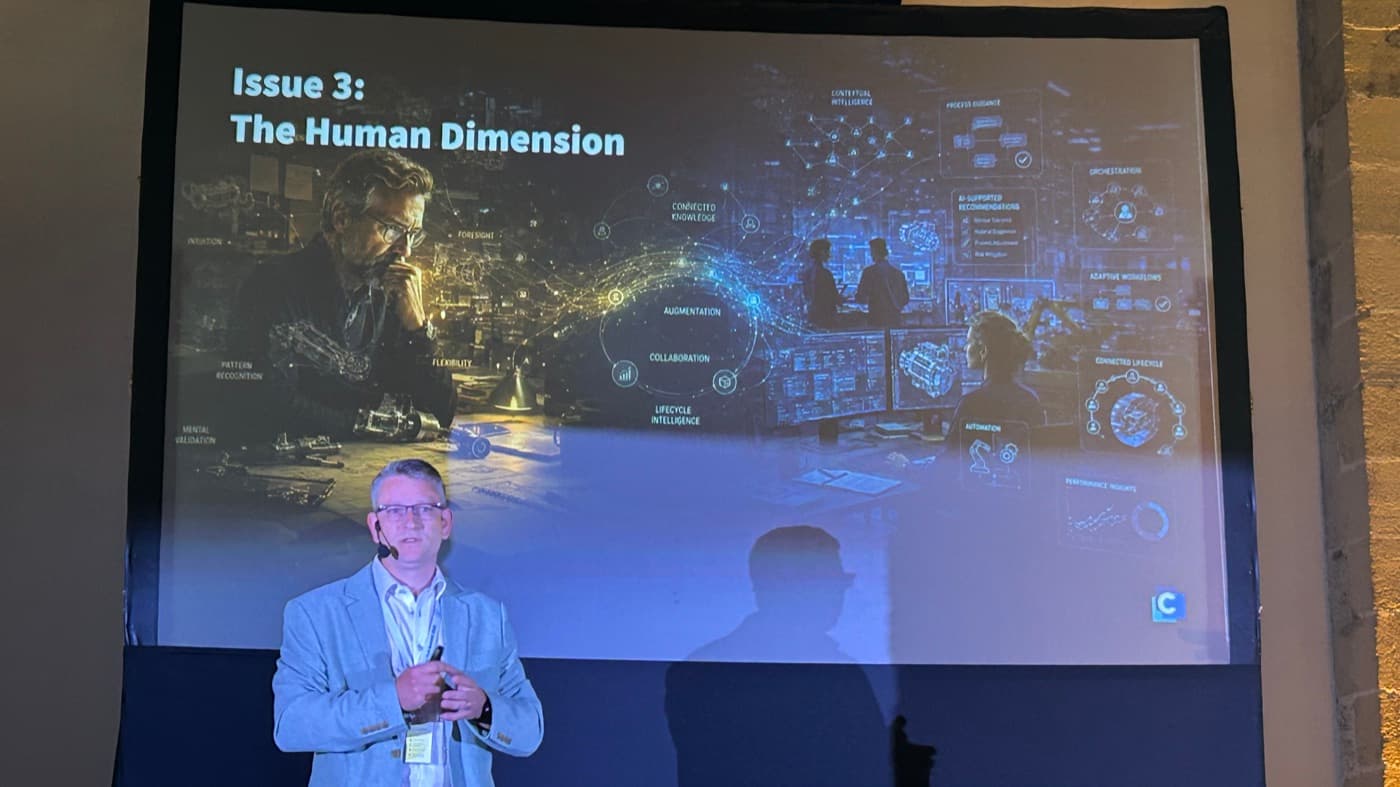
Annelie Uvhagen, Bjørn Arvid Fidjeland, Henrik Limborg (Gentelligence) PLM as System of Intelligence, Not System of Record
PLM is transitioning from transactional system to intelligence platform. "The #1 reason enterprise AI projects fail is still poor data quality." Most enterprises lack orchestration despite having abundant technology (PLM, ERP, AI pilots, dashboards). "The winners in the next decade will not be the companies with the most systems, but those that learn, align, and adapt fastest."
Session 14
Manuel Oliva (Airbus Defence and Space) Modeling the Entire Industrial System, Not Just the Product
Coordinating teams across 15+ countries, with product design and industrial design forced to evolve concurrently. "Manufacturing engineers must simultaneously consider process feasibility, machine constraints, assembly sequencing, cost, compliance, logistics across countries, lifecycle maintainability." AI functions as a "decision-support engine connected to lifecycle models" — not a chatbot layer.
Session 15
Antonio Casaschi (ASSA ABLOY) 400+ Acquisitions, 65,000 Employees — Pragmatic AI at Scale
ASSA ABLOY abandoned top-down PLM standardization entirely. User-centered design, behavioral science, and trust-building replaced mandates. Practical AI applications: multilingual enterprise interactions, AI-driven employee interviews, knowledge extraction, workflow augmentation, intelligent navigation across fragmented systems. "Augment workers rather than replace them."
Session 16
James Wright (CONTACT Software) Knowledge Management as the New PLM Differentiator
"No one person is that smart anymore." Single experts cannot simultaneously attend all meetings, review every decision, or transfer tacit knowledge at modern innovation cadences. Manufacturing knowledge and service considerations still arrive after critical decisions are finalized. AI's role: surface tacit knowledge, guide workflows, connect stakeholders, accelerate organizational learning.
Session 17
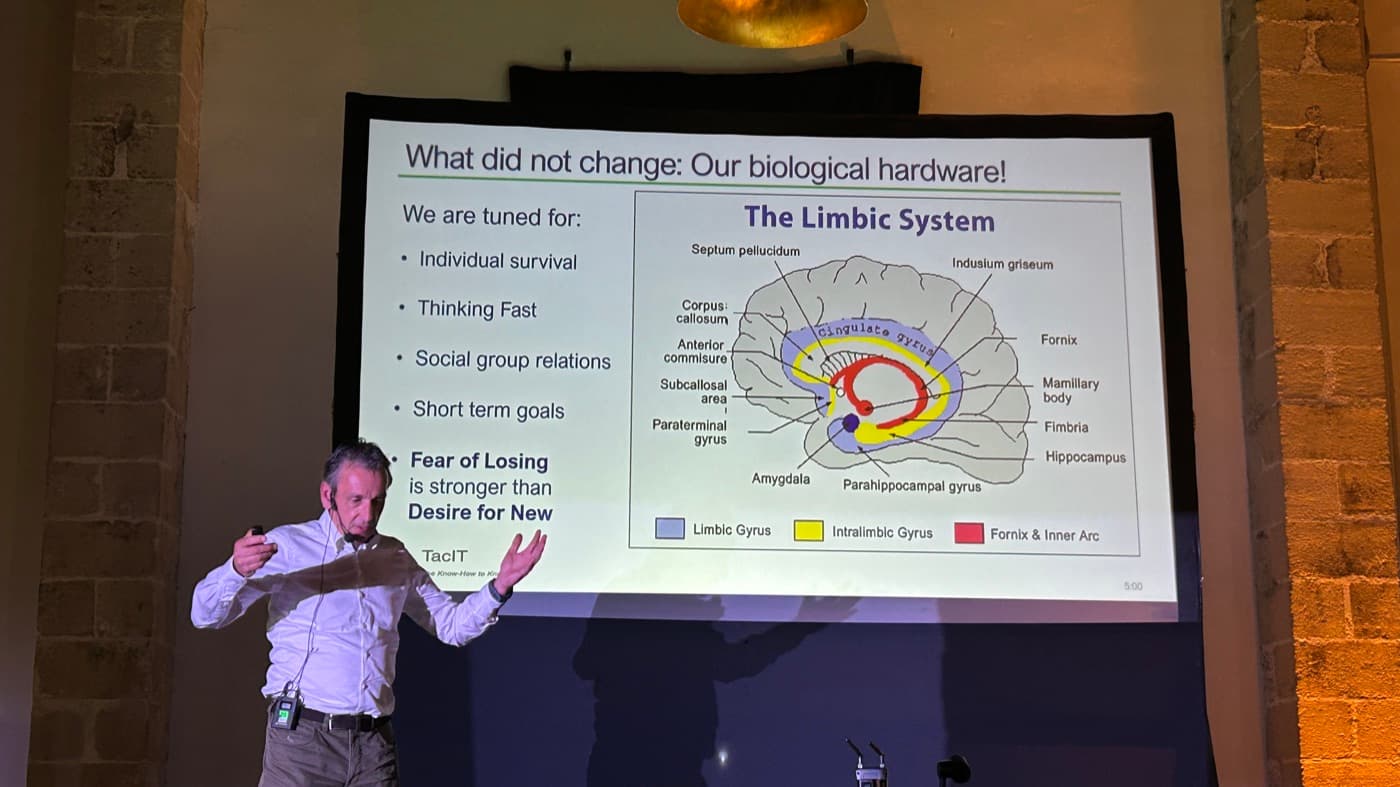
Dennis Götting (PTC) Grounded AI vs. Generic AI — Plausible is Not Trusted
AI must be anchored in enterprise context, PLM data, and organizational semantics to avoid becoming "plausible but useless." Volkswagen Codebeamer: 53% effort reduction on requirements tasks through AI-generated requirements and dependency analysis. "Most companies lack serious engineering data strategies for AI integration."
Session 18
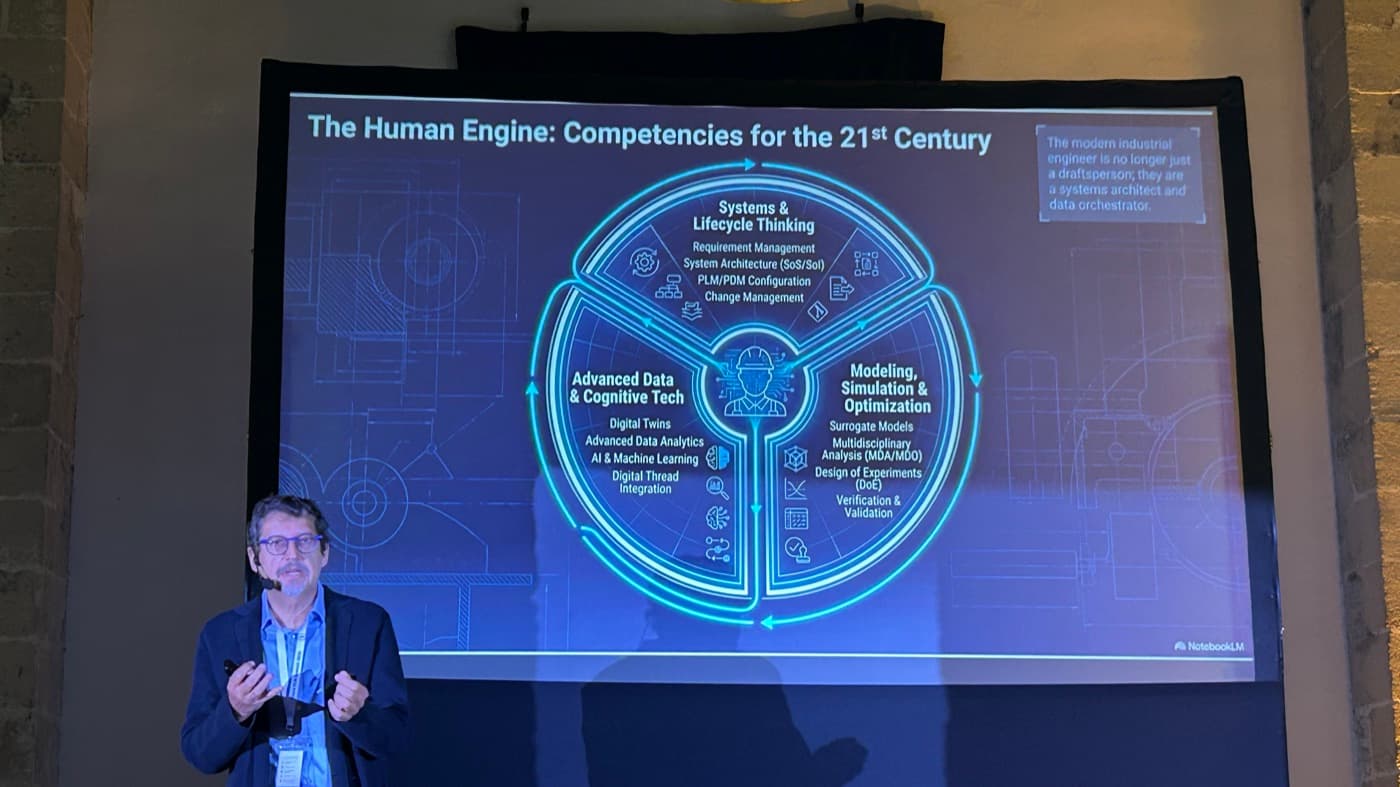
AI Workshop — Oleg Shilovitsky, Martin Eigner, Helena Gutierrez (moderated by Viktoria Tsiokou) Engineering Identity in the AI Era
The most honest AI conversation at the conference. "The real battle isn't PLM vs AI. It's AI vs Excel." "Responsibility cannot be outsourced to ChatGPT." "The danger isn't AI replacing engineers. It's engineers losing expertise by over-trusting AI." Engineer value is migrating from routine execution toward judgment, systems thinking, problem definition, and accountability.
Session 19
Helene Ålander PLM and Commercial Strategy — From System of Record to Revenue Engine
"How does PLM increase willingness to pay?" Enterprise B2B customers now behave like consumers — comparing visually, seeking simplicity, responding emotionally. Tier anchoring in PLM pricing: premium tiers often exist to make mid-tier options appear optimal. "Structure without empathy does not sell" — customers need clarity on fit, value, and tradeoffs.
Session 20 — Thought Leadership
Jos Voskuil AI, PLM, and the Future of Engineering Knowledge
Jos Voskuil brought his characteristic sharpness to the intersection of AI and PLM — challenging assumptions about where AI creates genuine value versus where it creates noise, and what it means for engineers and organizations navigating rapid change.
Session 21 — Case Study
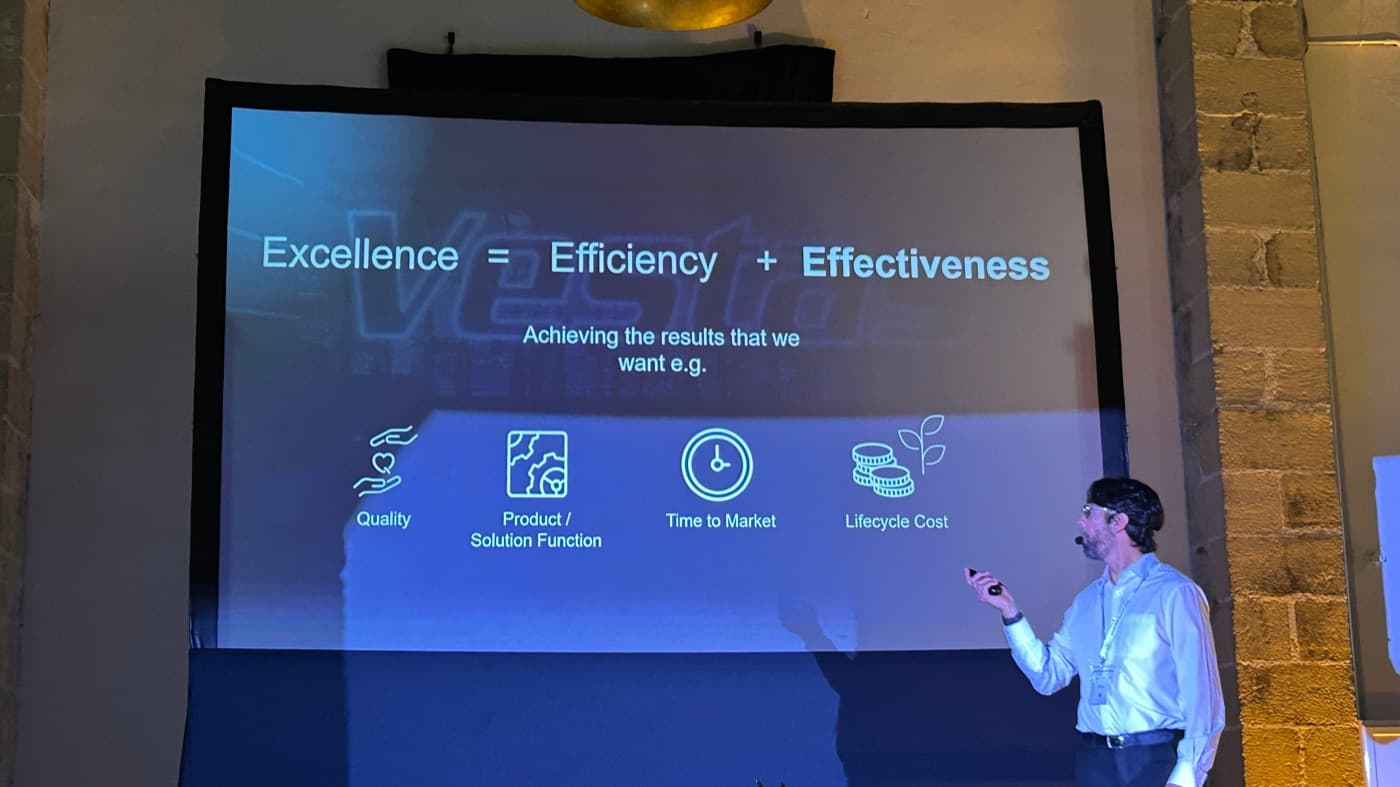
Dennys Gomes (Vestas) MBE in Practice — How Vestas Replaced 850 Drawings and Saved €1M+
Vestas discovered suppliers used only a fraction of provided engineering documentation. Pivot: optimize data, not drawings. Tower documentation: 400 hours → 35 hours. ~850 drawings replaced with automated model generation. First-wave savings exceeded €1M annually. Delivery timelines shortened by 11 weeks. Strategy: simplify, structure semantically, establish interoperability — then layer AI.
Full analysis: Share PLM Summit 2026 — From Data Silos to Digital Transformation
Want to listen instead of read? 56 DemystifyingPLM articles are available as audio.
Browse audio →Looking up PLM terminology? Browse the canonical reference.
PLM Glossary →Cite this article
Finocchiaro, Michael. “Share PLM Summit 2026 — Fino Post Index.” DemystifyingPLM, May 12, 2026, https://www.demystifyingplm.com/shareplmsummit-2026-fino-post-index
Michael Finocchiaro (opens in a new tab)
PLM industry analyst · 35+ years at IBM, HP, PTC, Dassault Systèmes
Firsthand knowledge of the evolution from early 3D modeling kernels to today's cloud-native platforms and agentic AI — the history, strategy, and future of PLM.