Key Takeaways
- If you cannot answer which supplier lot went into serial number 4471, no amount of IIoT dashboarding fixes it. That is an MES gap.
- If your MES is the only path from machines to the enterprise, every new use case becomes an MES integration project. That is an IIoT gap.
- Start the IIoT program at the Unified Namespace and make MES a publisher and subscriber. Do not route the plant through the MES.
- Score vendors by MINT layer ownership before feature lists. A platform that claims all four layers usually owns one and a half.
Short Answer
An IIoT platform is the plant's data backbone: it connects to PLCs, sensors and machines over OPC UA, MQTT and native drivers, normalizes and contextualizes that data at the edge, publishes it into a Unified Namespace, stores it in a time-series historian and exposes it to enterprise systems. MES is the execution system: it dispatches work orders against a released manufacturing BOM and routing, guides operators, records material and lot consumption, captures quality events and produces the as-built record. In MINT Stack terms IIoT owns the I and N layers and MES owns M. They overlap on machine monitoring, OEE and dashboards, which is why vendors blur them, but neither can do the other's job.
- IIoT platforms own connectivity, edge contextualization, the Unified Namespace, the historian and enterprise integration. MES owns work order execution, work instructions, material and lot consumption, in-line quality and the as-built record.
- The overlap is real and lives in machine monitoring, OEE, andon and lightweight digital work instructions. Low-code IIoT platforms can build those; they cannot produce a governed as-built record tied to a released product definition.
- The clean architecture has MES subscribing to the UNS for machine state and publishing production events back to it. MES is a client of the data backbone, not the backbone.
- Buying an IIoT platform to avoid MES produces dashboards without genealogy. Buying MES to avoid an IIoT platform produces point-to-point integrations with the MES as the bottleneck.
- Vendors now span both (Velotic, Ignition with MES modules, Tulip). The question is not which vendor but who owns each MINT layer, because the seam does not disappear when one company sells both sides of it.
MES vs IIoT: Clearing Up the Overlap
Put an IIoT platform demo next to an MES demo and for the first ten minutes they look like the same product. Both show machine status. Both show OEE. Both have a screen an operator can tap. That resemblance is the source of a lot of expensive architecture decisions, because the two systems solve different problems and the overlap is the least important part of either.
Here is the short version. An IIoT platform moves and contextualizes plant data. MES governs execution against a released product definition. One is a backbone. The other is a system that runs on it.
This is the companion to MES vs PLM, which drew the boundary on the engineering side of MES. This one draws it on the data side.
What an IIoT Platform Owns
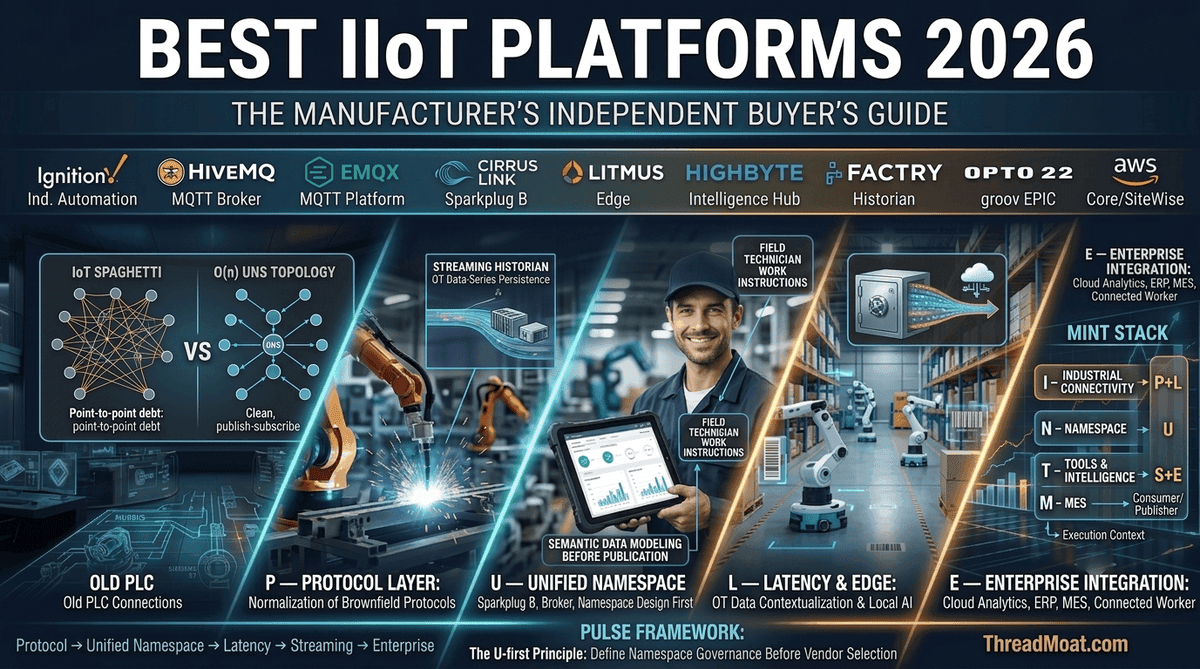
In the MINT Stack that organizes the Best MES Software 2026 and Best IIoT Platforms 2026 guides, an IIoT platform owns the I and N layers: Industrial Connectivity and Namespace. The IIoT guide decomposes those two layers into five concerns, the PULSE framework, and that is the cleanest inventory of what the platform is for:
- Protocol normalization. Talking to PLCs, drives, sensors and legacy equipment over OPC UA, MQTT, Modbus, EtherNet/IP and PROFINET, and turning tag soup into structured data.
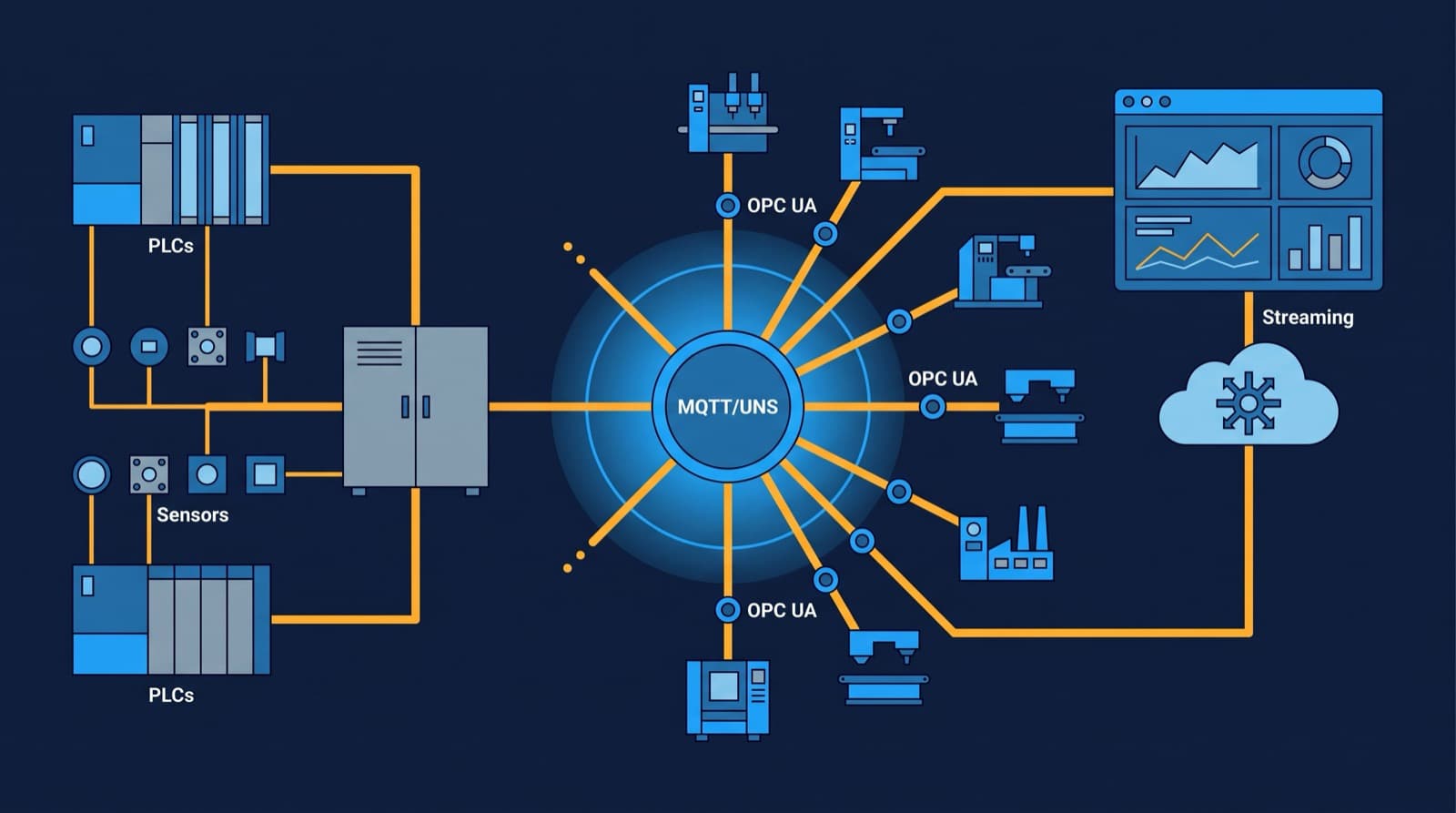
- Unified Namespace. A single, hierarchical, event-driven publish-and-subscribe backbone, usually on an MQTT broker, in which every producer and consumer in the plant meets. The UNS is the architectural answer to point-to-point integration sprawl.
- Edge computing. Contextualizing data where it is produced: adding asset, product and order context, filtering, buffering when the network drops, running models locally.
- Streaming and historian. Time-series persistence at machine resolution, for the process engineer today and the AI model next year.
- Enterprise integration. Exposing the plant's data to MES, ERP, maintenance, quality and analytics through the UNS and APIs.
None of that knows what a work order is. That is the point. The IIoT layer is deliberately agnostic about what the data is for, so that every consumer, MES included, can use it without the plant being re-plumbed each time.
What MES Owns
MES owns the M layer, and its job is execution against a governed definition. It picks up the manufacturing BOM and routing that PLM releases and turns them into physical production:
- Work order dispatch and sequencing against the released routing.
- Operator work instructions tied to the specific revision being built.
- Material and lot consumption. Which supplier lot, which serial, consumed at which operation, by whom.
- Quality at the line. In-process inspection, nonconformance, deviation disposition.
- The as-built record. The authoritative record of what was actually produced, at which configuration, from which materials.
That last item is the one an IIoT platform cannot produce, however good its dashboards are. The as-built record only means something because it is tied to a released, revision-controlled definition upstream. Genealogy without a governed baseline is a log file. Supply chain traceability and configuration management both depend on this being MES's job and MES doing it.
Why They Overlap, and Why It Misleads
The overlap is real and it lives in exactly the features that demo well: machine monitoring, OEE, andon boards, downtime reasons, lightweight digital work instructions. A low-code IIoT platform can build all of those in an afternoon. So can the MES. So can a connected-worker app.
Vendors have leaned into it. Velotic sells connectivity, historian, MES and applications as one portfolio. Ignition ships MES modules on top of its SCADA and IIoT core. Tulip started as an execution layer and reached into connectivity. Siemens, AVEVA and Critical Manufacturing pair their MES with their own IIoT stacks. That is convenient, and it hides the seam without removing it. When one vendor owns both sides, the ownership questions move into the contract and the configuration, and they still have to be answered.
The mistake is to conclude from the overlap that one can substitute for the other. Machine monitoring is the cheap 20 percent of both products. The expensive 80 percent, protocol breadth and namespace on one side, genealogy and governed execution on the other, does not overlap at all.
The Handoff Architecture
The clean pattern makes MES a client of the data backbone rather than the backbone itself.
IIoT layer to MES. The IIoT platform publishes normalized, contextualized machine and process data into the UNS. MES subscribes to what execution needs: machine state, cycle counts, process values, quality signals from inline gauges.
MES to the plant. MES publishes its own events into the same namespace: work order started, operation complete, lot consumed, hold placed, nonconformance raised. Those events carry the product and order context that the raw machine data lacks.
Everyone else. Maintenance, energy, analytics, digital twins and AI subscribe to both streams from the UNS. Nobody integrates with the MES to get machine data, and nobody integrates with a PLC to get order context.
The MES guide's MINT section and the IIoT guide's UNS chapter both make the same argument from opposite ends: start at the namespace. The Unified Namespace explainer covers the pattern itself.
What Goes Wrong Without the Boundary
When the IIoT platform is used as an MES substitute. The plant gets excellent dashboards and no genealogy. Work instructions live in a low-code app with no link to the released revision. Nobody can say which lot went into which unit. The first recall, audit or customer complaint exposes it, and the fix is the MES project that was avoided, now with two years of undocumented process embedded in dashboards.
When the MES is used as the IIoT platform. Every machine is integrated into the MES, because that is where the connectivity lives. Every new use case, predictive maintenance, energy monitoring, a quality model, becomes an MES integration ticket. Data the MES does not need for execution is never captured. The MES becomes the bottleneck for the whole plant's data, and the vendor's connectivity roadmap becomes the plant's roadmap.
When one vendor sells both and nobody owns the namespace. The portfolio pitch is coherence. The delivery is often the vendor's MES talking to the vendor's connectivity through the vendor's proprietary bus, with the UNS as a marketing slide. Lock-in at the data layer is the most expensive kind, because it is the layer everything else depends on.
Capability Comparison
| Capability | IIoT Platform | MES |
|---|---|---|
| Protocol normalization (OPC UA, MQTT, Modbus, PROFINET) | Owns | Consumes |
| Unified Namespace | Owns | Publishes and subscribes |
| Edge contextualization | Owns | No |
| Time-series historian | Owns | Stores execution events only |
| Machine monitoring and OEE | Yes | Yes |
| Andon and downtime reasons | Yes | Yes |
| Work order dispatch against a released routing | No | Owns |
| Revision-controlled work instructions | Lightweight | Owns |
| Material and lot consumption | No | Owns |
| Quality events and nonconformance | Signals only | Owns |
| As-built record and genealogy | No | Owns |
| Enterprise integration (ERP, maintenance, analytics) | Owns the data path | Publishes its events |
Five Questions That Tell You Which One You Are Missing
- Can you say, today, which supplier lot went into a given serial number? If not, the gap is MES.
- Does every new analytics or AI use case require a change to the MES? If yes, the gap is IIoT.
- Do machines that the MES does not schedule still publish their data somewhere queryable? If not, the gap is the namespace.
- Are operator work instructions tied to the released revision, or to a document someone last edited? If the latter, the gap is MES governance, whatever the app is called.
- Who owns the MQTT broker, and is it in the vendor's contract or yours? If you cannot answer, the gap is architectural ownership, and no purchase fixes it.
Summary
IIoT platforms and MES are complementary layers of one manufacturing architecture. The IIoT platform owns the plant's data: connectivity, edge context, the Unified Namespace, the historian and the path to the enterprise. MES owns execution: work orders, instructions, material consumption, quality and the as-built record, all governed by the definition PLM released.
They meet at the namespace. Get that seam right, MES as a publisher and subscriber rather than the backbone, and both systems do what they are good at. Get it wrong in either direction and the plant ends up with dashboards and no genealogy, or an MES that has become the most expensive integration hub in the company.
For the vendor side of the decision, the Best MES Software 2026 guide scores every platform by MINT layer ownership, and the Best IIoT Platforms 2026 guide does the same across the PULSE layers.
Want to listen instead of read? 56 DemystifyingPLM articles are available as audio.
Browse audio →Looking up PLM terminology? Browse the canonical reference.
PLM Glossary →Cite this article
Finocchiaro, Michael. “MES vs IIoT Platform: Who Owns What on the Plant Floor?.” DemystifyingPLM, September 26, 2026, https://www.demystifyingplm.com/mes-vs-iiot
PLM industry analyst · 35+ years at IBM, HP, PTC, Dassault Systèmes
Firsthand knowledge of the evolution from early 3D modeling kernels to today's cloud-native platforms and agentic AI — the history, strategy, and future of PLM.