All Articles

Manufacturing

28 articles

Manufacturing

Production systems, supply chain, and operational excellence.

Overview

This page explores the fundamentals, significance, and connections of Manufacturing in the context of modern product lifecycle management, digital transformation, and industry innovation.

Key Themes

  • Core concepts and definitions
  • Why this topic matters to your organization
  • Current trends and future directions
  • Integration with broader PLM strategies

Related Articles


Last Updated: 2026-05-05 | Category: Insights
Best BIM Software 2026 — BUILD framework across authoring, coordination, and digital twin

Best BIM Software 2026: The Independent Buyer's Guide for AEC and Owner Organizations

The best BIM software in 2026 depends on which stakeholder you are — design team, general contractor, trade contractor, or owner/operator — and which of the five BUILD layers your organization needs to own. This is the independent guide to fifteen platforms across BIM authoring, construction coordination, and digital twin continuity, organized through the BUILD framework: Building model ownership, Upstream authoring, Interoperability standards, Lifecycle handoff, and Digital twin continuity.

· 25 min read
Best IIoT Platforms 2026 — PULSE framework across protocol normalization, Unified Namespace, edge computing, streaming historian, and enterprise integration

Best IIoT Platforms 2026: The Manufacturer's Independent Buyer's Guide

The best IIoT platform in 2026 depends on whether you design the Unified Namespace first — and most manufacturers don't. This is the independent guide to Industrial Internet of Things platforms — Ignition, HiveMQ, EMQX, Kepware/Velotic, Litmus Edge, AVEVA PI System, PTC ThingWorx — matched to the PULSE framework and the U-first insight that separates manufacturers building scalable IIoT architectures from those building IoT spaghetti.

· 19 min read
Best SCM Software 2026 — CHAIN framework vendor comparison

Best SCM Software 2026: The Supply Chain Independent Buyer's Guide

The best SCM software in 2026 depends on which planning horizon your organization needs to own first — and most buyers get that question wrong. This is the independent guide to supply chain management software — SAP IBP, Kinaxis RapidResponse, Blue Yonder, o9 Solutions, Oracle SCM, Anaplan, and the full landscape from multi-enterprise visibility to AI-native risk — matched to the CHAIN framework and the H-first insight that determines whether a supply chain transformation succeeds.

· 28 min read
Best EAM APM Software 2026 — FIELD framework vendor comparison

Best Operations & Asset Management Software 2026: The CIO's Independent Buyer's Guide

The best EAM/APM software in 2026 depends on how many of the five FIELD layers your organization needs under unified governance. This is the independent guide — IBM Maximo, SAP PM, IFS, MaintainX (Autodesk), Tractian, TwinThread (AVEVA), and the full operations software landscape — matched to heavy asset industries, process manufacturing, and mid-market industrials who need the architecture question answered before the platform question.

· 22 min read
Case Study Productive Machines Manukai Machining Ai

Productive Machines and Manukai: Taking Machining AI from Research Lab to Shop Floor

Productive Machines spent 10 years developing a digital twin for CNC machining processes at the University of Sheffield's Advanced Manufacturing Research Center before commercializing it. Manukai applied frontier AI models — designed for text and reasoning — to CNC machining optimization. Both are solving the same underlying problem: aerospace manufacturers are running on tribal knowledge, and the engineers who hold it are retiring.

· 9 min read
Case Study Limitless Cnc Dirac Ai Manufacturing Augmentation

Limitless CNC and Dirac: The 80/20 Rule of Manufacturing AI — Augment the Human, Don't Replace Them

Limitless CNC and Dirac are both operating from the same premise: the right role for AI in manufacturing is to handle the 80% of tasks that are routine, repetitive, and rule-based — freeing experienced engineers to spend their time on the 20% that requires judgment, expertise, and accountability. That framing matters because the alternative framing — AI as replacement — creates organizational resistance that kills adoption before the technology gets a chance to prove itself.

· 8 min read
Case Study Lambda Function Up2Parts Manufacturing Automation

Lambda Function and up2parts: How Two Founders Automated the Most Painful Part of Manufacturing Sales

CNC quoting is one of the highest-friction, most error-prone processes in precision manufacturing — and it is almost entirely manual. Lambda Function and up2parts (OptoParts) both built AI-driven automation for different parts of the manufacturing workflow, starting from the practitioner's perspective: Lambda from inside a CNC machine shop, up2parts from a decade of manufacturing domain expertise. The result is workflow automation that eliminates the category of work that kills manufacturing company growth.

· 8 min read
Case Study Cognasim Cds Simulation Manufacturing

CognaSIM and Cognitive Design Systems: Closing the Design-Simulation-Manufacturing Gap

CognaSIM and Cognitive Design Systems are attacking the same structural problem from different directions: the gap between what engineers design, what simulation validates, and what manufacturing can actually build. The result of that gap — costly late-stage changes, simulation-manufacturing misalignment, and tribal knowledge silos — costs aerospace programs billions per year. Both companies are building AI-driven bridges across it.

· 9 min read
Case Study Capgemini Engineering Ai Transformation

Capgemini Engineering: What 25 Years of AI Looks Like in Real Manufacturing Programs

Dr. Bob Engels has led AI programs at Capgemini since 1998 — through expert systems, deep learning, and now LLMs. His perspective cuts through the hype: here is what actually works in aerospace and automotive manufacturing, why multimodal AI is the most underused capability in engineering today, and what the gap between AI strategy and AI implementation looks like from inside the world's largest engineering services firm.

· 10 min read

Key Concepts

5-Axis Machining

5-axis machining refers to CNC machining operations where the cutting tool can move along three linear axes (X, Y, Z) and simultaneously rotate around two rotary axes (typically A and B, or A and C). 5-axis capability allows machining of complex, undercut, and contoured geometries in a single setup that would otherwise require multiple setups or specialized fixturing on 3-axis machines. Applications include aerospace structural components, turbine blades and blisks, impellers, complex molds, and medical implants.

Adaptive Manufacturing

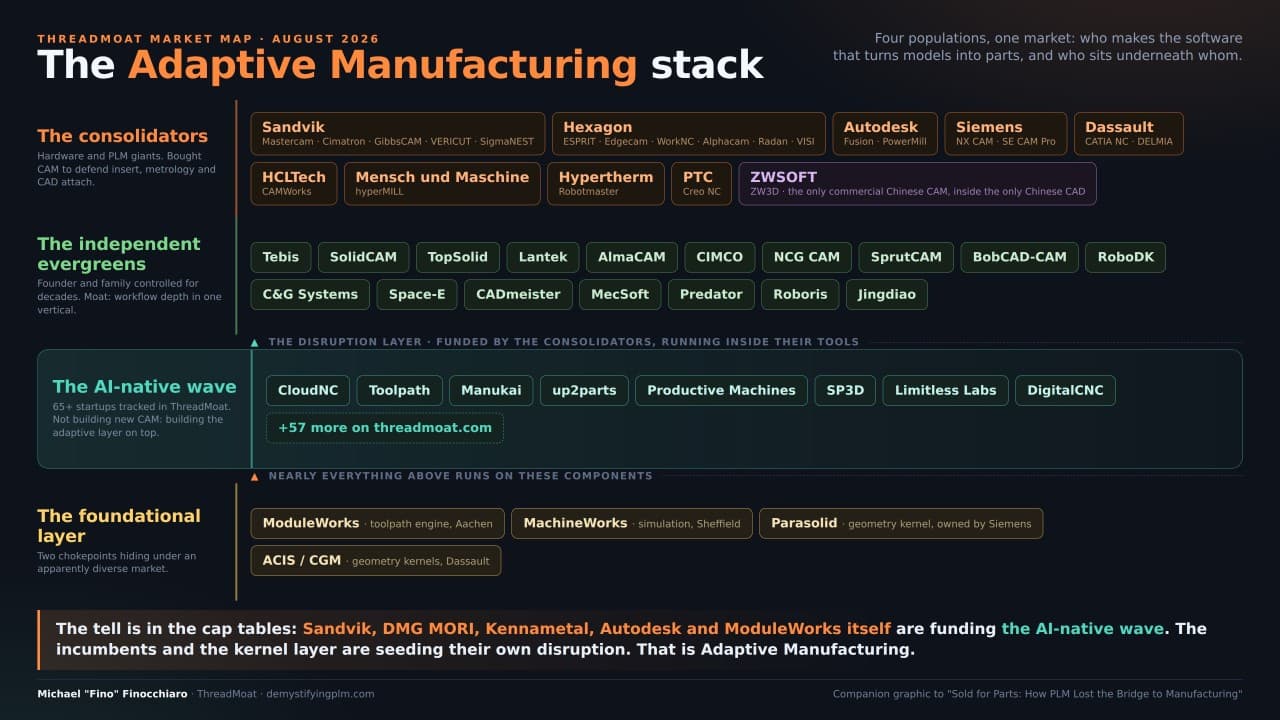
Adaptive Manufacturing is production that senses its own state and changes what it does next. It closes the loop between measurement and action on the shop floor: measure the part and adjust the toolpath, detect tool wear and re-plan the operation, feed inspection results back upstream before the next part is cut. The term is process-agnostic, covering subtractive machining, additive manufacturing and the hybrid of the two, and it describes a behavior rather than an infrastructure. It is distinct from Industry 4.0 (a connectivity ambition), smart manufacturing (a marketing adjective) and closed-loop machining (a single feedback circuit). Adaptive Manufacturing is also the name of the ThreadMoat market map category for the 65+ AI-native startups building this sense-decide-act layer on top of existing CAM, CNC and metrology systems.

AI Engineering Copilot

An AI assistant embedded in engineering tools (CAD, simulation, PLM) that provides contextual suggestions, automates routine tasks, retrieves relevant historical data, and proposes design modifications — operating as a real-time collaborator in the engineer's existing workflow.

AI in Manufacturing

The application of artificial intelligence techniques to manufacturing processes, quality control, design optimization, and production planning to improve efficiency, reduce defects, and accelerate innovation cycles.

AI-Assisted BOM

A bill of materials generated or augmented by AI tools — either through automated part classification, LLM-assisted specification writing, or AI-driven component substitution recommendations — rather than manually authored by engineers.