All Articles

Adaptive Manufacturing Articles

In-depth analysis tagged Adaptive Manufacturing — covering PLM history, vendor strategy, and the technical decisions reshaping engineering software.

1 article

Key Concepts

Adaptive Manufacturing

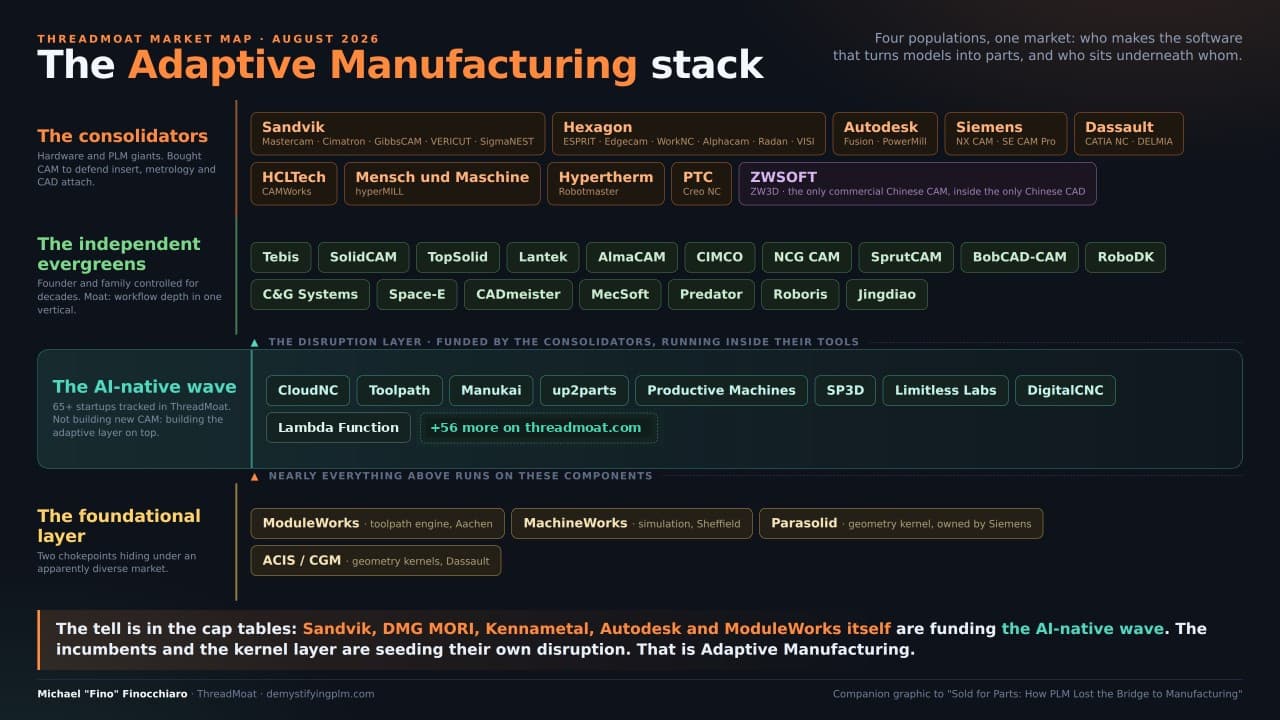
Adaptive Manufacturing is production that senses its own state and changes what it does next. It closes the loop between measurement and action on the shop floor: measure the part and adjust the toolpath, detect tool wear and re-plan the operation, feed inspection results back upstream before the next part is cut. The term is process-agnostic, covering subtractive machining, additive manufacturing and the hybrid of the two, and it describes a behavior rather than an infrastructure. It is distinct from Industry 4.0 (a connectivity ambition), smart manufacturing (a marketing adjective) and closed-loop machining (a single feedback circuit). Adaptive Manufacturing is also the name of the ThreadMoat market map category for the 65+ AI-native startups building this sense-decide-act layer on top of existing CAM, CNC and metrology systems.

STEP-NC (ISO 10303 AP238)

STEP-NC, formally ISO 10303 AP238, is a standard that extends the STEP product data model to machining. Instead of the 1950s-era G-code emitted by a post-processor, STEP-NC carries associative, machine-portable manufacturing programs that reference the part geometry, features, tolerances and operations directly, so the same program can in principle run on any compliant controller without a machine-specific post-processor.

Toolpath Kernel

A toolpath kernel is a licensable software component that computes cutter paths (roughing, finishing, multi-axis, simulation) which CAM vendors embed inside their own products, in the same way CAD vendors license a geometry kernel such as Parasolid or ACIS. ModuleWorks of Aachen is the dominant toolpath kernel supplier; its investors include DMG Mori, Mitsubishi Electric, Kennametal and Autodesk. MachineWorks (Sheffield) is the other significant independent, focused on simulation and verification.