All Articles

Buyer's Guides 2026

Independent, vendor-neutral comparisons of engineering software across the full product lifecycle — from design tools through manufacturing execution. No analyst-quadrant hedging, no vendor funding. Each guide matches platforms to the programs they actually fit.

11 articles

Best BIM Software 2026 — BUILD framework across authoring, coordination, and digital twin

Best BIM Software 2026: The Independent Buyer's Guide for AEC and Owner Organizations

The best BIM software in 2026 depends on which stakeholder you are — design team, general contractor, trade contractor, or owner/operator — and which of the five BUILD layers your organization needs to own. This is the independent guide to fifteen platforms across BIM authoring, construction coordination, and digital twin continuity, organized through the BUILD framework: Building model ownership, Upstream authoring, Interoperability standards, Lifecycle handoff, and Digital twin continuity.

· 25 min read
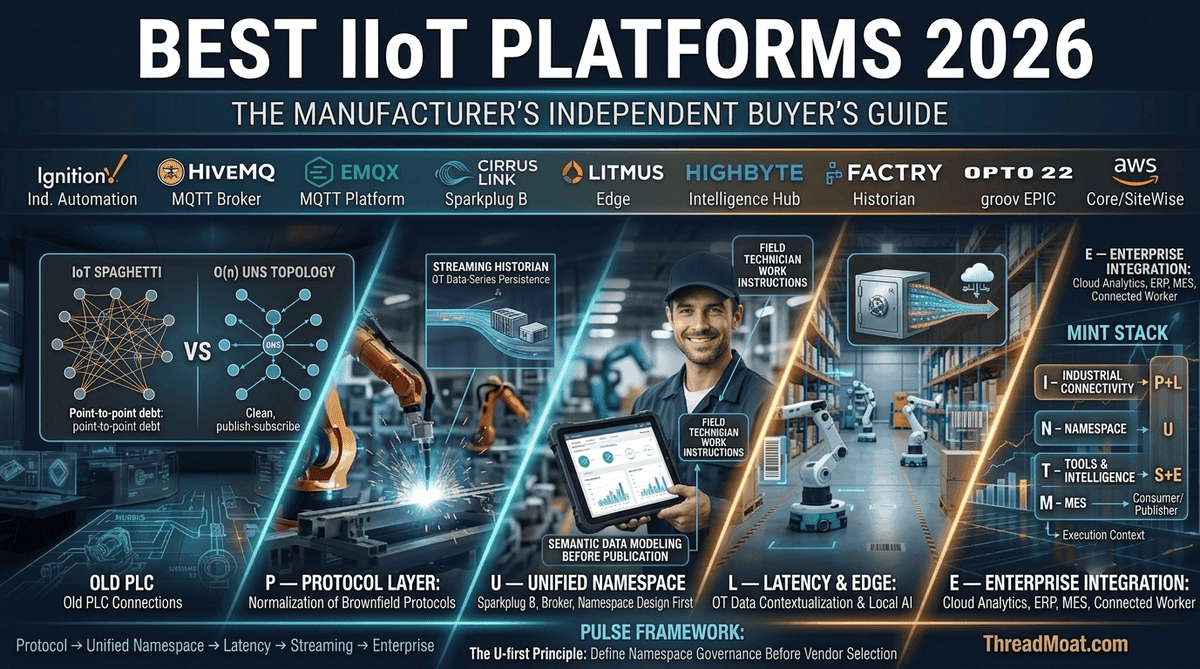
Best IIoT Platforms 2026 — PULSE framework across protocol normalization, Unified Namespace, edge computing, streaming historian, and enterprise integration

Best IIoT Platforms 2026: The Manufacturer's Independent Buyer's Guide

The best IIoT platform in 2026 depends on whether you design the Unified Namespace first — and most manufacturers don't. This is the independent guide to Industrial Internet of Things platforms — Ignition, HiveMQ, EMQX, Kepware/Velotic, Litmus Edge, AVEVA PI System, PTC ThingWorx — matched to the PULSE framework and the U-first insight that separates manufacturers building scalable IIoT architectures from those building IoT spaghetti.

· 19 min read
Best SCM Software 2026 — CHAIN framework vendor comparison

Best SCM Software 2026: The Supply Chain Independent Buyer's Guide

The best SCM software in 2026 depends on which planning horizon your organization needs to own first — and most buyers get that question wrong. This is the independent guide to supply chain management software — SAP IBP, Kinaxis RapidResponse, Blue Yonder, o9 Solutions, Oracle SCM, Anaplan, and the full landscape from multi-enterprise visibility to AI-native risk — matched to the CHAIN framework and the H-first insight that determines whether a supply chain transformation succeeds.

· 28 min read
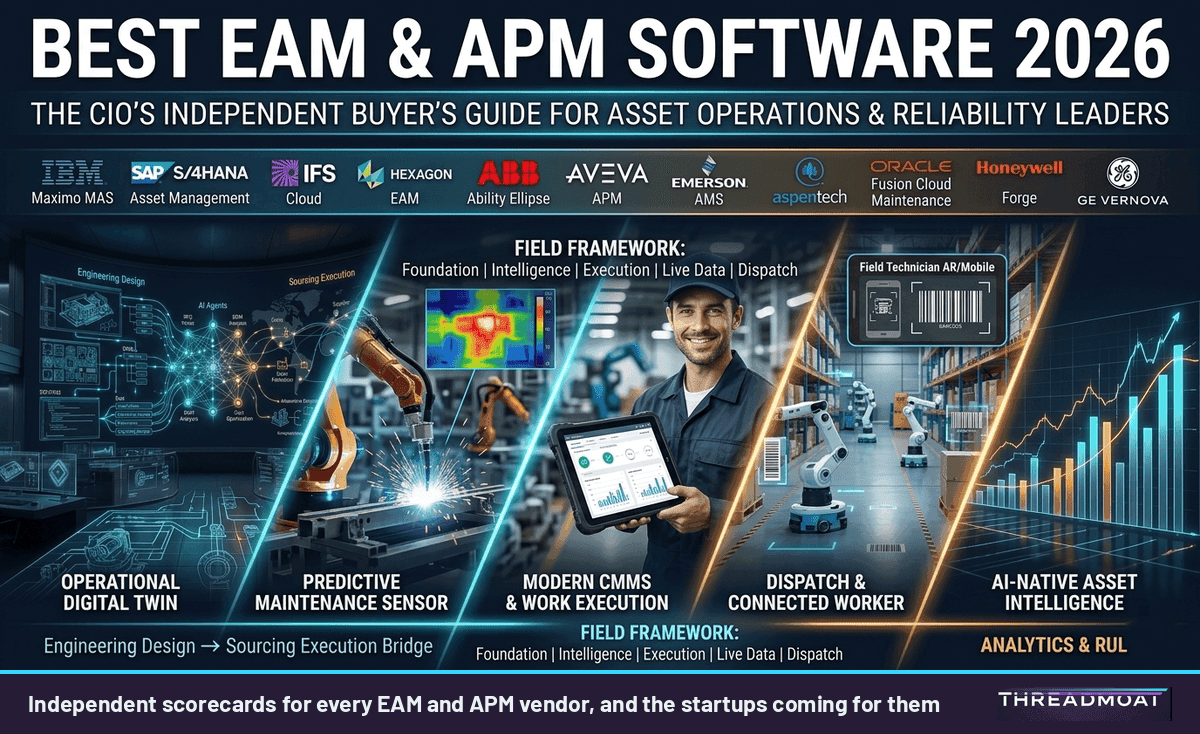
Best EAM APM Software 2026 — FIELD framework vendor comparison

Best Operations & Asset Management Software 2026: The CIO's Independent Buyer's Guide

The best EAM/APM software in 2026 depends on how many of the five FIELD layers your organization needs under unified governance. This is the independent guide — IBM Maximo, SAP PM, IFS, MaintainX (Autodesk), Tractian, TwinThread (AVEVA), and the full operations software landscape — matched to heavy asset industries, process manufacturing, and mid-market industrials who need the architecture question answered before the platform question.

· 22 min read
Best Simulation Software 2026 — CAE suites vs new constellation vendors

Best Simulation Software 2026: Incumbents, Specialists, and the New Constellation

The best simulation software in 2026 depends on whether you need deep multiphysics breadth, vertical domain expertise, or cloud-native accessibility. The market has quietly split into three layers: legacy CAE suites that still dominate complex physics, vertical specialists built for casting, molding, EM, and process simulation, and a new constellation of cloud-native and AI-assisted tools redefining how engineers interact with simulation. This is the independent guide to all three.

· 22 min read

Key Concepts

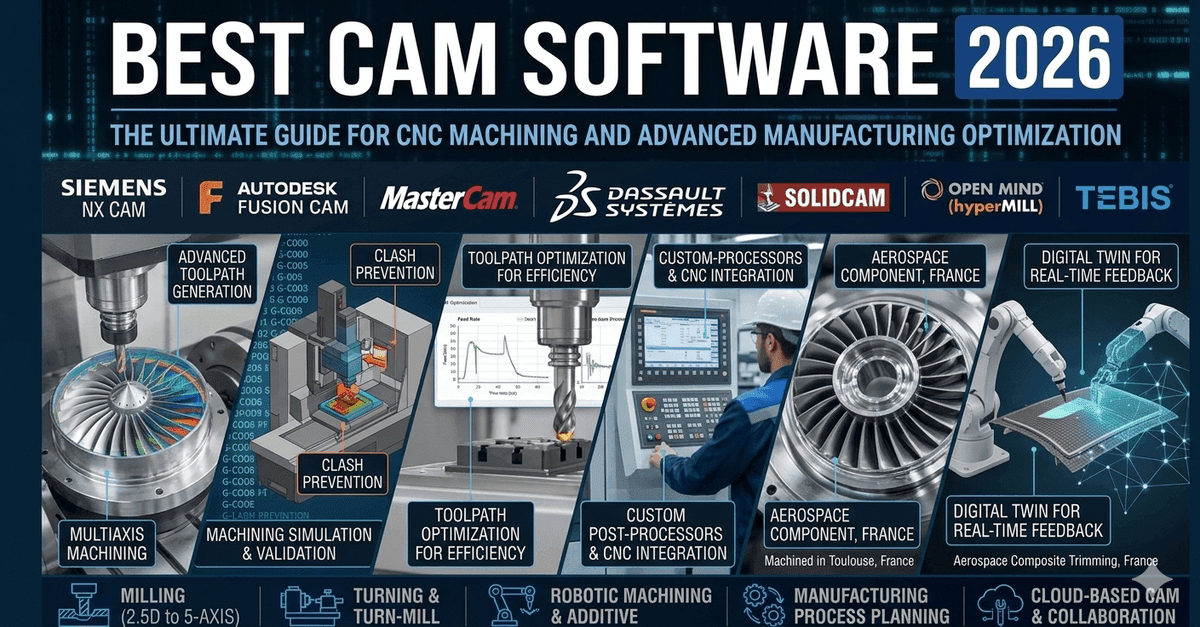
5-Axis Machining

5-axis machining refers to CNC machining operations where the cutting tool can move along three linear axes (X, Y, Z) and simultaneously rotate around two rotary axes (typically A and B, or A and C). 5-axis capability allows machining of complex, undercut, and contoured geometries in a single setup that would otherwise require multiple setups or specialized fixturing on 3-axis machines. Applications include aerospace structural components, turbine blades and blisks, impellers, complex molds, and medical implants.

APM (Asset Performance Management)

Asset Performance Management (APM) software applies AI, machine learning, and physics-based models to asset condition data to predict failures, estimate remaining useful life, recommend maintenance strategies, and — in advanced implementations — close the loop autonomously back into operational control. APM sits in the Intelligence (I) and Live Data (L) layers of the FIELD framework. It is distinct from EAM: EAM manages asset data and work execution; APM manages asset intelligence and predictive capability.

Arena PLM

Arena PLM (acquired by PTC in 2021) is a cloud-native PLM platform for midmarket manufacturers, particularly strong in medical devices, electronics, and consumer products. It was originally BOM.com — a cloud BOM management tool that expanded into full PLM governance. Arena is the dominant cloud PLM choice for FDA-regulated medical device companies under 200 users.

BIM (Building Information Modeling)

Building Information Modeling (BIM) is a process and set of technologies for creating and managing digital representations of physical and functional characteristics of built assets. BIM models are intelligent 3D databases — each element carries structured data (dimensions, materials, costs, specifications, maintenance requirements) in addition to geometry. BIM is distinct from CAD: a CAD drawing describes geometry; a BIM model describes a building's elements and their relationships, enabling clash detection, quantity takeoff, lifecycle cost analysis, and operational data handover.

CAD (Computer-Aided Design)

Computer-Aided Design (CAD) is the use of software to create 2D drawings and 3D models of physical objects. CAD tools range from 2D drafting software (AutoCAD) to parametric solid modelers (SolidWorks, Creo) to surface modeling tools (CATIA, Alias) to simulation-integrated environments (NX, Fusion 360). CAD is the starting point of the digital product record that PLM manages.