Key Takeaways
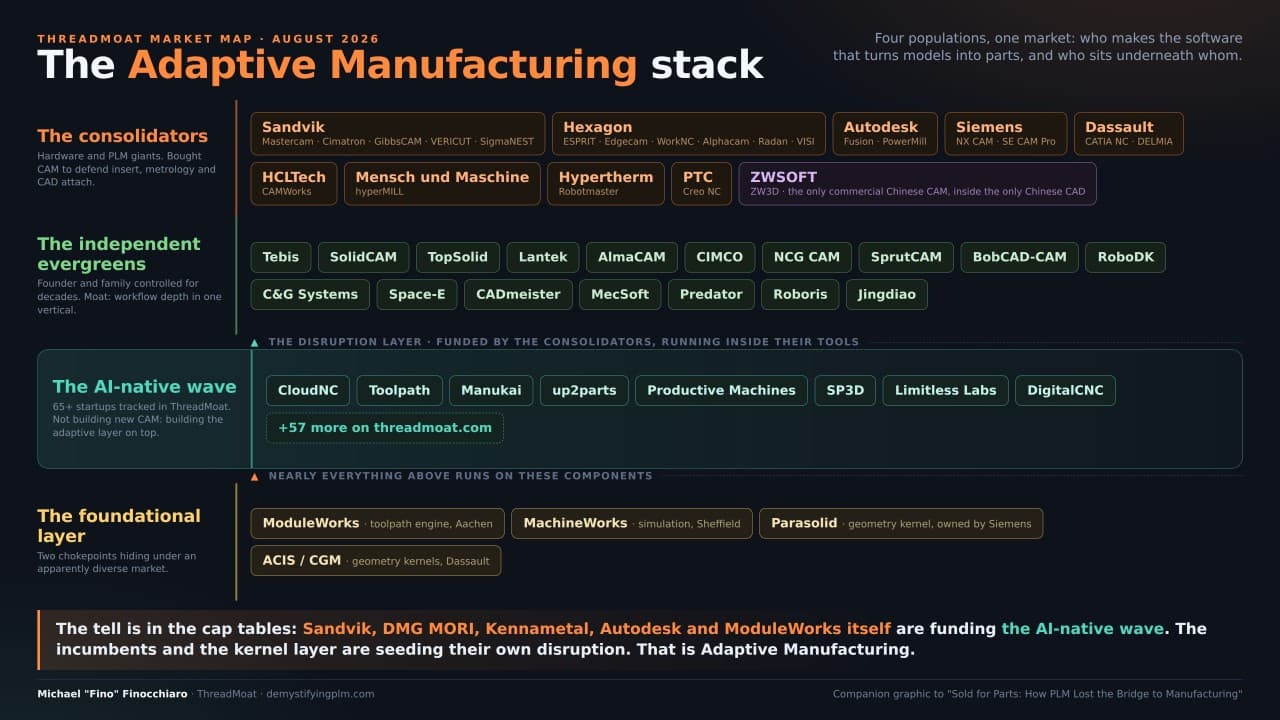
- The two largest owners of CAM software are Sandvik (cutting tools) and Hexagon (metrology), not Dassault, Siemens or PTC. The PLM majors treated CAM as an attach product; their suppliers bought the future of the process.
- Adaptive Manufacturing names a behavior, not an infrastructure ambition: production that senses its own state and changes what it does next. Measure the part, adjust the toolpath; detect tool wear, re-plan the operation.
- Both acquirers independently assembled the same sense-decide-cut loop from opposite ends. When two industrial giants spend a decade and billions converging on one loop, the loop is the product.
- The independent CAM evergreens (Tebis, SolidCAM, TopSolid, Lantek, CIMCO) survive on workflow depth, not algorithms. Underneath most of them sit two chokepoints: Siemens' Parasolid kernel and ModuleWorks' toolpath engine.
- The G-code file, the last digital artifact that touches the part, is the least managed file in the factory. You cannot close an adaptive loop through a USB stick; governance, not toolpath math, is the binding constraint.
- ThreadMoat tracks 65+ AI-native Adaptive Manufacturing startups. Sandvik, DMG MORI, Kennametal, Autodesk and ModuleWorks itself are on their cap tables, and Siemens has integrated two of them into NX CAM.
Short Answer
Adaptive Manufacturing is production that senses its own state and changes what it does next: measure the part, adjust the toolpath; detect tool wear, re-plan the operation; feed inspection results upstream before the next part is cut. The evidence that it is a real category rather than a relabel of Industry 4.0 is the M&A record. Sandvik (cutting tools) and Hexagon (metrology), not the PLM vendors, are now the largest owners of CAM software, and both have assembled the same sense-decide-cut stack from opposite ends. The same incumbents are funding, shipping and buying from the 65+ AI-native startups building the adaptive layer on top of existing CAM.
- Sandvik acquired Mastercam, Cimatron, GibbsCAM, SigmaNEST, VERICUT and ICAM, then started buying its own reseller channel. Hexagon assembled the Vero portfolio, ESPRIT and NCSIMUL and kept CAM welded to metrology when it spun off Octave.
- Whoever owns CAM decides which tool gets used, how hard it is pushed and how long the cycle runs. For a consumables vendor that defends insert attach; for a metrology vendor it gives inspection data somewhere to go.
- Adaptive is process-agnostic: it covers subtractive, additive and hybrid. Directed energy deposition with melt-pool monitoring is the purest sense-decide-act loop in manufacturing today, and the same two buyers are positioned there.
- STEP-NC (ISO 10303 AP238) tried for fifteen-plus years to replace post-processors with associative, machine-portable programs. Adoption is near zero because the post-processor and controller dialect are moats. The unmanaged G-code is an equilibrium, not an oversight.
- The AI-native wave (CloudNC, Manukai, up2parts, Toolpath, Limitless Labs, Productive Machines, DigitalCNC) is not building new CAM systems. It is building the adaptive layer inside Fusion, Mastercam, NX and Creo.
- The next battle is the channel: Sandvik is absorbing the resellers that independents rely on to reach machine shops. You can squeeze out a competitor by owning the people who install, train and support.
Why it matters: Nobody in the top tier bought CAM because CAM is a good business. They bought it because whoever owns the bridge between the digital model and the physical part gets to define how manufacturing adapts. The PLM industry sold that bridge for attach revenue, and its suppliers are building the future on it.
A cutting tool maker and a metrology giant own more CAM software than any PLM vendor. The same incumbents are funding, shipping and buying from the 65+ AI-native startups in my ThreadMoat database. Everyone is converging on one layer, and I have been calling it Adaptive Manufacturing for years. Here is the case.
Here is a fact that should bother the PLM industry more than it does: the two largest owners of CAM software on the planet are Sandvik, a cutting tool company, and Hexagon, a metrology company.
Not Dassault. Not Siemens. Not PTC. The companies that spent thirty years telling us they own the digital thread from concept to customer let the most critical link in that thread, the point where a model stops being geometry and becomes metal removal, get bought out from under them by their own suppliers.
I have spent 35+ years in this industry, and I do not think that happened by accident.
The bridge nobody wanted, until everybody did
CAM has always been the awkward middle child of engineering software. Too shop-floor for the CAD crowd, too geometric for the automation crowd. For decades the PLM majors treated it as an attach product: something you bundle so the CAD seat does not walk out the door.
To be fair, the flagship tiers carry real DNA. CATIA and DELMIA machining is Dassault's own code, with a lineage reaching back through the Euclid teams absorbed with Matra Datavision in the late nineties. NX CAM is thirty years of Unigraphics machining heritage, and it is the same engine inside Solid Edge CAM Pro. But drop one tier and the make-versus-buy truth comes out: SOLIDWORKS CAM is not Dassault code at all. It is CAMWorks, written and maintained by HCLTech, running on Parasolid, the geometry kernel owned by Siemens. Dassault's mid-market CAM is built by an outside firm on top of its arch-rival's kernel. Sit with that for a second.
Meanwhile, the physical side of manufacturing looked at that same handoff layer and saw something else entirely.
Sandvik went on the acquisition run of the decade: Mastercam, Cimatron, GibbsCAM, SigmaNEST, VERICUT, ICAM. Then, over the last eighteen months, it changed tactics and started buying its own distribution channel: MLC CAD Systems' CAM business, In-House Solutions in Canada, QTE, resellers in Sweden, Italy, Poland. Hexagon assembled the other pole: the entire Vero portfolio (Edgecam, WorkNC, Alphacam, Radan, VISI), then ESPRIT, then NCSIMUL. And when Hexagon spun off its asset lifecycle software into Octave this year, note what stayed home: CAM stayed welded to metrology.
Why would a company that makes carbide inserts, and a company that makes coordinate measuring machines, pay software multiples for toolpath code?
Because the toolpath is where the physics gets decided. CAM dictates which tool gets used, how hard it gets pushed, and how long the cycle runs. If you sell consumables, owning CAM defends insert attach. If you sell measurement, owning CAM means inspection data has somewhere to go. The PLM vendors were defending CAD seats. The hardware players were buying the future of the process itself.
This is why I call it Adaptive Manufacturing
For a few years now I have used the term Adaptive Manufacturing as a category in my ThreadMoat market map, and I regularly get pushback on it. Isn't this just Industry 4.0? Smart manufacturing? Closed-loop machining with better PR?
No. And the CAM consolidation is my evidence.
Industry 4.0 describes an infrastructure ambition: connect everything, collect everything. Smart manufacturing is a marketing adjective in search of a noun. Closed-loop machining is real but narrow, a control engineer's term for one feedback circuit. Adaptive Manufacturing names a behavior: production that senses its own state and changes what it does next. Measure the part, adjust the toolpath. Detect tool wear, re-plan the operation. Feed inspection results back upstream before the next part is cut, not in a quarterly quality review.
Now look at what the acquirers actually assembled. Hexagon owns the sensors, the metrology software, and the CAM systems: sense and decide and cut, one P&L. Sandvik owns the cutting tools, the toolpath generation, the verification (VERICUT), and, less noticed, metrology assets of its own. Neither company describes its strategy to investors as "we bought some CAM tools." Both describe variations of connected, data-driven, self-correcting manufacturing.
They are building Adaptive Manufacturing stacks. They just have not agreed to call it that yet. The M&A record is the proof that the category is real: when two industrial giants independently spend a decade and billions assembling the same sense-decide-cut loop from opposite ends, the loop is the product. A term that predicts where the money goes is doing its job.
One more thing the term has to carry: adaptive is process-agnostic. It covers additive as naturally as subtractive, and above all the hybrid of the two. Directed energy deposition with melt-pool monitoring, adjusting power and feed layer by layer as the build drifts, is the purest sense-decide-act loop in manufacturing today. And notice who is positioned there. Sandvik sells the metal powders. Hexagon simulates the builds with Simufact and inspects them afterwards. The machine tool builders are shipping hybrid platforms that deposit and mill in a single setup. Subtractive, additive, hybrid: same loop, same buyers. That is what "closed-loop machining" as a label cannot stretch to cover, and why I stopped using it.
The independents, and the moat that actually holds
Against this backdrop, the survival of the independent CAM evergreens is instructive. Tebis has been family controlled since 1984. SolidCAM, TopSolid, Lantek, Alma, CIMCO, the Japanese domestic players like C&G Systems and NTT Data Engineering Systems: all still standing, decades in.
What they share is not technology breadth. It is workflow depth. Tebis owns mould and die not because its cutter paths are magic but because its process libraries encode thirty years of tooling shop practice. Lantek owns sheet metal nesting the same way. The lesson for every startup founder I talk to: in the bridge between engineering and manufacturing, the moat is never the algorithm. It is the encoded knowledge of how a specific industry actually makes things.
Which brings me to the uncomfortable footnote. A large share of the "independent" CAM market runs on the same toolpath kernel from ModuleWorks in Aachen, whose investors now include DMG Mori, Mitsubishi Electric, Kennametal and Autodesk. One component supplier, part-owned by machine tool and tooling OEMs, underneath half the diverse-looking logos on the map. And it stacks. Underneath the toolpath layer sits the geometry layer, where Parasolid holds the overwhelming share of licensed kernels, ACIS a distant second, Granite and CGM barely registering outside their parents. Peel back the apparently diverse CAM market and you find two chokepoints: Siemens' geometry kernel below, Aachen's toolpath engine above. Nobody prices that concentration risk. Somebody should.
The most critical file in the factory is the least managed
Here is a drum I have been beating for years, and this article is where it finally connects. Follow a part through a typical multi-vendor shop. The design lives in PDM, revision-controlled, access-controlled, audited. Then it goes over the wall as a STEP file, gets programmed in Mastercam or GibbsCAM, and the post-processor emits a G-code file. That file, the last digital artifact that touches the part, the one your AS9100 auditor actually cares about, lands on a shared drive, a DNC folder, or a USB stick. The digital thread ends at the post-processor.
The single-vendor stacks have an answer, to be fair. Teamcenter's Shop Floor Connect manages NC programs with revision control all the way to the machine and back, and DELMIA output lives natively on the 3DEXPERIENCE platform. But those answers cover their own CAM only. For everyone else there is a parallel, disconnected layer: DNC software. Two of the evergreens on my map, CIMCO and Predator, built decades-long businesses on the simple fact that PLM abdicated the G-code.
And before anyone says the fix is obvious, know that the industry already tried. STEP-NC (ISO 10303 AP238) spent fifteen-plus years building an associative, machine-portable replacement for 1950s-era G-code, one that eliminates post-processors entirely. Boeing and NIST validated portable five-axis programs. Vendor adoption: nearly none, two decades on. Why? Because the post-processor and the controller dialect are moats. Nobody who owns that layer profits from neutralizing it. The unmanaged G-code is not an oversight. It is an equilibrium.
Which is exactly why it belongs in this article: you cannot close an adaptive loop through a USB stick. Sense, decide, cut, measure, adjust requires the NC program to be a managed, versioned object with a live link back to the model it came from. And with the AI-native wave about to generate programs at ten times the rate humans do, the binding constraint on Adaptive Manufacturing will not be toolpath math. It will be governance.
The third population: the AI-native wave
There is a population the ownership map cannot show, and it is the one I spend most of my time tracking. ThreadMoat currently follows more than 65 startups in the Adaptive Manufacturing category, and the pattern across them is remarkably consistent: they are not building new CAM systems. They are building the adaptive layer on top of the ones that exist.
CloudNC's CAM Assist and Zurich's Manukai attack the programming bottleneck head on, both claiming order-of-magnitude reductions in CNC programming time, and both working inside Fusion, Mastercam and NX rather than against them. Bavaria's up2parts automates part classification and process planning for the Mittelstand. Boston's Toolpath goes upstream and collapses quoting, DFM and toolpath preparation into a single AI workflow for job shops, what its founders call Human Aided Manufacturing.
The loudest proof point yet arrived in June: Limitless Labs (until recently LimitlessCNC) closed a 27.3 million raised. Its pitch is an agentic "Physical AI" foundation model trained on machining physics and CAD geometry rather than text, running inside Mastercam, NX and Creo, and it is already in production at Blue Origin, the Cadillac Formula 1 team and, most tellingly, at Sandvik and Iscar. Read that list again: two of the world's largest cutting tool companies are customers of the disruption layer.
Meanwhile Sheffield has quietly become the physics capital of this wave. Productive Machines optimizes feeds and speeds with machining-dynamics digital twins before a single chip is cut, and DigitalCNC, a second AMRC spinout, simulates what a specific machine will actually do with a given toolpath, tightening cycle-time estimates from the industry's habitual 20 to 40 percent optimism to roughly plus or minus five percent, then writing the verified corrections back into CAM.
And the validation now comes from every direction at once. Siemens has integrated CloudNC's CAM Assist and Productive Machines' SenseNC directly into NX CAM. On the cap tables, Sandvik, DMG MORI and Schaeffler sit behind up2parts; Kennametal, ModuleWorks and Autodesk behind Toolpath; Lockheed Martin and Autodesk behind CloudNC; Dell Technologies Capital behind Limitless Labs. The same companies consolidating the old layer, the kernel supplier underneath it, and now the incumbents' own product roadmaps are all converging on the same thesis from different directions. When incumbents fund the disruptors, ship them inside their flagships, and buy from them as customers, the category is real. And its name is not Industry 4.0.
What to watch next
The battle for Adaptive Manufacturing will not be fought on feature lists. It will be fought in the channel. Sandvik is systematically absorbing the very resellers that the independents rely on to reach machine shops. You can squeeze a competitor out of the market without ever out-engineering them, simply by owning the people who install, train and support. That is the quiet story of 2026 in this space, and almost nobody is covering it.
So here is my thesis in one line: nobody in the top tier bought CAM because CAM is a good business. They bought it because whoever owns the bridge between the digital model and the physical part gets to define how manufacturing adapts. The PLM industry sold that bridge for attach revenue. Its suppliers picked it up and are building the future on it.
Call it what you like. I call it Adaptive Manufacturing, and the M&A map says I am not wrong.
What am I missing? If you are running an independent CAM business or building in this space, I want to hear how the channel squeeze looks from your side.
Originally published in the PLM Demystified newsletter on LinkedIn on August 4, 2026. This is the canonical version. For vendor scorecards on the platforms and startups named here, see the Best CAM Software 2026 buyer's guide and the ThreadMoat Adaptive Manufacturing category.
Want to listen instead of read? 56 DemystifyingPLM articles are available as audio.
Browse audio →Looking up PLM terminology? Browse the canonical reference.
PLM Glossary →Cite this article
Finocchiaro, Michael. “The Case for Adaptive Manufacturing: The Money Has Already Voted.” DemystifyingPLM, August 4, 2026, https://www.demystifyingplm.com/insights/case-for-adaptive-manufacturing
PLM industry analyst · 35+ years at IBM, HP, PTC, Dassault Systèmes
Firsthand knowledge of the evolution from early 3D modeling kernels to today's cloud-native platforms and agentic AI — the history, strategy, and future of PLM.
Related Articles
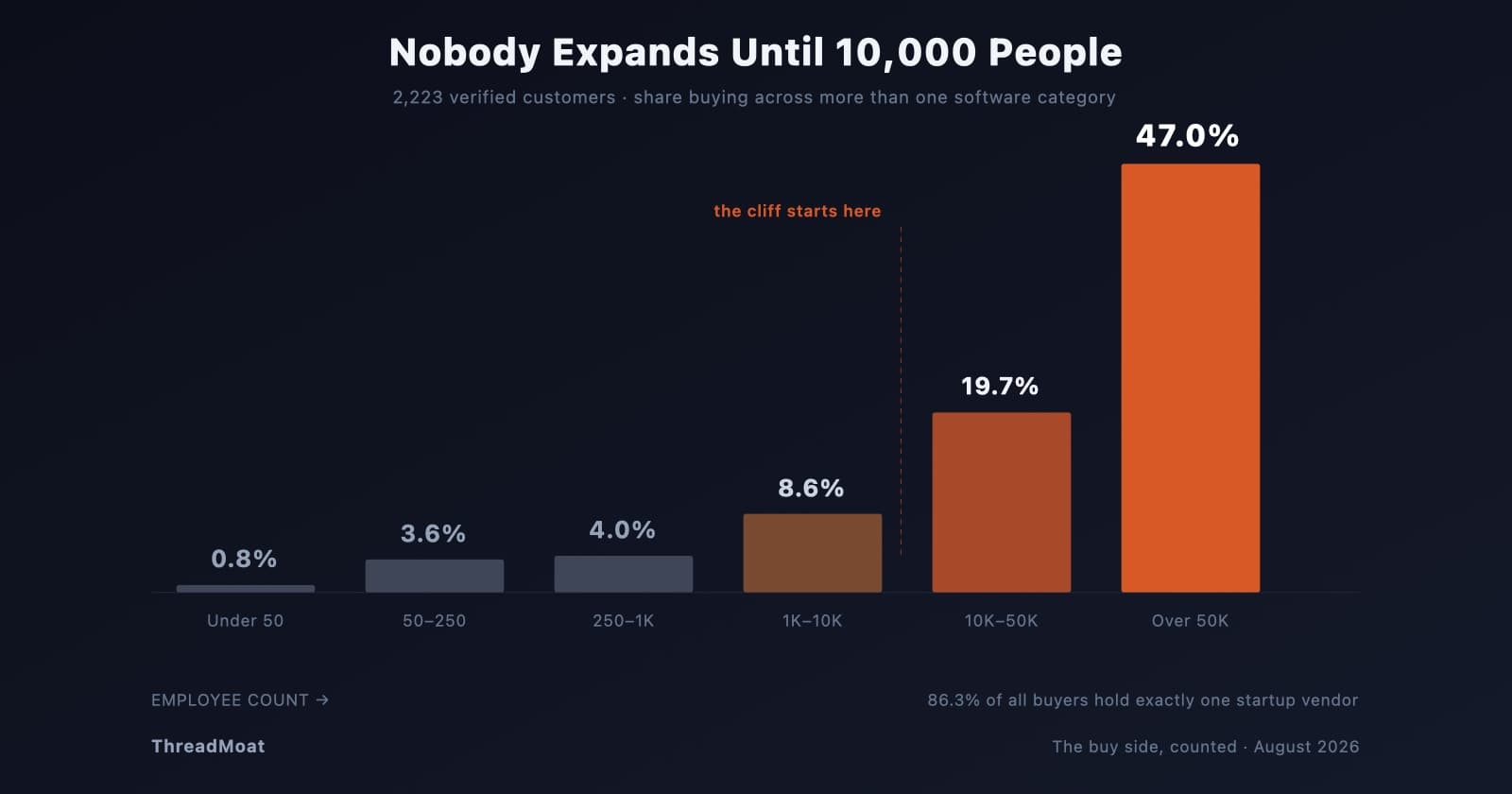
You Already Own a Module That Does This: What the Buy-Side Data Means for PLM Leads
Sep 6, 2026 · 4 min read
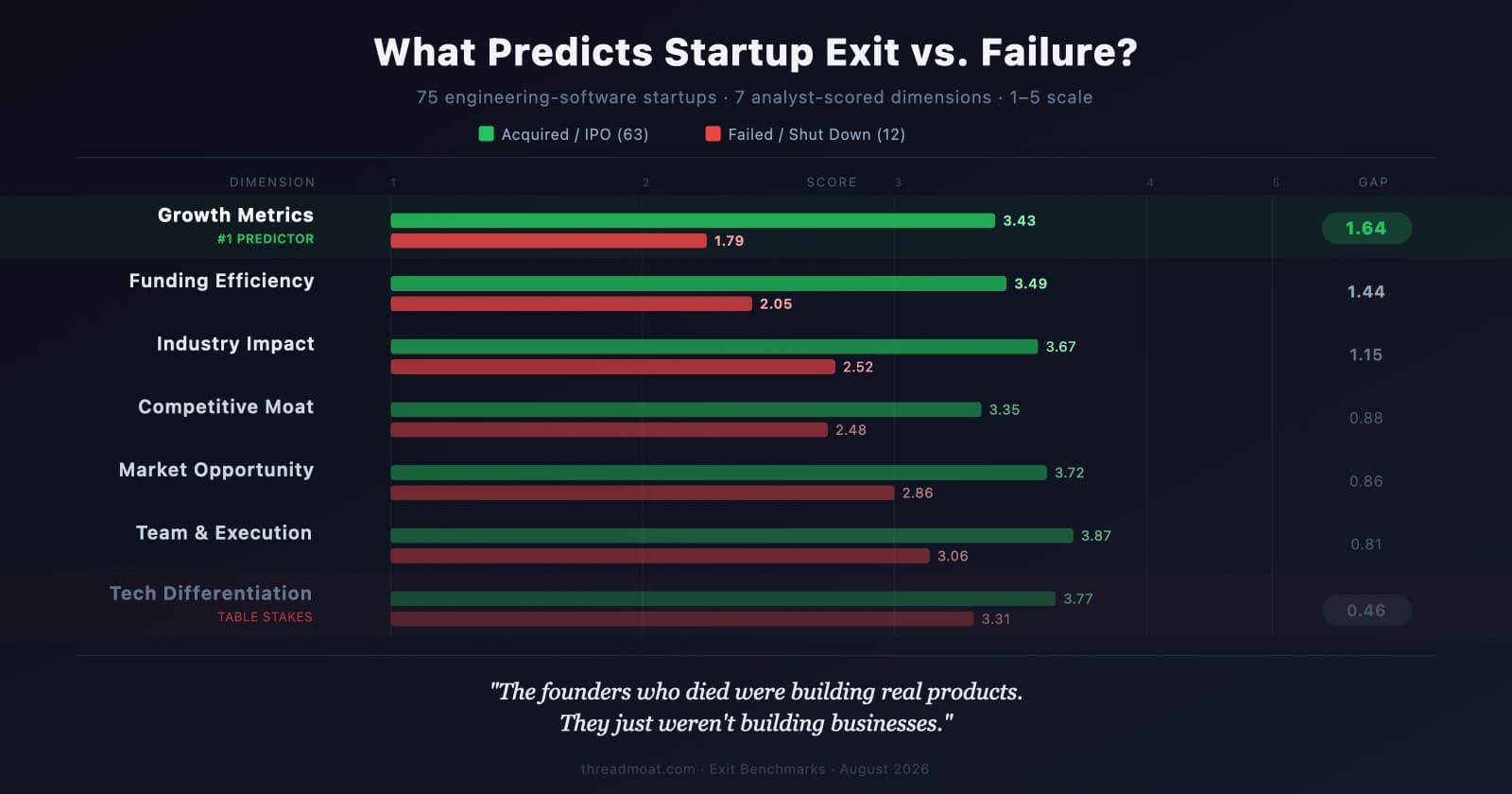
Vendor Risk: What Startup Exit Predictors Mean for Your PLM Stack
Sep 6, 2026 · 4 min read
The 80/20 Rule for AI in Manufacturing: Which Tasks AI Owns and Which Humans Keep
May 23, 2026 · 8 min read