All Articles

Insights

13 articles

Insights

Expert analysis and forward-looking perspectives on digital transformation.

Overview

This page explores the fundamentals, significance, and connections of Insights in the context of modern product lifecycle management, digital transformation, and industry innovation.

Key Themes

  • Core concepts and definitions
  • Why this topic matters to your organization
  • Current trends and future directions
  • Integration with broader PLM strategies

Related Articles


Last Updated: 2026-05-05 | Category: Insights
Key Concepts

Adaptive Manufacturing

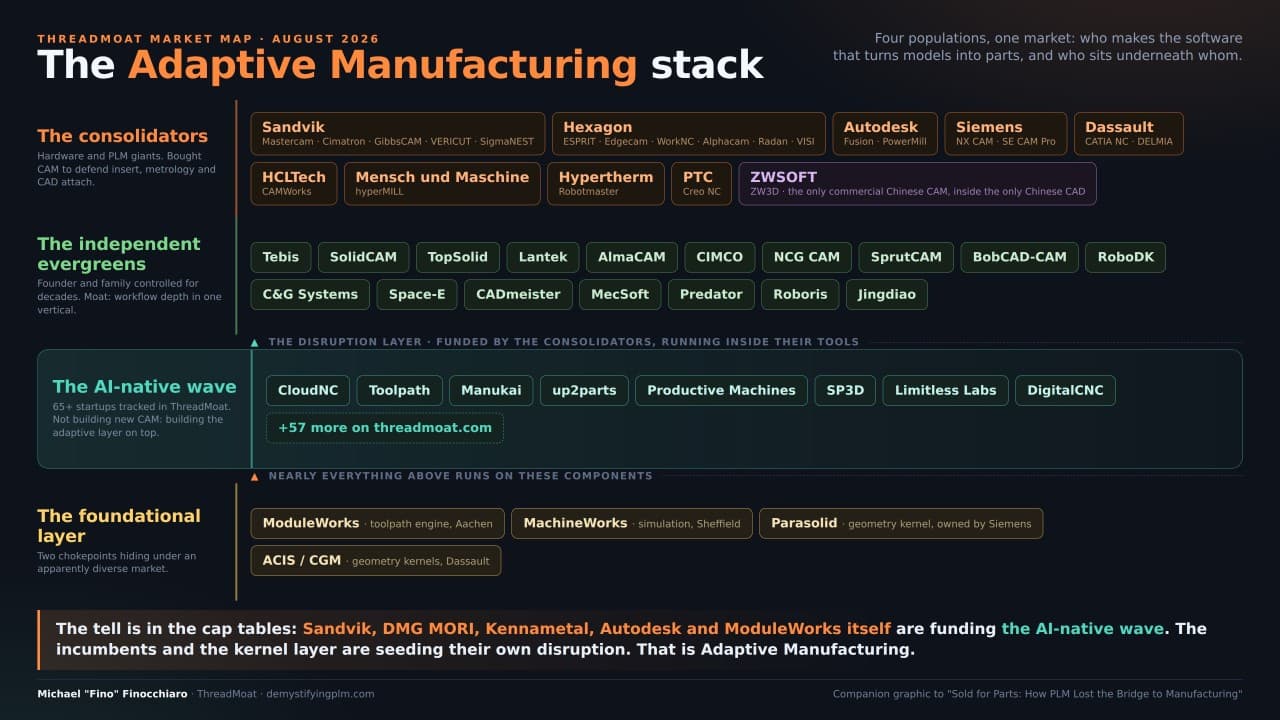
Adaptive Manufacturing is production that senses its own state and changes what it does next. It closes the loop between measurement and action on the shop floor: measure the part and adjust the toolpath, detect tool wear and re-plan the operation, feed inspection results back upstream before the next part is cut. The term is process-agnostic, covering subtractive machining, additive manufacturing and the hybrid of the two, and it describes a behavior rather than an infrastructure. It is distinct from Industry 4.0 (a connectivity ambition), smart manufacturing (a marketing adjective) and closed-loop machining (a single feedback circuit). Adaptive Manufacturing is also the name of the ThreadMoat market map category for the 65+ AI-native startups building this sense-decide-act layer on top of existing CAM, CNC and metrology systems.

Adaptive Meshing

Mesh refinement strategy where element size is adjusted based on predicted or actual stress concentration. Fine mesh where stresses are high, coarse mesh where they are low.

Agent-Native Architecture

Software designed from inception around autonomous AI agents that can read, reason about, and act on domain data. Not retrofitted AI (chatbot on the sidebar); deeply integrated into the system's core.

Agentic PLM

A PLM architecture in which AI agents autonomously monitor product data state, detect workflow triggers, and execute actions — routing approvals, propagating changes, and resolving data conflicts — without waiting for human dispatch.

Autonomous Quality Control

AI-powered automated inspection using computer vision, thermal imaging, or spectroscopy to detect defects in real-time during manufacturing. Unlike sampling-based inspection, autonomous QC inspects 100% of parts.