Key Takeaways
- Of 614 verified startup purchases that extend the Siemens ecosystem, 96.6% land in a category Siemens already ships a product for. Buyers are not filling portfolio gaps; they are bolting a newer capability onto a module they already own.
- Every vertical buys a different thing: aerospace buys traceability at 3x the average rate, automotive buys simulation, logistics buys supply chain intelligence. A horizontal 'AI for manufacturing' pitch is a pitch to nobody.
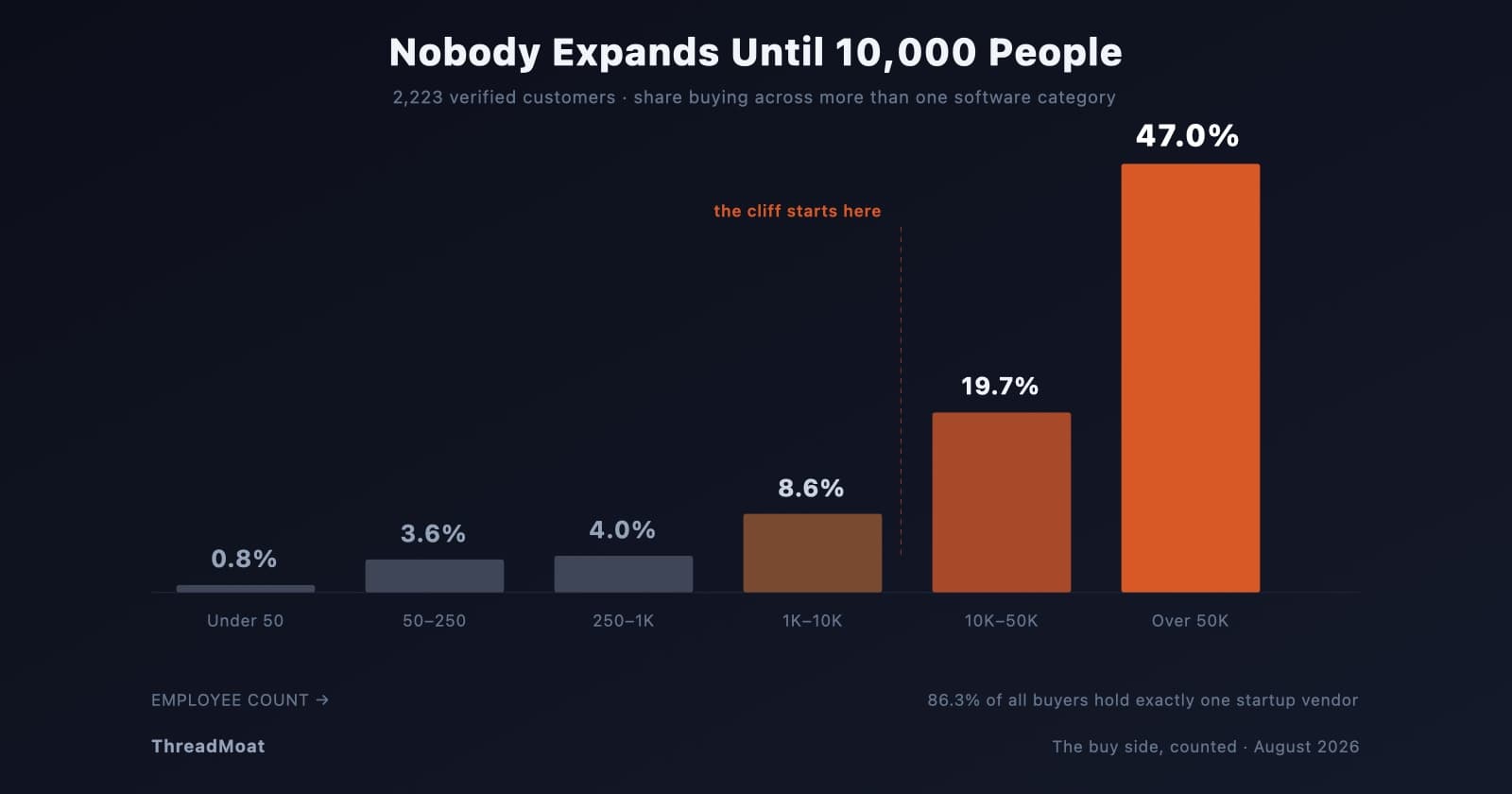
- 97.6% of SMBs in the dataset bought exactly one startup, ever. Cross-category expansion is a cliff that starts around 10,000 employees, driven by org charts, not product quality.
- Startups (24.1%) and SMBs (18.4%) buy agentic orchestration software at roughly double the enterprise rate (12.3%). The blocker in large companies is procurement risk underwriting, not appetite.
- For the PLM lead the practical job is to be the registry: know which pilots exist, which module they overlap, and which capability they add that the module cannot.
Short Answer
ThreadMoat's buy-side census of 2,223 organisations shows that industrial companies buy from startups even when they already own an incumbent module in the same category: 96.6% of Siemens-ecosystem purchases overlap a Siemens product. For a PLM or engineering-IT lead, that reframes vendor evaluation. The question is not whether the portfolio has a gap but whether the capability the startup ships (physics surrogates, geometric part search, autonomous CAM, agentic orchestration) postdates the architecture of the module you own. It also means expansion beyond one vendor rarely happens below 10,000 employees, so the first choice has to be the right one.
- The dataset covers 2,967 confirmed purchase relationships between 2,223 organisations and 475 startups; only 47% of the 935 tracked startups can name a customer at all.
- 39% of purchases involve a startup that declares compatibility with an incumbent platform rather than replacing it. Customers are bolting on, not ripping out.
- Government and defence bodies hold 1.88 startup vendors each versus 1.02 for SMBs; the US Department of Defense alone appears as eleven separate purchasing entities.
- Only 0.8% of companies under 50 staff buy across more than one category, against 47% of companies above 50,000.
- Small companies lead on agentic software because an owner can decide on a Tuesday; enterprise procurement is an insurance mechanism whose job is not to be wrong.
Everyone in PLM has an opinion about who buys from startups. ThreadMoat now has a list: 2,223 organisations, 2,967 verified purchase relationships, 475 named startups, each row carrying the buyer's industry, size band and the category of what they bought. The full analysis is in Who Actually Buys From Industrial Software Startups? on ThreadMoat. This companion reads the same numbers from the practitioner's chair: what changes when a startup lands on your desk and you already run Teamcenter, Windchill or 3DEXPERIENCE.
The evaluation question is not "do we have a gap"
The number that should reorganise your vendor evaluation is 96.6%. Of the 614 verified purchases that extend the Siemens ecosystem, 593 land on a category where Siemens already ships a product: process optimisation next to Tecnomatix and Opcenter, CAD acceleration next to NX, digital thread next to Teamcenter, simulation next to Simcenter. Twenty-one purchases sit in genuine white space. Siemens does it to itself, too: it is the largest buyer of industrial software startups in the dataset, and 25 of the 30 purchases ThreadMoat can classify are in categories Siemens sells.
So your peers are not filling gaps. They already own a module that nominally does the job, and they bought a startup anyway. The data cannot say why, but the vendors tell you: physics-informed surrogates, generative topology optimisation, geometric part search, code-driven CAD, autonomous CAM. These capabilities postdate the architecture the incumbent module was built on. Owning the category on the price list is not the same as owning the capability.
The practical consequence: when the incumbent account manager says "we have that," the right response is a capability test, not a portfolio check. Put the startup and the module on the same part, the same dataset, the same week.
Buy the fix for your cost line, not "AI for manufacturing"
Every vertical in the dataset buys a different thing. Aerospace and defence buys digital thread and traceability at three times the average rate, because certification is its cost line. Automotive buys analysis and simulation at 2.6 times, because prototypes are. Food and beverage buys operations intelligence, because an hour of drift on a continuous line is an hour of scrap. Construction buys progress monitoring and CAD acceleration.
If a startup pitches you "AI across discrete manufacturing," it is pitching the average column of twelve industries that each want something different. Ask which of your cost lines it removes. If the answer is not specific to your vertical, the reference customers will not be either.
Your first startup is probably your only one
86.3% of buyers hold exactly one startup vendor. For SMBs the figure is 97.6%: of 418 small and mid-sized businesses, ten hold more than one. Cross-category expansion is not a gradient; it is a floor and then a cliff, and the cliff starts around 10,000 employees, where 19.7% of companies buy across more than one category, rising to 47% above 50,000.
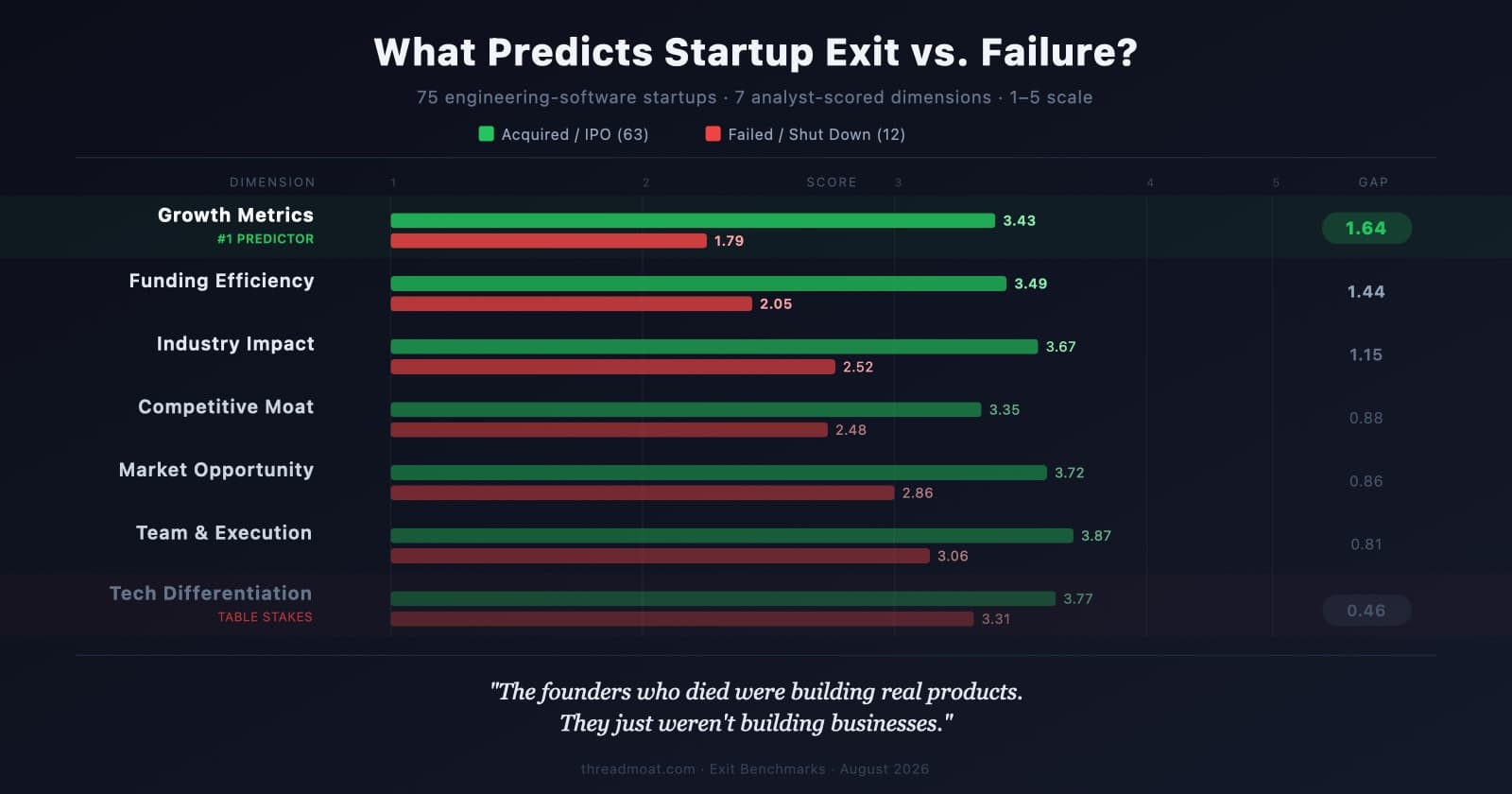
Two readings, depending on where you sit. If you are the one person evaluating software at a 500-person manufacturer, the data says you will not get a second swing for years. Choose for the capability that removes your largest cost line, and check the vendor's survival odds (see the companion piece on what predicts whether a startup gets acquired or dies).
If you are the PLM lead at a 50,000-person company, the data says your organisation is already holding nearly three startup vendors on average, bought by digital groups and plants that do not know about each other. Expansion at that scale is an org chart, not a product achievement. Your leverage is to be the registry: which pilots exist, which module each overlaps, which capability each adds, and which contracts renew when. Nobody else in the building has that list.
Agentic software is being bought by the small companies first
Startups (24.1%) and SMBs (18.4%) buy software with an agentic thesis at roughly double the enterprise rate (12.3%). Government trails at 6.1%. That ordering inverts the discourse, where agents are an enterprise story with a long pilot phase in front of them.
ThreadMoat's read is that the mechanism is risk, not appetite. Enterprise procurement is an insurance function whose job is to not be wrong, and a vendor founded in 2023 fails that underwriting however good the product is. A forty-person shop has an owner who can decide on a Tuesday. For enterprise practitioners the implication is useful: the production references for agentic PLM tooling exist, they are just at companies smaller than yours. Ask the vendor for them, and ask your procurement team what evidence would actually change the underwriting.
The honest limit
Only 47% of the 935 startups ThreadMoat tracks can name a customer at all. Everything above describes the half that can be seen, and "verified" means the relationship was confirmed, not that contract value or deployment scope is known. Treat the numbers as base rates, not as a ranking of vendors. For the vendor-level view, the ThreadMoat scorecards and the DPLM buyer's guides (PLM, CAD, CAM, MES, simulation) are the next stop.
Source data and full analysis: Who Actually Buys From Industrial Software Startups?, ThreadMoat customer census, export of 24 August 2026.
Cite this article
Finocchiaro, Michael. “You Already Own a Module That Does This: What the Buy-Side Data Means for PLM Leads.” DemystifyingPLM, September 6, 2026, https://www.demystifyingplm.com/insights/startup-buy-side-data-plm-practitioners