All Articles

Key Concepts

23 articles

Market Dynamics

Understanding the dynamics of the market is essential for PLM practitioners to stay ahead of the curve. This includes analyzing customer needs, identifying emerging technologies, and gauging competitive landscape changes. Regularly following industry news and attending relevant conferences like Aras Connect Paris 2024 or Capgemini Engineering Horizons Conference 2025 can provide valuable insights.

Technology Trends

Key technology trends in PLM include digital twins, cloud computing, artificial intelligence (AI), and blockchain. For instance, the Siemens Realize LIVE 2020 Announcements highlighted significant advancements in these areas, which have profound implications for product development methodologies. Similarly, Aras ACE 2025 focused on the integration of AI to enhance decision-making processes.

Best Practices

Best practices in industry-analysis encompass methodologies such as SWOT analysis (Strengths, Weaknesses, Opportunities, Threats) and Porter's Five Forces model. These frameworks help PLM practitioners assess their strategic positioning and identify areas for improvement. The pre-conference workshops on data interoperability at events like Aras Connect Paris 2024 emphasize the importance of seamless data flow across various stages of the product lifecycle.
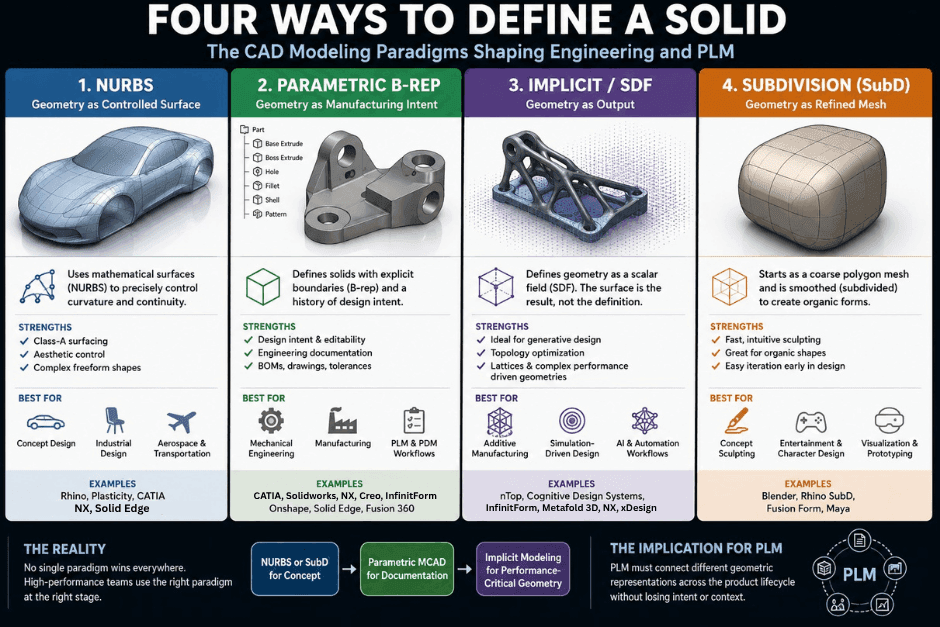

CAD modeling paradigms — NURBS, parametric, implicit SDF, and subdivision surface approaches to defining geometry

Four Ways to Define a Solid: The CAD Modeling Paradigms Behind Modern PLM

Four fundamentally different mathematical approaches underlie every CAD tool you use. NURBS-based modelers sculpt smooth surfaces. Parametric MCAD captures manufacturing intent in a feature tree. Implicit/SDF systems generate geometry from physics and constraints. Subdivision surfaces bridge concept sculpting and NURBS refinement. Understanding which paradigm applies — and when to combine them — is the strategic question for every engineering team in 2026.

Key Concepts

150% BOM

An informal name for a Modular BOM, reflecting that the structure contains more parts than any single product instance will ever use — it is 'over-specified' by design so that option logic can select the correct subset.

ALM (Application Lifecycle Management)

Application Lifecycle Management (ALM) is the discipline and toolset for managing the full lifecycle of a software application — requirements capture, development, testing, release, and maintenance. In the context of PLM, ALM becomes relevant as modern engineered products (vehicles, medical devices, industrial equipment) contain increasing amounts of embedded software. ALM tools like PTC Codebeamer, Siemens Polarion, and IBM Engineering Lifecycle Management bridge software development practices (agile, CI/CD) with hardware-oriented PLM processes (change orders, configurations, regulatory traceability).

As-Built Record

A record of the actual configuration of a specific product unit as it was manufactured — the components used, their revision levels and lot numbers, and any deviations from the design specification that were authorized at build time.

As-Maintained Record

A running log of all changes, repairs, component replacements, and service events that have occurred on a product unit since it left the factory, maintained throughout the unit's operational life.

Asset Lifecycle Management (ALM)

Management of assets and their associated data throughout their operational lifetime, including installation, operation, maintenance, and decommissioning. AVEVA focuses on this domain.