All Articles

Simulation (CAE)

5 articles

Simulation (CAE)

Simulation — also called Computer-Aided Engineering (CAE) — is the discipline of virtually testing products before physical prototypes are built. The major platforms include Ansys, Siemens Simcenter, Dassault SIMULIA, and challengers like SimScale and Neural Concept. As AI-accelerated solvers and cloud-native simulation platforms emerge, the boundary between simulation and generative design is dissolving.

Historically, simulation was a downstream validation step — engineers completed a design in CAD and handed it off to analysis specialists who ran FEA or CFD to confirm it met requirements. That model is breaking down. AI-accelerated solvers now enable simulation at the concept stage, and platforms like Neural Concept embed surrogate models directly in the design loop. This shift means simulation is becoming a continuous design constraint rather than a final gatekeeper, changing how PLM data management systems need to handle simulation artifacts.

The PLM integration story is also maturing. Siemens Simcenter is tightly coupled to Teamcenter, SIMULIA is embedded in the 3DEXPERIENCE platform, and Ansys has invested in connectors across the major PLM ecosystems. This integration matters because aerospace, automotive, and defense programs require full traceability between simulation inputs, approved design revisions, and certification evidence — traceability that only exists when simulation is managed inside the PLM system, not in standalone file folders.

Related Articles


Last Updated: 2026-06-02 | Category: Insights
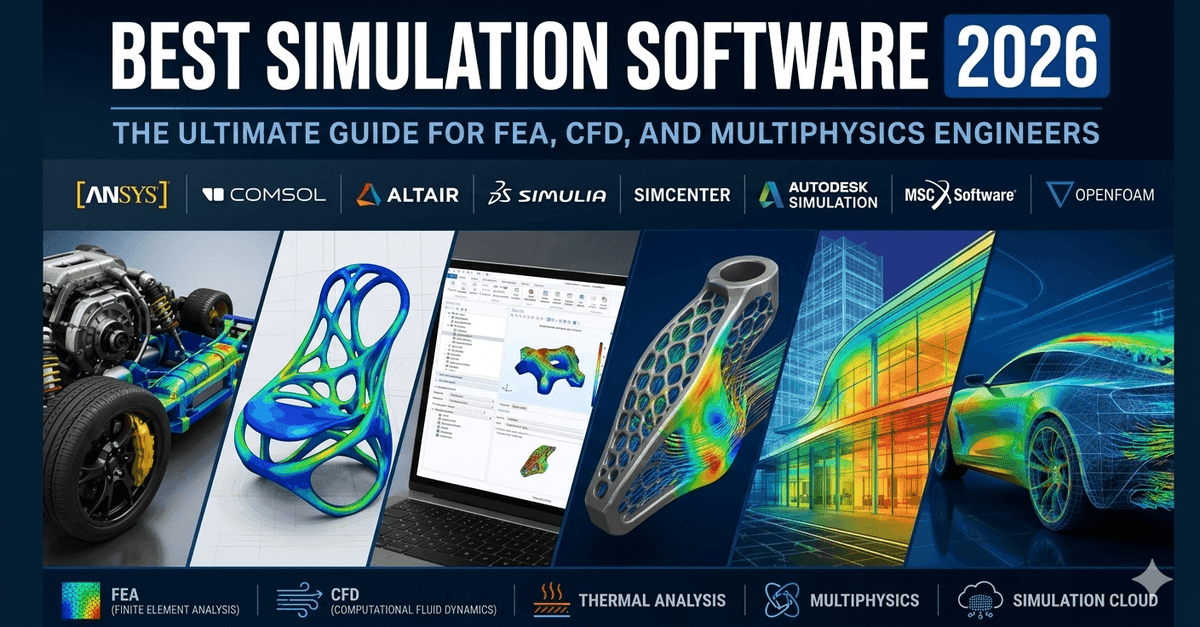
Best Simulation Software 2026 — CAE suites vs new constellation vendors

Best Simulation Software 2026: Incumbents, Specialists, and the New Constellation

The best simulation software in 2026 depends on whether you need deep multiphysics breadth, vertical domain expertise, or cloud-native accessibility. The market has quietly split into three layers: legacy CAE suites that still dominate complex physics, vertical specialists built for casting, molding, EM, and process simulation, and a new constellation of cloud-native and AI-assisted tools redefining how engineers interact with simulation. This is the independent guide to all three.

· 19 min read
Case Study Ntop Neural Concept Design Optimization

nTop and Neural Concept: Engineering the Next Generation of AI-Driven Product Design

nTop and Neural Concept are both solving the same engineering design bottleneck — the gap between what engineers can imagine and what simulation can evaluate in reasonable time. nTop eliminates the CAD-to-simulation-to-manufacturing loop latency with computational geometry. Neural Concept, backed by $100M from Goldman Sachs, applies deep learning to reduce simulation cycle times by orders of magnitude. Together they represent where AI meets the fundamental physics of design.

· 9 min read
Case Study Cognasim Cds Simulation Manufacturing

CognaSIM and Cognitive Design Systems: Closing the Design-Simulation-Manufacturing Gap

CognaSIM and Cognitive Design Systems are attacking the same structural problem from different directions: the gap between what engineers design, what simulation validates, and what manufacturing can actually build. The result of that gap — costly late-stage changes, simulation-manufacturing misalignment, and tribal knowledge silos — costs aerospace programs billions per year. Both companies are building AI-driven bridges across it.

· 9 min read

Key Concepts

Adaptive Meshing

Mesh refinement strategy where element size is adjusted based on predicted or actual stress concentration. Fine mesh where stresses are high, coarse mesh where they are low.

Asset Performance Management

An operational discipline using real-time sensor data, predictive analytics, and digital twin models to monitor the health and performance of physical assets, predict maintenance needs, and optimize availability and efficiency.

CFD (Computational Fluid Dynamics)

Computational Fluid Dynamics (CFD) is the simulation of fluid flow, heat transfer, and related phenomena using numerical methods. CFD discretizes the fluid domain into a computational mesh and solves the Navier-Stokes equations (and turbulence models, combustion chemistry, or multiphase physics as required) to predict velocity fields, pressure distributions, thermal gradients, and mass transport. CFD is central to aerodynamic design, thermal management, combustion, HVAC, and any engineering context where fluid behavior determines performance or safety.

Design Optimization

Automated search through design space (geometry, material, topology) to find solutions that meet performance goals (minimize mass, keep stress below threshold, maximize stiffness) or objectives (maximize efficiency, minimize cost).

Digital Twin

A digital twin is a virtual representation of a physical product, asset, or system that is synchronized with real-world data to reflect current state, predict future behavior, or support operational decisions. In engineering, digital twins range from design-phase simulation models updated with as-built geometry, to operational twins that receive live sensor data from deployed assets and run predictive models in real time. Digital twins that connect simulation to operations require integration between the simulation platform, the PLM system (which holds the product model), and the MES or IIoT layer (which provides operational data).