CAE (Computer-Aided Engineering)
Computer-Aided Engineering (CAE) is the software discipline and toolset for simulating the performance of a design under real-world conditions — structural loads, temperature, vibration, fluid flow — before the design is finalized for manufacturing. CAE is upstream in the product lifecycle. It consumes CAD geometry as input and outputs simulation results (stress maps, deformation plots, flow visualizations, temperature distributions) that tell the design engineer whether the design will work as intended.
CFD (Computational Fluid Dynamics)
CFD (Computational Fluid Dynamics) is the branch of engineering simulation that predicts fluid flow, heat transfer, and related physical phenomena using numerical methods applied to a computational mesh. CFD discretizes the fluid domain — air, water, coolant, combustion gases — into millions of cells and solves the Navier-Stokes equations iteratively to compute velocity fields, pressure distributions, thermal gradients, turbulence behavior, and mass transport. The key choices in any CFD analysis are: turbulence model (RANS, LES, DNS — each a different fidelity/cost tradeoff), mesh strategy (structured hexahedral for maximum accuracy, unstructured tetrahedral for complex geometry, hybrid for both), solver algorithm (pressure-based for incompressible flow, density-based for high-speed compressible), and boundary conditions (inlet velocity, wall temperature, outlet pressure). CFD applications span automotive exterior aerodynamics, aircraft aerodynamic design and engine intake analysis, electronics thermal management (junction temperatures, heat sink design), HVAC and building airflow, combustion and burner design, and biomedical flow (blood flow through stents and heart valves). Leading CFD solvers include Ansys Fluent and CFX (general-purpose), Siemens Simcenter STAR-CCM+ (automotive, industrial), OpenFOAM (open-source, HPC-capable), and Cadence Fidelity (aerospace-grade precision).
FEA (Finite Element Analysis)
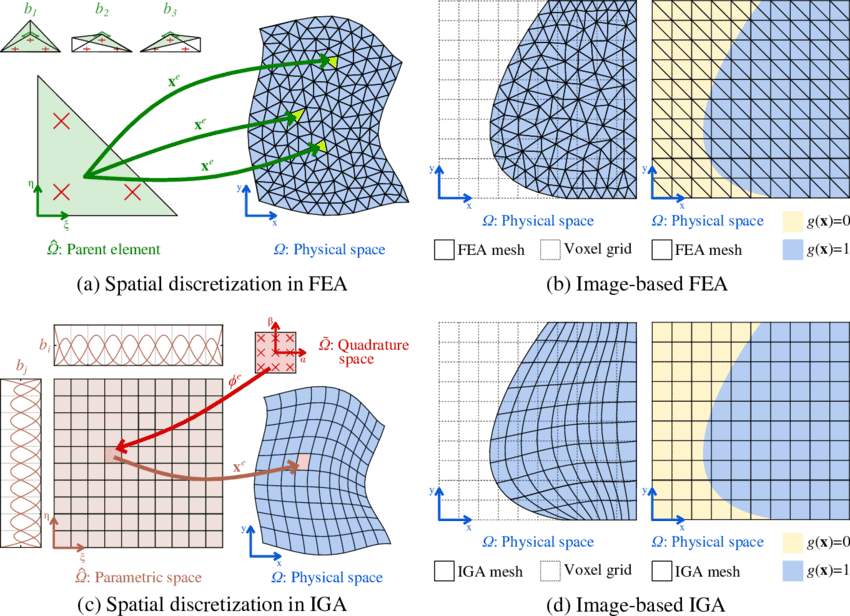
Finite Element Analysis (FEA) is a computational simulation method that discretizes a physical structure into a mesh of finite elements to solve partial differential equations governing structural mechanics, heat transfer, and related physics. FEA predicts stresses, strains, deformations, vibrations, and thermal distributions in solid bodies under applied loads and boundary conditions. FEA is the foundation of structural simulation in CAE suites (Ansys Mechanical, Simcenter Nastran, Abaqus) and is used across aerospace, automotive, consumer products, medical devices, and civil engineering for design validation and certification.