Show all chapters ▸Hide chapters ▾
- 1Best PLM Software 2026: Q1 Edition (Archived)
- 2Best MES Software 2026: Q1 Edition (Archived)
- 3Best BIM Software 2026: The Independent Buyer's Guide for AEC and Owner Organizations
- 4Best CAD Software 2026: The Engineer's Honest Guide
- 5Best CAM Software 2026: The Machinist's Independent Guide
- 6Best Operations & Asset Management Software 2026: The CIO's Independent Buyer's Guide
- 7Best IIoT Platforms 2026: The Manufacturer's Independent Buyer's Guide
- 8Best MES Software 2026: The Manufacturer's Independent Guide
- 9Best PLM Software 2026: The Independent Buyer's Guide
- 10Best SCM Software 2026: The Supply Chain Independent Buyer's Guide
- 11Best Simulation Software 2026: Incumbents, Specialists, and the New Constellation
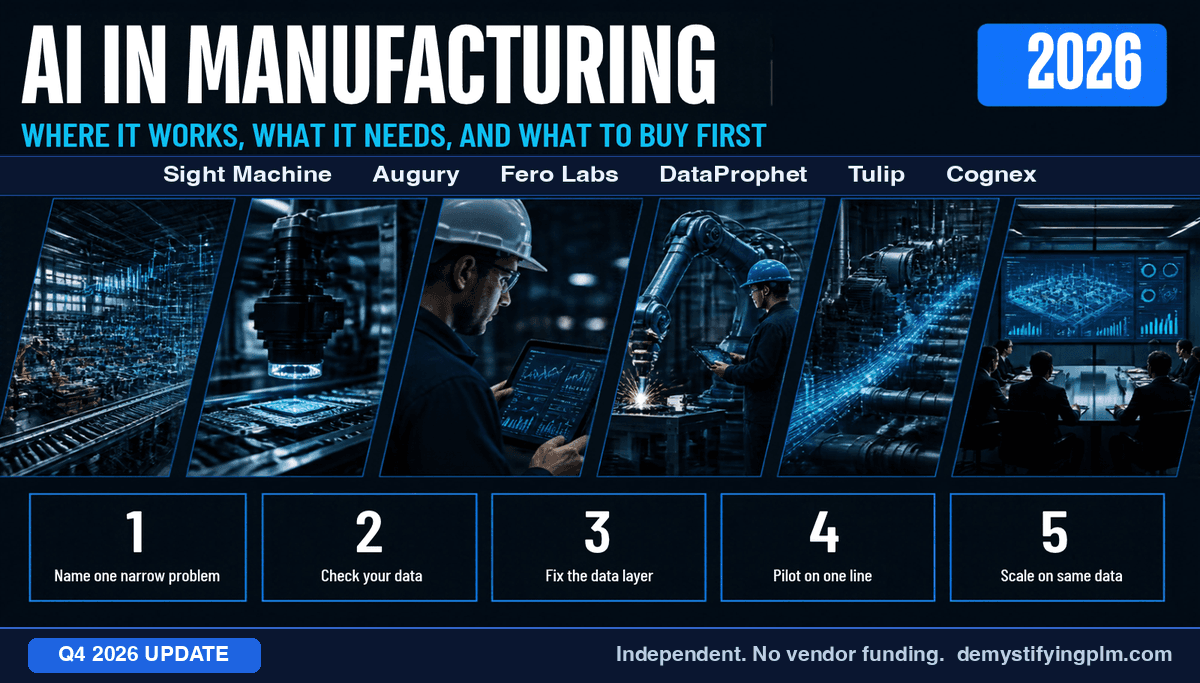
- 12AI in Manufacturing 2026: Where It Works, What It Needs, and What to Buy First
- 13Best Industrial AI Platforms 2026: The Independent Buyer's Guide
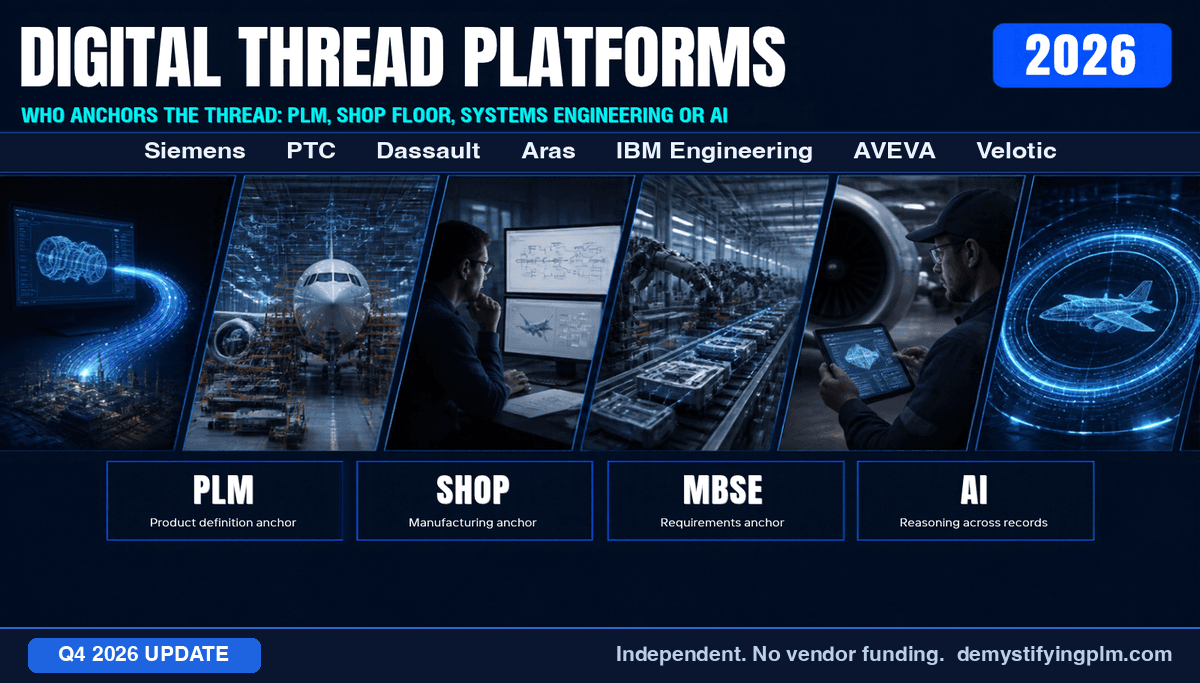
- 14Digital Thread Platforms 2026: The Independent Buyer's Guide
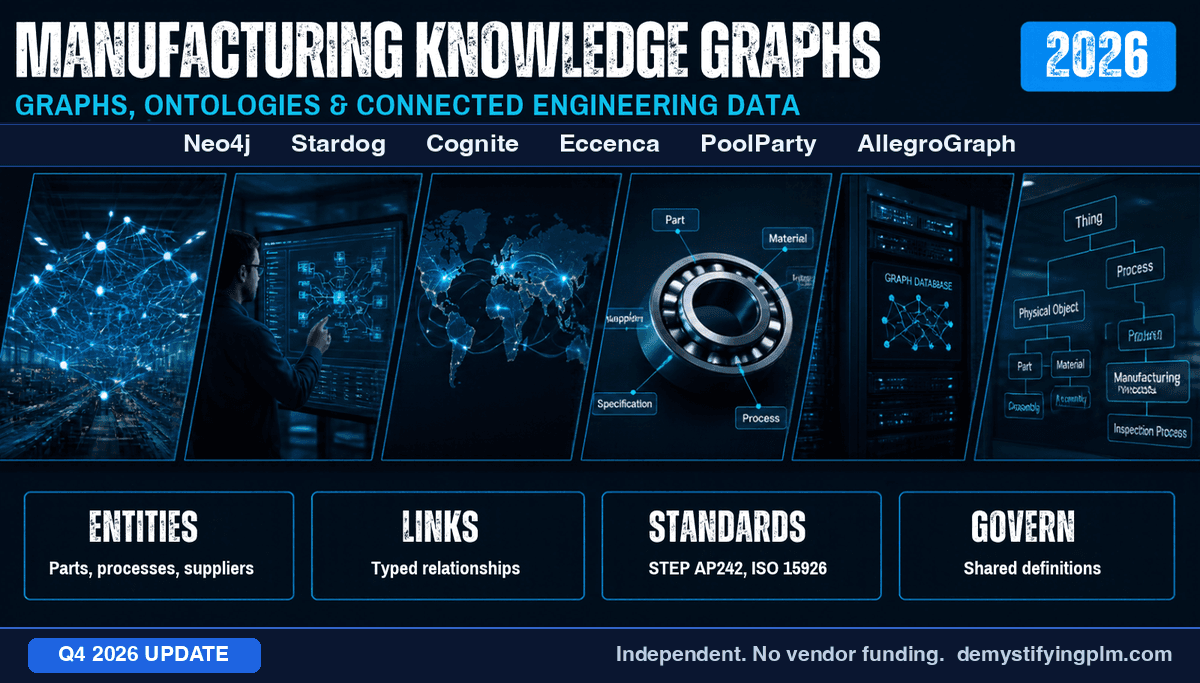
- 15Manufacturing Knowledge Graphs 2026: The Independent Buyer's Guide
Key Takeaways
- Start with the use case your existing data already supports
- Fix data readiness before you evaluate vendors
- Buy narrow before broad - a single well-defined problem before a platform
- Put AI where the data lives - plant layer, execution layer and product definition
- Plan for model monitoring and ownership as an ongoing cost
Short Answer
AI in manufacturing works best on narrow problems with clean data: visual inspection and machine health are the most mature, process optimization and planning follow, and generative AI for documentation and engineering assistance is the newest. The binding constraint is data readiness, not algorithms. Fix the plant and product data layers first, then buy the use case that your data already supports.
- Visual inspection and machine health are the most mature use cases. Process optimization, planning and forecasting come next. Generative AI for documentation and engineering guidance is the newest
- Data readiness, not model quality, decides outcomes. Labeled examples, baseline history, contextualized plant data and a clean product definition are the real inputs
- Narrow, well-defined problems pay back faster than broad cross-functional optimization
- AI needs a home in the stack - plant data in the unified namespace, execution records in MES, product definition in PLM
- Generative AI changes how people ask questions of engineering data. It does not remove the need for governed data underneath
- Treat every accuracy and payback figure as a vendor claim until reproduced on your line
The Short Version
AI in manufacturing is not one purchase. It is a set of use cases at different levels of maturity, each with its own data requirement. The sensible order is: fix the data layer, pick the mature use case your data already supports, then expand.
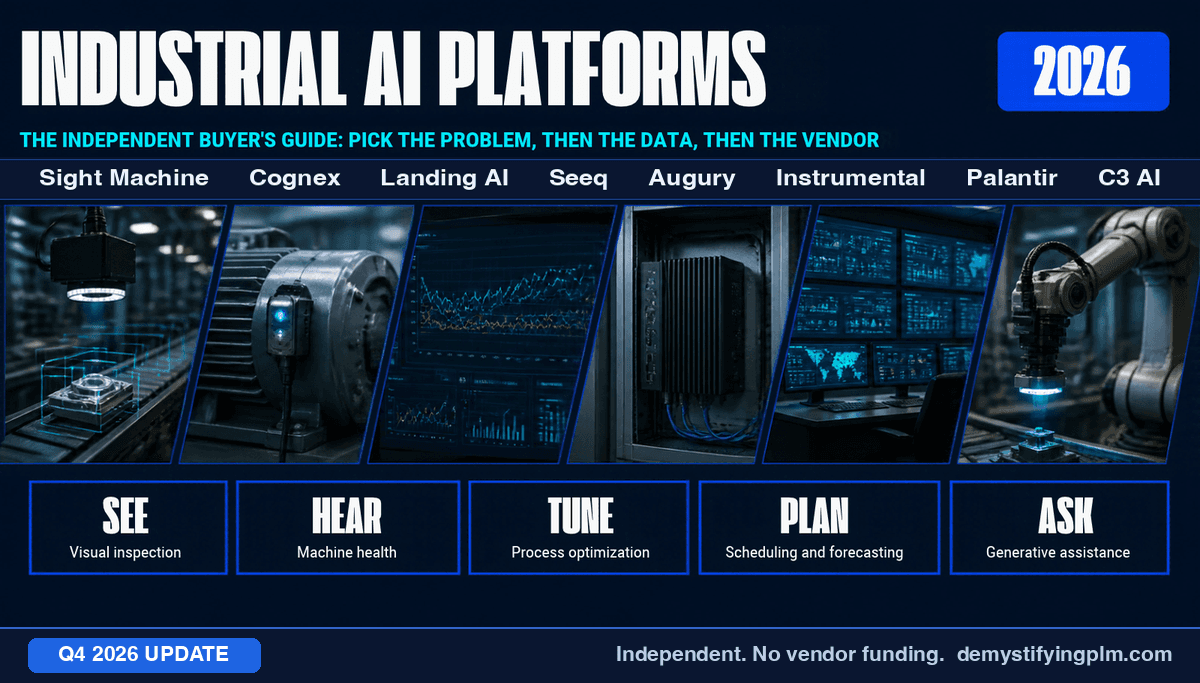
This guide is the use-case companion to Best Industrial AI Platforms 2026, which covers the platforms. It applies the same scope test as the rest of the series: only AI that depends on product or production data is covered.
Use Cases, Data Needs and Where to Look
| Use case | Maturity | Data it needs | Where the software is covered |
|---|---|---|---|
| Visual inspection | Mature | Labeled images of good parts and each defect type | Industrial AI platforms |
| Machine health and predictive maintenance | Mature | Baseline sensor history, maintenance records | EAM-APM, Industrial AI platforms |
| Process parameter optimization | Established | Process parameters linked to quality outcomes | Industrial AI platforms, MES |
| Production scheduling | Established | Orders, routings, capacity, actuals | MES, SCM |
| Demand and supply forecasting | Established | Sales and supply history, BOM and change data | SCM |
| Engineering assistance and design exploration | Early to emerging | Governed product data, simulation results | PLM, Simulation |
| Documentation and operator guidance (generative) | Early | Work instructions, process records, product definition | MES, PLM |
Maturity here is the author's judgment from vendor deployments and published case material, not a measured score.
Data Readiness Comes First
Four inputs recur in every use case:
- Labeled examples. Especially for rare defects. Without them, inspection models cannot be trusted.
- Baseline history. Machine health needs a period of normal operation to define abnormal.
- Contextualized plant data. A sensor value without machine, product and order context is hard to use. This is the unified namespace problem in the IIoT guide.
- A clean product definition. Models that judge quality or suggest changes need to know what the product is supposed to be, which lives in PLM.
If any of these is missing, fix it before the pilot. A vendor cannot supply it for you.
Buy in This Order
- A narrow problem with data you already have. Inspection on one line, or machine health on one asset class.
- The data layer it depends on. Namespace, historian and MES records, if they are the bottleneck.
- A second use case on the same data. Process optimization often reuses the data that inspection produced.
- Broader platforms and generative tools. Once governed data exists for them to read.
Representative Vendors
Examples, not a ranking, drawn from the platform guide and adjacent categories: Sight Machine and Augury for analytics and machine health, Fero Labs and DataProphet for process optimization, Tulip for frontline operations. Platform notes and buyer questions are in Best Industrial AI Platforms 2026.
What to Be Skeptical About
- Accuracy figures quoted without a stated dataset or line.
- Payback periods that exclude data engineering and model operations.
- "AI-native" labels. Ask what the model does that rules could not.
- Platform breadth presented as a substitute for a working first use case.
Startups to Watch
Startups in this guide
ThreadMoat tracks the startups behind this category, with stage, funding and independent scoring. No vendor funding, no paid placements. Browse them on ThreadMoat:
Related Articles
- Best Industrial AI Platforms 2026 — the platform and vendor view
- Manufacturing Knowledge Graphs 2026 — the connected-data layer that lets AI reason across engineering and operations
Related Buyer's Guides
- Best PLM Software 2026 — VAULT framework
- Best Simulation Software 2026 — SOLVE framework
- Best MES Software 2026 — MINT Stack
- Best EAM/APM Software 2026 — FIELD framework
- Best SCM Software 2026 — CHAIN framework
- Best IIoT Platforms 2026 — PULSE framework
- Best Industrial AI Platforms 2026
All guides: no vendor funding, no analyst-quadrant hedging. Full vendor scorecards and competitive data at threadmoat.com.
A ThreadMoat Independent Research Report | Author: Michael Finocchiaro | Edition: 2026 Q4 | Last Updated: 2026-11-05
Want to listen instead of read? 56 DemystifyingPLM articles are available as audio.
Browse audio →Show all chapters ▸Hide chapters ▾
- 1Best PLM Software 2026: Q1 Edition (Archived)
- 2Best MES Software 2026: Q1 Edition (Archived)
- 3Best BIM Software 2026: The Independent Buyer's Guide for AEC and Owner Organizations
- 4Best CAD Software 2026: The Engineer's Honest Guide
- 5Best CAM Software 2026: The Machinist's Independent Guide
- 6Best Operations & Asset Management Software 2026: The CIO's Independent Buyer's Guide
- 7Best IIoT Platforms 2026: The Manufacturer's Independent Buyer's Guide
- 8Best MES Software 2026: The Manufacturer's Independent Guide
- 9Best PLM Software 2026: The Independent Buyer's Guide
- 10Best SCM Software 2026: The Supply Chain Independent Buyer's Guide
- 11Best Simulation Software 2026: Incumbents, Specialists, and the New Constellation
- 12AI in Manufacturing 2026: Where It Works, What It Needs, and What to Buy First
- 13Best Industrial AI Platforms 2026: The Independent Buyer's Guide
- 14Digital Thread Platforms 2026: The Independent Buyer's Guide
- 15Manufacturing Knowledge Graphs 2026: The Independent Buyer's Guide
Looking up PLM terminology? Browse the canonical reference.
PLM Glossary →Cite this article
Finocchiaro, Michael. “AI in Manufacturing 2026: Where It Works, What It Needs, and What to Buy First.” DemystifyingPLM, November 5, 2026, https://www.demystifyingplm.com/ai-in-manufacturing-2026
Michael Finocchiaro (opens in a new tab)
PLM industry analyst · 35+ years at IBM, HP, PTC, Dassault Systèmes
Firsthand knowledge of the evolution from early 3D modeling kernels to today's cloud-native platforms and agentic AI — the history, strategy, and future of PLM.