Show all chapters ▸Hide chapters ▾
- 1Best PLM Software 2026: Q1 Edition (Archived)
- 2Best MES Software 2026: Q1 Edition (Archived)
- 3Best BIM Software 2026: The Independent Buyer's Guide for AEC and Owner Organizations
- 4Best CAD Software 2026: The Engineer's Honest Guide
- 5Best CAM Software 2026: The Machinist's Independent Guide
- 6Best Operations & Asset Management Software 2026: The CIO's Independent Buyer's Guide
- 7Best IIoT Platforms 2026: The Manufacturer's Independent Buyer's Guide
- 8Best MES Software 2026: The Manufacturer's Independent Guide
- 9Best PLM Software 2026: The Independent Buyer's Guide
- 10Best SCM Software 2026: The Supply Chain Independent Buyer's Guide
- 11Best Simulation Software 2026: Incumbents, Specialists, and the New Constellation
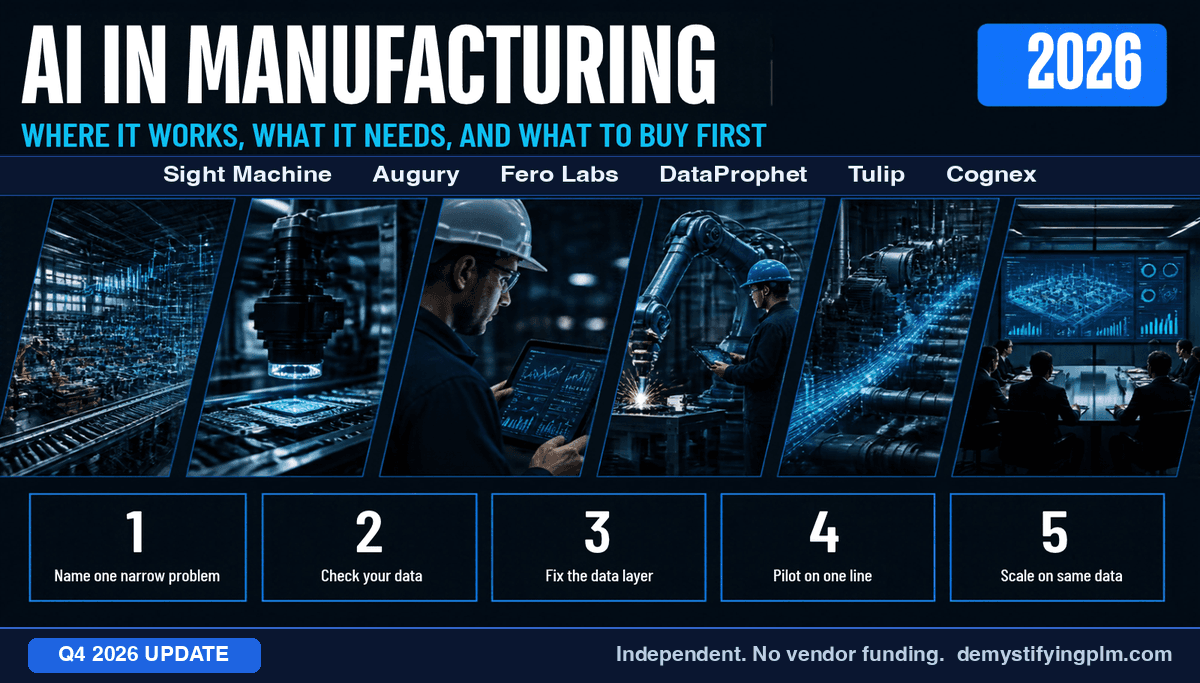
- 12AI in Manufacturing 2026: Where It Works, What It Needs, and What to Buy First
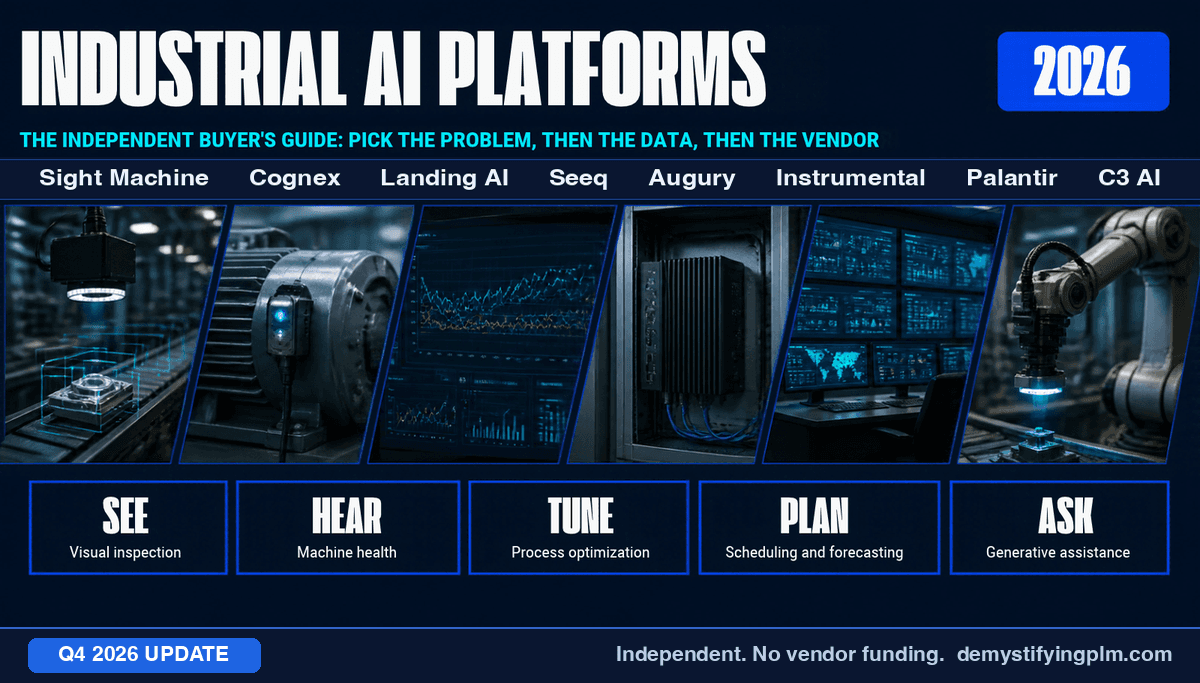
- 13Best Industrial AI Platforms 2026: The Independent Buyer's Guide
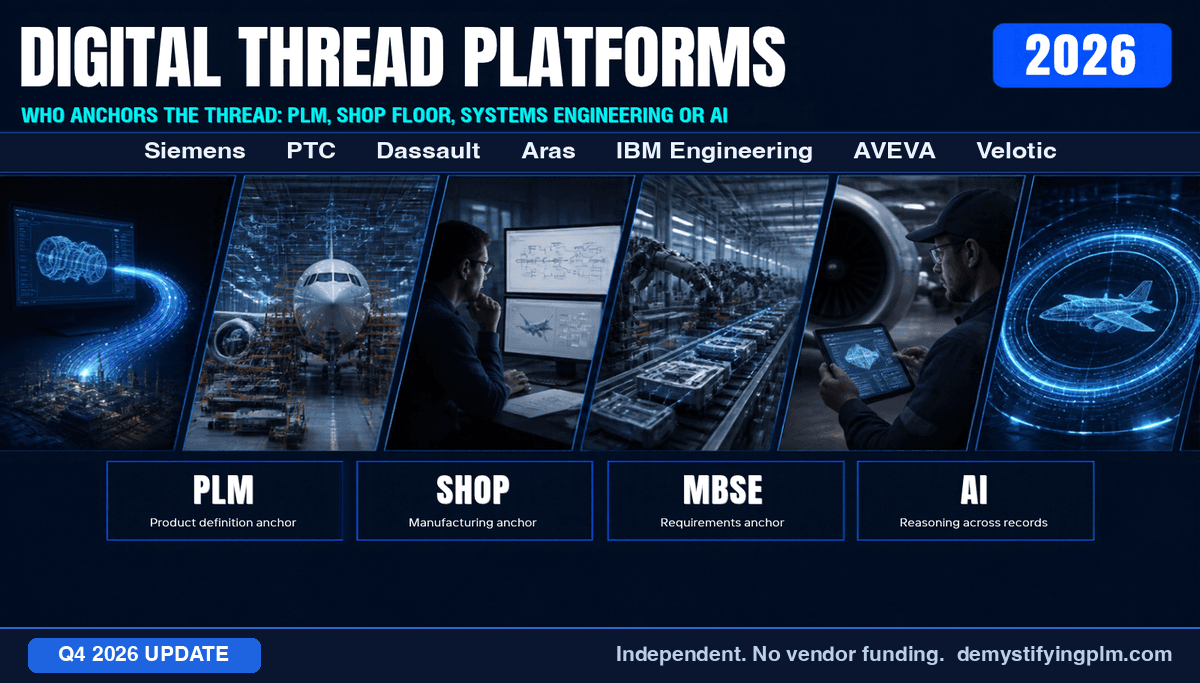
- 14Digital Thread Platforms 2026: The Independent Buyer's Guide
- 15Manufacturing Knowledge Graphs 2026: The Independent Buyer's Guide
Key Takeaways
- Start from a specific cross-system question you cannot answer today
- Agree entity definitions and ownership before choosing a platform
- Reuse standards (STEP AP242, ISO 15926, QUDT) where they fit
- Keep transactional data in relational systems and link to them from the graph
- Ask how the graph is kept in sync with the source systems
Short Answer
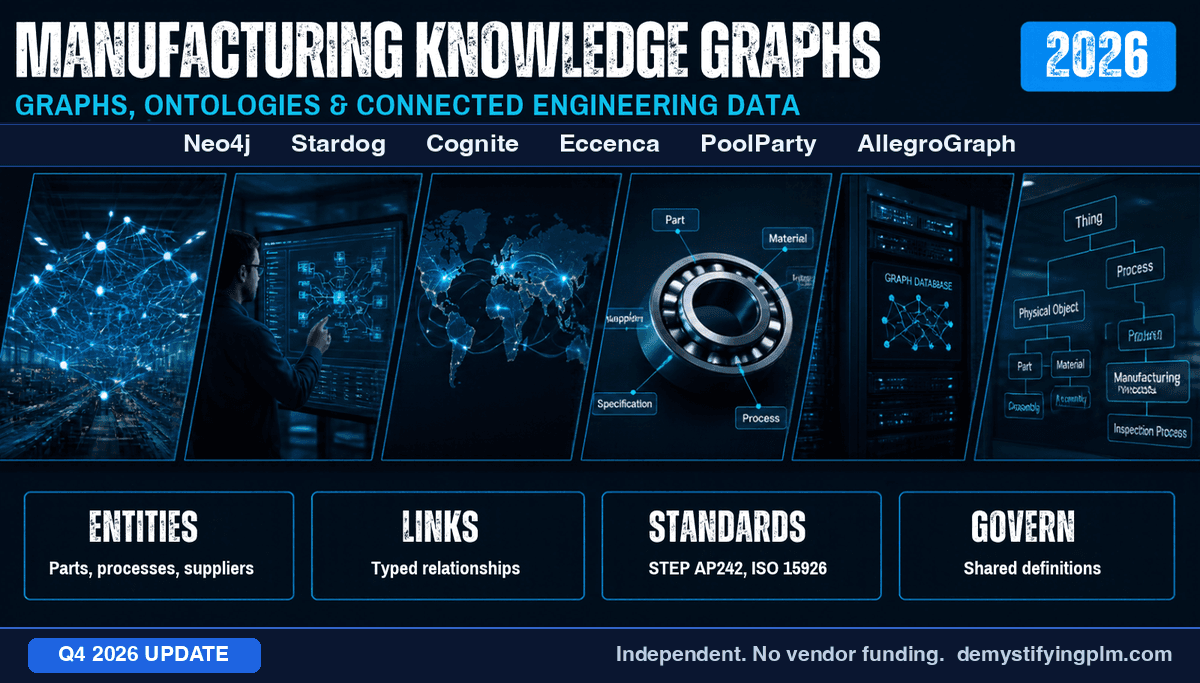
A manufacturing knowledge graph stores parts, processes, suppliers, requirements and equipment as connected entities, so questions that cross systems (what is affected if this specification changes?) become queries instead of integration projects. Choose between a graph database you model yourself, a semantic platform built around ontologies, and an industrial data platform that ships a contextualization layer. The technology is manageable. Agreeing shared definitions across engineering, manufacturing and supply chain is the hard part.
- A knowledge graph represents entities and typed relationships, which suits multi-hop questions across engineering, operations and supply chain data
- Relational tables stay better for transactional work such as inventory and orders. Graphs are better for impact analysis, traceability and risk propagation
- Standards give a head start - STEP AP242 for product data, ISO 15926 for process plants, QUDT for quantities and units
- Three platform types - graph databases, semantic platforms, and industrial data platforms with built-in contextualization
- Ontology governance, meaning shared definitions across functions and sometimes companies, is the main barrier
- Graphs are increasingly used to ground language models in traceable engineering data
What a Knowledge Graph Is For
Manufacturers hold the answers to many cross-system questions already, spread over PLM, MES, ERP, quality and service systems. A knowledge graph makes those answers queryable by storing entities and relationships rather than tables.
Typical questions it makes cheap:
- Which products are affected if this component specification changes?
- Which suppliers provide parts with a similar failure history?
- Which requirements trace to this test result and this as-built record?
This guide applies the series scope test: it covers graph and semantic platforms because they depend on product and production data (BOM, change, supplier, process and equipment records). General-purpose knowledge management with no product data model is out of scope.
Three Platform Types
| Type | What you get | Examples | Best when |
|---|---|---|---|
| Graph database | A store and query language you model yourself | Neo4j, AllegroGraph | You have engineers and a clear first use case |
| Semantic platform | Ontology tooling, reasoning and integration | Stardog, Eccenca, PoolParty | Shared definitions and traceability are the main goal |
| Industrial data platform | A pre-built contextualization layer over plant and engineering data | Cognite, Bentley iTwin | You want a working model of assets quickly in a given domain |
Standards Worth Reusing
- STEP AP242 for product and manufacturing information exchange, common in aerospace and automotive.
- ISO 15926 for process plant data.
- QUDT for quantities, units and dimensions.
Adopting a standard does not remove the governance work, but it shortens it.
Platform Notes
Neo4j and AllegroGraph
Neo4j is the most widely used graph database and a common base for custom graphs. AllegroGraph is an RDF triple store used where semantic interoperability with older systems matters. Both are building blocks: the model, the ingestion and the governance are yours.
Stardog, Eccenca and PoolParty
These put the ontology at the centre. They suit organisations whose first problem is agreeing definitions and tracing compliance across systems. Ask each how changes in source systems flow into the graph.
Cognite and Bentley iTwin
Both ship a contextualization model for a domain: operational and engineering data for Cognite, infrastructure engineering models for iTwin. They reach a working asset model faster than a build-it-yourself graph, at the cost of fitting their model.
Agree This Before You Build
- The first question. One cross-system question the graph must answer.
- The entities and owners. Who defines and maintains each entity type.
- The identifiers. How parts, suppliers and equipment are keyed across systems.
- The sync model. How the graph stays current with PLM, MES and ERP.
Reading the Market Honestly
Vendor claims for graph-based AI are early and hard to compare. No scores are assigned here. Ask for a customer whose graph runs in production against live PLM or MES data, and what it replaced.
Startups to Watch
Startups in this guide
ThreadMoat tracks the startups behind this category, with stage, funding and independent scoring. No vendor funding, no paid placements. Browse them on ThreadMoat:
Related Articles
- Digital Thread Platforms 2026 — the records a knowledge graph connects
- AI in Manufacturing 2026 — where graph-grounded AI fits among use cases
Related Buyer's Guides
- Best PLM Software 2026 — VAULT framework
- Best IIoT Platforms 2026 — PULSE framework
- Best MES Software 2026 — MINT Stack
- Digital Thread Platforms 2026
- Best Industrial AI Platforms 2026
All guides: no vendor funding, no analyst-quadrant hedging. Full vendor scorecards and competitive data at threadmoat.com.
A ThreadMoat Independent Research Report | Author: Michael Finocchiaro | Edition: 2026 Q4 | Last Updated: 2026-11-05
Want to listen instead of read? 56 DemystifyingPLM articles are available as audio.
Browse audio →Show all chapters ▸Hide chapters ▾
- 1Best PLM Software 2026: Q1 Edition (Archived)
- 2Best MES Software 2026: Q1 Edition (Archived)
- 3Best BIM Software 2026: The Independent Buyer's Guide for AEC and Owner Organizations
- 4Best CAD Software 2026: The Engineer's Honest Guide
- 5Best CAM Software 2026: The Machinist's Independent Guide
- 6Best Operations & Asset Management Software 2026: The CIO's Independent Buyer's Guide
- 7Best IIoT Platforms 2026: The Manufacturer's Independent Buyer's Guide
- 8Best MES Software 2026: The Manufacturer's Independent Guide
- 9Best PLM Software 2026: The Independent Buyer's Guide
- 10Best SCM Software 2026: The Supply Chain Independent Buyer's Guide
- 11Best Simulation Software 2026: Incumbents, Specialists, and the New Constellation
- 12AI in Manufacturing 2026: Where It Works, What It Needs, and What to Buy First
- 13Best Industrial AI Platforms 2026: The Independent Buyer's Guide
- 14Digital Thread Platforms 2026: The Independent Buyer's Guide
- 15Manufacturing Knowledge Graphs 2026: The Independent Buyer's Guide
Looking up PLM terminology? Browse the canonical reference.
PLM Glossary →Cite this article
Finocchiaro, Michael. “Manufacturing Knowledge Graphs 2026: The Independent Buyer's Guide.” DemystifyingPLM, November 5, 2026, https://www.demystifyingplm.com/manufacturing-knowledge-graphs-2026
Michael Finocchiaro (opens in a new tab)
PLM industry analyst · 35+ years at IBM, HP, PTC, Dassault Systèmes
Firsthand knowledge of the evolution from early 3D modeling kernels to today's cloud-native platforms and agentic AI — the history, strategy, and future of PLM.