Show all chapters ▸Hide chapters ▾
- 1Best PLM Software 2026: Q1 Edition (Archived)
- 2Best MES Software 2026: Q1 Edition (Archived)
- 3Best BIM Software 2026: The Independent Buyer's Guide for AEC and Owner Organizations
- 4Best CAD Software 2026: The Engineer's Honest Guide
- 5Best CAM Software 2026: The Machinist's Independent Guide
- 6Best Operations & Asset Management Software 2026: The CIO's Independent Buyer's Guide
- 7Best IIoT Platforms 2026: The Manufacturer's Independent Buyer's Guide
- 8Best MES Software 2026: The Manufacturer's Independent Guide
- 9Best PLM Software 2026: The Independent Buyer's Guide
- 10Best SCM Software 2026: The Supply Chain Independent Buyer's Guide
- 11Best Simulation Software 2026: Incumbents, Specialists, and the New Constellation
- 12AI in Manufacturing 2026: Where It Works, What It Needs, and What to Buy First
- 13Best Industrial AI Platforms 2026: The Independent Buyer's Guide
- 14Digital Thread Platforms 2026: The Independent Buyer's Guide
- 15Manufacturing Knowledge Graphs 2026: The Independent Buyer's Guide
Key Takeaways
- Decide where your authoritative data lives, then pick the matching anchor
- Settle data ownership and change notification before integration work starts
- Prove one segment, design to manufacturing, before scaling
- Treat the thread and the twin as different things with different owners
- Ask each vendor which integrations are in production today, not on the roadmap
Short Answer
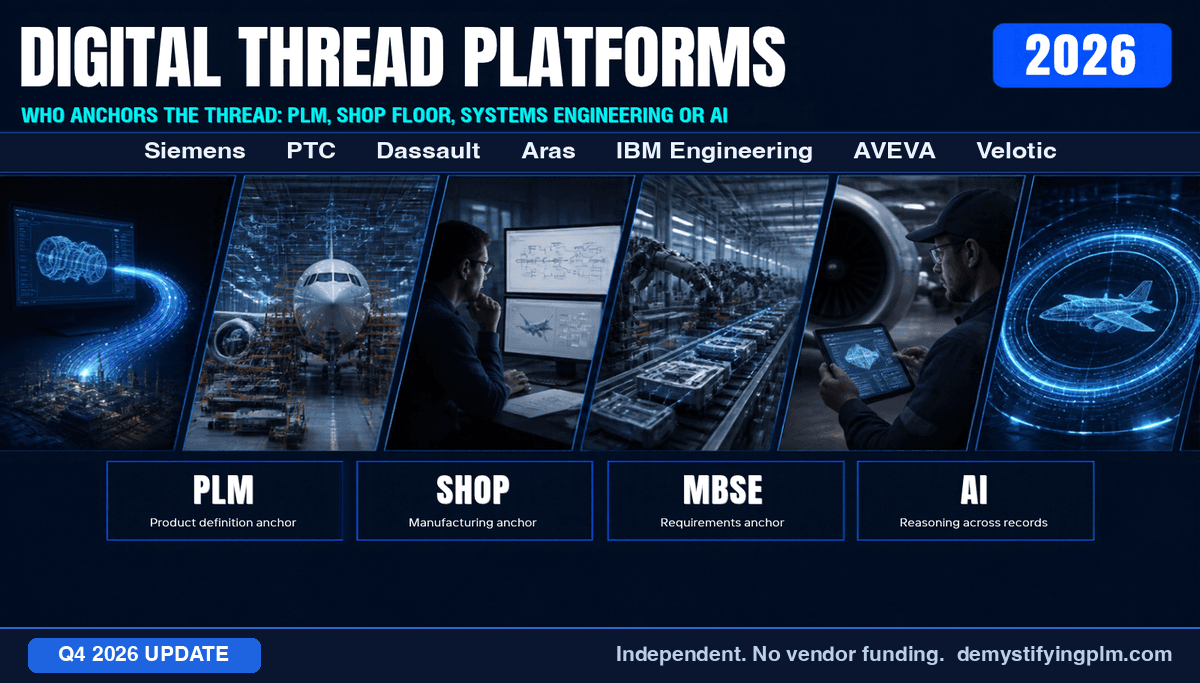
A digital thread is an architecture, not a product: a governed flow of data that keeps design, manufacturing and service records traceable to each other. Platforms differ by where they anchor the thread. PLM-anchored threads start from the product definition, manufacturing threads start from the shop floor, systems engineering threads start from requirements, and AI-native tools reason across records without owning them. Choose by where your authoritative data already lives, and decide data ownership before you decide technology.
- A digital thread is a governed data flow across the lifecycle, not a single product you can buy
- Platforms differ by anchor - PLM-anchored, manufacturing-anchored, systems-engineering-anchored, or AI-native
- The thread carries data between systems. The digital twin is the model that consumes it. The thread enables the twin, not the reverse
- Data governance (who owns it, who may change it, who is notified) is the hardest part of every thread programme
- Start with one product family and one lifecycle segment, usually design to manufacturing, then expand
- The cognitive thread adds reasoning across the records. It depends on the thread existing first
What a Digital Thread Is, and Is Not
A digital thread is an architecture: a governed flow of data that links the records of a product across its lifecycle. It is not a product you can buy in a single box, and vendors who sell it that way are selling an anchor, not the whole thread.
It is also not a digital twin. The thread is the conduit. The twin consumes what the thread carries. For the twin, see What is a Digital Twin?.
This guide applies the series scope test: it covers thread platforms because they depend on product and production data (BOM, change, as-built and field records). Pure integration middleware with no product data model is out of scope.
The Four Anchors
| Anchor | Starts from | Typical vendors | Best when |
|---|---|---|---|
| PLM-anchored | The product definition: CAD, BOM, change | Siemens, PTC, Dassault, Aras | PLM is already your system of record for the product |
| Manufacturing-anchored | The shop floor: process, quality, as-built | Velotic (Proficy), plant data and MES vendors | The gap is between engineering intent and production reality |
| Systems-engineering-anchored | Requirements and architecture models | IBM Engineering Lifecycle Management | Regulated, complex systems with formal requirements |
| AI-native | Reasoning across records without owning them | Newer vendors covered in the PLM guide | You already have governed data and want AI over it |
Pick the anchor that matches where your authoritative data lives. A thread anchored where your data does not live means re-keying and reconciliation.
Platform Notes
Siemens, PTC and Dassault
The three large PLM vendors are the natural orchestrators for discrete manufacturers because they hold the CAD and product structure. They differ in packaging: Siemens as a portfolio (NX, Teamcenter, Opcenter, Simcenter), PTC around Windchill and Creo with operational data connected back, Dassault as a single-platform model. Ask each which of the claimed connections to MES, ERP and field data are in production at a customer like you.
Aras
Aras is open-core and highly configurable, which suits organisations that need a custom thread architecture and have the team to build it. The trade-off is that configuration is your responsibility.
IBM Engineering Lifecycle Management
Strongest where requirements and systems models drive the programme. The MBSE end of the thread is where it is most often chosen.
AVEVA and Velotic
These anchor from operations. AVEVA is common in process industries, with engineering and operations data in one family. Velotic (the former GE Proficy business) brings manufacturing and historian data. Both help close the gap between as-designed and as-built.
Governance Before Technology
Write down, before integration begins:
- Who owns each data object at each lifecycle stage.
- Who may change it, and under what approval.
- Who is notified when it changes, and by what mechanism.
- What the identifiers are: part numbers, status codes and naming across legacy systems.
Most thread programmes fail on this list, not on connectors.
Reading the Market Honestly
Thread claims are easy to make and hard to verify. Ask for a reference customer whose thread runs from design to manufacturing in production, and ask what it replaced. No scores are assigned here: the evidence for scoring thread depth is thinner than for the framework guides.
Startups to Watch
Startups in this guide
ThreadMoat tracks the startups behind this category, with stage, funding and independent scoring. No vendor funding, no paid placements. Browse them on ThreadMoat:
Related guides
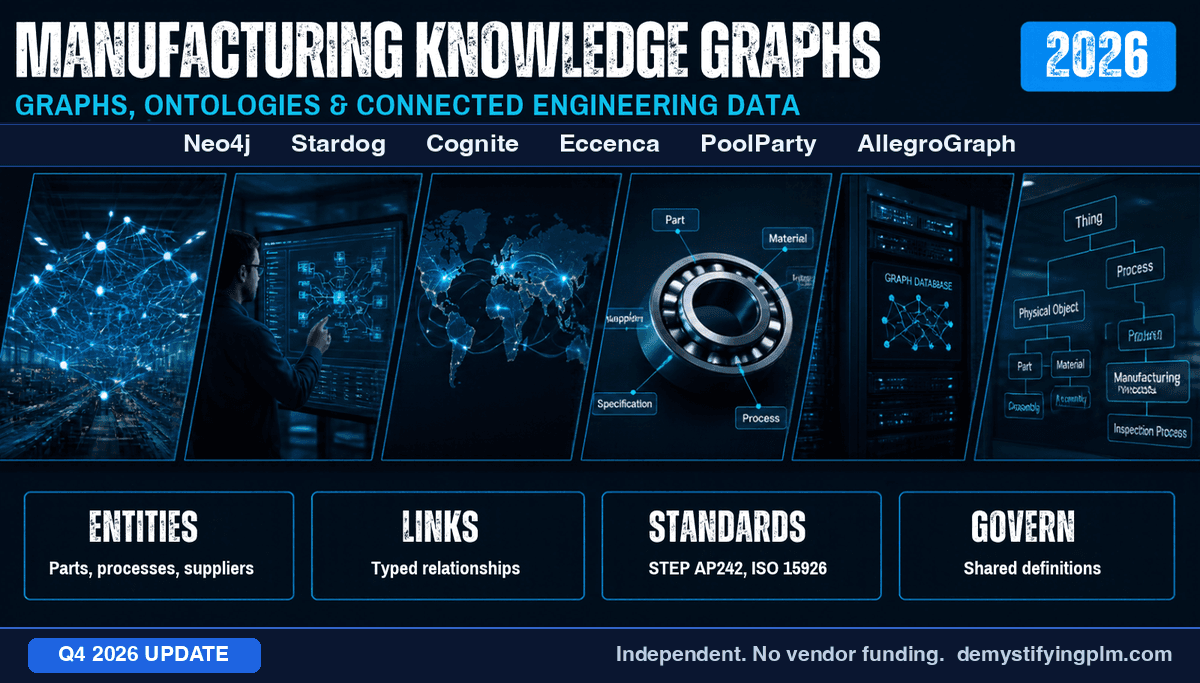
The thread starts from the product definition in Best PLM Software 2026, whose cognitive-thread section covers AI over these records. The simulation results that flow through the thread are covered in Best Simulation Software 2026. The connected-data layer under both is in Manufacturing Knowledge Graphs 2026.
Related Articles
- What is a Digital Twin? — the model that consumes the thread
- Manufacturing Knowledge Graphs 2026 — semantic layer for connecting the records
Related Buyer's Guides
- Best PLM Software 2026 — VAULT framework · product lifecycle, BOM, change management
- Best Simulation Software 2026 — SOLVE framework
- Best MES Software 2026 — MINT Stack
- Best IIoT Platforms 2026 — PULSE framework
- Manufacturing Knowledge Graphs 2026
All guides: no vendor funding, no analyst-quadrant hedging. Full vendor scorecards and competitive data at threadmoat.com.
A ThreadMoat Independent Research Report | Author: Michael Finocchiaro | Edition: 2026 Q4 | Last Updated: 2026-11-05
Want to listen instead of read? 56 DemystifyingPLM articles are available as audio.
Browse audio →Show all chapters ▸Hide chapters ▾
- 1Best PLM Software 2026: Q1 Edition (Archived)
- 2Best MES Software 2026: Q1 Edition (Archived)
- 3Best BIM Software 2026: The Independent Buyer's Guide for AEC and Owner Organizations
- 4Best CAD Software 2026: The Engineer's Honest Guide
- 5Best CAM Software 2026: The Machinist's Independent Guide
- 6Best Operations & Asset Management Software 2026: The CIO's Independent Buyer's Guide
- 7Best IIoT Platforms 2026: The Manufacturer's Independent Buyer's Guide
- 8Best MES Software 2026: The Manufacturer's Independent Guide
- 9Best PLM Software 2026: The Independent Buyer's Guide
- 10Best SCM Software 2026: The Supply Chain Independent Buyer's Guide
- 11Best Simulation Software 2026: Incumbents, Specialists, and the New Constellation
- 12AI in Manufacturing 2026: Where It Works, What It Needs, and What to Buy First
- 13Best Industrial AI Platforms 2026: The Independent Buyer's Guide
- 14Digital Thread Platforms 2026: The Independent Buyer's Guide
- 15Manufacturing Knowledge Graphs 2026: The Independent Buyer's Guide
Looking up PLM terminology? Browse the canonical reference.
PLM Glossary →Cite this article
Finocchiaro, Michael. “Digital Thread Platforms 2026: The Independent Buyer's Guide.” DemystifyingPLM, November 5, 2026, https://www.demystifyingplm.com/digital-thread-platforms-2026
Michael Finocchiaro (opens in a new tab)
PLM industry analyst · 35+ years at IBM, HP, PTC, Dassault Systèmes
Firsthand knowledge of the evolution from early 3D modeling kernels to today's cloud-native platforms and agentic AI — the history, strategy, and future of PLM.