Show all chapters ▸Hide chapters ▾
- 1Best PLM Software 2026: Q1 Edition (Archived)
- 2Best MES Software 2026: Q1 Edition (Archived)
- 3Best BIM Software 2026: The Independent Buyer's Guide for AEC and Owner Organizations
- 4Best CAD Software 2026: The Engineer's Honest Guide
- 5Best CAM Software 2026: The Machinist's Independent Guide
- 6Best Operations & Asset Management Software 2026: The CIO's Independent Buyer's Guide
- 7Best IIoT Platforms 2026: The Manufacturer's Independent Buyer's Guide
- 8Best MES Software 2026: The Manufacturer's Independent Guide
- 9Best PLM Software 2026: The Independent Buyer's Guide
- 10Best SCM Software 2026: The Supply Chain Independent Buyer's Guide
- 11Best Simulation Software 2026: Incumbents, Specialists, and the New Constellation
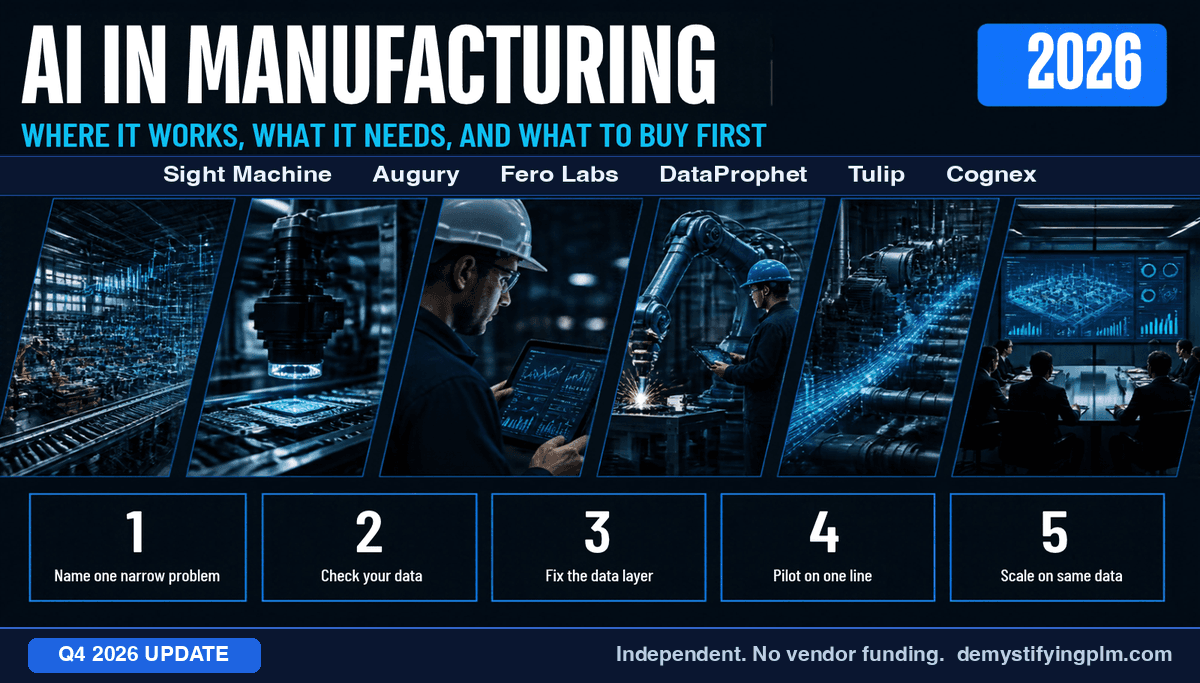
- 12AI in Manufacturing 2026: Where It Works, What It Needs, and What to Buy First
- 13Best Industrial AI Platforms 2026: The Independent Buyer's Guide
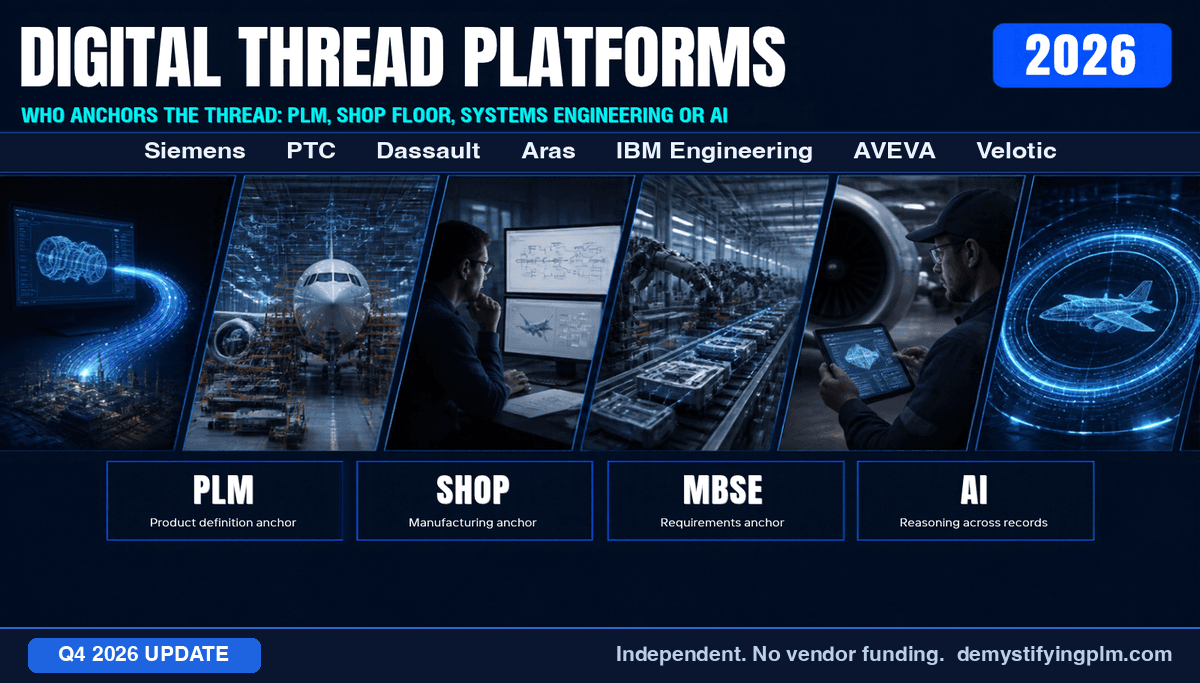
- 14Digital Thread Platforms 2026: The Independent Buyer's Guide
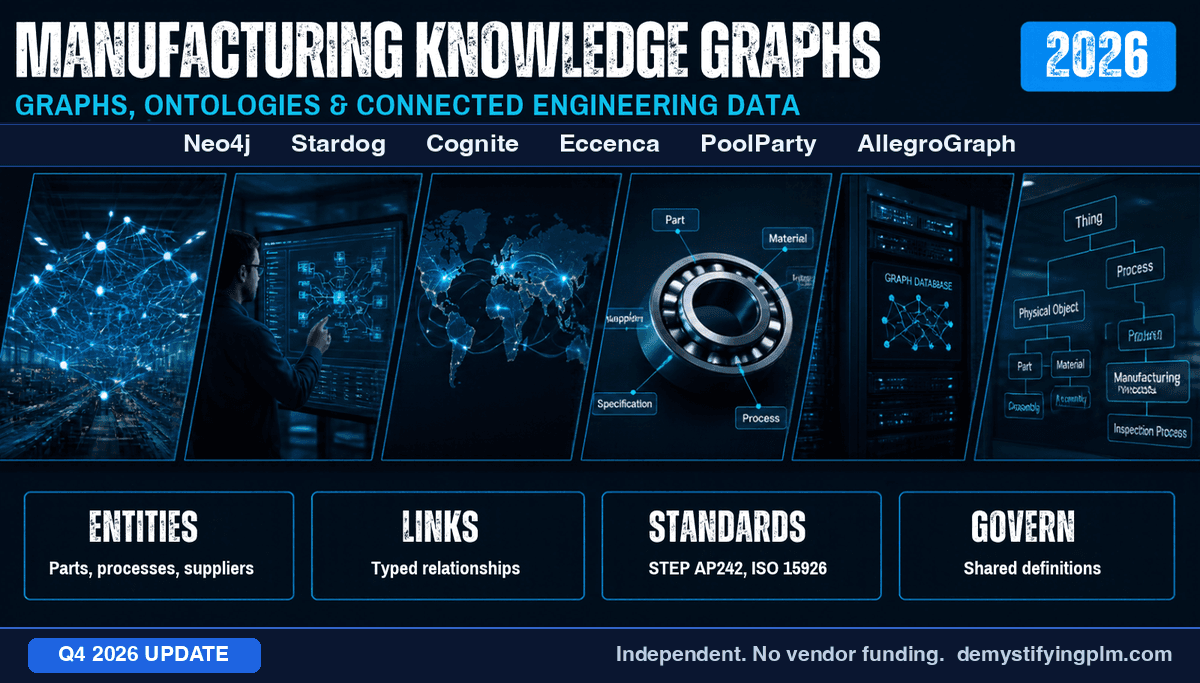
- 15Manufacturing Knowledge Graphs 2026: The Independent Buyer's Guide
Key Takeaways
- Choose the problem before the platform. Visual inspection, machine health, process yield and planning are different products with different data needs
- Confirm data readiness in writing before the pilot. Labeled defect images, baseline sensor history and clean production context are the real prerequisites
- Vertical tools reach value sooner. Horizontal platforms reward organisations that already have data engineering capacity
- Plan for model operations from day one - monitoring, retraining and ownership
- Treat vendor accuracy and payback figures as claims until they are reproduced on your own line
Short Answer
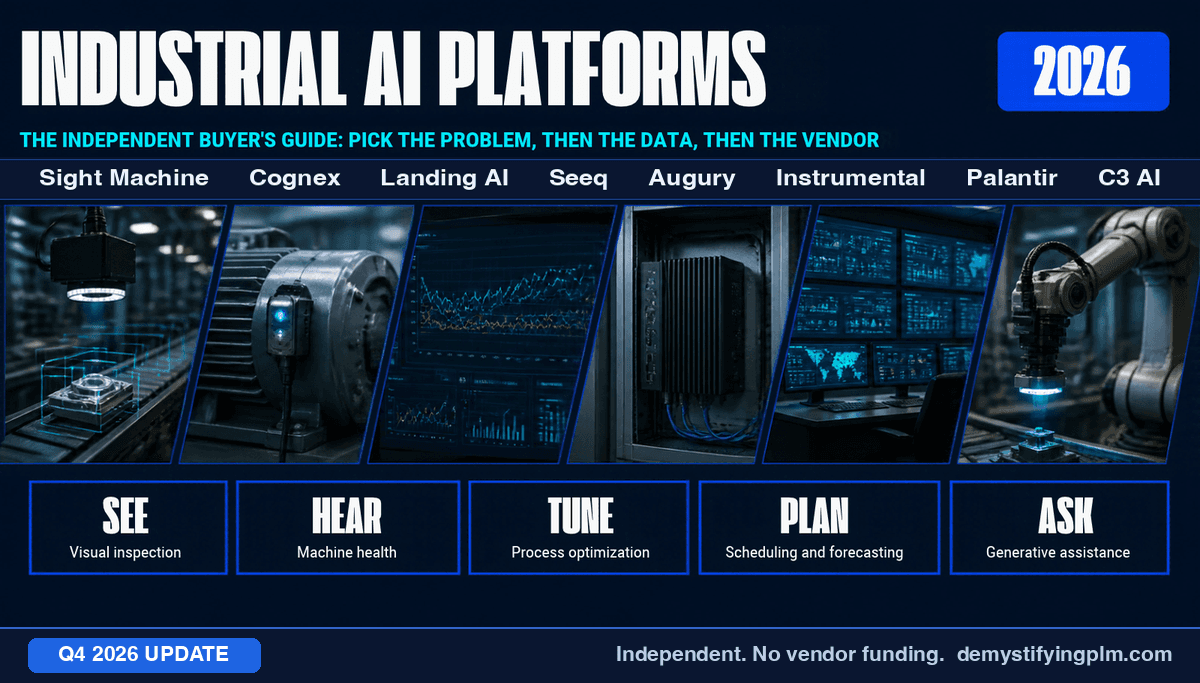
The best industrial AI platform is the one whose data you can actually supply. Start from the problem (defect detection, machine health, process yield, planning), check that the data exists in usable form, and only then compare vendors. Vertical, problem-specific platforms usually reach production faster than horizontal ones because they need less setup. Horizontal enterprise platforms pay off when you already have a mature data foundation and a team to run it.
- Pick the problem first, then the data, then the vendor. Most failed industrial AI projects failed on data readiness, not on the model
- Problem-specific platforms (visual inspection, machine health, process analytics) usually go live faster than horizontal enterprise platforms
- Edge versus cloud is a latency and connectivity decision, not a quality one. Train centrally, run where the decision is made
- Industrial AI sits on top of the plant data layer. If the namespace and historian are weak, no platform will fix it
- Ask every vendor how a model is monitored, retrained and retired. The model that worked in March can drift by September
- This guide does not score vendors. Evidence for scoring is thinner than for the framework-based guides, and it says so
What This Guide Covers
Industrial AI is a crowded label. In this guide it means software that applies machine learning to production and product data: images of parts, sensor and process streams, machine telemetry, production records and the engineering definition of the product. That is the same scope test used across this series: if the capability does not depend on product or production data, it is out of scope.
In scope: visual inspection, process and quality analytics, machine health monitoring, closed-loop process optimization, and enterprise AI platforms used on plant data.
Out of scope: general-purpose AI assistants, generic business analytics, and robotics hardware. Robots are tracked on ThreadMoat, not here.
For the use-case view (what AI does in manufacturing, in what order, with what return), read the companion guide AI in Manufacturing 2026.
How to Choose: Problem, Data, Vendor
- Name the problem. Defects, downtime, yield, scheduling and forecasting are different purchases.
- Check the data. Do labeled examples, baseline history and process context exist in usable form? If not, fix that first. It is usually a plant data layer issue, covered in the IIoT guide.
- Pick the deployment shape. Edge for in-cycle decisions, cloud for training and fleet analytics.
- Then compare vendors. Integration with your PLCs, historian and MES matters more than the demo.
The Landscape by Job
| Platform | Job | Deployment | Typical fit |
|---|---|---|---|
| Sight Machine | Production and quality analytics | Cloud and edge | Discrete and process plants with machine data |
| Cognex (ViDi) | Visual inspection | Edge | Difficult surface and assembly inspection |
| Landing AI | Visual inspection | Cloud and edge | Teams with limited labeled data |
| Seeq | Time-series process analytics | Cloud and on-premises | Process engineers working directly with historian data |
| Augury | Machine health | Edge and cloud | Rotating equipment: motors, pumps, compressors |
| Instrumental | Electronics assembly quality | Cloud | Electronics assembly lines |
| Palantir Foundry | Enterprise data and applications | Hybrid | Large organisations with data engineering teams |
| C3 AI | Enterprise AI applications | Cloud | Large asset-heavy organisations |
Deployment and focus are taken from vendor materials and should be confirmed in a pilot. No scores are assigned: the public evidence is not strong enough to score these vendors the way the framework guides score theirs.
Platform Notes
Visual inspection: Cognex and Landing AI
Cognex is the established machine vision vendor and ViDi brings deep learning to inspection problems that rule-based vision handles badly. Landing AI approaches the same job from the data side, with tooling built around training from small labeled sets. The practical test is the same for both: run your own worst defects through it and measure false rejects as well as misses.
Production and process analytics: Sight Machine, Seeq, Instrumental
Sight Machine models production data across machines and lines to explain quality and OEE. Seeq puts time-series analytics directly in the hands of process engineers, which is a different adoption model from a data science team building models. Instrumental targets electronics assembly, tying process data to unit-level quality outcomes.
Machine health: Augury
Augury combines vibration and acoustic sensing with diagnosis for rotating equipment. It overlaps with the Intelligence layer of the EAM-APM guide, where the execution gap between a prediction and a work order is the real constraint.
Enterprise platforms: Palantir Foundry and C3 AI
These are horizontal. They can integrate plant, supply chain and engineering data and build applications on it, which is powerful if you have the foundation and the team, and slow if you do not. Evaluate them on time to a first production use case, not on the platform breadth in the pitch.
Questions to Ask Every Vendor
- What data, in what volume and form, must we supply before go-live?
- Does inference run offline at the edge, and what happens when the plant network fails?
- How is model drift detected, who retrains, and how often?
- Which PLCs, historians, MES and PLM systems have you integrated in production, not in a roadmap?
- Can we reproduce your quoted accuracy or payback on our own line before we sign?
Startups to Watch
The industrial AI category moves faster than any guide. ThreadMoat tracks the startups behind it, with stage, funding and independent scoring.
Startups in this guide
ThreadMoat tracks the startups behind this category, with stage, funding and independent scoring. No vendor funding, no paid placements. Browse them on ThreadMoat:
Related Articles
- AI in Manufacturing 2026 — the use-case and return view that pairs with this guide
- Best IIoT Platforms 2026 — the plant data layer industrial AI depends on
Related Buyer's Guides
The ThreadMoat Buyer's Guide series covers the full engineering and manufacturing software stack:
- Best PLM Software 2026 — VAULT framework · product lifecycle, BOM, change management
- Best Simulation Software 2026 — SOLVE framework · FEA, CFD, AI surrogates
- Best MES Software 2026 — MINT Stack · manufacturing execution
- Best EAM/APM Software 2026 — FIELD framework · asset management, predictive maintenance
- Best IIoT Platforms 2026 — PULSE framework · connectivity, unified namespace, edge
- AI in Manufacturing 2026 — applications, readiness and return
All guides: no vendor funding, no analyst-quadrant hedging. Full vendor scorecards and competitive data at threadmoat.com.
A ThreadMoat Independent Research Report | Author: Michael Finocchiaro | Edition: 2026 Q4 | Last Updated: 2026-11-05
Want to listen instead of read? 56 DemystifyingPLM articles are available as audio.
Browse audio →Show all chapters ▸Hide chapters ▾
- 1Best PLM Software 2026: Q1 Edition (Archived)
- 2Best MES Software 2026: Q1 Edition (Archived)
- 3Best BIM Software 2026: The Independent Buyer's Guide for AEC and Owner Organizations
- 4Best CAD Software 2026: The Engineer's Honest Guide
- 5Best CAM Software 2026: The Machinist's Independent Guide
- 6Best Operations & Asset Management Software 2026: The CIO's Independent Buyer's Guide
- 7Best IIoT Platforms 2026: The Manufacturer's Independent Buyer's Guide
- 8Best MES Software 2026: The Manufacturer's Independent Guide
- 9Best PLM Software 2026: The Independent Buyer's Guide
- 10Best SCM Software 2026: The Supply Chain Independent Buyer's Guide
- 11Best Simulation Software 2026: Incumbents, Specialists, and the New Constellation
- 12AI in Manufacturing 2026: Where It Works, What It Needs, and What to Buy First
- 13Best Industrial AI Platforms 2026: The Independent Buyer's Guide
- 14Digital Thread Platforms 2026: The Independent Buyer's Guide
- 15Manufacturing Knowledge Graphs 2026: The Independent Buyer's Guide
Looking up PLM terminology? Browse the canonical reference.
PLM Glossary →Cite this article
Finocchiaro, Michael. “Best Industrial AI Platforms 2026: The Independent Buyer's Guide.” DemystifyingPLM, November 5, 2026, https://www.demystifyingplm.com/best-industrial-ai-platforms-2026
Michael Finocchiaro (opens in a new tab)
PLM industry analyst · 35+ years at IBM, HP, PTC, Dassault Systèmes
Firsthand knowledge of the evolution from early 3D modeling kernels to today's cloud-native platforms and agentic AI — the history, strategy, and future of PLM.